
BuddhistCatholicContemplativeEvangelicalGeneral ChristianHinduJewishLatter-day SaintMuslimNew VisionsProgressive Christian
Beliefs
- Buddhist
- Catholic
- Contemplative
- Evangelical
- General Christian
- Hindu
- Jewish
- Latter-day Saint
- More Voices
- Muslim
- New Visions
- Pagan
- Progressive Christian
Topics
- Religion News
- Food and Religion
- Sports and Religion
- Religious Art
- Religious Music and Entertainment
- Religious Events
- History and Religion
- Style and Religion
- Politics and Religion
- Women in Religion
- Recreation Outdoors and Religion
- Business Finance and Religion
- Careers Workplace and Religion
- Education and Religion
- Family Parenting and Religion
- Health Fitness and Religion
- Home and Religion
- Relationships and Religion
- Technology and Religion
- Travel and Religion
Columnists
- Buddhist Columnists
- Business Finance and Religion Columnists
- Careers Workplace and Religion Columnists
- Catholic Columnists
- Contemplative Columnists
- Education and Religion Columnists
- Evangelists Columnists
- Family Parenting and Religion Columnists
- General Christian Columnists
- Health Fitness and Religion Columnists
- Hindu Columnists
- History and Religion Columnists
- Home and Religion Columnists
- Jewish Columnists
- More Voices Columnists
- Latter Day Columnists
- Muslim Columnists
- New Visions Columnists
- Nonreligious Columnists
- Pagan Columnists
- Politics and Religion Columnists
- Progressive Columnists
- Recreation Outdoors and Religion Columnists
- Relationships and Religion Columnists
- Religion News Columnists
- Religious Art Columnists
- Religious Events Columnists
- Religious Music and Entertainment Columnists
- Sports and Religion Columnists
- Style and Religion Columnists
- Technology and Religion Columnists
- Travel and Religion Columnists
- Women in Religion Columnists
Resource Library
- 2026 Calendar
- Library of World Religions
- The 100 Most Holy Places on Earth
- Patheos Answers
- Podcasts
- Videos
- Faith Leaders Database
- Anglican Episcopalian
- Bahai
- Baptist
- Buddhism
- Christianity
- Confucianism
- Eastern Orthodoxy
- Hinduism
- Holiness and Pentecostal
- ISKCON
- Islam
- Judaism
- Lutheran
- Methodist
- The Church of Jesus Christ of Latter-day Saints
- New Age
- Paganism
- Presbytarian and Reformed
- Protestantism
- Religion Behind the Scenes
- Roman Catholic
- Scientology
- Shia Islam
- Sikhism
- Sufism
- Sunni Islam
- Taoism
- Zen
- See all religions
Research Tools
 Ad-Free & Subscriber Log-In Subscription Support
Ad-Free & Subscriber Log-In Subscription Support
Follow Patheos 

- Trending:
- Forgiveness
- |
- Marriage
- |
- Consciousness
- |
- Death Penalty
- |
- Election
- |
- Halloween
 Hippie Heretic
- Home
- Progressive Christian
- What Defines a Heretic? Am I One?
What Defines a Heretic? Am I One?
Last updated on: April 1, 2017 at 7:27 am by Chuck McKnight
What Defines a Heretic? Am I One? 2017-04-01T07:27:59-07:00 Chuck McKnight
Patheos Explore the world's faith through different perspectives on religion and spirituality! Patheos has the views of the prevalent religions and spiritualities of the world.
Biblical definition
Biblically speaking, the word heretic comes from the Greek hairetikon, meaning “divisive” (Titus 3:10). A heretic is one who purposes to create disunity, fragmenting the church. In this sense, I am not a heretic. My heart’s desire is to see the church fully united once more. This is one of the key driving factors that motivates everything I do. I hate disunity with a passion.
Though I align myself most closely with the Anabaptists, I do so with the full acknowledgement that they are just one tradition within the whole of Christ’s beautiful universal church. I long for the day when Anabaptists, Eastern Orthodox, Roman Catholics, Protestants, and all the rest will sit together around one common table—when we will together break bread and drink wine in memory of our Savior, without stopping to worry about how our brothers and sisters may happen to understand the sacrament.
Historical definitions
Historically speaking, a heretic may be defined as one who denies the creeds of Christianity—namely the Apostles’ Creed or the Nicene Creed. By this definition, I am also not a heretic, as I fully affirm them both (though I side with the Eastern Orthodox regarding the filioque controversy).
Moving a step further, some would define a heretic as a person who holds to any one of a rather large list of heresies condemned by church councils since those initial historic creeds. But here we run into some problems.
For one thing, to condemn all these as heresies would be to condemn nearly all Protestants as heretics. I’m not willing to do that.
For another thing, Nicea marked the beginning of the Christendom era of the church. For nearly 300 years, the earliest Christians unanimously opposed the use of violence, but this all changed when the church and state became fused. Ever since Constantine supposedly became a Christian, the church has entered into an unholy alliance with the state and its sword. Some of the greatest travesties in human history have come about through this union—crusades, inquisitions, and the like.
That’s not to say that the church became wholly and irredeemably corrupt; nor is it to say that the historic church has nothing to teach us from this point forward. But it is to say that I have a hard time treating any later councils as authoritative, given Christendom’s compromised state of union with empire. Even the First Council of Nicea is a struggle for me due to Constantine’s influence. Yet the church’s findings there seem to have still been based on the historic faith, rather than on any corruption brought about by the state.
Individualized definitions
Yet another way to define a heretic is based solely on the theological whims of the accuser. Such accusations these days seem to come mostly from fundamentalists and conservative evangelicals. Accusations of heresy are thrown around with nary a creed nor council to back them up, but merely a private interpretation of Scripture. It is in this manner that I am frequently called a heretic.
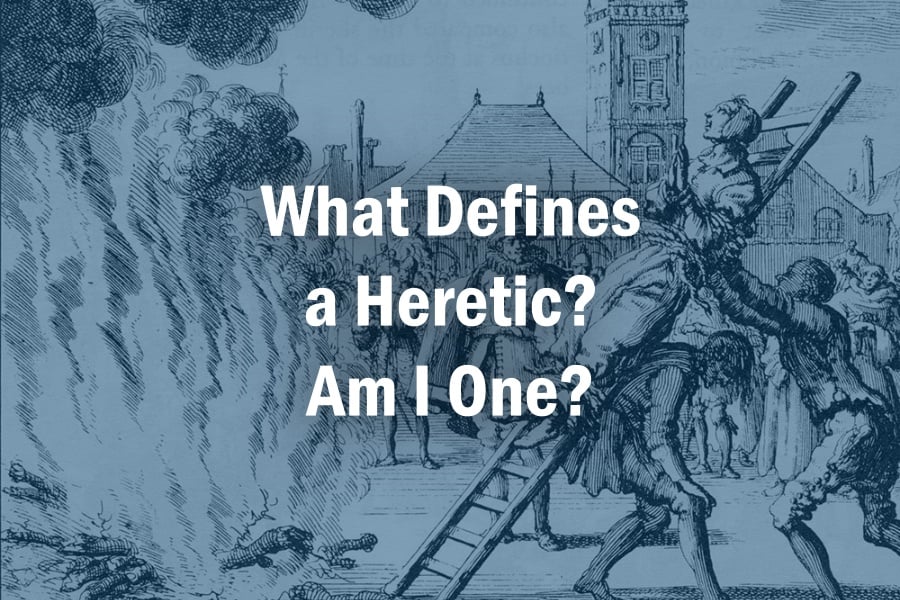
Thankfully, fellow Christians are no longer killing each other for this today, though that was not the case during the time of the Protestant Reformation. Nearly every branch of Western Christianity—Roman Catholics and all manner of Protestants alike—were killing one another as heretics. The Anabaptists, though condemned and persecuted from all sides, were the only ones who kept their hands free from bloodshed.1 And this is one of the many reasons I align myself with them.
Though Anabaptists are no longer condemned as heretics by most modern denominations, they did bear that title historically. And so, if being an Anabaptist makes one a heretic, then I am not ashamed to bear that name either.
Additional definition
Finally, I should note that up until now I’ve been discussing Christian heresies. But it’s worth remembering that Christianity itself was considered a heresy when it first came on the scene (Acts 24:14, KJV). Indeed, the way of following Jesus is a heresy compared to the world’s way of doing things. And in this sense, more than any other, I will proudly count myself a heretic—a hippie heretic.
1 Whenever I make the claim that Anabaptists kept themselves free from bloodshed, someone always brings up the Münster Rebellion. Here’s why I say that doesn’t count. Historically, there were four major groups of “Anabaptists,” i.e., those who practiced believer’s baptism during the time of the Protestant Reformation: the radical Anabaptists, the rational Anabaptists, the spiritualistic Anabaptists, and the biblical Anabaptists. (I’m taking these categories from the Logos Mobile Ed course MI101 Introducing Global Missions by Don Fanning.) Other than their shared belief about baptism, these groups were not very directly connected. Of these groups, only the biblical Anabaptists have continued in any significant extent to this day, as represented by the Mennonites, Amish, Hutterites, Brethren in Christ, etc. When I use the term Anabaptist, I am generally referring to this group, unless I specify otherwise. On the other hand, the “Anabaptists” involved in the Münster Rebellion would be among those classified as radical Anabaptists. And they were soundly denounced by the major leaders of the biblical Anabaptists in their day.
Previous Post

November 30, 2015
Introducing My New Blog: Hippie Heretic
Next Post

December 2, 2015 My 7 Blogging Promises
Browse Our Archives
Select a Category Church Personal Reviews Scripture Social Justice Theology
Select a Month August 2021 September 2020 August 2020 July 2019 March 2019 December 2018 November 2018 October 2018 September 2018 August 2018 July 2018 June 2018 May 2018 April 2018 March 2018 January 2018 December 2017 November 2017 October 2017 September 2017 August 2017 July 2017 June 2017 May 2017 April 2017 March 2017 February 2017 January 2017 December 2016 November 2016 October 2016 July 2016 June 2016 April 2016 March 2016 February 2016 January 2016 December 2015 November 2015
Follow Us!
TAKE THE
Religious Wisdom Quiz
What tax collector wrote a Gospel and was called by Jesus?
Select your answer to see how you score.
Barnabas Luke Mark Matthew
Related posts from Hippie Heretic


Yes, Metaxas, Racism Is Still Wrong without God

The Big Book of Hippie Heretics (Daneen Akers'...

Progressives Need to Start Preaching Hell Again
TRENDING AT PATHEOS Progressive Christian

What Being a Modern-Day Apostle Means to Me
In my last column, I discussed the ins and outs of modern-day...

Did Ancient China Once Worship the God of...
Across human history, a common thread weaves through the origins of the...

Love Your Neighbor – Including Earth-Kin: Lev. 19,...
God’s command to love your neighbor means acting in an ethical and...

Lead a Church Study of “Jesus and Lao...
Guest writer Jack Thomas (The Irreverent Reverend) reflects on leading his church...

Pastoral Wisdom for Responding to Sermon Pushback
Getting sermon pushback on your social justice sermon? Learn practical, Proverbs-based strategies...

Principles for Understanding the Apostolic Ministry Today
Whenever people discover that my formal ministry title is "apostle," as in...
view all Progressive Christian blogs
Ad-Free & Subscriber Log-In Subscription Support
- About Us
- 2026 Calendar
- Videos
- Podcasts
- Library of World Religions
- Faith In Media Tracker
- Advertise With Us
- Write for Us
- Privacy Policy
- Terms of Service
- Do Not Sell My Data
- Contact Us
- Radiant Digital
- Manage Newsletter Subscriptions
- Unsubscribe From Notifications
- Sitemap
Copyright 2008-2026, Patheos. All rights reserved.
Subscription Support Ad-Free & Subscriber Log-In
Follow Patheos