
BuddhistCatholicContemplativeEvangelicalGeneral ChristianHinduJewishLatter-day SaintMuslimNew VisionsProgressive Christian
Beliefs
- Buddhist
- Catholic
- Contemplative
- Evangelical
- General Christian
- Hindu
- Jewish
- Latter-day Saint
- More Voices
- Muslim
- New Visions
- Pagan
- Progressive Christian
Topics
- Religion News
- Food and Religion
- Sports and Religion
- Religious Art
- Religious Music and Entertainment
- Religious Events
- History and Religion
- Style and Religion
- Politics and Religion
- Women in Religion
- Recreation Outdoors and Religion
- Business Finance and Religion
- Careers Workplace and Religion
- Education and Religion
- Family Parenting and Religion
- Health Fitness and Religion
- Home and Religion
- Relationships and Religion
- Technology and Religion
- Travel and Religion
Columnists
- Buddhist Columnists
- Business Finance and Religion Columnists
- Careers Workplace and Religion Columnists
- Catholic Columnists
- Contemplative Columnists
- Education and Religion Columnists
- Evangelists Columnists
- Family Parenting and Religion Columnists
- General Christian Columnists
- Health Fitness and Religion Columnists
- Hindu Columnists
- History and Religion Columnists
- Home and Religion Columnists
- Jewish Columnists
- More Voices Columnists
- Latter Day Columnists
- Muslim Columnists
- New Visions Columnists
- Nonreligious Columnists
- Pagan Columnists
- Politics and Religion Columnists
- Progressive Columnists
- Recreation Outdoors and Religion Columnists
- Relationships and Religion Columnists
- Religion News Columnists
- Religious Art Columnists
- Religious Events Columnists
- Religious Music and Entertainment Columnists
- Sports and Religion Columnists
- Style and Religion Columnists
- Technology and Religion Columnists
- Travel and Religion Columnists
- Women in Religion Columnists
Resource Library
- 2026 Calendar
- Library of World Religions
- The 100 Most Holy Places on Earth
- Patheos Answers
- Podcasts
- Videos
- Faith Leaders Database
- Anglican Episcopalian
- Bahai
- Baptist
- Buddhism
- Christianity
- Confucianism
- Eastern Orthodoxy
- Hinduism
- Holiness and Pentecostal
- ISKCON
- Islam
- Judaism
- Lutheran
- Methodist
- The Church of Jesus Christ of Latter-day Saints
- New Age
- Paganism
- Presbytarian and Reformed
- Protestantism
- Religion Behind the Scenes
- Roman Catholic
- Scientology
- Shia Islam
- Sikhism
- Sufism
- Sunni Islam
- Taoism
- Zen
- See all religions
Research Tools
 Ad-Free & Subscriber Log-In Subscription Support
Ad-Free & Subscriber Log-In Subscription Support
Follow Patheos 

- Trending:
- Forgiveness
- |
- Marriage
- |
- Consciousness
- |
- Death Penalty
- |
- Election
- |
- Halloween

- Home
- Hindu
- Politics and Religion
- Civilizational India (Bharat): Beyond the Western Optics
Civilizational India (Bharat): Beyond the Western Optics
Last updated on: July 22, 2026 at 8:46 pm by Vijendra Agarwal
Civilizational India (Bharat): Beyond the Western Optics 2026-07-22T20:46:11-06:00 Vijendra Agarwal
Patheos Explore the world's faith through different perspectives on religion and spirituality! Patheos has the views of the prevalent religions and spiritualities of the world.
Why India Cannot Be Understood Through a Western Lens
Editor's Note:
This essay is the first in a four-part series examining Hinduism, Indian civilization, religious freedom, and the evolving relationship between India and the United States.
India is the world’s largest democracy, an emerging economic power, a strategic partner of the United States, and a nation of extraordinary diversity. Each of these descriptions is accurate. Yet none fully explains what India is as an ancient civilization. We introduce India (Bharat) with its sacred geography that in itself is very telling.
Sacred Geography: Faith Shaping the Landscape
“Civilizations endure not because history leaves them untouched, but because generations continue to remember who they are.”
Perhaps nowhere is India’s civilization and history more visible than in its sacred geography.
Unlike many religious traditions that center on a single holy city or a limited number of sacred locations, Hinduism views its vast landscape as sacred. Together, the rivers, mountains, forests, temples, and pilgrimage routes form a spiritual geography extending across the Indian subcontinent.
Among these sacred places, none occupies a more central position than the River Ganga.
Mother Ganga: For millions of Hindus, the Ganga is not merely a river. She is revered as Maa Ganga (Mother Ganga), whose waters symbolize purification, renewal, and the continuity of life itself. Pilgrims travel hundreds or even thousands of miles to bathe in her waters, perform religious rites, or honor deceased family members.
Varanasi, situated on the banks of the Ganga, is a sacred city that has served as one of Hinduism’s most iconic spiritual centers for centuries. It is regarded as one of the world’s oldest continuously inhabited cities, a place where daily life, worship, scholarship, music, and ritual exist side by side. At sunrise, pilgrims descend the ghats to offer prayers while priests conduct ancient ceremonies that have been performed for generations.
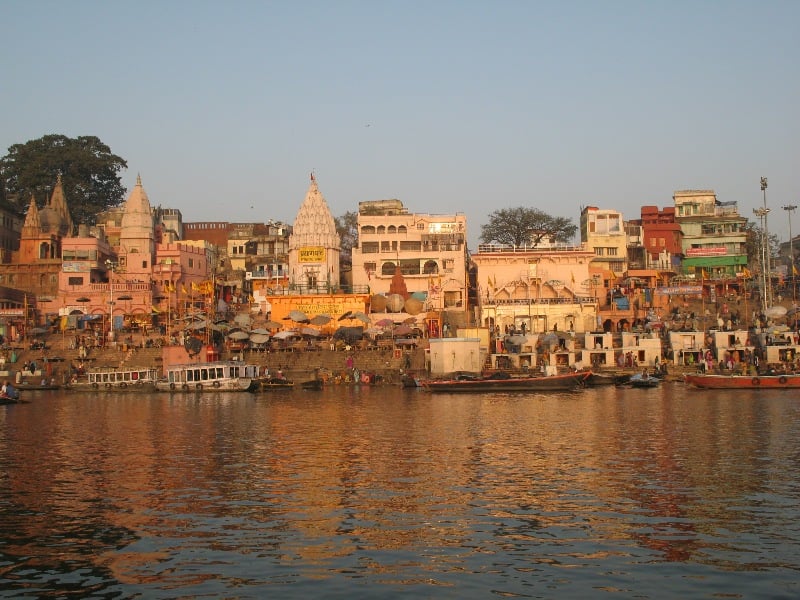
Sunrise over the ghats of Varanasi on the River Ganga. The Ganga symbolizes purification, continuity, and the enduring heritage of Sanatana Dharma. Måns Sjödahl, Public domain, via Wikimedia Commons.

For many visitors, Varanasi appears timeless. Yet it has not frozen in history. Rather, it illustrates how an ancient civilization continues to adapt while preserving traditions that remain meaningful to millions of people today. The 21st-century Kashi Vishwanath Corridor has revitalized the age-old crescent-shaped ghats and widened the narrow gullies leading to the ghats of the Ganga. Yet, these restorations of Varanasi ghats, including many temples located in and around the ghats, illustrate Bharat’s cultural heritage.
This understanding of sacred geography provides an important key to interpreting many aspects of Indian public life. Places that might appear to outsiders as merely historical monuments have profound religious and civilizational significance for Hindus. Recognizing this distinction helps explain why debates over sacred sites evoke emotions that extend well beyond contemporary politics.
Modern India in the Western Context
To understand India requires looking beyond the vocabulary of modern politics toward one of the world’s oldest continuously living civilizations. This distinction is not merely academic. It shapes how India understands itself, how its people interpret their history, and why contemporary debates involving religion, culture, and national identity are often misunderstood abroad.
Western observers generally approach nations through familiar categories such as race, ethnicity, church-state relations, majority and minority rights, or liberal democracy. Those frameworks are valuable, but they do not always capture India’s historical experience. India’s civilization developed over thousands of years without a single founder, central religious authority, or universally accepted creed. Instead, it evolved through a remarkable continuity of philosophical inquiry, pilgrimage, sacred geography, local traditions, and cultural memory.
At the heart of this civilization lies what many Hindus call Sanatana Dharma, the Eternal Dharma. Rather than representing a single institutional religion in the Western sense, Sanatana Dharma encompasses a broad family of philosophical schools, devotional traditions, rituals, and ways of life that have developed over millennia. Diversity has not been an exception within Hindu civilization; it has been one of its defining characteristics.
This civilizational perspective helps explain why many Indians often understand their country differently from the way it is portrayed in the West. Political debates certainly matter, but they unfold within a civilization whose historical memory stretches back several thousand years. Appreciating that continuity is essential for understanding contemporary India.
Bharat’s Civilization Before a Nation
“Modern India became an independent nation in 1947. Indian civilization, however, long predates the modern state.”
Ancient cities, sacred rivers, pilgrimage routes, epics, temples, monasteries, universities, and philosophical traditions connected communities across the subcontinent centuries before the emergence of modern political boundaries of 1947. The Ramayana, the Mahabharata, the Upanishads, and countless regional traditions formed a shared cultural inheritance that transcended kingdoms and dynasties.
This continuity does not imply that India’s history has been free from conflict and change. Successive invasions, imperial rule, and colonial administration profoundly changed the subcontinent. The medieval period witnessed the destruction and conversion of numerous temples during military campaigns by successive Muslim rulers. It followed the British colonial rule, which reshaped political institutions, education, and economic structures in ways that continue to influence India today. These historical experiences remain subjects of scholarly research and public debate, and they continue to shape how many Indians understand questions of identity, memory, and cultural restoration. Some of those memories continue to haunt the new generation, considering the hostilities, mass killings, destruction, and looting of ancient India at the hands of Muslim rulers and Imperial power.
Yet despite these upheavals, the underlying civilizational framework endured. Pilgrimage continued. Festivals continued. Sacred texts continued to be studied and transmitted. Families preserved rituals, languages, and traditions across generations. For many Indians, this continuity represents one of the defining characteristics of Hindu civilization.
Understanding this historical resilience is essential because it explains why many contemporary issues are interpreted not simply as political questions but also as civilizational memory.
Diversity Within a Hindu Civilization
One of the most common misconceptions about India is that describing it as a Hindu civilization somehow overlooks its extraordinary religious diversity. The opposite is true. Understanding Hindu civilization helps explain why India remains home to one of the world’s most religiously diverse societies today.
According to the 2021 Pew Research Center study, approximately four out of every five Indians identify as Hindu. India is also home to one of the world’s largest Muslim populations, alongside substantial Christian, Sikh, Buddhist, Jain, Jewish, Zoroastrian (Parsi), Bahá’í, tribal, and indigenous communities. Many of these traditions have flourished on the Indian subcontinent for centuries, and in some cases for more than two thousand years.
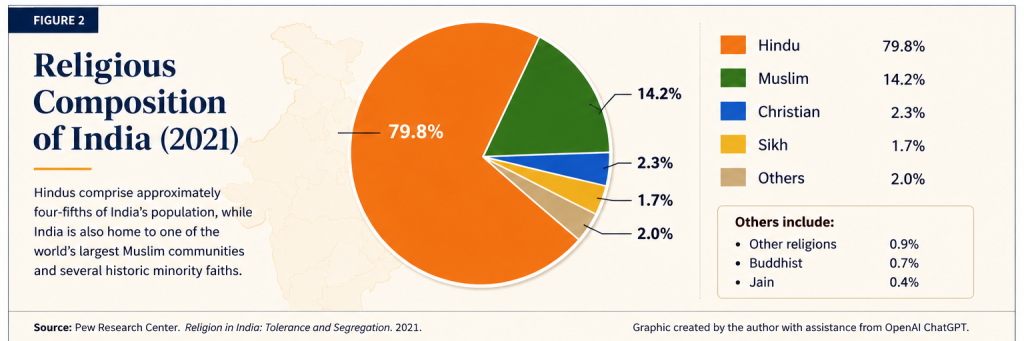
Figure 2. Religious Composition of India (2021). Hindus comprise approximately four-fifths of India’s population, while India is also home to one of the world’s largest Muslim communities and several historic minority faiths. Data Source: Pew Research Center (2021).
India’s diversity did not emerge despite its civilizational foundations; rather, it developed within them. Hindu philosophical traditions generally evolved without a central ecclesiastical authority defining a single path to spiritual truth. Different schools of philosophy, devotional traditions, regional customs, and local practices coexisted, debated, and influenced one another over many centuries.
This historical reality should not be romanticized. India’s long history includes periods of conflict, social inequality, religious tension, and political violence, as do the histories of most civilizations. Yet it also includes remarkable examples of intellectual pluralism, interfaith interaction, and cultural adaptation that continue to shape Indian society today.
Understanding both dimensions, the challenges as well as the achievements, is essential to appreciating the complexity of India’s civilizational experience.
Ram Mandir: A Civilizational Memory
Few contemporary developments illustrate the relationship between history, religion, and civilizational identity more clearly than the consecration of the Shri Ram Janmabhoomi Mandir in Ayodhya in January 2024.
For many Hindus, the temple represents far more than a new place of worship. It symbolizes the restoration of a sacred site associated with Lord Rama, one of the most revered figures and the central character of the Ramayana. After decades of legal proceedings, archaeological debate, and public controversy, the Supreme Court of India awarded the disputed site for the construction of the temple while also directing that land be provided elsewhere for a mosque.
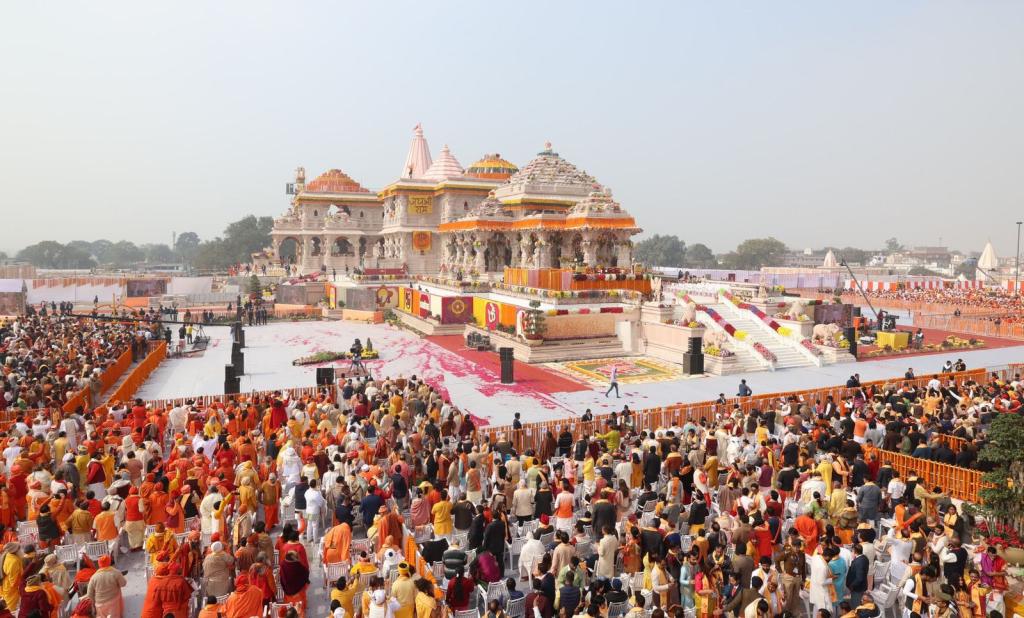
Shri Ram Janmabhoomi Mandir, Ayodhya. Consecrated in January 2024, the temple is viewed by many Hindus as the restoration of a sacred site and an affirmation of India’s civilizational continuity.
The temple’s significance extends beyond the legal judgment itself. For many Indians, it represents the recovery of historical memory following centuries during which numerous temples were damaged, destroyed, or repurposed under successive waves of conquest and imperial rule. These historical experiences remain the subject of scholarly debate regarding their scale, regional variation, and interpretation. Nevertheless, they continue to occupy an important place in the collective memory of many Hindus.
Likewise, British colonial rule left its own enduring legacy. The colonial administration reshaped India’s economy, educational institutions, and governance while introducing legal and political structures that continue to influence modern India. Independence in 1947 marked not only the birth of a sovereign republic but also the beginning of a broader effort to recover and reinterpret India’s civilizational heritage.
Whether one views Ram Mandir primarily through a religious, historical, legal, or political lens, its importance cannot be understood without recognizing the deeper civilizational context from which it emerged.
Looking Beyond
India is an ancient civilization and a modern constitutional democracy. It is home to extraordinary religious diversity and is also the birthplace of Hinduism, Buddhism, Jainism, and Sikhism. It embraces technological innovation while preserving traditions that have shaped daily life for thousands of years.
This complexity explains why India is a pluralistic society that cannot be simply categorized. Frameworks developed to understand the relationship between religion and the modern Western state do not always capture the historical experience of a civilization whose identity has evolved through sacred geography, philosophical diversity, and cultural continuity rather than through a single ecclesiastical institution.
More than a century before contemporary American institutions began formally evaluating religious freedom in India, Swami Vivekananda introduced Hindu philosophy to a broad American audience at the World’s Parliament of Religions in Chicago. On September 11, 1893, he addressed the gathering as “Sisters and Brothers of America.” He introduced Hinduism as an ancient, pluralistic tradition committed to tolerance and the acceptance of multiple paths to spiritual truth. His appearance marked a noteworthy moment in the Western encounter with modern Hindu thought, demonstrating that Sanatana Dharma could engage confidently with the wider world without abandoning its civilizational foundations.
Recognizing India as a civilization does not resolve every contemporary debate. It does, however, provide a more complete foundation for understanding those debates.
It is more than a century after Vivekananda introduced Hindu thought that the United States began evaluating India through a very different framework. That framework, and the questions it raises about perspective, representation, and religious freedom, is the subject of the next essay. Additionally, how should the international community evaluate a civilization that does not fit neatly within familiar Western optics? c
Those questions would be addressed in the next essay in this series.
Next: USCIRF and India: Why Two American Institutions Tell Different Stories.
Previous Post

March 17, 2025
Maha Kumbh: An Unimaginable “Green” Confluence of Hindus
Next Post

August 7, 2026 Understanding USCIRF: Religious Freedom in India and Beyond
Recent Comments
Browse Our Archives
Select a Category Hinduism as Civilization Hinduism as Vililization Uncategorized
Select a Month August 2026 July 2026 March 2025 August 2024 June 2024 January 2024 November 2023 September 2023 May 2023 April 2023 October 2022
TAKE THE
Religious Wisdom Quiz
I denounced Israel's opulent lifestyle—those who lie on beds of ivory and dine on choice lambs. What were they at ease in?
Select your answer to see how you score.
Their palaces Their security Zion Their wealth
Related posts from Hinduism and the Nation
Understanding USCIRF: Religious Freedom in India and Beyond
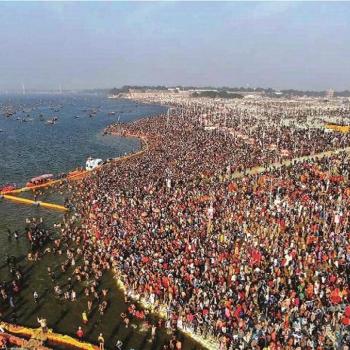
Maha Kumbh: An Unimaginable “Green” Confluence of Hindus

Hinduism and the Olympics: Manu Bhaker and Bhagavad...
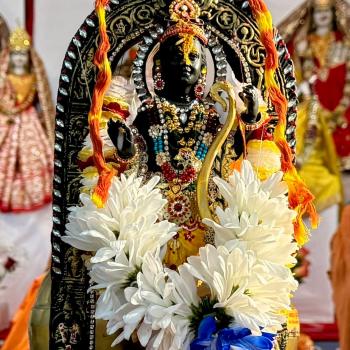
Ram Rath Yatra In The U. S. And...
TRENDING AT PATHEOS Hindu

I was strolling through the top floor of the brand new Parthenon...

What Does Gêvâh Mean For Kimberley Guifoyle &...
This week, a lot of the news is focused on Kimberly Guilfoyle....

INNER CIRCLE: Profound Mystery (Of Christ In All...
Ephesians 5:31-32 “For this reason, a man will leave his father and...

Do Not Rejoice When Your Enemy Falls: The...
Turning an execution into a public spectacle is a disturbing expression of...

'The Chosen' S6 Trailer: The Passion Gets Very...
Not many watching 'The Chosen' worry about spoilers, but just because they...

The purpose-driven labor priest
A labor activist reads Rick Warren and it gets me wondering about...
view all Hindu blogs
What Are Your Thoughts?leave a comment
Ad-Free & Subscriber Log-In Subscription Support
- About Us
- 2026 Calendar
- Videos
- Podcasts
- Library of World Religions
- Faith In Media Tracker
- Advertise With Us
- Write for Us
- Privacy Policy
- Terms of Service
- Do Not Sell My Data
- Contact Us
- Radiant Digital
- Manage Newsletter Subscriptions
- Unsubscribe From Notifications
- Sitemap
Copyright 2008-2026, Patheos. All rights reserved.
Subscription Support Ad-Free & Subscriber Log-In
Follow Patheos