
BuddhistCatholicContemplativeEvangelicalGeneral ChristianHinduJewishLatter-day SaintMuslimNew VisionsProgressive Christian
Beliefs
- Buddhist
- Catholic
- Contemplative
- Evangelical
- General Christian
- Hindu
- Jewish
- Latter-day Saint
- More Voices
- Muslim
- New Visions
- Pagan
- Progressive Christian
Topics
- Religion News
- Food and Religion
- Sports and Religion
- Religious Art
- Religious Music and Entertainment
- Religious Events
- History and Religion
- Style and Religion
- Politics and Religion
- Women in Religion
- Recreation Outdoors and Religion
- Business Finance and Religion
- Careers Workplace and Religion
- Education and Religion
- Family Parenting and Religion
- Health Fitness and Religion
- Home and Religion
- Relationships and Religion
- Technology and Religion
- Travel and Religion
Columnists
- Buddhist Columnists
- Business Finance and Religion Columnists
- Careers Workplace and Religion Columnists
- Catholic Columnists
- Contemplative Columnists
- Education and Religion Columnists
- Evangelists Columnists
- Family Parenting and Religion Columnists
- General Christian Columnists
- Health Fitness and Religion Columnists
- Hindu Columnists
- History and Religion Columnists
- Home and Religion Columnists
- Jewish Columnists
- More Voices Columnists
- Latter Day Columnists
- Muslim Columnists
- New Visions Columnists
- Nonreligious Columnists
- Pagan Columnists
- Politics and Religion Columnists
- Progressive Columnists
- Recreation Outdoors and Religion Columnists
- Relationships and Religion Columnists
- Religion News Columnists
- Religious Art Columnists
- Religious Events Columnists
- Religious Music and Entertainment Columnists
- Sports and Religion Columnists
- Style and Religion Columnists
- Technology and Religion Columnists
- Travel and Religion Columnists
- Women in Religion Columnists
Resource Library
- 2026 Calendar
- Library of World Religions
- The 100 Most Holy Places on Earth
- Patheos Answers
- Podcasts
- Videos
- Faith Leaders Database
- Anglican Episcopalian
- Bahai
- Baptist
- Buddhism
- Christianity
- Confucianism
- Eastern Orthodoxy
- Hinduism
- Holiness and Pentecostal
- ISKCON
- Islam
- Judaism
- Lutheran
- Methodist
- The Church of Jesus Christ of Latter-day Saints
- New Age
- Paganism
- Presbytarian and Reformed
- Protestantism
- Religion Behind the Scenes
- Roman Catholic
- Scientology
- Shia Islam
- Sikhism
- Sufism
- Sunni Islam
- Taoism
- Zen
- See all religions
Research Tools
 Ad-Free & Subscriber Log-In Subscription Support
Ad-Free & Subscriber Log-In Subscription Support
Follow Patheos 

- Trending:
- Forgiveness
- |
- Marriage
- |
- Consciousness
- |
- Death Penalty
- |
- Election
- |
- Halloween

- Home
- Hindu
- Politics and Religion
- Bharat (India)’s Values, Culture, and Heritage During the G20
Bharat (India)’s Values, Culture, and Heritage During the G20
Last updated on: September 27, 2023 at 4:21 pm by Vijendra Agarwal
Bharat (India)’s Values, Culture, and Heritage During the G20 2023-09-27T16:21:21-06:00 Vijendra Agarwal
Patheos Explore the world's faith through different perspectives on religion and spirituality! Patheos has the views of the prevalent religions and spiritualities of the world.

This year’s G20 summit was proudly hosted by Prime Minister Modi in New Delhi. It was an unprecedented geopolitical event in which the New Delhi declaration was unanimously agreed by all G20 members. Another political dimension was the unanimity for admitting the African Union as a permanent member of G20. This added 55 African countries with an economy worth about $3 trillion and 1.4 billion in population.
The third accomplishment was the revival of the new “Spice Route,” clinched among India, the US, the EU, Saudi Arabia, and the UAE. It is to set up the India-Middle East-Europe Economic Corridor (IMEE EC). Modi called it an “effective medium for economic integration of India, west Asia and Europe.” President Biden said, “This is a real big deal,” and he thanked Modi for it.
A controversy arose because the ancient name “Bharat,” (not India) was prominently displayed on G20 poster boards around Delhi. India’s constitution uses Bharat, which is called India. The opposition political parties were unhappy with the dinner invitation by President Murmu stating, “President of Bharat.” The placard on the table occupied by Prime Minister Modi also visibly had Bharat.
One can ask what is in the name. Without diving into history, the highly visible “Bharat,” is an ancient name going back to early scriptures. India’s Minister of External Affairs, S. Jaishankar, said in an interview, “When you say Bharat,” it evokes a “sense, a meaning and a connotation.” The ancient name Bharat also signifies our deep-rooted association with the Sanatan Dharma.
This article discusses several aspects of the G20 in the decked-up Dulhan Delhi signifying Bharat’s ancient values, cultural heritage, and traditions.
Dulhan Delhi never had Bharat as visible to the world starting with the newly built Bharat Mandapam for hosting G20. Bharat was prominent to the citizens and G20 participants alike during the G20 and ~200 meetings and events in sixty cities preceding it. They could not escape the name Bharat.
Bharat Mandapam
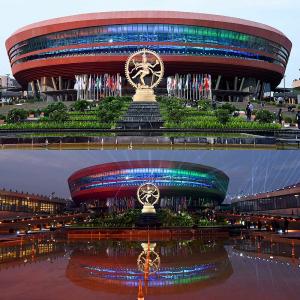
The shape of the Bharat Mandapam is inspired by the elegant form of the Shankha (conch shell). It is associated with Lord Vishnu and Goddess Laxmi in Hindu mythology. It is believed that the Shankh when blown, produces a sound that can destroy evil and sin. The unique architecture of Mandapam with modern amenities and “Bharat’s rich traditions,” symbolized the nation’s confidence in its heritage.
The iconic Shiva Nataraja in front of the Bharat Mandapam could not escape anyone’s eyes attending the G20. The Nataraja, the Lord of dance, is the tallest (27 feet) bronze icon as of now. This form of the Lord is a synthesis of ancient Bharat’s religion, philosophy, art, craft, and science.
The G20 Logo and One World
The G20 logo for 2023 (shown on the top of the page) was unveiled by Prime Minister Modi at the 2022 G20 held in Indonesia. It shows the planet Earth sitting atop a lotus flower, the national flower of Bharat. The Goddess of wealth, Lakshmi, also sits atop a lotus flower. In a Tweet, Modi said that the lotus flower is “a representation of hope,” and “no matter how adverse the circumstances are the lotus still blooms.”  A more important part is the theme for G20 in the ancient Sanskrit language, “Vasudeva Kutumbakam (World is one family)” shown on the right. Under this title, the G20 had three sessions titled One Earth, One Family, and One Future. The language in itself is an identity of Bharat.
An equally important aspect was the globalization of the homemade Modi mantra in Hindi, “Sab ka Saath, Sab ka Vikas, Sab ka Vishwas, Sab ka Prayas” (Everyone’s support, Everyone’s development, Everyone’s trust, Everyone’s efforts). Modi cited the” global trust deficit” as one of the issues that could be tackled if all worked together and trusted everyone in the development of the world as one family.
Dharma Chakra and Nalanda U.
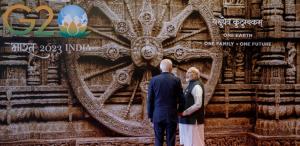 During G20, Bharat’s cultural and religious heritage included the iconic Dharma Chakra from Konark’s Sun God temple in Odisha. On the first day of G20, Dharma Chakra inside the Mandapam was the place for greeting the world leaders and the photo opportunity. A relic from the 12th century, the Sun God has a huge framework, symmetry, precision, and detailed artwork that never ceases to astound visitors. Modi even explained its history and significance to G20 leaders including President Biden (shown in the photo).
Likewise, in the evening dinner, the ruins of Nalanda University, one of the oldest institutes in the world, were the background for a photo opportunity with the dignitaries. Nalanda was in operation between the 5th and 12th centuries. Its legacy goes back to Buddha’s and Mahavira’s era reflecting ancient advancement of disseminating knowledge and wisdom.
It embraces diversity, meritocracy, freedom of thought, collective governance, autonomy, and knowledge which align with the core principles of democracy. As one of the earliest universities in the world, Nalanda is a living testament to the enduring spirit of Bharat’s advanced educational pursuit. It was committed to building a harmonious world in alignment with Vasudhaiva Kutumbakam.
Vegetarianism: The exquisite dinner also had roots in the country’s cultural, religious, and philosophical traditions. Vegetarianism is primarily related to promoting non-violence, compassion for all living beings, and the health-related virtues of a plant-based diet. The delicacies were as diverse as the country with famous cuisine from each State and even the countries represented by G20 leaders.
A more intriguing aspect of the dinner was a millet-heavy menu. Bharat is the largest producer of millet which for long has been considered a ‘poor man’s food.’ This received global attention when the UN declared 2023 as the International Year of Millets at Modi’s request. Thus, Bharat could market millet globally as a healthy food.
Barefoot Walk by Leaders: An ancient value observed by the dignitaries was a visit to Mahatma Gandhi Samadhi (memorial) without shoes. The photo shows Modi and Biden leading the barefoot walk. Modi gifted a scarf made of Khadi (homespun cotton) which Gandhi used as a resistance movement against British fabric.
Going barefoot is a common practice in Bharat when visiting places of worship and sacred places. It has both religious and scientific significance in removing dusty/dirty shoes for the cleanliness (when possible, people wash their feet) and sanctity of sacred places. Gandhi Memorial is a shrine of peace and non-violence. Footwear, made of leather from dead animals, is not allowed in the places of worship.
This tradition is followed even today in homes to maintain cleanliness. In fact, the author’s family and many people of Indian origin in the United States follow the practice of asking the guests to remove their shoes. Most people understand it.
The local culture, traditions, and/or tourism were prominently shared with the delegates in the meetings before the G20 summit. For example, they were given walnuts, saffron, and other gifts and taken for boat rides on the pristine Dal Lake in Kashmir. A yoga session was arranged in the south Indian temple town of Hampi. A quaint heritage walk to palaces and forts was in Indore (Madhya Pradesh). It was always a cultural tour of ancient Bharat wherever the delegates went.
The G20 was a window to highlight Bharat and its iconic cultural heritage and values. Call it Modi magic, superb strategy, strong political statement, meticulous planning, master stroke, diplomacy, and/or sheer luck. Modi’s team was remarkably successful in establishing Bharat’s global diplomacy and Sanatan Dharma values while keeping the leaders of other political parties perplexed and baffled.
Previous Post
September 7, 2023
Forgiveness in Hinduism and the Hindu Temple of Minnesota
Recent Comments
Browse Our Archives
Select a Category Hinduism as Civilization Hinduism as Vililization Uncategorized
Select a Month August 2026 July 2026 March 2025 August 2024 June 2024 January 2024 November 2023 September 2023 May 2023 April 2023 October 2022
TAKE THE
Religious Wisdom Quiz
I built a 75-foot gallows for my enemy, but I was hanged on it instead. Who am I?
Select your answer to see how you score.
Ahasuerus Bigthana Mordecai Haman
Related posts from Hinduism and the Nation

Understanding USCIRF: Religious Freedom in India and Beyond
"Ram Lalla" in Ayodhya, Hinduism, and Minnesota Celebration
HANUMAN: Part II Diplomacy With Defiance
HANUMAN: Part I-The Diplomat in Disguise
TRENDING AT PATHEOS Hindu

The Sermon on the Mount, Part I: Matthew...
The Sermon on the Mount, Part I (Matthew 4:12-5:12) St. Matthew moves...

What's up from Crossway: Reviewing some of their latest A few weeks...

Janie Learns the Way of the Cross: A...
Teaching children about Jesus' Passion can be challenging. Many parents and educators...

Looking For Good Catholic Writing - October 2026
He alone extends the heavens, and he walks upon the waves of...

In "Irreplaceable," our book on vocation and technology, Trevor Sutton and I...

I was strolling through the top floor of the brand new Parthenon...
view all Hindu blogs
What Are Your Thoughts?leave a comment
Ad-Free & Subscriber Log-In Subscription Support
- About Us
- 2026 Calendar
- Videos
- Podcasts
- Library of World Religions
- Faith In Media Tracker
- Advertise With Us
- Write for Us
- Privacy Policy
- Terms of Service
- Do Not Sell My Data
- Contact Us
- Radiant Digital
- Manage Newsletter Subscriptions
- Unsubscribe From Notifications
- Sitemap
Copyright 2008-2026, Patheos. All rights reserved.
Subscription Support Ad-Free & Subscriber Log-In
Follow Patheos