
BuddhistCatholicContemplativeEvangelicalGeneral ChristianHinduJewishLatter-day SaintMuslimNew VisionsProgressive Christian
Beliefs
- Buddhist
- Catholic
- Contemplative
- Evangelical
- General Christian
- Hindu
- Jewish
- Latter-day Saint
- More Voices
- Muslim
- New Visions
- Pagan
- Progressive Christian
Topics
- Religion News
- Food and Religion
- Sports and Religion
- Religious Art
- Religious Music and Entertainment
- Religious Events
- History and Religion
- Style and Religion
- Politics and Religion
- Women in Religion
- Recreation Outdoors and Religion
- Business Finance and Religion
- Careers Workplace and Religion
- Education and Religion
- Family Parenting and Religion
- Health Fitness and Religion
- Home and Religion
- Relationships and Religion
- Technology and Religion
- Travel and Religion
Columnists
- Buddhist Columnists
- Business Finance and Religion Columnists
- Careers Workplace and Religion Columnists
- Catholic Columnists
- Contemplative Columnists
- Education and Religion Columnists
- Evangelists Columnists
- Family Parenting and Religion Columnists
- General Christian Columnists
- Health Fitness and Religion Columnists
- Hindu Columnists
- History and Religion Columnists
- Home and Religion Columnists
- Jewish Columnists
- More Voices Columnists
- Latter Day Columnists
- Muslim Columnists
- New Visions Columnists
- Nonreligious Columnists
- Pagan Columnists
- Politics and Religion Columnists
- Progressive Columnists
- Recreation Outdoors and Religion Columnists
- Relationships and Religion Columnists
- Religion News Columnists
- Religious Art Columnists
- Religious Events Columnists
- Religious Music and Entertainment Columnists
- Sports and Religion Columnists
- Style and Religion Columnists
- Technology and Religion Columnists
- Travel and Religion Columnists
- Women in Religion Columnists
Resource Library
- 2026 Calendar
- Library of World Religions
- The 100 Most Holy Places on Earth
- Patheos Answers
- Podcasts
- Videos
- Faith Leaders Database
- Anglican Episcopalian
- Bahai
- Baptist
- Buddhism
- Christianity
- Confucianism
- Eastern Orthodoxy
- Hinduism
- Holiness and Pentecostal
- ISKCON
- Islam
- Judaism
- Lutheran
- Methodist
- The Church of Jesus Christ of Latter-day Saints
- New Age
- Paganism
- Presbytarian and Reformed
- Protestantism
- Religion Behind the Scenes
- Roman Catholic
- Scientology
- Shia Islam
- Sikhism
- Sufism
- Sunni Islam
- Taoism
- Zen
- See all religions
Research Tools
 Ad-Free & Subscriber Log-In Subscription Support
Ad-Free & Subscriber Log-In Subscription Support
Follow Patheos 

- Trending:
- Forgiveness
- |
- Marriage
- |
- Consciousness
- |
- Death Penalty
- |
- Election
- |
- Halloween

- Home
- Hindu
- Politics and Religion
- HANUMAN: Part II Diplomacy With Defiance
HANUMAN: Part II Diplomacy With Defiance
Last updated on: September 5, 2023 at 11:18 am by Vijendra Agarwal
HANUMAN: Part II Diplomacy With Defiance 2023-09-05T11:18:34-06:00 Vijendra Agarwal
Patheos Explore the world's faith through different perspectives on religion and spirituality! Patheos has the views of the prevalent religions and spiritualities of the world.
In earlier articles, we offered Hanuman Ji’s profile followed by his diplomacy skills in brokering friendship between Lord Ram and Sugriva. The following includes more examples of his diplomacy when Hanuman arrives in Lanka, finds Sita, and meets Ravana.
Hanuman Heading to Lanka:
Tasked to find Sita, Hanuman asked Ram to give him something to establish his credibility as his representative. Ram offered the wedding ring to Hanuman. With the ability to disguise himself and stay under the radar, Hanuman flew across the ocean (using his power embodied in him as the son of Wind God).
As he entered the foreign land of Lanka, Hanuman used his intelligence-gathering skills (present-day drones). He keenly observed the surroundings- the people of Lanka and their demeanor, the architectural landscape, and the security arrangements as much as possible without being noticed. Hindu epic Ramayana documents many challenges and obstacles faced by Hanuman en route to Lanka which he successfully removed with his Divine power and skills.
Ashok Vatika: Finally, Hanuman entered the manicured garden, Ashoka Vatika, where Sita was held in captivity of King Ravana. Hidden on a tree assuming a diminutive, Hanuman observed Sita and took cognizance of her state of mind and the activities around her.
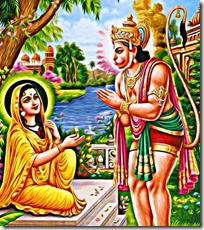
Hanuman meeting with Sita in Ashok Vatika (source)
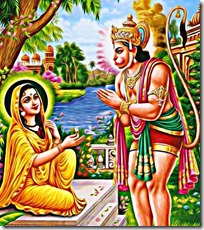
Assuring himself of the safe surroundings, Hanuman dropped the wedding ring which made Sita very curious and concerned. Then, he jumped down to appear face-to-face with Sita Ji. Hanuman, using his diplomatic skills, introduced him as the humble messenger of Lord Ram. At first, Sita was very scared that Ravana came as an imposter because he was very capable to play the game. However, the skilled Hanuman succeeded in gaining Sita’s trust and confidence that he was Ram bhakta (devotee) Hanuman and not an imposter.
Courageous Ambassador with Presence of Mind
Encounter with Meghnath: With the main mission of Sita’s whereabouts complete, Hanuman wanted to assess the military strength of King Ravana. He used his presence of mind to start damaging Ashok Vatika with the intention of engaging the soldiers (guarding the Vatika) in a show of strength. Indeed, the soldiers were no match for the strong and undefeatable Hanuman.
The defeated soldiers informed King Ravana who asked his son Meghnath to go to Ashok Vatika. After a brief fight, Meghnath arrested Hanuman and brought him to the court of King Ravana. Important to observe again is Hanuman’s presence of mind in that he did not resist his arrest and thus he could meet Ravana to assess his strength.
Ravana’s Court: Face to face with Ravana in his court, the proud Hanuman asserted his presence as Ram’s humble servant. Hanuman narrated Bhagwan Ram’s glory unhesitatingly. He diplomatically suggested that Ravana should free Sita and seek Ram’s forgiveness. Such words infuriated Ravana. He rose from his throne to punish Hanuman for his arrogant statement in court.

Hanuman in Ravana’s Court in Lanka; Ravana with ten heads and Hanuman with an enormous tail as a show of their respective Divine powers. (source)
In the process, Hanuman successfully gauged Ravana’s temper, tantrums, personality, mental state, and strength as Ram’s emissary. Hanuman observed that one of Ravana’s ministers and courtiers, Vibhishan, Ravana’s younger brother, was different. Vibhishan advised his brother that killing an emissary is against the moral duty of King Ravana. Heeding his brother’s advice, Ravana ordered that Hanuman be punished for his defiance, insult, and entering Lanka as an intruder.
Punishment to Hanuman: Ravana’s court chose to punish Hanuman by burning his tail. The daring Hanuman chanted Sri Ram and used his Divine power to lengthen his tail. Ravana and his courtiers were in utter amazement. In a show of his strength, defiant Hanuman challenged Ravana once again for freeing Sita and no war with Ram before walking out with a burning tail.
Burning Lanka: While leaving Lanka, Hanuman fearlessly caused significant damage by igniting a fire in buildings with his burning tail. When Ravana was notified about the damage, he ordered the capture of Hanuman. However, Ravana’s soldiers failed miserably to arrest flying Hanuman.
Clearly, Hanuman used his strong capabilities and skills in finding Sita and diplomacy to convey a strong message to Ravana. Hanuman’s return from Lanka triumphantly was just the beginning of his becoming a trusted/loyal friend and devout bhakta of Lord Ram.
Since Ravan failed to free Sita and avoid war with Ram, Hanuman led the army of Vanaras. Both sides had strong warriors with Divine blessings and potent armaments. However, Hanuman with Lord Ram’s presence played a crucial role in winning the war against Lanka’s Ravana. An immortal warrior and Diplomat par excellence, Hanuman offered help at every juncture.
Returning to Ayodhya: Finally, Hanuman accompanied Ram, Sita, and Lakshman to Ayodhya and earned a rightful place for himself. According to Uttara Kanda of Ramayan, Ram ordered Hanuman to stay on earth. Hanuman is fondly remembered and prayed with reverence wherever Lord Ram is praised.
Traditionally, the Hindus keep fast on Tuesday in honor of Lord Hanuman. Hindus believe that chanting Hanuman Chalisa removes all obstacles and challenges in one’s life.

Bajrang Dal manifesting Hanuman ji as a source of their strength (Wikipedia)
Hanuman and Today’s Politics: It is believed that Lord Indra blessed Hanuman with immunity from all sorts of weapons making him Vajradeh (body like a diamond) and gave him the name Bajrang Bali. In modern India, an organization called the Bajrang Dal is the youth wing of the Hindu Vishwa Parishad (VHP) with an ideology based on Hindutva.
India is undergoing a renaissance to preserve, protect, and promote Hindutva against the ever-growing anti-Hinduism propaganda. For example, Bajrang Dal is at a crossroads in the upcoming assembly elections in the State of Karnataka. India’s oldest but struggling Congress party manifesto mentions that it might “impose a ban” on Bajrang Dal. The manifesto also equates Bajrang Dal with the outlawed Islamic group called Popular Front of India (PFI). PFI is reportedly linked with terrorism and other anti-national activities. Consequently, VHP has kicked up a storm lashing out at Congress.
It is no secret that Prime Minister Modi, a Hindu nationalist himself, is using the slogan of Jai Bajrang Bali (Hail Bajrang Bali-Hanuman) in his campaign rallies. It is a political counter-attack against Congress’s manifesto in Karnataka. Bajrang Dal is also calling for chanting Hanuman Chalisa to remove all obstacles to winning the election and protest against Congress’s manifesto.
Previous Post
April 29, 2023
HANUMAN: Part I-The Diplomat in Disguise
Next Post

September 7, 2023 Forgiveness in Hinduism and the Hindu Temple of Minnesota
Recent Comments
Browse Our Archives
Select a Category Hinduism as Civilization Hinduism as Vililization Uncategorized
Select a Month August 2026 July 2026 March 2025 August 2024 June 2024 January 2024 November 2023 September 2023 May 2023 April 2023 October 2022
TAKE THE
Religious Wisdom Quiz
What animal tricked Eve in the garden?
Select your answer to see how you score.
A serpent A wolf A lion A fox
Related posts from Hinduism and the Nation

Civilizational India (Bharat): Beyond the Western Optics

Maha Kumbh: An Unimaginable “Green” Confluence of Hindus

Hinduism and the Olympics: Manu Bhaker and Bhagavad...
Ram Rath Yatra In The U. S. And...
TRENDING AT PATHEOS Hindu

Emotion in Early Christianity by Andrew Crislip
Andrew Crislip’s Emotion in Early Christianity examines an often overlooked dimension of...

16 Spiritual Touchstones for a More Grounded Life
After decades of spiritual study, here are 16 principles I try...

Catholic Evangelization: Sharing Your Faith Every Day
Welcome back to the Graceful Awakening mini-series called, “From Faith to Mission.” ...

The Pillar of the Boatmen: the Ancient Monument...
The Pillar of the Boatmen is a Romano-Gaulish sculpture that dates from...

In one sense walking into Westminster Abbey is like walking down the...

'Super Scam Me' Exposes AI Jon Bon Jovi...
Leslie Pickett believed she was in a relationship with Jon Bon Jovi....
view all Hindu blogs
What Are Your Thoughts?leave a comment
Ad-Free & Subscriber Log-In Subscription Support
- About Us
- 2026 Calendar
- Videos
- Podcasts
- Library of World Religions
- Faith In Media Tracker
- Advertise With Us
- Write for Us
- Privacy Policy
- Terms of Service
- Do Not Sell My Data
- Contact Us
- Radiant Digital
- Manage Newsletter Subscriptions
- Unsubscribe From Notifications
- Sitemap
Copyright 2008-2026, Patheos. All rights reserved.
Subscription Support Ad-Free & Subscriber Log-In
Follow Patheos