
BuddhistCatholicContemplativeEvangelicalGeneral ChristianHinduJewishLatter-day SaintMuslimNew VisionsProgressive Christian
Beliefs
- Buddhist
- Catholic
- Contemplative
- Evangelical
- General Christian
- Hindu
- Jewish
- Latter-day Saint
- More Voices
- Muslim
- New Visions
- Pagan
- Progressive Christian
Topics
- Religion News
- Food and Religion
- Sports and Religion
- Religious Art
- Religious Music and Entertainment
- Religious Events
- History and Religion
- Style and Religion
- Politics and Religion
- Women in Religion
- Recreation Outdoors and Religion
- Business Finance and Religion
- Careers Workplace and Religion
- Education and Religion
- Family Parenting and Religion
- Health Fitness and Religion
- Home and Religion
- Relationships and Religion
- Technology and Religion
- Travel and Religion
Columnists
- Buddhist Columnists
- Business Finance and Religion Columnists
- Careers Workplace and Religion Columnists
- Catholic Columnists
- Contemplative Columnists
- Education and Religion Columnists
- Evangelists Columnists
- Family Parenting and Religion Columnists
- General Christian Columnists
- Health Fitness and Religion Columnists
- Hindu Columnists
- History and Religion Columnists
- Home and Religion Columnists
- Jewish Columnists
- More Voices Columnists
- Latter Day Columnists
- Muslim Columnists
- New Visions Columnists
- Nonreligious Columnists
- Pagan Columnists
- Politics and Religion Columnists
- Progressive Columnists
- Recreation Outdoors and Religion Columnists
- Relationships and Religion Columnists
- Religion News Columnists
- Religious Art Columnists
- Religious Events Columnists
- Religious Music and Entertainment Columnists
- Sports and Religion Columnists
- Style and Religion Columnists
- Technology and Religion Columnists
- Travel and Religion Columnists
- Women in Religion Columnists
Resource Library
- 2026 Calendar
- Library of World Religions
- The 100 Most Holy Places on Earth
- Patheos Answers
- Podcasts
- Videos
- Faith Leaders Database
- Anglican Episcopalian
- Bahai
- Baptist
- Buddhism
- Christianity
- Confucianism
- Eastern Orthodoxy
- Hinduism
- Holiness and Pentecostal
- ISKCON
- Islam
- Judaism
- Lutheran
- Methodist
- The Church of Jesus Christ of Latter-day Saints
- New Age
- Paganism
- Presbytarian and Reformed
- Protestantism
- Religion Behind the Scenes
- Roman Catholic
- Scientology
- Shia Islam
- Sikhism
- Sufism
- Sunni Islam
- Taoism
- Zen
- See all religions
Research Tools
 Ad-Free & Subscriber Log-In Subscription Support
Ad-Free & Subscriber Log-In Subscription Support
Follow Patheos 

- Trending:
- Forgiveness
- |
- Marriage
- |
- Consciousness
- |
- Death Penalty
- |
- Election
- |
- Halloween

- Home
- Hindu
- History and Religion
- The Four Comforting Myths Hindus Tell Themselves
The Four Comforting Myths Hindus Tell Themselves
Last updated on: March 16, 2026 at 9:07 am by Shashi Holla
The Four Comforting Myths Hindus Tell Themselves 2026-03-16T09:07:11+08:00 Shashi Holla
Patheos Explore the world's faith through different perspectives on religion and spirituality! Patheos has the views of the prevalent religions and spiritualities of the world.
Among Hindus today, certain ideas circulate endlessly on social media and in casual conversations. They are repeated so often that they have become articles of faith. Yet many of these beliefs are not historical truths but comforting myths that weaken Hindu civilisational confidence.

(The Apsara dance, a national cultural icon of Cambodia, brings the epic Ramayana to life through its graceful movements and storytelling. Source:Viator)
If Hinduism is to remain a living force in the modern world, these myths must be confronted honestly.
Myth One: “The Whole World Is One Family”
One of the most frequently quoted Sanskrit sayings today is “Vasudhaiva Kutumbakam”, derived from the ancient Sanskrit text Maha Upanishad. Even Indian PM Modi get applauded overseas for chanting this. It expresses the noble idea that humanity is one family and that the boundaries dividing people are ultimately artificial.
In principle, it is one of the most beautiful ethical ideas produced by any civilisation.
But in practice, its modern invocation often reveals a deep civilisational naivety.
Hindus enthusiastically repeat this phrase online as proof of the moral superiority of their tradition. Yet in the real world, many religious communities do not operate according to such universalist assumptions. They see the world not as a shared family but as a field in which belief systems compete for influence, followers, and narratives of dominance.
While Hindus proclaim universal brotherhood, other communities confidently assert the truth of their own traditions and actively expand their religious boundaries.
Idealism, when detached from social reality, becomes self-disarming.
Myth Two: Hinduism was never missionary
Another widely repeated claim is that Hinduism has never been a missionary religion. People often celebrate this idea as evidence of Hindu tolerance and moral grandstanding.
Yet history tells a very different story.
During the first millennium CE, Indian civilisation expanded far beyond the subcontinent through maritime trade networks and cultural diplomacy. Brahmin scholars, merchants, and navigators carried Sanskrit learning, temple rituals, and Hindu cosmology across the Indian Ocean.
Entire regions of Southeast Asia absorbed Hindu political and religious ideas. The temples of Angkor Wat in Cambodia and the Sanskritised courts of Indonesia and Thailand stand as enduring monuments to this civilisational influence.
These societies were not merely “inspired” by India. They adopted Hindu kingship rituals, Sanskrit literature, temple architecture, and Vedic philosophies.
In other words, Hindu civilisation once possessed a powerful outward cultural energy.
The claim that Hinduism was never missionary is therefore not historically accurate. What is true is something different: Hindu society gradually lost its missionary confidence during the last millennium.
Myth three: All Religions are the same
The deeper issue facing Hindus today is not philosophical weakness. Hindu thought remains one of the most intellectually sophisticated spiritual traditions in the world.
The problem is psychological and institutional.
Many Hindus assume that all religions are essentially the same and therefore see little need to study competing traditions seriously. This intellectual laziness produces a comforting illusion: if all paths lead to the same truth, then there is no need to defend one’s own tradition or articulate its distinctive value.
But in reality, religions differ profoundly in theology, structure, and focus. Some traditions emphasise universal spiritual exploration. Others emphasise doctrinal certainty and active expansion.
Ignoring these differences does not create harmony. It simply creates asymmetry and conflicts.
Myth Four: Religion is private and apolitical
Another modern assumption among many Hindus is that religion should remain purely personal and apolitical. Love, marriage, faith, and identity are often treated as matters that belong solely to the private sphere.
Yet history suggests otherwise.
Religion has always been intertwined with community formation, social institutions, and political power. Across the world, religious organisations operate schools, charities, media networks, and missionary programs designed to expand their influence.
Even personal relationships can become avenues for religious expansion and identity formation.
To pretend that religion exists outside social and political realities is not spiritual wisdom. It is simply a failure to observe how the world actually works.
The Cost of Civilisational Complacency
The result of these comforting myths is complacency.
Hindu philosophy remains widely admired. Yoga, meditation, and Vedantic ideas have spread globally. Yet the institutional structures needed to communicate and sustain Hindu thought are comparatively weak.
Without intellectual renewal and organisational energy, even the richest traditions risk becoming museum cultures rather than living civilisations.
Toward a Hindu Awakening
The way forward does not require abandoning the universal ideals of Hindu philosophy. Concepts like pluralism, tolerance, and spiritual freedom remain valuable contributions to humanity.
But those ideals must be combined with clarity, confidence, and civilisational self-respect.
Hindu society must rediscover three essential qualities:
- Intellectual seriousness about its own traditions
- Institutional strength to communicate its ideas globally
- Civilisational confidence in defending and explaining its worldview
Without these qualities, even the noblest philosophies can fade into irrelevance.
The world does not automatically preserve civilisations simply because they once produced game-changing ideas.
Civilisations survive only when their people possess the will to sustain them.
Shashi Holla , Australia
Style and Religion
Hinduism is missionary? Myths about Hinduism

About Shashi Holla
Shashi Holla is an Indo-Australian Health entrepreneur based in Western Australia. He is also a Hindu Chaplain at Curtin University. Recently, he published a book titled ‘India-Australia: Bharat’s Legacy of Connection, History and Diaspora’ by Garuda Publishers https://garudalife.in/india-australia-bharats-legacy-of-connection-history-diaspora You can read more about the author here.
Previous Post

November 28, 2025
The Dhwaja(Flag)Over Ayodhya: A Hindu Civilisational Revival
Next Post

July 30, 2026 Hormuz: A Shared Hindu and Zoroastrian Heritage
Browse Our Archives
Select a Category Uncategorized
Select a Month July 2026 March 2026 November 2025 October 2025
Follow Us!
TAKE THE
Religious Wisdom Quiz
Who is the most common author of the Psalms?
Select your answer to see how you score.
David Moses Solomon Asaph
Related posts from Hindu Indigeneity
Hormuz: A Shared Hindu and Zoroastrian Heritage
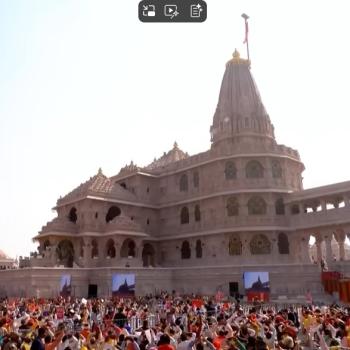
The Dhwaja(Flag)Over Ayodhya: A Hindu Civilisational Revival

Conversion Zealots and Interfaith Marriages: A Dharmic Lens

Interfaith Harmony Through a Dharmic Lens: Katrina &...
TRENDING AT PATHEOS Hindu

Indian Hindu pilot’s valor in line of duty...
There is a hoary maritime tradition that the captain of the...

Movie on Neem Karoli Baba’s life is a...
Neem Karoli Baba’s life (1900-1973) is associated with miracles he made in...

20 Questions to Ask Before an Interfaith Marriage,...
Four questions every interfaith couple should discuss before marriage: Conversion. Will either...

Avadhānam: The Art of Concentration and Intellectual Mastery
What is Avadhānam? In the summer of 2015, during a three-day Sanskrit...

Jesus in the Dharma: Where Christ Fits in...
Where Does Jesus Fit in Hinduism? That’s a question I get often...
Hormuz: A Shared Hindu and Zoroastrian Heritage
Every evening, somewhere in the world, a newsreader utters the words: "The...
view all Hindu blogs
Ad-Free & Subscriber Log-In Subscription Support
- About Us
- 2026 Calendar
- Videos
- Podcasts
- Library of World Religions
- Faith In Media Tracker
- Advertise With Us
- Write for Us
- Privacy Policy
- Terms of Service
- Do Not Sell My Data
- Contact Us
- Radiant Digital
- Manage Newsletter Subscriptions
- Unsubscribe From Notifications
- Sitemap
Copyright 2008-2026, Patheos. All rights reserved.
Subscription Support Ad-Free & Subscriber Log-In
Follow Patheos