
BuddhistCatholicContemplativeEvangelicalGeneral ChristianHinduJewishLatter-day SaintMuslimNew VisionsProgressive Christian
Beliefs
- Buddhist
- Catholic
- Contemplative
- Evangelical
- General Christian
- Hindu
- Jewish
- Latter-day Saint
- More Voices
- Muslim
- New Visions
- Pagan
- Progressive Christian
Topics
- Religion News
- Food and Religion
- Sports and Religion
- Religious Art
- Religious Music and Entertainment
- Religious Events
- History and Religion
- Style and Religion
- Politics and Religion
- Women in Religion
- Recreation Outdoors and Religion
- Business Finance and Religion
- Careers Workplace and Religion
- Education and Religion
- Family Parenting and Religion
- Health Fitness and Religion
- Home and Religion
- Relationships and Religion
- Technology and Religion
- Travel and Religion
Columnists
- Buddhist Columnists
- Business Finance and Religion Columnists
- Careers Workplace and Religion Columnists
- Catholic Columnists
- Contemplative Columnists
- Education and Religion Columnists
- Evangelists Columnists
- Family Parenting and Religion Columnists
- General Christian Columnists
- Health Fitness and Religion Columnists
- Hindu Columnists
- History and Religion Columnists
- Home and Religion Columnists
- Jewish Columnists
- More Voices Columnists
- Latter Day Columnists
- Muslim Columnists
- New Visions Columnists
- Nonreligious Columnists
- Pagan Columnists
- Politics and Religion Columnists
- Progressive Columnists
- Recreation Outdoors and Religion Columnists
- Relationships and Religion Columnists
- Religion News Columnists
- Religious Art Columnists
- Religious Events Columnists
- Religious Music and Entertainment Columnists
- Sports and Religion Columnists
- Style and Religion Columnists
- Technology and Religion Columnists
- Travel and Religion Columnists
- Women in Religion Columnists
Resource Library
- 2026 Calendar
- Library of World Religions
- The 100 Most Holy Places on Earth
- Patheos Answers
- Podcasts
- Videos
- Faith Leaders Database
- Anglican Episcopalian
- Bahai
- Baptist
- Buddhism
- Christianity
- Confucianism
- Eastern Orthodoxy
- Hinduism
- Holiness and Pentecostal
- ISKCON
- Islam
- Judaism
- Lutheran
- Methodist
- The Church of Jesus Christ of Latter-day Saints
- New Age
- Paganism
- Presbytarian and Reformed
- Protestantism
- Religion Behind the Scenes
- Roman Catholic
- Scientology
- Shia Islam
- Sikhism
- Sufism
- Sunni Islam
- Taoism
- Zen
- See all religions
Research Tools
 Ad-Free & Subscriber Log-In Subscription Support
Ad-Free & Subscriber Log-In Subscription Support
Follow Patheos 

- Trending:
- Forgiveness
- |
- Marriage
- |
- Consciousness
- |
- Death Penalty
- |
- Election
- |
- Halloween
 Hindu 2.0
- Home
- Hindu
- A History and Travel Guide to Ancient Varanasi (Benares)
A History and Travel Guide to Ancient Varanasi (Benares)
Last updated on: April 29, 2017 at 4:28 pm by Sunil Daman
A History and Travel Guide to Ancient Varanasi (Benares) 2017-02-10T13:53:12+05:30 Sunil Daman
Patheos Explore the world's faith through different perspectives on religion and spirituality! Patheos has the views of the prevalent religions and spiritualities of the world.
No matter what you call it – Kashi, Banaras, or Varanasi – it is probably the oldest and most exciting city in the world. According to lore, Kashi, “the City of Light,” is literally the “mother” of all cities. It was the first city, built by the first king, in the Anandavana, the forest of bliss carpeted with the sacred kusha grass. Before ancient Greece rose to its pinnacle, before Rome or Babylon, Kashi was a great metropolis and was already a thriving religious and commercial center. Way before Christ was born, Kashi was there. Gautama gave his first sermon at Sarnath near Kashi, and the reason he picked Sarnath for the sermon was because great numbers of spiritual seekers passed through there while traveling to Kashi.
According to India’s great epic, the Mahabharat, the name Varanasi derives from the fact that the city (at that time, at least, before it grew into its current proportions) was situated between the rivulets Varana in the north and Asi in the south, which flowed into the Ganga, along the banks of which Varanasi spread. Banaras was coined later, and meant the ras or juice of life. Benares doesn’t really mean anything at all. When the British adopted the name Banaras, they anglicized it as they had done with many other words, and made it Benares.

There’s temples all over the place in Varanasi.
The Holiest Place on Earth
The city’s population today stands at 1 million according to the 2001 census. During festivals and times of spiritual significance, the city bursts out of its seams and may house as many as 5 million. Every year, around 30 million pilgrims are estimated to make their way to Varanasi. India or Bharat with its sights, sounds, smells and tastes that overwhelm the senses is present in all its profusion in Kashi, squeezed into a vibrant microcosm. Kashi is essence of Sanatana Dharma, as the Hindu way of life is traditionally known. It can pick you up and shake you down, breaking all your expectations and priorities, and presenting a visitor with a bundle of contradictions. Life, death and everything in between are up for display at Kashi. Nothing is hidden. It encapsulates life in all its naked glory.
For someone from outside India, Kashi can be quite a shock. A sacred cow may nudge you out of the way not too gently. And the corpses crackling on the funeral pyre can be an overdose of reality to those who have hidden from their mortality all their life. Kashi cannot be ignored by anyone. Some love it, some hate it, but none remain indifferent to it. Life isn’t the same again once you’ve been to Kashi.
In the Hindu way of life, Kashi is the holiest place on earth. It stands on the trishul of Lord Shiva himself. The entire city is dedicated to the three-eyed God of Destruction. It is Avimukta, the sacred space never to be forsaken by Shiva. Those who die here are guaranteed liberation or mukti from the cycle of repeated birth and death. Manikarnika, the chief burning ghat on the Ganga’s banks is never without a body burning on the pyre. This is said to be every Hindu’s duty: to ensure that Manikarnika never goes idle!
Know one quite knows exactly how many temples are there in Kashi. There seems to be one in every streetcorner. Some estimates place the number of “major” temples at 2000, and the number of “minor” ones at 30,000 or more. The entire city was built to a plan to resemble a gigantic yantra, a machine that would become a process of liberation for every human being who entered the space. No wonder then that it was called the city of light.
Kashi is so special that even the Ganga flows towards the north towards her Himalayan home, the only such instance along its entire course in the plains, when it enters the city’s precincts. The river is quite flat and calm most of the year, as it passes through Kashi. But the monsoon sends the river into spate, and as it’s waters rise, temples, ghats and buildings often stay submerged for three months of the year. It is not unusual to see a temple half submerged in the river. Ancient Kashi was frequently engulfed by the river’s waters, and the holy men and their disciples would move to the small hillocks and continue their processes. Today however, the river’s banks are lined with high walls, though they are sometimes inadequate to contain the rise of the river.
As Ma Ganga or Mother Ganga winds through the city, she sanctifies the many ghats. She is one of the key lifelines of the spiritual process at work in Kashi. She is the bringer of life and taker of souls. She comforts the ill and purifies the sadhak (seeker). In the Hindu way of life, the river’s journey represents man’s own winding way through life. many times by her great waters.
A Cultural Capital
Kashi was also the city of knowledge. A great center of learning, it was the epicenter of the immense cultural fabric that spread out across North India. Music, art, literature, science and mathematics, all found their greatest masters in Kashi. The Banaras Hindu University is an echo of that ancient glory, and is making a spirited but entirely inadequate effort to regain what has been lost, and maintain what has somehow survived to today’s times.
Kashi was the center of Sanskrit learning in northern India. Sanskrit is among the oldest languages in the world and is still spoken as the mother tongue of 14,000 people in India. It is also the main language used in rituals and various other religious rites. It is the classical language of India. Like Latin in medieval Europe, Sanskrit was used extensively in literature. Most of the important scriptures and texts of Indian lore were written primarily in Sanskrit, though they were also frequently translated into other regional languages.
The city maintained a healthy tradition of Sanskrit expertise and knowledge for many generations after use of the language died out elsewhere. Today, Sanskrit is primarily restricted to priestly use, but Kashi retains about 40 Sanskrit schools and colleges with a total of over 2000 Sanskrit speakers and experts in the language. The city is home to the Banaras Sanskrit University, which has an extraordinary collection of 150,000 rare Sanskrit manuscripts.
Traditionally, the schools in Kashi and indeed in the whole of India, were maintained as patashalas or gurukuls, where the students were taught under the guidance of a Guru. The Guru is the ultimate authority on all spiritual matters. They transmitted the spiritual process through the time-honored guru-disciple relationship. For the most part, this aspect of Kashi is mostly lost. There still are a few genuine Gurus, but they are hard to come by, especially while trying to sift through the hordes of masqueraders. However, those few that are genuine and still available are keeping alive a process that has survived many thousands of years, through even the worst depredations of the invading hordes. Hopefully, modern India will not wipe them off the map.
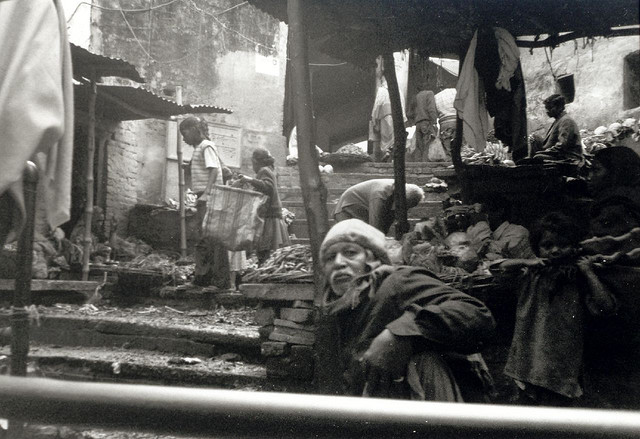
Varanasi can be rather filthy at times, something the current Prime Minister Narendra Modi has promised to change. Ahron de Leeuw – Flickr (CC-BY)
Kashi in Turbulence
Kashi’s preeminence made it the focus of a sustained campaign of destruction when Islamic kings took the throne of Delhi from the twelfth century onwards. So thoroughly did they do their job of wiping out the city’s heritage that there is no building in the city today older than 600 years. First came Qutbuddin Aibak’s armyies in 1194, and they say he destroyed over a thousand temples. When the Mughals arrived in the sixteenth century, Shah Jahan, builder of the Taj Mahal, ordered almost a hundred temples destroyed, and Aurangzeb accelerated this policy of persecution and bigotry. He reimposed the jazia, a tax that was specially levied on non-Muslims by the Mughal kings. He destroyed temples and placed many restrictions to wipe the already impoverished Hindu cultural institutions. He even forbade music at his court because it was idolatrous and seduced the people from their true end of contemplating Allah.
In 1659, Aurangzeb ordered the destruction of the holy temple of Krittivasa. In 1669, he ordered the destruction of two of the city’s most sacred temples, the Vishnu Temple of Bindu Madhava and the Kashi Vishwanath Temple. Mosques were immediately constructed upon the ruins. It is said that when the Vishwanath temple was being destroyed, even the ascetics and sadhus took up arms to battle the Mughal armies, but were ruthlessly slaughtered. The Alamgir Mosque, which dominates the northern skyline of the Ganga’s riverfront, stands on the site of the Temple of Bindu Madhava. At the site of Kashi Vishwanath, Aurangzeb had the Gyan Vapi mosque constructed. He even changed the city’s name to Muhammadabad and set up the royal mint there to issue coins bearing the new name. But the name never stuck and passed into history with his death.
But Kashi has risen and thrived through all the insanity of religious warfare. With characteristically Indian resurgence, the city incorporated every element that was thrown or thrust at it. HEr misfortunes only seem to have increased its sanctity. What keeps Sanatana Dharma so vibrant despite all that has happened is that it is not a centralized religious system. It is as much a way of life. The way a Hindu sits, eats or sleeps is as much Sanatana Dharma as the way he worships his deity. The Islamic invaders ailed to understand this and attempted to stamp out the Hindu way of life by attacking the sacred places, chief of which was Kashi. But whatever may change on the surface, Kashi goes on. As long as human beings seeking ultimate liberation exist, Kashi will stay alive it is said.
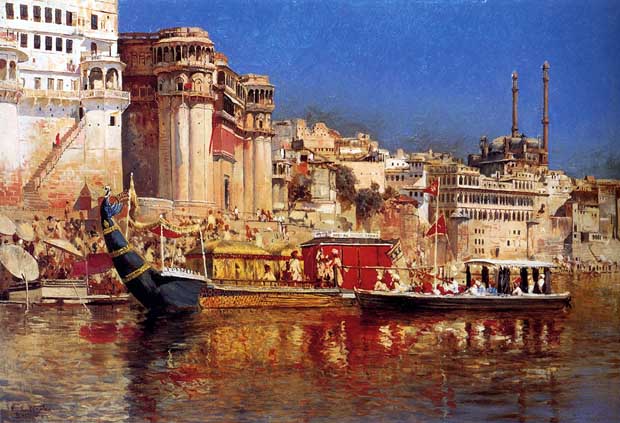
Kashi in the good ol’ days – the nineteenth century.
Eternal City
The old city stretches out from around the Chowk, the center, and goes down to the river. It is a maze of unmarked by lanes and narrow streets, wide enough for cows, goats, dogs and pedestrians – and crazy two-wheeler drivers. The houses crowd over these lanes and hid the sun itself! There is bustling activity, especially around the temples!
The city today is struggling under its creaking infrastructure today, and filth and trash stand by side with the temples and cultural heritage. But India’s new Prime Minister seems set to change all that. His poll promise to Varanasi – also the constituency that voted him into a parliament seat with landslide margins – was to turn the city into a smart city, a blend of modern and mystical. He recently concluded the Kashi-Kyoto pact with Japan, during his three-day visit to the country when he met Japanese Prime Minister Shinzo Abe. Modi’s visit to Kyoto’s Toji temple, a UNESCO World Heritage site seems to have favorably impressed him, and he has requested Japan’s expertise in reconstructing Kashi, while retaining its Pauranik Swarup or ancient ethos.
Travel Info
Banarasis, the natives of the city are known for their carefree, kind of crazy attitude of abandon and good humor. The traffic chaos epitomizes this joie de vivre, and this love of good living and culture that is positively infectious. The city throbs with what the locals call masti.
Another specialty of Kashi is bhang, a decoction of hashish. The streets have plenty of stalls selling the stuff mixed in varius forms. In tea, in lassi or buttermilk, bhang kulfi or cones of ice cream, or as little pills. The availability of bhang is one reason why Kashi is frequented by foreigners today.
Previous Post

April 29, 2017
Do This One Thing to Live Blissfully - Sadhguru Video
Next Post
April 30, 2017 Do you want to understand or experience _ Sadhguru Video
Browse Our Archives
Select a Category books Devi worship India jk videos Master's Talks quotes Sadhguru Videos sanatana dharma travel Uncategorized Videos Yoga and meditation
Select a Month June 2021 May 2021 April 2021 November 2019 October 2019 May 2019 April 2019 February 2019 January 2019 December 2018 November 2018 October 2018 September 2018 August 2018 July 2018 June 2018 October 2017 September 2017 August 2017 July 2017 June 2017 May 2017 April 2017 March 2017 February 2017 January 2017 September 2016 August 2016 July 2016 March 2016 February 2016 June 2015 May 2015 April 2015 March 2015 February 2015 January 2015 December 2014 November 2014 October 2014 September 2014
TAKE THE
Religious Wisdom Quiz
What did John see coming down from heaven in Revelation 21?
Select your answer to see how you score.
The New Jerusalem The Ark of the Covenant A chariot of fire The four horsemen
Related posts from Hindu 2.0

All You Need to Know About the Ganga...

6 Famous Places In Kashi You Should Visit
A Brief History of the Somnath Temple
TRENDING AT PATHEOS Hindu

Indian Hindu pilot’s valor in line of duty...
There is a hoary maritime tradition that the captain of the...

Movie on Neem Karoli Baba’s life is a...
Neem Karoli Baba’s life (1900-1973) is associated with miracles he made in...

20 Questions to Ask Before an Interfaith Marriage,...
Four questions every interfaith couple should discuss before marriage: Conversion. Will either...

Avadhānam: The Art of Concentration and Intellectual Mastery
What is Avadhānam? In the summer of 2015, during a three-day Sanskrit...

Jesus in the Dharma: Where Christ Fits in...
Where Does Jesus Fit in Hinduism? That’s a question I get often...

Hormuz: A Shared Hindu and Zoroastrian Heritage
Every evening, somewhere in the world, a newsreader utters the words: "The...
view all Hindu blogs
Ad-Free & Subscriber Log-In Subscription Support
- About Us
- 2026 Calendar
- Videos
- Podcasts
- Library of World Religions
- Faith In Media Tracker
- Advertise With Us
- Write for Us
- Privacy Policy
- Terms of Service
- Do Not Sell My Data
- Contact Us
- Radiant Digital
- Manage Newsletter Subscriptions
- Unsubscribe From Notifications
- Sitemap
Copyright 2008-2026, Patheos. All rights reserved.
Subscription Support Ad-Free & Subscriber Log-In
Follow Patheos