
BuddhistCatholicContemplativeEvangelicalGeneral ChristianHinduJewishLatter-day SaintMuslimNew VisionsProgressive Christian
Beliefs
- Buddhist
- Catholic
- Contemplative
- Evangelical
- General Christian
- Hindu
- Jewish
- Latter-day Saint
- More Voices
- Muslim
- New Visions
- Pagan
- Progressive Christian
Topics
- Religion News
- Food and Religion
- Sports and Religion
- Religious Art
- Religious Music and Entertainment
- Religious Events
- History and Religion
- Style and Religion
- Politics and Religion
- Women in Religion
- Recreation Outdoors and Religion
- Business Finance and Religion
- Careers Workplace and Religion
- Education and Religion
- Family Parenting and Religion
- Health Fitness and Religion
- Home and Religion
- Relationships and Religion
- Technology and Religion
- Travel and Religion
Columnists
- Buddhist Columnists
- Business Finance and Religion Columnists
- Careers Workplace and Religion Columnists
- Catholic Columnists
- Contemplative Columnists
- Education and Religion Columnists
- Evangelists Columnists
- Family Parenting and Religion Columnists
- General Christian Columnists
- Health Fitness and Religion Columnists
- Hindu Columnists
- History and Religion Columnists
- Home and Religion Columnists
- Jewish Columnists
- More Voices Columnists
- Latter Day Columnists
- Muslim Columnists
- New Visions Columnists
- Nonreligious Columnists
- Pagan Columnists
- Politics and Religion Columnists
- Progressive Columnists
- Recreation Outdoors and Religion Columnists
- Relationships and Religion Columnists
- Religion News Columnists
- Religious Art Columnists
- Religious Events Columnists
- Religious Music and Entertainment Columnists
- Sports and Religion Columnists
- Style and Religion Columnists
- Technology and Religion Columnists
- Travel and Religion Columnists
- Women in Religion Columnists
Resource Library
- 2026 Calendar
- Library of World Religions
- The 100 Most Holy Places on Earth
- Patheos Answers
- Podcasts
- Videos
- Faith Leaders Database
- Anglican Episcopalian
- Bahai
- Baptist
- Buddhism
- Christianity
- Confucianism
- Eastern Orthodoxy
- Hinduism
- Holiness and Pentecostal
- ISKCON
- Islam
- Judaism
- Lutheran
- Methodist
- The Church of Jesus Christ of Latter-day Saints
- New Age
- Paganism
- Presbytarian and Reformed
- Protestantism
- Religion Behind the Scenes
- Roman Catholic
- Scientology
- Shia Islam
- Sikhism
- Sufism
- Sunni Islam
- Taoism
- Zen
- See all religions
Research Tools
 Ad-Free & Subscriber Log-In Subscription Support
Ad-Free & Subscriber Log-In Subscription Support
Follow Patheos 

- Trending:
- Forgiveness
- |
- Marriage
- |
- Consciousness
- |
- Death Penalty
- |
- Election
- |
- Halloween
 Hindtrospectives
- Home
- Muslim
- Why I Stand With Standing Rock #NoDAPL
Why I Stand With Standing Rock #NoDAPL
Last updated on: September 14, 2016 at 1:46 pm by Hind Makki
Why I Stand With Standing Rock #NoDAPL 2016-09-14T13:46:05-06:00 Hind Makki
Patheos Explore the world's faith through different perspectives on religion and spirituality! Patheos has the views of the prevalent religions and spiritualities of the world.
It’s been an emotional roller coaster of a week for American Muslims. This weekend, the 15th anniversary of the 9/11 terror attacks overlapped with the Day of Arafah, the culmination of the annual Hajj pilgrimage and the holiest day of the Muslim calendar.
Monday, millions of Muslims across the country awoke on the holiday of Eid-ul-Adha, to news of a Florida mosque being burnt down in a case of suspected arson. The floodgates opened and news of anti-Muslim bigotry began to make waves among American Muslim activists.
The two New York mothers who were attacked, along with their babies. The Scottish tourist who was set on fire. The polls showing that 76% of Republicans think Muslims don’t belong in this country and support Trump’s proposed ban on Muslims. An anti-Muslim armed militia managed to intimidate a Georgia county’s Board of Commissioners into cancelling a scheduled meeting on zoning for a new proposed mosque in the area. And news came from the United Kingdom of a pregnant woman who was kicked so hard in a racist attack, that her child subsequently died.
American Muslims have been preoccupied lately with simply existing in the age of Trump.
It is understandable that because we are in crisis mode, our focus has been on dismantling the Islamophobia that is creating a dam of fear in our communities. Even with all this pressure we’re enduring, many Muslim leaders and activists – exemplifying the teachings of our faith – are hearing the call of our Indigenous sisters and brothers, and standing in solidarity with Standing Rock.
“The world is beautiful and verdant, and verily God, be He exalted, has made you His stewards in it, and He sees how you acquit yourselves.” – Sahih Muslim
In the western plains, hundreds of tribes are gathered to protect the Missouri River from the The Dakota Access oil pipeline. The Company responded by unleashing dogs and macing the non-violent protesters, and the US Government stepped in to temporarily halt the construction of the pipeline.
The story of a powerful corporation taking over lands they don’t own with no consultation of the native inhabitants of that land, in order to profit the fossil fuel industry with little regard to how it might effect the environment, is a story too familiar to Muslims in America and across the world.
Muslims believe that humanity was created to be a worshiper of God and God’s “vicegerent on earth.” The role of vicegerent means that all people – not only Muslims or people of faith – are tasked with preserving the environment and protecting all living and non-living beings on this planet. Muslims, too, believe in honoring commitments between nations and the sacredness of upholding treaties. That is why so many of us are standing with the Water Protectors at Standing Rock, who themselves began their action with a prayer walk by the youth of that nation.
Dale Gutierrez, the founder of La Alianza and a Muslim Xicano of Yaqui descent, has been organizing actions in Nebraska, and collaborating with a network of activists in Winnebago, Ponca, Omaha, and Lakota tribes to raise awareness and halt the DAPL. In the “first demonstration back in August, we had 500 people – which is good for Omaha. We stopped traffic and ultimately headed up to the USACE office; it was the first action in the city to take place, there’s been quite a bit more since then.” Gutierrez will be heading to Standing Rock later this month to coordinate efforts in person.
The Acting Coordinator of the Interfaith Community for Palestinian Rights, Haithem El-Zabri, is based in Austin, Texas, 1300 miles from North Dakota. He left for Standing Rock this weekend in solidarity with the tribes, telling me:
As a Muslim, it is heavy on my heart to see such abuse continue against an indigenous people that has been largely wiped out and, in addition to risking a source of water to an estimated 18 million human beings and countless other living beings.
As a Palestinian, I identify very strongly with indigenous struggles, as what has befallen my people is a replica of European colonization of the Americas and genocide of its indigenous peoples. The genocide, the abuse of the environment, the breaking of treaties, the violence… it is no different from what Palestinians see on a daily basis from Israel. Our causes are connected and we face the same forces that are the source of the US government’s aggressive interventions abroad, all intended to exploit the world’s resources for the benefit of the corporations and at the expense of the people. And all this without regard to the consequences to our planet, environment, and both human and non-human life.
So when I saw the scenes coming out of Standing Rock, I knew I had to be there. When I heard the calls coming out from there for people to join in solidarity, I knew I had to be there. When I saw my people in these tribes, my heart was there already. I feel it is my duty as a Palestinian, as an American, as a Muslim, as a conscientious human being, to stand with my native sisters and brothers in their righteous struggle, and in fact with any oppressed people and together face injustice. This is for our planet, our water, our environment, our future, our children, and not least for human rights and the dignity of our indigenous sisters and brothers. I want them to know that Palestine stands with them. I want to carry their message across 1,300 miles from Texas to North Dakota.
Even those who cannot leave their homes are actively in solidarity with Standing Rock. In a prayer commemorating the Day of Arafah, the renowned American Imam Zaid Shakir, directly linked the day’s atonement fast for liberation to the struggle at Standing Rock to preserve water, which is life. Dr. Hatem Bazian, a Palestinian-American academic and activist, writes clearly of the connection of American and Israeli settler-colonialism in an impassioned pledge of solidarity with the Standing Rock Sioux Tribe.
Journalist Dilshad Ali, of the Muslimah Next Door blog and editor of the Patheos Muslim channel gets personal on why she stands with Standing Rock, “I’m from North Dakota and have been following this story closely and support the Standing Rock Sioux nation fully. That is Sioux country over there. That’s my childhood.” And academic Dr. Shabana Mir writes, “I’m sharing stories with a particular interest because of my ties to Oklahoma and my Native American students and friends there, as well as [being] an anthropologist with a commitment to public anthropology.”
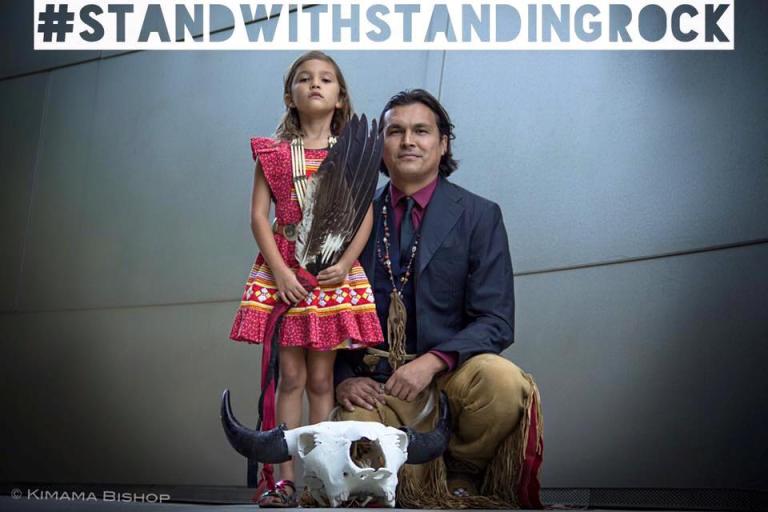
Earlier this year, a positive story about the history of Muslims in America made it’s way through my newsfeed. A reporter had learned of the existence of a tiny North Dakota mosque, built in 1929 by Lebanese and Syrian immigrants. It is a modest building, and not really in use now. The descendants of those immigrants are taking care of it as a marker for the cemetery where their ancestors are interred. I’m not sure whether those early immigrants had a relationship with the local Indigenous tribes; what I do know is that many immigrant-descended Muslims often forget that they and their families are thriving in colonized lands. History is important to preserve, but let’s not relegate Native Americans to the dustbins of history. They are here now, they are alive now, and they are calling for our solidarity and support now.
So what more can we do to stand in solidarity with Standing Rock? Activist El-Zabri says it best, “Those who can’t [come in person] can support in a number of different ways, including raising awareness about the issue, mobilizing their communities, participating in local donation drives, caravans, rallies, and other local actions, calling government officials, media, and Energy Transfer Partners, to voice your opinion and let them realize the magnitude of public opposition to their action, online actions and donations, prayers, and thoughts… everything helps! This is our struggle; all of us.”
To that end, several of us have started a Launch Good appeal to Support Standing Rock. We are asking people to financially support the Water Protectors, to uplift the voices of our Native American sisters and brothers, to learn about the history of the Standing Rock Sioux tribe and to join the movement to stop the Dakota Access oil pipeline. I am standing with Standing Rock – won’t you join me?
Previous Post

August 19, 2016
Banning Burkinis Won't Stop Muslim Integration
Next Post

November 7, 2016 Live Tweeting #Election2016
Browse Our Archives
Select a Category #BlackLivesMatter #MyMosqueMyStory #ZoulSoul American Hijabi in Europe Black History Month Ertugrul Hindtrospectives Linksies Mawlid Pop Culture Trans Atlantic Relations Uncategorized
Select a Month February 2018 December 2017 February 2017 January 2017 December 2016 November 2016 September 2016 August 2016 July 2016 February 2016 January 2016 December 2015 November 2015 September 2015 August 2015 July 2015 June 2015 April 2015 February 2015 January 2015 December 2014 November 2014 August 2014 June 2014 May 2014 April 2014 March 2014 February 2014 January 2014 December 2013 November 2013 September 2013 August 2013 July 2013 June 2013 May 2013 April 2013 March 2013 December 2012 November 2012 August 2012 July 2012 June 2012 May 2012 April 2012 March 2012 February 2012 October 2010 September 2010
Follow Us!
TAKE THE
Religious Wisdom Quiz
What did Isaiah see in his vision in Isaiah 6?
Select your answer to see how you score.
The Lord seated on His throne A burning bush A chariot of fire A ladder to heaven
Related posts from Hindtrospectives

Ertugrul - Your Muslim friend's new Bey
Why are we not all Quebec City?
Exploring Blackness and Sudanese Identities
TRENDING AT PATHEOS Muslim

25 Years Later: How Much Has Changed for...
As we approach the 25th anniversary of September 11th, I’ve found myself...

Podcast: Third Spaces & The Rise of Yemeni...
In the latest episode of The Artistic Foodies Podcast, hosts Abbas...

HalalFest Picks: Best 60 Halal Spots for Super...
Back in 2016, I came up with a list of 29...

Unity Is America’s Strength — Division Is Its...
by Hidayatullah Ahsan When Valentina Gomez, a Republican candidate for Congress in...

Zohran Mamdani and New York’s Fight Against Islamophobia
This past June, against all odds, Zohran Mamdani won the Democratic primary...

What the Fourth of July Means to a...
As we mark another Fourth of July, millions of Americans will celebrate...
view all Muslim blogs
Ad-Free & Subscriber Log-In Subscription Support
- About Us
- 2026 Calendar
- Videos
- Podcasts
- Library of World Religions
- Faith In Media Tracker
- Advertise With Us
- Write for Us
- Privacy Policy
- Terms of Service
- Do Not Sell My Data
- Contact Us
- Radiant Digital
- Manage Newsletter Subscriptions
- Unsubscribe From Notifications
- Sitemap
Copyright 2008-2026, Patheos. All rights reserved.
Subscription Support Ad-Free & Subscriber Log-In
Follow Patheos