
BuddhistCatholicContemplativeEvangelicalGeneral ChristianHinduJewishLatter-day SaintMuslimNew VisionsProgressive Christian
Beliefs
- Buddhist
- Catholic
- Contemplative
- Evangelical
- General Christian
- Hindu
- Jewish
- Latter-day Saint
- More Voices
- Muslim
- New Visions
- Pagan
- Progressive Christian
Topics
- Religion News
- Food and Religion
- Sports and Religion
- Religious Art
- Religious Music and Entertainment
- Religious Events
- History and Religion
- Style and Religion
- Politics and Religion
- Women in Religion
- Recreation Outdoors and Religion
- Business Finance and Religion
- Careers Workplace and Religion
- Education and Religion
- Family Parenting and Religion
- Health Fitness and Religion
- Home and Religion
- Relationships and Religion
- Technology and Religion
- Travel and Religion
Columnists
- Buddhist Columnists
- Business Finance and Religion Columnists
- Careers Workplace and Religion Columnists
- Catholic Columnists
- Contemplative Columnists
- Education and Religion Columnists
- Evangelists Columnists
- Family Parenting and Religion Columnists
- General Christian Columnists
- Health Fitness and Religion Columnists
- Hindu Columnists
- History and Religion Columnists
- Home and Religion Columnists
- Jewish Columnists
- More Voices Columnists
- Latter Day Columnists
- Muslim Columnists
- New Visions Columnists
- Nonreligious Columnists
- Pagan Columnists
- Politics and Religion Columnists
- Progressive Columnists
- Recreation Outdoors and Religion Columnists
- Relationships and Religion Columnists
- Religion News Columnists
- Religious Art Columnists
- Religious Events Columnists
- Religious Music and Entertainment Columnists
- Sports and Religion Columnists
- Style and Religion Columnists
- Technology and Religion Columnists
- Travel and Religion Columnists
- Women in Religion Columnists
Resource Library
- 2026 Calendar
- Library of World Religions
- The 100 Most Holy Places on Earth
- Patheos Answers
- Podcasts
- Videos
- Faith Leaders Database
- Anglican Episcopalian
- Bahai
- Baptist
- Buddhism
- Christianity
- Confucianism
- Eastern Orthodoxy
- Hinduism
- Holiness and Pentecostal
- ISKCON
- Islam
- Judaism
- Lutheran
- Methodist
- The Church of Jesus Christ of Latter-day Saints
- New Age
- Paganism
- Presbytarian and Reformed
- Protestantism
- Religion Behind the Scenes
- Roman Catholic
- Scientology
- Shia Islam
- Sikhism
- Sufism
- Sunni Islam
- Taoism
- Zen
- See all religions
Research Tools
 Ad-Free & Subscriber Log-In Subscription Support
Ad-Free & Subscriber Log-In Subscription Support
Follow Patheos 

- Trending:
- Forgiveness
- |
- Marriage
- |
- Consciousness
- |
- Death Penalty
- |
- Election
- |
- Halloween
 Hindtrospectives
- Home
- Muslim
- From a Woman’s Eye
From a Woman’s Eye
Last updated on: October 17, 2016 at 10:07 pm by Hind Makki
From a Woman’s Eye 2016-10-17T22:07:20-06:00 Hind Makki
Patheos Explore the world's faith through different perspectives on religion and spirituality! Patheos has the views of the prevalent religions and spiritualities of the world.
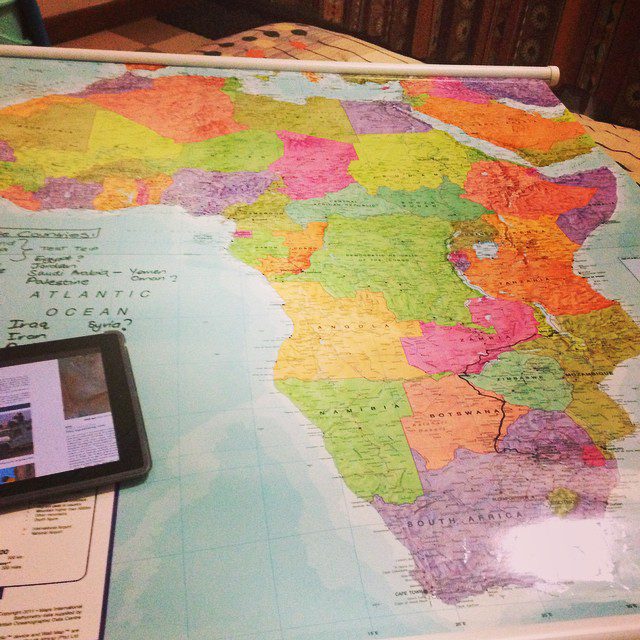
This is Day 18 of Hindtrospectives’ #MyMosqueMyStory series for Ramadan 2015
*Editor’s Note: Khairunnisa and Farhaan Khan have embarked on an overland trip “from Johannesburg to Jerusalem and beyond.” Throughout, they stop at houses of worship, meet local people and learn about local cultures. In this essay, Khairunnisa writes of her experiences in the mosques and churches they visited.
By Khairunnisa Khan
Physiologically speaking, an eye is an eye and gender should not change what we see, right? Technically yes, but in the hyper gendered social context we live in, what women see or are allowed to see is very different to what men see. This is even more dramatically so when it comes to religious or sacred spaces.
Farhaan and I have been married for a number of years and are keen travellers. We spent many holidays in South Africa, in the first few years of our partnership, driving within the country and then in later years we planned a much longer journey. On the 1st March 2015, we set out on our first overland journey from Johannesburg to Jerusalem and beyond.
As I write this piece, we are fasting our first Ramadan fast in Aqaba, Jordan, having been through nine countries to date. To be honest, we are road addicts and amongst the many wonderfully insightful experiences we have been privy to, our musings on the mosques (and a couple of churches) are my favourites. Travelling together naturally evolved into a comparison of each of our own experience and how they contrasted when visiting the very same places.
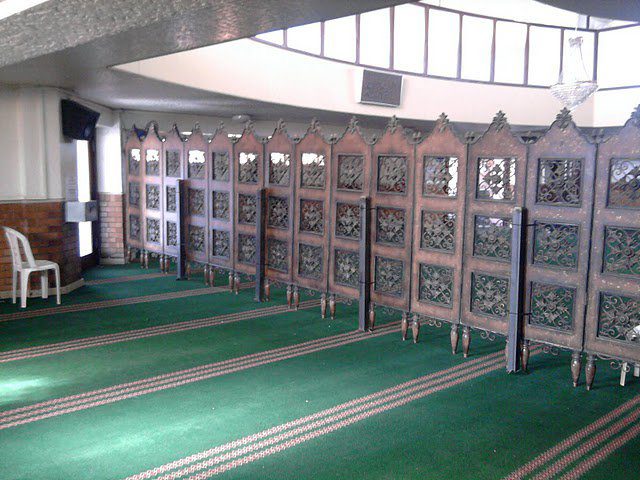
Masjid ul Islam in Johannesburg/Safiyyah Surtee
The struggles as a new couple many years ago when we first ventured out together for prayer, were not only just about different experiences, but in South Africa we often struggled just to find some space at all for me. South Africa’s diversity is a diversity echoed within the Muslim community as well, and as such prayer spaces for women range from non-existent to equal and shared and many variations in between. We recall the many instances of awkwardness looking for a space to pray in congregation and being met with every possible excuse under the sun. We recall the many times I had waited uncomfortably in the car, and the many more times that Farhaan angrily opted not to pray in congregation and we made our two ‘man’ jamaat on the side of the road.
As a woman I have become accustomed to being turned away and ‘making a plan’. Farhaan on the other hand was navigating through women’s access issues from a new perspective. We were both learning. However, the more we journeyed over land after March 2015, the more I missed the open spaces back home. From Sultan Bahu the mosque I grew up attending, I missed the freedom of not being monitored for errors, I missed not worrying about whether I would be scolded for my bare feet or not wearing a black abaya. I missed Masjidul Islam for its progressive seminars and for brilliantly designing equality and dignity into the women’s space. I thought of all the legends, past and living (Shamima Shaikh, Farhana Ismail, Fatima Seedat, Firdouza Waggie, Safiyyah Surtee, Shaakera Banoo and many others) who continue to educate and struggle and I thought about all I learnt from them back home. Every visit to a sacred space on our journey became both something to continue to learn from and an opportunity to appreciate what I had left behind.
Travelling with the luxury of cameras, two pairs of eyes, and having a love for the diversity in our community gave our reflections renewed life. Every mosque visit was an adventure. Getting through the hurdles of finding the women’s space, usually through awkward exchanges with the male attendees, and then experiencing the prayer in a completely different setting each time we entered a new country or town. The spaces for women on our journey varied from bad hidden dungeons to semi-hidden decent but somewhat smaller spaces, to dusty backyards and everything in between. The end of our mosque visits turned into a ritual of comparing notes and pictures back at the car which then culminated in this post.
Malawi
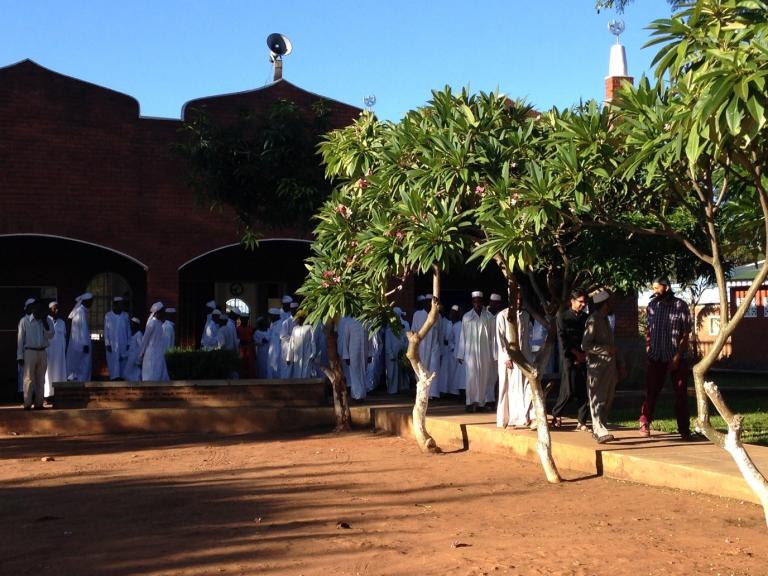
Men at the mosque after Asr prayers
A reaction from a woman to my wish to pray Friday prayers at the local mosque had prompted many thoughts. I had written a little about the subject academically before, but had never captured my personal experience or any of the drama of it all. That hot Friday afternoon, I was about to be escorted by the woman’s father to the local mosque along with two other men when the shock in her response stopped me in my tracks and jolted many reflections in my head. Her father had tried in two separate conversations to lead me to pray at home, but eventually accepted my decision and by prayer time was even excited to have me accompany him. This woman bless her soul turned out to be my muse.
It was not so much her that sparked the thought, as it was the shock in her voice and what it represented. It was the climax and build-up of responses too many times before that rolled into that moment, the: “Yes there is place for women, but let me introduce you to my wife who reads at home!“, the “yes, women do attend, but are you sure you really want to go?” and the cherry of all, “oh no shame, it really is no problem if you read here with us, you really don’t have to go“. The intentions I have to acknowledge, are all well-meaning, but there is history and context, oh so much of it behind all of these reactions.
As I sat there and looked around at the congregated women in the mosque, I reflected simply on why I loved being here. It was right here that I got to have a glimpse of people of a new country in all their mundane realness as they came in hurriedly from work, university and travelling from their homes in nearby towns. It was here that social and class barriers had no relevance, as women stood dusty heel to dusty heel side by side in spiritual unison. It was the only time that I would willingly leave my air conditioned middle class room to stand next to other women, not knowing the details of each others’ lives and struggles but occasionally being forced to take in the whiff of someone else’s hard day’s labour. It was here that we got to interact and speak to each other. Even as we listened to the Imam offer advice and guidance on some issue plaguing the community, it gave insight into the social context, into what was being addressed and what was being avoided.
That day I also watched the many people outside the mosque who had seemingly travelled from far away to beg and the women who risked being stampeded to offer their charity to them. The women’s section was the usual size (a bit less than half the men’s section) with a good view to the congregation and had a shared main entrance with the rest of the congregation. Interestingly I noted how some women still opted to enter from around the corner. This was definitely not a dungeon, but it got quite full quickly and became very stuffy. This situation would repeat itself in so many more towns to come. I just could not understand why the space for women had to always be less than half, as if pre-empting female attendees to continue being less than half that of men forever. This made no sense to me. Being completely caught up in my reflections that day, I forgot to take pictures.
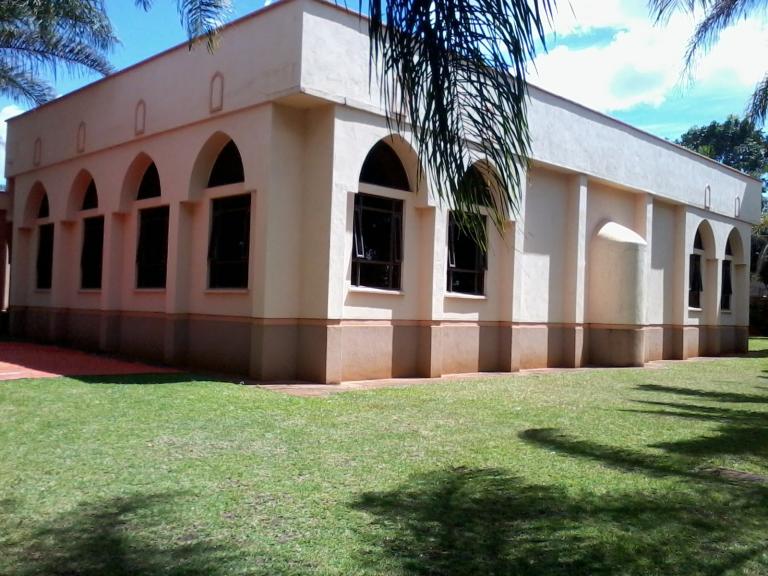
Islamic College in Malawi
We did take pictures at the next stop. A tour to a tertiary Islamic Institute that is transitioning into a combined secular Islamic College. We were guests of honour and were treated to a personal tour of the male campus where we met students and teaching staff and were guided through the facilities as well as the mission and vision of the institute, all of which was quite inspiring. We happened to be there during the Asr (mid-afternoon) prayer.
This being a male only college, the equal co-ed reception that I enjoyed during the tour quickly changed as we split ways for prayer. The male congregation proceeded to the mosque on the premises and I was asked to pray in one of the dormitory rooms. I watched and listened jealously afterwards from outside, as speeches were made and good wishes were given for my and Farhaan’ s journey.
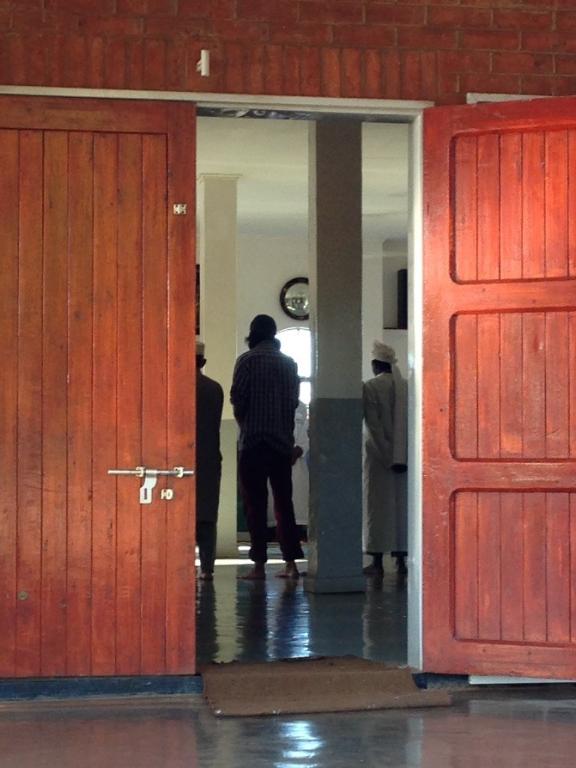 I was told earlier about how locals have an interesting tradition of walking in a circle after prayer, each having a turn to greet the Imam and vice versa. I watched this from outside as Farhaan the traveller was included in the sacred circle and was greeted with importance. Impromptu speeches were made, laughs were exchanged and prayers for travellers were recited. Farhaan did not take pictures as he was in the spotlight and was asked to say a few words at the end too. He told me afterwards that the men had turned around to call me in after the prayer. Perhaps I was too caught up in my thoughts to notice, perhaps I should have been more explicitly invited in, perhaps I should have walked in, but all I could do in the moment was watch from outside.
Tanzania
We chose to pray at the Shia mosque in Arusha. We were nervous to attend prayers here, our perception being that Sunni’s don’t just casually traipse into a Shia mosque for prayer, particularly in a foreign country where we didn’t know anyone. However, such are the adventures of ‘FotheK‘, always finding ways of getting out of our comfort zones. I was totally intrigued by the ingenuity of the design of the women’s ‘lookout’ point. A square hole from the top section ensured that women had a clear view of the Imam, however they could not see the men and neither could the male congregation see the women. In fact, if the Imam had to steal a view of the women, he would have to very conspicuously look straight up into the ceiling, which he did not and which I admittedly checked for.
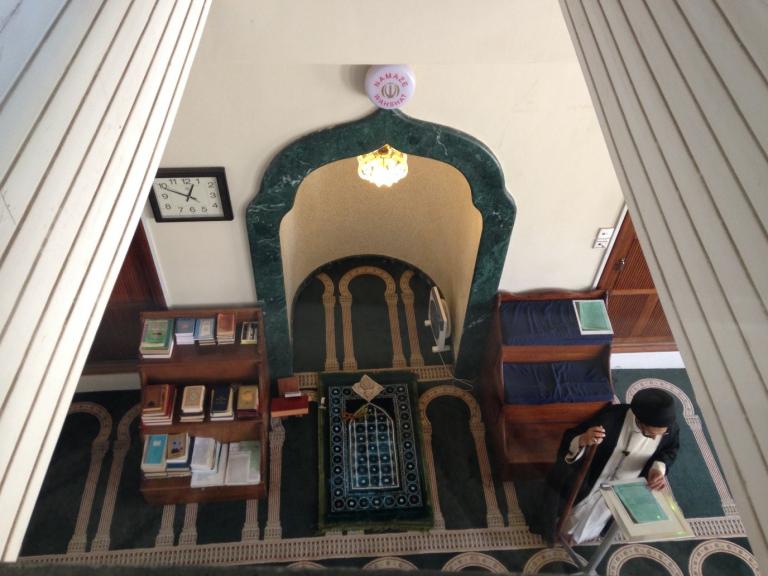
Women’s pov at Ksij Arusha Shia Mosque
I had prayed a few times in Shia mosques before. This was the first time the ‘stone’ was placed in front of me by a woman after I started my prayer without it. I didn’t mind the stone at all, but I smiled in my head as I realised that women had repeatedly been the rule enforcers in all my experiences so far. Farhaan was pretty much left to do whatever he pleased and none of the men seemed to notice that he was praying slightly differently. The dua for unity at the end of the prayer was incredibly powerful. I giggled as I enjoyed the manner in which the women fervently held fists together and called out the Shahada aloud. We chatted later about how humanity could learn from this community. Humanity was in serious need of a similar prayer for unity.
Ethiopia
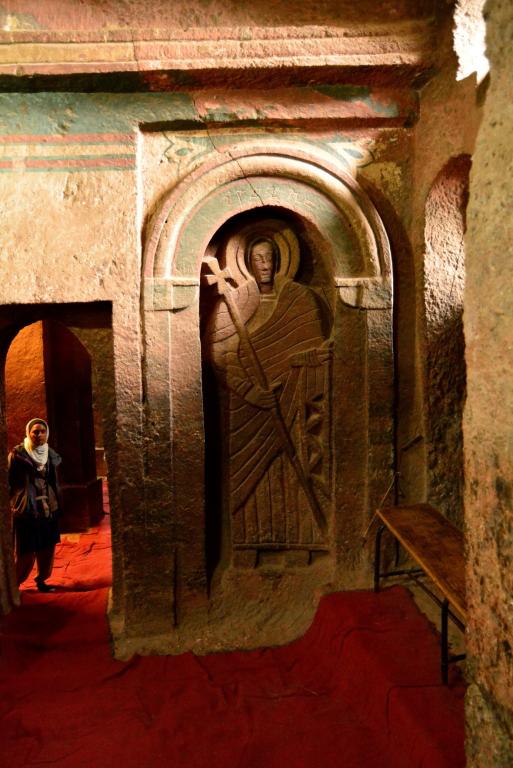
Tomb of King Lalibela/Farhaan Khan
In Lalibela our tour of the rock-hewn churches were going amazingly well. So amazingly well that I happened to meet a beautiful priest that I could not help kissing the hand of in the traditional orthodox Christian way of showing respect. I later imagined friends and family pointing out the swift reckoning I received for this act in the form of my continued suffering weeks after from painful blistering flea bites from the carpets there. But I digress terribly. At this point I was having an insightfully spiritual experience across the religious divide. That is until we reached the highlight of the tour, the tomb of King Lalibela himself. Imagine my surprise when I was asked to wait outside. I could not help but draw parallels between female prohibitions in this sacred tomb to the access issues for women that I had been reflecting on thus far. Farhaan was whisked off into the tomb, shown around and given the full commentary while I sneakily peeked through a slit in the door. I spent quite a bit of time watching the ‘inner circle’ of men from that one spot on the carpet…which is most likely where I got my flea bites!
Sudan
By far our most contrasting experience. We spent quite a few days in Khartoum waiting for our Umrah visa’s to arrive from South Africa. I had heard a lot about the Grand Mosque in Khartoum and looked forward to seeing it up close. That never happened. When we did visit the mosque for Friday prayers it was busy and very hot and we noticed immediately that only men were walking towards the building. I waited across the street while Farhaan inquired about the women’s area. We were escorted to a well-hidden dusty ‘backyard’ sheet metal and fibreglass (or similar) enclosure on a side street. I was told later that the Grand Mosque itself is quite splendid both inside and out. I grudgingly took a few looks at it from outside on another day. I noticed how it took up almost an entire block. I did not feel like going inside as the memory of the contrasting ‘backyard’ was too fresh. I found it very difficult to reconcile my experiences in the masjid with the Sudanese people i met, all of whom were incredibly warm, loving and open to discussion in all other aspects…the religious rigidity just didn’t fit.
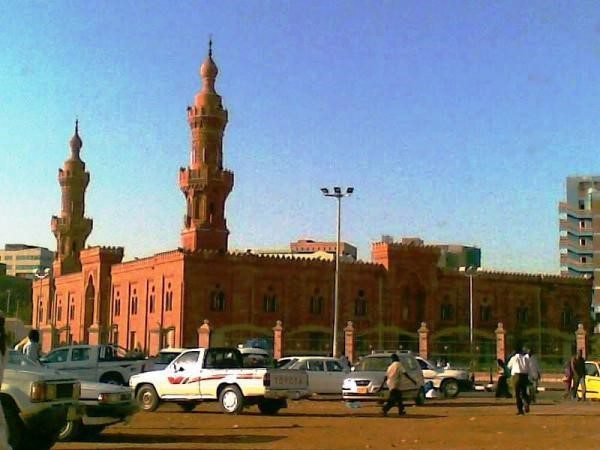
Grand Mosque in Khartoum/Wikimapia
As I sat sweating in the dreadful heat of the ‘backyard’ that Friday, I reflected on the role of women as rule enforcers on my visits. I thought about that time I was whacked with a stick while in prayer at the Somali mosque in Johannesburg for not spreading my legs far apart enough while standing. I remembered the time I was reproached with absolute horror at the Shia mosque when I unwittingly defaulted to lifting my hands up on the wrong occasion. I pondered on a few moments ago here in the ‘backyard’ being shown in slow childlike demonstrations what some ‘correct’ versus ‘incorrect’ prayer position was. If only I could speak her language I thought, I would ask her if she believed all 1.6 billion Muslims in the world were lifting every last fingertip in the same way. I may even ask her if she thought it was reasonable to force women to wear socks in the five hundred degree desert heat (exaggeration for point making purposes only). But I just smiled politely and shook my head in agreement as I always do in these situations.
It’s all these rules that riddle me with anxiety before every visit to the mosque. Not knowing what faux pas I may be committing next that may lead me directly to the gates of hell…bare feet I thought, that’s the one that will get me in trouble. Oppressing innocent bystanders with the sight of my feet. Am I crazy that I still want to be here in the mosque? I wondered. We did not have the required Sudanese ‘photo permits’ at the time of visiting the mosque so you will see a Google image of the mosque from the main entrance.
Saudi Arabia
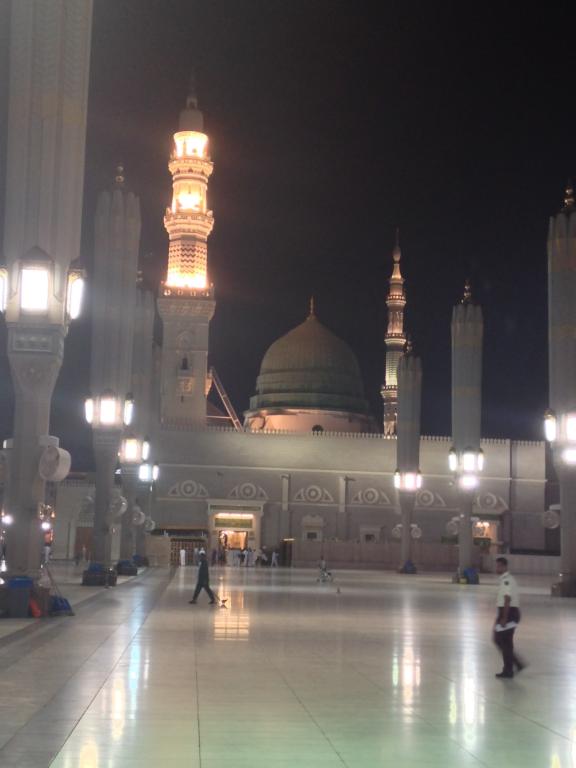
“For all the lovers…for all the women longing to greet our Master of everlasting beauty, grace and justice through the main entrance,”Ya Nabi Salaam Alayka”
My experiences of mosque spaces here would be amusing if the holiness of the two main cities weren’t so close to my Muslim identity and spirituality. My reflections here saddened and burdened my heart the most. There seemed to be a constant preoccupation amongst officials with separating the genders and eliminating bid’a.
As I watched them motioning women away in Makkah and hurriedly putting up red and white tape after the five prayers in the Prophets’ mosque in Madinah, stopping cute old ladies from standing and offering salutations, I pondered about the resource planning required for the two Harams. What a remarkable number of people it took to carry out the various policing of correct religious procedure. I wondered about the profile of the recruit it would take to successfully mete out these very important tasks. I was burdened by these cynical and jaded reflections in the holiest of holy places, and I had to repeatedly reprimand myself to focus on my higher purpose.
In Madinah, my mood was melancholy and subdued. Women are only allowed into the mausoleum of the Prophet Muhammad (peace and salutations upon him) very early in the morning and really late at night. This results in all sorts of logistical dynamics around the women trying to offer their salutations and respects. Admittedly, the system works and efficiency is ever the hallmark. Women are shepherded in large groups from one cordoned off point to another until they reach a section closed off for women only. Just before women are allowed in, we are given instructions by a female official of which there are several, all speaking in different languages at the same time over a loud speaker.
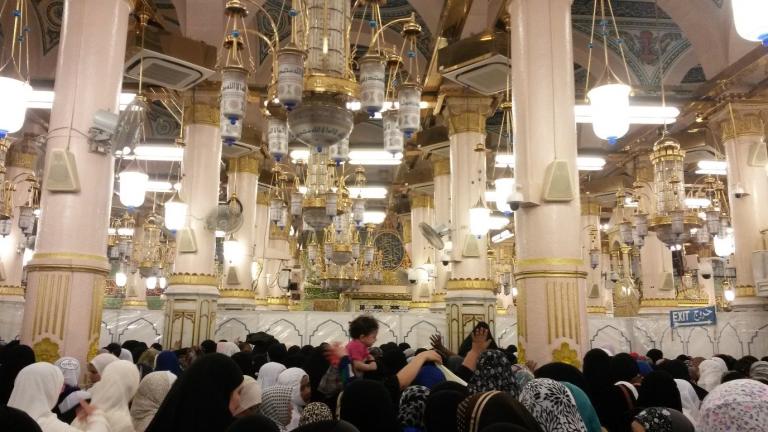
Women’s section at the Mosque of Prophet Mohammed in Madinah
Once inside it all becomes very confusing. The view is obstructed by high screens and when you are blessed with my height and size, you probably will not manage to see past about 80 percent of hundreds of other average sized women all rushing in at the same time tightly packed into a small space. The shepherding continues as women are turned towards the qiblah not knowing exactly where the Prophet (peace and salutations be upon him) is lying.
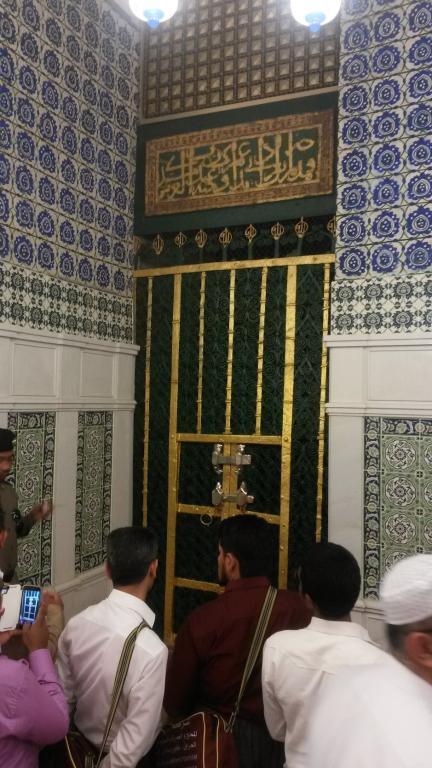
Mosque of Prophet Mohammed in Madinah: Access for men to the house of the Prophet
For me personally this was all too much and it just didn’t feel right. So just as I did in 2010, I slowly made my way outside. I stood outside at the far end of the green dome behind another cordoned off area directly behind the red and white tape. I faced the main entrance of the Prophet’s tomb (only men are allowed into the main entrance), and I recited my salutations standing, because that is how I do it. I wept while I did so. I wept for humanity and the lack of it, I wept for the ironic position I stood in, in front of the best of creation who fought against all odds for justice when justice was deeply lacking.
Sometimes I knew precisely why I wept and sometimes I didn’t. I wept for all the times I couldn’t weep before, and for all the times I laughed when I meant to cry and I greeted my beloved with all my heart and soul, outside under the night sky and the stars, standing defiantly. Farhaan was inside, in the front following a single queue of men moving slowly in dignified repetition, offering salutations as they passed the front of the decorated mausoleum within which the blessed Prophet (peace and salutations be upon him) lay, every detail in view.
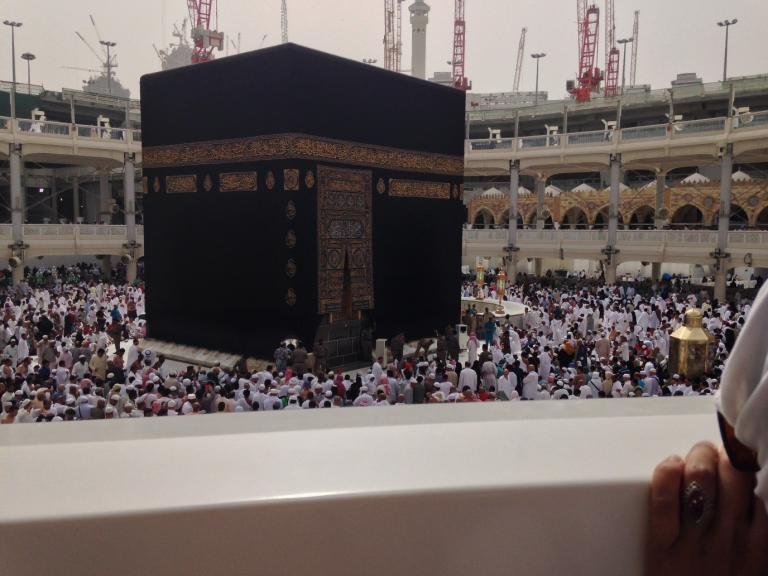
While in Makkah, even though Farhaan and I did not get to pray the five daily prayers together, we did complete our ritual circumambulations around the Ka’aba together like everyone else. It was deeply symbolic of the ultimate return to the One. Of how no matter how we try to hone in on the difference, the detail, the rule, the category, the right and the wrong, in the end the bigger picture matters and we return to the one creator, cycle completed just as we moved around the Ka’ba symbolically as one.
I wondered as we moved around rhythmically if the symbolic meanings that I thought about were the same that others had in mind. I wondered what others were thinking as they recited their prayers and supplications, and I wondered how obvious it was that while we prayed collectively, and asked for forgiveness collectively, that we would also be accepting responsibility collectively. Where one goes wrong, have we not all erred in some way?
Khairunnisa lives in Johannesburg, South Africa where she consulted in the field of organisational psychology and business management for over ten years. She also has a keen interest in the study of religion and maintains an academic relationship with the University of Johannesburg to fulfill this. She is currently a wandering traveller with her husband on an overland journey from Africa to the Middle East and beyond and pens her thoughts in between drives and setting up camp. Follow her on Twitter at @Khair_Al_Nisa and keep up with the Khans’ travels here and here.
Previous Post

July 4, 2015
Taraweeh Through the Times
Next Post
July 6, 2015 What Are We Losing?
Browse Our Archives
Select a Category #BlackLivesMatter #MyMosqueMyStory #ZoulSoul American Hijabi in Europe Black History Month Ertugrul Hindtrospectives Linksies Mawlid Pop Culture Trans Atlantic Relations Uncategorized
Select a Month February 2018 December 2017 February 2017 January 2017 December 2016 November 2016 September 2016 August 2016 July 2016 February 2016 January 2016 December 2015 November 2015 September 2015 August 2015 July 2015 June 2015 April 2015 February 2015 January 2015 December 2014 November 2014 August 2014 June 2014 May 2014 April 2014 March 2014 February 2014 January 2014 December 2013 November 2013 September 2013 August 2013 July 2013 June 2013 May 2013 April 2013 March 2013 December 2012 November 2012 August 2012 July 2012 June 2012 May 2012 April 2012 March 2012 February 2012 October 2010 September 2010
Follow Us!
TAKE THE
Religious Wisdom Quiz
What animal did David protect his sheep from as a young shepherd?
Select your answer to see how you score.
Horse and boar Lion and bear Wolf and fox Eagle and serpent
Related posts from Hindtrospectives
Religion and Culture in a Caribbean Mosque
A Mosque The Prophet Would Recognize
TRENDING AT PATHEOS Muslim

25 Years Later: How Much Has Changed for...
As we approach the 25th anniversary of September 11th, I’ve found myself...

Podcast: Third Spaces & The Rise of Yemeni...
In the latest episode of The Artistic Foodies Podcast, hosts Abbas...

HalalFest Picks: Best 60 Halal Spots for Super...
Back in 2016, I came up with a list of 29...

Unity Is America’s Strength — Division Is Its...
by Hidayatullah Ahsan When Valentina Gomez, a Republican candidate for Congress in...

Zohran Mamdani and New York’s Fight Against Islamophobia
This past June, against all odds, Zohran Mamdani won the Democratic primary...

What the Fourth of July Means to a...
As we mark another Fourth of July, millions of Americans will celebrate...
view all Muslim blogs
Ad-Free & Subscriber Log-In Subscription Support
- About Us
- 2026 Calendar
- Videos
- Podcasts
- Library of World Religions
- Faith In Media Tracker
- Advertise With Us
- Write for Us
- Privacy Policy
- Terms of Service
- Do Not Sell My Data
- Contact Us
- Radiant Digital
- Manage Newsletter Subscriptions
- Unsubscribe From Notifications
- Sitemap
Copyright 2008-2026, Patheos. All rights reserved.
Subscription Support Ad-Free & Subscriber Log-In
Follow Patheos