
BuddhistCatholicContemplativeEvangelicalGeneral ChristianHinduJewishLatter-day SaintMuslimNew VisionsProgressive Christian
Beliefs
- Buddhist
- Catholic
- Contemplative
- Evangelical
- General Christian
- Hindu
- Jewish
- Latter-day Saint
- More Voices
- Muslim
- New Visions
- Pagan
- Progressive Christian
Topics
- Religion News
- Food and Religion
- Sports and Religion
- Religious Art
- Religious Music and Entertainment
- Religious Events
- History and Religion
- Style and Religion
- Politics and Religion
- Women in Religion
- Recreation Outdoors and Religion
- Business Finance and Religion
- Careers Workplace and Religion
- Education and Religion
- Family Parenting and Religion
- Health Fitness and Religion
- Home and Religion
- Relationships and Religion
- Technology and Religion
- Travel and Religion
Columnists
- Buddhist Columnists
- Business Finance and Religion Columnists
- Careers Workplace and Religion Columnists
- Catholic Columnists
- Contemplative Columnists
- Education and Religion Columnists
- Evangelists Columnists
- Family Parenting and Religion Columnists
- General Christian Columnists
- Health Fitness and Religion Columnists
- Hindu Columnists
- History and Religion Columnists
- Home and Religion Columnists
- Jewish Columnists
- More Voices Columnists
- Latter Day Columnists
- Muslim Columnists
- New Visions Columnists
- Nonreligious Columnists
- Pagan Columnists
- Politics and Religion Columnists
- Progressive Columnists
- Recreation Outdoors and Religion Columnists
- Relationships and Religion Columnists
- Religion News Columnists
- Religious Art Columnists
- Religious Events Columnists
- Religious Music and Entertainment Columnists
- Sports and Religion Columnists
- Style and Religion Columnists
- Technology and Religion Columnists
- Travel and Religion Columnists
- Women in Religion Columnists
Resource Library
- 2026 Calendar
- Library of World Religions
- The 100 Most Holy Places on Earth
- Patheos Answers
- Podcasts
- Videos
- Faith Leaders Database
- Anglican Episcopalian
- Bahai
- Baptist
- Buddhism
- Christianity
- Confucianism
- Eastern Orthodoxy
- Hinduism
- Holiness and Pentecostal
- ISKCON
- Islam
- Judaism
- Lutheran
- Methodist
- The Church of Jesus Christ of Latter-day Saints
- New Age
- Paganism
- Presbytarian and Reformed
- Protestantism
- Religion Behind the Scenes
- Roman Catholic
- Scientology
- Shia Islam
- Sikhism
- Sufism
- Sunni Islam
- Taoism
- Zen
- See all religions
Research Tools
 Ad-Free & Subscriber Log-In Subscription Support
Ad-Free & Subscriber Log-In Subscription Support
Follow Patheos 

- Trending:
- Forgiveness
- |
- Marriage
- |
- Consciousness
- |
- Death Penalty
- |
- Election
- |
- Halloween
 Hindtrospectives
- Home
- Muslim
- An Afrikan Ramadan
An Afrikan Ramadan
Last updated on: October 17, 2016 at 10:09 pm by Hind Makki
An Afrikan Ramadan 2016-10-17T22:09:30-06:00 Hind Makki
Patheos Explore the world's faith through different perspectives on religion and spirituality! Patheos has the views of the prevalent religions and spiritualities of the world.
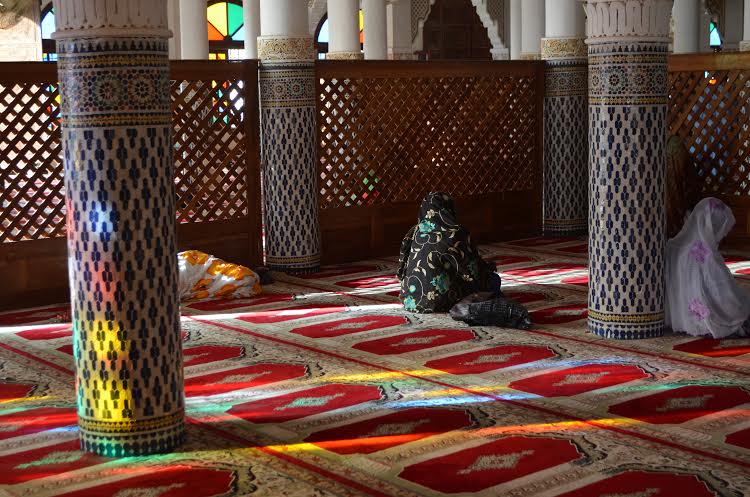
Grand Mosque in Medina Baye, Senegal/Ihssan Tahir
This is Day 28 of Hindtrospectives’ #MyMosqueMyStory series for Ramadan 2015
By Ihssan Tahir
*Author’s Note: The spelling of Africa as Afrika is intentional and used by many Pan-Afrikanists to emphasize a united continent free from colonized forces.
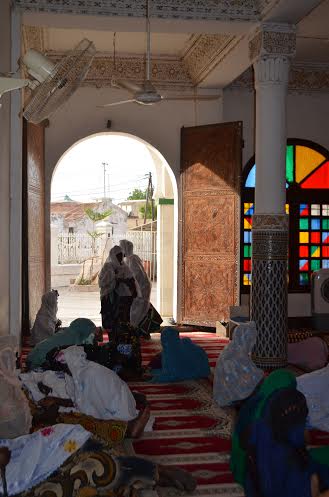
Grand Mosque in Medina Baye/Ihssan Tahir
It was midday and the sun beat down with vengeance. One would have thought that the people had committed some sort of crime the way her rays pierced the sand encrusted roads. It made me hot just to look out the window. I reminded myself that it was Senegal and, after all, we were in the month of June. The landscape was bursting with colors of the earth. Every imaginable hue of green and brown filled the horizon. I took a deep breath in and savored the moment of being in an Afrikan Muslim country during one of the holiest months.
I wrapped my mulfaa (traditional Mauritanian garment) and slipped on my flip flops. As I made my way to the Grand Mosque I noticed a group of teenage boys sleeping under a makeshift tent. Some lay sleeping with books clutched in their hands while others loosely grasped onto dhikr beads. In many Afrikan countries it is customary to take afternoon naps, especially during the sweltering humid summers. You’re either doing one of two things during the daytime hours in Ramadan, that is sleeping or being at the mosque. Anyone who visits Medina Baye understands the importance of the Grand Mosque, which is made of gleaming white marble with brightly colored stained glass windows. It stands in the center of the city inviting people into its doors.
___
It was 2014 and I left for Senegal on a whim and in hopes of attaining a much needed spiritual high during Ramadan. My travels and my need to jump on a plane every couple months have taken me to numerous places such as Ethiopia, Bangladesh and Mali. Over the years, I have experimented with my spirituality and wrestled with the idea of how I believe Islam should fit into my life. After an emotional whirlwind, a profound dream, and a deep conversation with a friend, my heart finally settled on Tariqah Tijannniyah, a branch of mystical Sufism heavily practiced in parts of North and West Afrika. This journey took me to the spiritual city of Medina Baye, roughly three hours from the bustling coastal city of Dakar.
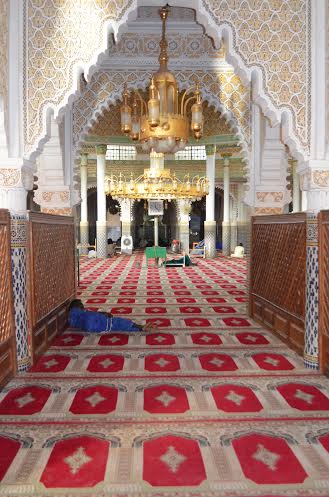
Grand Mosque in Medina Baye
The experience of being in a West Afrikan country was impacted by my upbringing and perceived notions of Islam. This was the first time I had ever witnessed women and men interact freely and openly within a mosque setting. Women, the old and young, were an inclusive part of the congregation. Women were not cramped into corners or basements and, most importantly, they walked around unabashed. In a majority of Afrikan cultures both men and women function together side by side without any issues. I firmly believe other parts of the Muslim world could take note of this because gender relations seem to be an ongoing issue in many Arab and South Asian communities.
Along with that, women in many parts of Afrika are an integral part of society and their status is recognized. Growing up, my movements – especially within the mosque – were always calculated. The invisible gender lines were never crossed. I internally cringed and avoided going to the male section, lest my need for attaining a prayer schedule be confused with a sexual advance. Being in Senegal, it was refreshing to see women simultaneously owning their womanhood and spiritual spaces without apology.
One of the most memorable experiences at the Grand Mosque happened on a remarkably hot day after dhur prayer. I sat in silence as people shuffled out of the over-sized mosque doors. All of a sudden, a young woman began to sing. As her voice echoed throughout the mosque her body swayed to the rhythm. I was equally amazed by her boldness and by the beauty in her voice. I attended dhur prayer everyday just to hear her sing. Since my French was minimal and my Wolof was not up to par, language was constantly a barrier. I quickly realized that I didn’t need words to connect with her. Her name is Asmau and I was told later that she descends from a long line of Nigerian (Hausa) singers, a tradition solely passed down to the women in her family. It was customary for her to bust out in religious song after congregational prayers. She received occasional glances but was never scolded. Asmau was given the freedom to spiritually express herself. For me she represents the epitome of spiritual empowerment.
During my trip, I had several revelations. Like the belongings I brought with me, I quickly realized I had other baggage to unpack. I grew up in a Muslim community that severely lacked methodological diversity. As a child, Islam was very clear cut and there was only one way to practice it. Any sort of deviance was often met with reprimanding and hostility. As I embraced my adulthood, and all that came along with it, I felt as though my spirituality wasn’t being cultivated. Something was missing and I couldn’t quite figure out was that was. My search for spiritual tranquility took me to the mosque that I often frequented as a child. I would spend countless hours attending classes, praying and conversing within this space but my feelings of emptiness did not budge.
My mosque spoke to my identity as a Muslim but I slowly realized that I am so much more than that. I am Black, I am a woman and I am a person who has the overwhelming need to belong. Do these other identities not count? I refuse to believe Islam trumps everything else that makes me who I am. Allah, in all His magnificence, had skillfully created me to be myself. As a Black Muslim woman I have learned to own all my identities. I would never feel forced to choose.
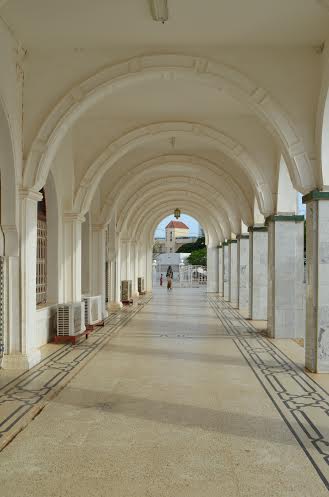
Grand Mosque in Medina Baye/Ihssan Tahir
I often found myself looking for community and attempting to find a place where I felt like I could religiously fit in but still be authentic to who I am. I have often found that conservative interpretations of any religion typically tend to clump people into categories. Often this will leave people feeling like they’ve lost a sense of individuality and who they truly are. With age, I have learned many key life lessons. The most important one is being authentic to who you truly are.
As life moves forward and dreams become a reality, I now live in northern California. With a marriage quickly approaching next month, I foresee a lot of life changes. Looking back, I recognize I was in search for a more holistic approach to my existence and traveling the world filled that gap. The world became my mosque and now I understand that restricting myself to one space is not necessary in order to feel a sense of belonging and community.
Sometimes what you are searching for is within you. You just need an experience or awakening to bring your true self to the surface.
Ihssan Tahir is a twenty something living in Oakland, California. You can follow her candid blog about love and life and on Twitter.
Previous Post

July 14, 2015
A Very Indigenous Ramadan
Next Post
July 15, 2015 A Beloved Guest’s Departure: One Woman’s I’tikaf
Browse Our Archives
Select a Category #BlackLivesMatter #MyMosqueMyStory #ZoulSoul American Hijabi in Europe Black History Month Ertugrul Hindtrospectives Linksies Mawlid Pop Culture Trans Atlantic Relations Uncategorized
Select a Month February 2018 December 2017 February 2017 January 2017 December 2016 November 2016 September 2016 August 2016 July 2016 February 2016 January 2016 December 2015 November 2015 September 2015 August 2015 July 2015 June 2015 April 2015 February 2015 January 2015 December 2014 November 2014 August 2014 June 2014 May 2014 April 2014 March 2014 February 2014 January 2014 December 2013 November 2013 September 2013 August 2013 July 2013 June 2013 May 2013 April 2013 March 2013 December 2012 November 2012 August 2012 July 2012 June 2012 May 2012 April 2012 March 2012 February 2012 October 2010 September 2010
Follow Us!
TAKE THE
Religious Wisdom Quiz
In Hebrews, Abel's blood spoke, but what does Jesus' blood speak?
Select your answer to see how you score.
Words of warning The same message as Abel's Words of judgment A better word than the blood of Abel
Related posts from Hindtrospectives
Ethnicity, Skin, and Language: My Sudanese Identity
American Routes to African Roots

TRENDING AT PATHEOS Muslim

25 Years Later: How Much Has Changed for...
As we approach the 25th anniversary of September 11th, I’ve found myself...

Podcast: Third Spaces & The Rise of Yemeni...
In the latest episode of The Artistic Foodies Podcast, hosts Abbas...

HalalFest Picks: Best 60 Halal Spots for Super...
Back in 2016, I came up with a list of 29...

Unity Is America’s Strength — Division Is Its...
by Hidayatullah Ahsan When Valentina Gomez, a Republican candidate for Congress in...

Zohran Mamdani and New York’s Fight Against Islamophobia
This past June, against all odds, Zohran Mamdani won the Democratic primary...

What the Fourth of July Means to a...
As we mark another Fourth of July, millions of Americans will celebrate...
view all Muslim blogs
Ad-Free & Subscriber Log-In Subscription Support
- About Us
- 2026 Calendar
- Videos
- Podcasts
- Library of World Religions
- Faith In Media Tracker
- Advertise With Us
- Write for Us
- Privacy Policy
- Terms of Service
- Do Not Sell My Data
- Contact Us
- Radiant Digital
- Manage Newsletter Subscriptions
- Unsubscribe From Notifications
- Sitemap
Copyright 2008-2026, Patheos. All rights reserved.
Subscription Support Ad-Free & Subscriber Log-In
Follow Patheos