
BuddhistCatholicContemplativeEvangelicalGeneral ChristianHinduJewishLatter-day SaintMuslimNew VisionsProgressive Christian
Beliefs
- Buddhist
- Catholic
- Contemplative
- Evangelical
- General Christian
- Hindu
- Jewish
- Latter-day Saint
- More Voices
- Muslim
- New Visions
- Pagan
- Progressive Christian
Topics
- Religion News
- Food and Religion
- Sports and Religion
- Religious Art
- Religious Music and Entertainment
- Religious Events
- History and Religion
- Style and Religion
- Politics and Religion
- Women in Religion
- Recreation Outdoors and Religion
- Business Finance and Religion
- Careers Workplace and Religion
- Education and Religion
- Family Parenting and Religion
- Health Fitness and Religion
- Home and Religion
- Relationships and Religion
- Technology and Religion
- Travel and Religion
Columnists
- Buddhist Columnists
- Business Finance and Religion Columnists
- Careers Workplace and Religion Columnists
- Catholic Columnists
- Contemplative Columnists
- Education and Religion Columnists
- Evangelists Columnists
- Family Parenting and Religion Columnists
- General Christian Columnists
- Health Fitness and Religion Columnists
- Hindu Columnists
- History and Religion Columnists
- Home and Religion Columnists
- Jewish Columnists
- More Voices Columnists
- Latter Day Columnists
- Muslim Columnists
- New Visions Columnists
- Nonreligious Columnists
- Pagan Columnists
- Politics and Religion Columnists
- Progressive Columnists
- Recreation Outdoors and Religion Columnists
- Relationships and Religion Columnists
- Religion News Columnists
- Religious Art Columnists
- Religious Events Columnists
- Religious Music and Entertainment Columnists
- Sports and Religion Columnists
- Style and Religion Columnists
- Technology and Religion Columnists
- Travel and Religion Columnists
- Women in Religion Columnists
Resource Library
- 2026 Calendar
- Library of World Religions
- The 100 Most Holy Places on Earth
- Patheos Answers
- Podcasts
- Videos
- Faith Leaders Database
- Anglican Episcopalian
- Bahai
- Baptist
- Buddhism
- Christianity
- Confucianism
- Eastern Orthodoxy
- Hinduism
- Holiness and Pentecostal
- ISKCON
- Islam
- Judaism
- Lutheran
- Methodist
- The Church of Jesus Christ of Latter-day Saints
- New Age
- Paganism
- Presbytarian and Reformed
- Protestantism
- Religion Behind the Scenes
- Roman Catholic
- Scientology
- Shia Islam
- Sikhism
- Sufism
- Sunni Islam
- Taoism
- Zen
- See all religions
Research Tools
 Ad-Free & Subscriber Log-In Subscription Support
Ad-Free & Subscriber Log-In Subscription Support
Follow Patheos 

- Trending:
- Forgiveness
- |
- Marriage
- |
- Consciousness
- |
- Death Penalty
- |
- Election
- |
- Halloween
 Hindtrospectives
- Home
- Muslim
- Chapel Hill, CVE, and Millennial Muslims
Chapel Hill, CVE, and Millennial Muslims
Last updated on: February 26, 2015 at 2:31 pm by Hind Makki
Chapel Hill, CVE, and Millennial Muslims 2015-02-26T14:31:17-07:00 Hind Makki
Patheos Explore the world's faith through different perspectives on religion and spirituality! Patheos has the views of the prevalent religions and spiritualities of the world.
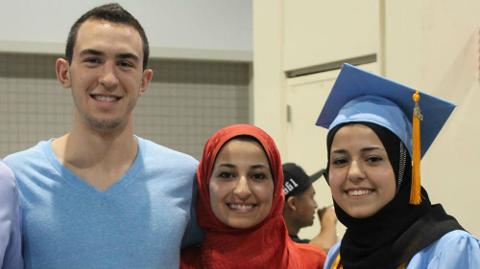 The media may have already lost interest, now breathlessly reporting the latest information about “Jihadi John’s” real identity, but many communities across the United States and around the world are still mourning the loss of three innocent souls, shot in their home in Chapel Hill, North Carolina. The murders of Deah Barakat, Yusor Abu-Salha, and Razan Abu-Salha a few weeks ago have touched us on a visceral and intimate level. I have seen Americans of all races, civil rights and interfaith activists, parents, and college students grieve and mourn together across the United States and abroad.
The Chapel Hill shooting struck an especially deep nerve among American Muslims. Many of us feel personally connected to each of the victims, to their families, and to their community, even though most of us had never met them. In the many conversations I’ve had over the last few weeks, one refrain was repeated by mourners across all generational, racial, and economic backgrounds: “I felt like I knew them. This loss is personal.”
Like millions of American Muslims, Deah, Yusor, and Razan expressed their deep religious faith by serving others. They maintained close interracial friendships within their tight-knit Muslim community as well as with their non-Muslims classmates and neighbors. They used social media to organize community service projects, but also to share the light-hearted, profound, and loving moments of their short lives. In other words: they were absolutely typical. Typical young American Muslims, typical college students, typical Millennials. Their community service, social activities and connection with their faith community was so typical, that they literally could have been members of any American Muslim family from Chicago to Chattanooga, from Los Angeles to Long Island.
In a country where an elected official can publicly declare “Islam is a cancer in our nation that needs to be cut out,” without any substantial pushback, the typical American Muslim is the one not portrayed by the media, but exemplified by the Chapel Hill victims: Deah, Yusor, and Razan lived lives that seamlessly integrated their religious faith, cultural heritage and American nationality. They shared the same dreams and aspirations that so many Millennial Muslims do. They laughed, fell in love, Facebooked, danced, applied for competitive academic placements, played sports, and showed their love for God by serving others – like practically every Muslim college student I know.
Yet in last week’s Countering Violent Extremism summit in the nation’s capitol, the U.S. government’s focus was on preventing violent extremism stemming from Muslim communities. Pundits spend air time analyzing why some Western Muslim youth might be susceptible to online recruitment, which is indeed an important step in understanding how to fight radical extremism, but does not tell the full story of the lives of American Muslims.
When I think of online recruits like “Jihadi John,” or the three young Brooklyn men arrested yesterday for plotting to join ISIS, I wrack my brain trying to think of any youth I know from my mosque or local universities whose stories echo those of these disenfranchised, angry young Muslims. I can however think of a hundred young Muslims in mosques, youth groups, and universities across the country, whose stories of service and love for humanity echo those of Deah, Yusor and Razan. By all accounts, these three young people were extraordinary human beings. But as young American Muslims, they were not the exception to the rule.
Still, the statistical outliers in American Muslim communities have become the focus, despite the fact that right-wing extremism has grown exponentially in the US over the last several years.
Days ago a Rhode Island Islamic school was vandalized, with the words, “Now this is a hate crime,” scrawled in an angry orange paint on the doors. A major mosque in Houston was deliberately set on fire by a man who had made anti-Muslim comments in the past. A Muslim family was physically attacked in broad daylight at a Dearborn, Michigan grocery store. In Washington state, a Hindu temple and a nearby middle school were defaced with swastikas and graffiti saying, “Muslims get out.” In Massachusetts, police are investigating a series of threatening letters left at a transit station, proclaiming, “We must kill all Muslims in America.” All of these incidents occurred in the days after the Chapel Hill murders.
Muslim Millennials are not cowed by the rising tide of Islamophobia, whether promoted by politicians pandering to a certain electorate, or replayed by a 24-hour media culture with an insatiable appetite for viewers. But unfortunately, with the Chapel Hill shooting, Islamophobia is coming into our homes and our safe spaces – and the spate of anti-Muslim attacks across the country over the last week has us on edge. Still, we carry the memories of Deah, Yusor, and Razan in our hearts as we uphold their legacy of service. Thousands of mourners came to Chapel Hill to pay their respects at the funeral. Hundreds of vigils have been held across the country and around the world, commemorating the lives of three young people who were murdered, execution-style, in their own home. Imams across the country eulogized them in sermons during Friday prayers. Hundreds of thousands of dollars are being donated on behalf of the three victims toward dental care for Syrian refugees and to feed the homeless in the US.
Lone wolves, feeling disenfranchised and alienated because of imagined slights that challenge their delusions of supremacy are the true faces of domestic terrorism. The majority of American Muslims – the Deahs, Yusors, and Razans – are not. As the CVE Summit wrapped up last week, the lesson may be that to focus on one group – whose hate has been falsely aggrandized by public figures in politics and the media – and not on the statistically-proven other is to try fixing a genuine threat with a flawed perception of reality. And it leaves us no safer.
Next Post

April 22, 2015 Top Muslim Women Twitterati
Browse Our Archives
Select a Category #BlackLivesMatter #MyMosqueMyStory #ZoulSoul American Hijabi in Europe Black History Month Ertugrul Hindtrospectives Linksies Mawlid Pop Culture Trans Atlantic Relations Uncategorized
Select a Month February 2018 December 2017 February 2017 January 2017 December 2016 November 2016 September 2016 August 2016 July 2016 February 2016 January 2016 December 2015 November 2015 September 2015 August 2015 July 2015 June 2015 April 2015 February 2015 January 2015 December 2014 November 2014 August 2014 June 2014 May 2014 April 2014 March 2014 February 2014 January 2014 December 2013 November 2013 September 2013 August 2013 July 2013 June 2013 May 2013 April 2013 March 2013 December 2012 November 2012 August 2012 July 2012 June 2012 May 2012 April 2012 March 2012 February 2012 October 2010 September 2010
Follow Us!
TAKE THE
Religious Wisdom Quiz
Who does Paul describe as his true son in the faith?
Select your answer to see how you score.
Titus Timothy Philemon Onesimus
Related posts from Hindtrospectives

Ertugrul - Your Muslim friend's new Bey

Mawlid 2017: Muslim Praise-Songs from around the World
Ethnicity, Skin, and Language: My Sudanese Identity

TRENDING AT PATHEOS Muslim

25 Years Later: How Much Has Changed for...
As we approach the 25th anniversary of September 11th, I’ve found myself...

Podcast: Third Spaces & The Rise of Yemeni...
In the latest episode of The Artistic Foodies Podcast, hosts Abbas...

HalalFest Picks: Best 60 Halal Spots for Super...
Back in 2016, I came up with a list of 29...

Unity Is America’s Strength — Division Is Its...
by Hidayatullah Ahsan When Valentina Gomez, a Republican candidate for Congress in...

Zohran Mamdani and New York’s Fight Against Islamophobia
This past June, against all odds, Zohran Mamdani won the Democratic primary...

What the Fourth of July Means to a...
As we mark another Fourth of July, millions of Americans will celebrate...
view all Muslim blogs
Ad-Free & Subscriber Log-In Subscription Support
- About Us
- 2026 Calendar
- Videos
- Podcasts
- Library of World Religions
- Faith In Media Tracker
- Advertise With Us
- Write for Us
- Privacy Policy
- Terms of Service
- Do Not Sell My Data
- Contact Us
- Radiant Digital
- Manage Newsletter Subscriptions
- Unsubscribe From Notifications
- Sitemap
Copyright 2008-2026, Patheos. All rights reserved.
Subscription Support Ad-Free & Subscriber Log-In
Follow Patheos