
BuddhistCatholicContemplativeEvangelicalGeneral ChristianHinduJewishLatter-day SaintMuslimNew VisionsProgressive Christian
Beliefs
- Buddhist
- Catholic
- Contemplative
- Evangelical
- General Christian
- Hindu
- Jewish
- Latter-day Saint
- More Voices
- Muslim
- New Visions
- Pagan
- Progressive Christian
Topics
- Religion News
- Food and Religion
- Sports and Religion
- Religious Art
- Religious Music and Entertainment
- Religious Events
- History and Religion
- Style and Religion
- Politics and Religion
- Women in Religion
- Recreation Outdoors and Religion
- Business Finance and Religion
- Careers Workplace and Religion
- Education and Religion
- Family Parenting and Religion
- Health Fitness and Religion
- Home and Religion
- Relationships and Religion
- Technology and Religion
- Travel and Religion
Columnists
- Buddhist Columnists
- Business Finance and Religion Columnists
- Careers Workplace and Religion Columnists
- Catholic Columnists
- Contemplative Columnists
- Education and Religion Columnists
- Evangelists Columnists
- Family Parenting and Religion Columnists
- General Christian Columnists
- Health Fitness and Religion Columnists
- Hindu Columnists
- History and Religion Columnists
- Home and Religion Columnists
- Jewish Columnists
- More Voices Columnists
- Latter Day Columnists
- Muslim Columnists
- New Visions Columnists
- Nonreligious Columnists
- Pagan Columnists
- Politics and Religion Columnists
- Progressive Columnists
- Recreation Outdoors and Religion Columnists
- Relationships and Religion Columnists
- Religion News Columnists
- Religious Art Columnists
- Religious Events Columnists
- Religious Music and Entertainment Columnists
- Sports and Religion Columnists
- Style and Religion Columnists
- Technology and Religion Columnists
- Travel and Religion Columnists
- Women in Religion Columnists
Resource Library
- 2026 Calendar
- Library of World Religions
- The 100 Most Holy Places on Earth
- Patheos Answers
- Podcasts
- Videos
- Faith Leaders Database
- Anglican Episcopalian
- Bahai
- Baptist
- Buddhism
- Christianity
- Confucianism
- Eastern Orthodoxy
- Hinduism
- Holiness and Pentecostal
- ISKCON
- Islam
- Judaism
- Lutheran
- Methodist
- The Church of Jesus Christ of Latter-day Saints
- New Age
- Paganism
- Presbytarian and Reformed
- Protestantism
- Religion Behind the Scenes
- Roman Catholic
- Scientology
- Shia Islam
- Sikhism
- Sufism
- Sunni Islam
- Taoism
- Zen
- See all religions
Research Tools
 Ad-Free & Subscriber Log-In Subscription Support
Ad-Free & Subscriber Log-In Subscription Support
Follow Patheos 

- Trending:
- Forgiveness
- |
- Marriage
- |
- Consciousness
- |
- Death Penalty
- |
- Election
- |
- Halloween
 Hindtrospectives
- Home
- Muslim
- The Challenge of Being Unmosqued in Ramadan
The Challenge of Being Unmosqued in Ramadan
Last updated on: June 27, 2014 at 6:38 pm by Hind Makki
The Challenge of Being Unmosqued in Ramadan 2014-06-27T18:38:59-06:00 Hind Makki
Patheos Explore the world's faith through different perspectives on religion and spirituality! Patheos has the views of the prevalent religions and spiritualities of the world.
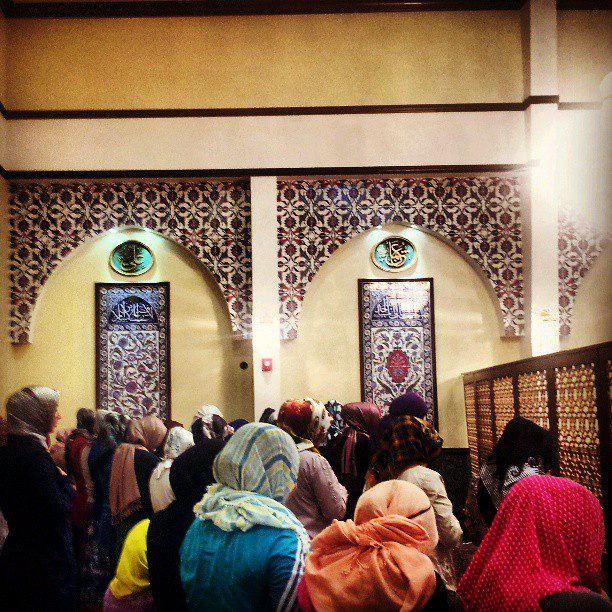
Women pray at the Turkish American Society of Chicago. Copyright Sana Rahim, 2013
Even though I’m Unmosqued*, Ramadan is the time of year when I wholeheartedly immerse myself in a constant Muslim community. Sometimes, that community is not mosque-based, like when I experienced Ramadan and Eid with Chicago’s convert community 2 years ago. But typically, I will visit the same mosque every night for Taraweeh, the extra prayers that Sunni Muslims offer in community every night during Ramadan. I will get to know the women who pray near me, we will bring each other sweets to savor after prayer, and sometimes I will join the group for a volunteer activity on a weekend. In other words, I am usually Mosqued during Ramadan.
This year has been a bit of a scramble for me; the imam I have spent the better part of the last decade praying with has moved to a mosque that is simply too far for me to commute to every night after breaking my fast. So I’m looking for a mosque home to spend the duration of this month. There are, of course, mosques near my home that don’t require a nearly one hour commute both ways. But even as my soul aches to pray Taraweeh in a mosque (as I’ve written before, I really do want to be Mosqued), my heart continues to encourage me to commit to only praying in spaces that elevate my spiritual experience of the Sacred Month. The mosques I spend my Ramadans in must at least try to embody the Prophetic Model and attempt to be:
- Welcoming to and inclusive of women
- Welcoming to and inclusive of disabled Muslims
- Welcoming to children (who are kept quietly busy throughout the prayer period)
- Proudly diverse in terms of ethnicity and racial make-up
- Accepting of worshipers as we are and welcoming of our diverse religious views
- Promoting the love of the Holy Quran through its nightly recitation by a qualified imam
This, then, is the challenge of the Unmosqued Muslim in Ramadan. My heart aches to find a mosque community that is inclusive and welcoming. Not all the spaces I’ve prayed in earn high marks in the implementation of each of these points, but they have earned high marks in their attempts. As the Islamic teaching says, “Verily, actions are based on their intentions.” Though most mosques in my area have not yet fully implemented the Prophetic model, I’m happy to pray Taraweeh with a group of Muslims who are at least trying their best to imitate the Prophetic model in their mosque. Many mosques see an influx of congregants during this month – less observant Muslims, Muslims who live quite a distance from the mosque, and some Unmosqued Muslims like yours truly, will make an effort and turn up during Ramadan. As Muslims believe that Satan and his discord-causing whispers are locked up in Ramadan, now is the time to open a corridor of understanding on all sides of the Unmosqued and Bemosqued debate.
One way to open that corridor is to have an open dialogue with your community about their relationship to the mosque – and the film Unmosqued is a great catalyst for that conversation. It was my honor to participate in this documentary last year, sharing my thoughts on the challenges that women, and other marginalized groups, face when we enter most mosques in the US. When the trailer was released in 2013, many people became concerned about the content of the film. However, upon it’s release, viewers realized that the filmmakers respectfully tackled the existential questions with which mosque leaders and mosque goers alike are grappling.
Unmosqued has several streams running through the course of the documentary. One current follows a group of young, mostly second generation and converted Muslims, attempting to get elected to their mosque board, on a unified platform of change. The viewer is in the room during their strategy sessions, endures generational misunderstandings with them, listens to their campaign speeches and witnesses their mosque’s election night.
This election drama is interwoven with the other currents explored in the film, which interviews all manner of Muslims: religious leaders and lay worshipers, men and women, converts and lifers, immigrants and American-born. Those interviewed discuss their personal relationships with the mosque, raise questions about the transparency of mosque administration and financial transactions and highlight the challenges particularly faced by young people, converts, ethnic minorities and women when they enter North American mosques.
The film does not really offer any cut and dried answers to those who see the unmosqued phenomenon as a crisis, though the rise of third spaces as an alternative to mosques is portrayed as an unequivocally positive development. The questions of race, ethnicity and religious legitimacy and authority is not fully deconstructed, either. Offering a cookie-cutter solution to this problem isn’t really the goal of this film, however. The goal is to catalyze a conversation among Muslims across North America about the evolving role of the American mosque and how it can be a welcoming spiritual home for one of the most diverse Muslim communities around the world. I believe it asks these questions while honoring both the experiences of those who have felt unwelcome in mosques, and of those who have offered their resources and time to build the (physical, emotional and financial) foundations of mosques across the country. Unmosqued is now available for purchase and I highly recommend that mosques schedule a Ramadan screening for their communities.
As for me, I look forward to the community I will find this month during our nightly prayers and the relationships that I will forge with the women praying to the right and left of me. I look forward to showcasing women’s prayer experiences on my blog Side Entrance – the beautiful, the adequate and the pathetic. I pray all my sisters and brothers find a home community this year for Ramadan – whether that means praying together in someone’s house, holding communal iftars at the local park, volunteering with your neighbors every weekend, or praying at the same mosque every night. Muslims believe Ramadan is a sacred and miraculous month for many reasons; this year and every year, my Ramadan miracle is that I am Mosqued and thrilled about it. The challenge of continuing that relationship with the mosque post-Ramadan can wait until Eid to be tackled.
*This article is part of an on-going series I am writing about being unmosqued and trying to remosque in 2014
Previous Post

May 12, 2014
Are Millennial Muslims Doomed To Become Unmosqued?
Next Post
August 14, 2014 7 Questions to Ask Before Asking if Muslims Condemn Terrorism
Browse Our Archives
Select a Category #BlackLivesMatter #MyMosqueMyStory #ZoulSoul American Hijabi in Europe Black History Month Ertugrul Hindtrospectives Linksies Mawlid Pop Culture Trans Atlantic Relations Uncategorized
Select a Month February 2018 December 2017 February 2017 January 2017 December 2016 November 2016 September 2016 August 2016 July 2016 February 2016 January 2016 December 2015 November 2015 September 2015 August 2015 July 2015 June 2015 April 2015 February 2015 January 2015 December 2014 November 2014 August 2014 June 2014 May 2014 April 2014 March 2014 February 2014 January 2014 December 2013 November 2013 September 2013 August 2013 July 2013 June 2013 May 2013 April 2013 March 2013 December 2012 November 2012 August 2012 July 2012 June 2012 May 2012 April 2012 March 2012 February 2012 October 2010 September 2010
Follow Us!
TAKE THE
Religious Wisdom Quiz
In 1 Peter, what does Peter say Sarah called Abraham?
Select your answer to see how you score.
Master Lord Father My beloved
Related posts from Hindtrospectives

Ertugrul - Your Muslim friend's new Bey
Mawlid 2017: Muslim Praise-Songs from around the World
Ethnicity, Skin, and Language: My Sudanese Identity
TRENDING AT PATHEOS Muslim

25 Years Later: How Much Has Changed for...
As we approach the 25th anniversary of September 11th, I’ve found myself...

Podcast: Third Spaces & The Rise of Yemeni...
In the latest episode of The Artistic Foodies Podcast, hosts Abbas...

HalalFest Picks: Best 60 Halal Spots for Super...
Back in 2016, I came up with a list of 29...

Unity Is America’s Strength — Division Is Its...
by Hidayatullah Ahsan When Valentina Gomez, a Republican candidate for Congress in...

Zohran Mamdani and New York’s Fight Against Islamophobia
This past June, against all odds, Zohran Mamdani won the Democratic primary...

What the Fourth of July Means to a...
As we mark another Fourth of July, millions of Americans will celebrate...
view all Muslim blogs
Ad-Free & Subscriber Log-In Subscription Support
- About Us
- 2026 Calendar
- Videos
- Podcasts
- Library of World Religions
- Faith In Media Tracker
- Advertise With Us
- Write for Us
- Privacy Policy
- Terms of Service
- Do Not Sell My Data
- Contact Us
- Radiant Digital
- Manage Newsletter Subscriptions
- Unsubscribe From Notifications
- Sitemap
Copyright 2008-2026, Patheos. All rights reserved.
Subscription Support Ad-Free & Subscriber Log-In
Follow Patheos