
BuddhistCatholicContemplativeEvangelicalGeneral ChristianHinduJewishLatter-day SaintMuslimNew VisionsProgressive Christian
Beliefs
- Buddhist
- Catholic
- Contemplative
- Evangelical
- General Christian
- Hindu
- Jewish
- Latter-day Saint
- More Voices
- Muslim
- New Visions
- Pagan
- Progressive Christian
Topics
- Religion News
- Food and Religion
- Sports and Religion
- Religious Art
- Religious Music and Entertainment
- Religious Events
- History and Religion
- Style and Religion
- Politics and Religion
- Women in Religion
- Recreation Outdoors and Religion
- Business Finance and Religion
- Careers Workplace and Religion
- Education and Religion
- Family Parenting and Religion
- Health Fitness and Religion
- Home and Religion
- Relationships and Religion
- Technology and Religion
- Travel and Religion
Columnists
- Buddhist Columnists
- Business Finance and Religion Columnists
- Careers Workplace and Religion Columnists
- Catholic Columnists
- Contemplative Columnists
- Education and Religion Columnists
- Evangelists Columnists
- Family Parenting and Religion Columnists
- General Christian Columnists
- Health Fitness and Religion Columnists
- Hindu Columnists
- History and Religion Columnists
- Home and Religion Columnists
- Jewish Columnists
- More Voices Columnists
- Latter Day Columnists
- Muslim Columnists
- New Visions Columnists
- Nonreligious Columnists
- Pagan Columnists
- Politics and Religion Columnists
- Progressive Columnists
- Recreation Outdoors and Religion Columnists
- Relationships and Religion Columnists
- Religion News Columnists
- Religious Art Columnists
- Religious Events Columnists
- Religious Music and Entertainment Columnists
- Sports and Religion Columnists
- Style and Religion Columnists
- Technology and Religion Columnists
- Travel and Religion Columnists
- Women in Religion Columnists
Resource Library
- 2026 Calendar
- Library of World Religions
- The 100 Most Holy Places on Earth
- Patheos Answers
- Podcasts
- Videos
- Faith Leaders Database
- Anglican Episcopalian
- Bahai
- Baptist
- Buddhism
- Christianity
- Confucianism
- Eastern Orthodoxy
- Hinduism
- Holiness and Pentecostal
- ISKCON
- Islam
- Judaism
- Lutheran
- Methodist
- The Church of Jesus Christ of Latter-day Saints
- New Age
- Paganism
- Presbytarian and Reformed
- Protestantism
- Religion Behind the Scenes
- Roman Catholic
- Scientology
- Shia Islam
- Sikhism
- Sufism
- Sunni Islam
- Taoism
- Zen
- See all religions
Research Tools
 Ad-Free & Subscriber Log-In Subscription Support
Ad-Free & Subscriber Log-In Subscription Support
Follow Patheos 

- Trending:
- Forgiveness
- |
- Marriage
- |
- Consciousness
- |
- Death Penalty
- |
- Election
- |
- Halloween

- Home
- Catholic
- Doctor Who, Mo Tzu, And The Peace Of Christ
Doctor Who, Mo Tzu, And The Peace Of Christ
Last updated on: December 16, 2020 at 4:10 am by Henry Karlson
Doctor Who, Mo Tzu, And The Peace Of Christ 2020-12-16T04:10:48-05:00 Henry Karlson
Patheos Explore the world's faith through different perspectives on religion and spirituality! Patheos has the views of the prevalent religions and spiritualities of the world.

Nelo Hotsuma: Daleks From Doctor Who / Wikimedia Commons

The television series Doctor Who is a science fiction television show about The Doctor, a Time Lord who travels through time and space to right wrongs. The Doctor is a special kind of pacifist, one who recognizes the need to defend those who are under threat by some would-be aggressor. This means that the Doctor, despite abhorring violence, uses it to fight off villains, if no other solution are available: “There are some corners of the universe which have bred the most terrible things. They must be fought.”[1]However, if the Doctor can find any other means to deal with the problems at hand, the Doctor will try to take it; violence, the use of force, is left as the last resort, and its use is as limited as possible (albeit, sometimes, with great threats, that mean, great use of force must be applied in return).
The Doctor has several foes which return to the series, from the fellow Time Lord, The Master, to the Daleks, a hate-filled genocidal race which desires to conquer the universe by destroying anyone who is not a Dalek. The mastermind behind the Daleks, Davros, also encountered the Doctor several times throughout the series, allowing him to observe and get to know the Doctor, and observe things which the Doctor would not want to admit, especially the fact that despite the Doctor’s dedication to peace, the Doctor truly is riddled with war, so much so that the Doctor’s friends and companions are transformed and turned into willing weapons for the Doctor’s crusade for peace: “The man who abhors violence, never carrying a gun, but this is the truth, Doctor: you take ordinary people and you fashion them into weapons.”[2] The Doctor’s path toward peace is through violence, not because the Doctor prefers violence, but because the Doctor sees the need to repel violence through violence. Nonetheless, Davros, in his hatred for the Doctor (because of the many times the Doctor stops Davros from his evil plans), is only able to partially understand the Doctor; Davros is not entirely correct. The Doctor doesn’t transform everyone into weapons. Some, actually, find themselves becoming deweaponized, so to speak, as the Doctor prefers to take every opportunity to stop violence and the cycle of violence. The Doctor encourages people to make peace with their enemies, to ignore the grievances of the past; if not, they risks becoming just as bad as their enemies:
You just want cruelty to beget cruelty. You’re not superior to people who were cruel to you. You’re just a whole bunch of new cruel people. A whole bunch of new cruel people, being cruel to some other people, who’ll end up being cruel to you. The only way anyone can live in peace is if they’re prepared to forgive. Why don’t you break the cycle?[3]
War, fighting, even when necessary as a defensive posture, must be understood for how terrible it is. It must be treated as a great shame. “So be careful how you tell that story, will you? Don’t glamourise it. Don’t make war sound like an exciting and thrilling game.”[4] The Doctor constantly tries to get those who would harm others to see the folly of their ways, to stop violence on their own initiative; sometimes, it works, as can be seen from this scene of The Happiness Patrol:
DOCTOR: Why? Scared? Why should you be scared? You’re the one with the gun.
DAVID: That’s right.
DOCTOR: You like guns, don’t you.
ALEX: He’ll kill you.
DOCTOR: Of course he will. That’s what guns are for. Pull the trigger, end a life. Simple, isn’t it.
DAVID: Yes.
DOCTOR: Makes sense, doesn’t it.
DAVID: Yes.
DOCTOR: A life killing life.
ALEX: Who are you?
DOCTOR: Shut up. Why don’t you do it then? Look me in the eye, pull the trigger, end my life. Why not?
DAVID: I can’t.
DOCTOR: Why not?
DAVID: I don’t know.
DOCTOR: No, you don’t, do you.
(The Doctor takes the gun from David).
DOCTOR: Throw away your gun.
(Alex drops his gun).
Often, the Doctor does not find it so easy to diffuse the situation. When the Doctor has to intervene, the Doctor will do what it takes to neutralize the threat at hand. This does not mean the Doctor approves of what happens when the plan is finished, because often those who the Doctor helped did not truly learn what the Doctor wanted them to learn. Instead of pursuing peace, they become would-be aggressors themselves, taking on and destroying those the Doctor had already stopped. They often have an excuse, such as saying the Doctor will not always be there to defend them. In the story, The Christmas Invasion, the Doctor stops an invasion from the alien species, the Sycorax; after their leader was killed by the Doctor, the Doctor tells them they should leave and never return; however, the Prime Minister of the United Kingdom, Harriet, at that time a friend of the Doctor, does not think that is good enough, and orders their destruction, which makes the Doctor furious:
HARRIET: Tell them to fire.
ALEX: Fire at will.
(Five green beams streak up into the sky, meet and fire out into space. The Sycorax asteroid ship goes KaBOOM!)
ROSE: What is that? What’s happening?
DOCTOR: That was murder.
HARRIET: That was defence. It’s adapted from alien technology. A ship that fell to Earth ten years ago.
DOCTOR: But they were leaving.
HARRIET: You said yourself, Doctor, they’d go back to the stars and tell others about the Earth. I’m sorry, Doctor, but you’re not here all the time. You come and go. It happened today. Mister Llewellyn and the Major, they were murdered. They died right in front of me while you were sleeping. In which case we have to defend ourselves.
DOCTOR: Britain’s Golden Age.
HARRIET: It comes with a price.
DOCTOR: I gave them the wrong warning. I should’ve told them to run as fast as they can, run and hide because the monsters are coming. The human race.
HARRIET: Those are the people I represent. I did it on their behalf.
DOCTOR: Then I should have stopped you.
HARRIET: What does that make you, Doctor? Another alien threat?

JoRockleyArt: The Fourth Doctor /pixabay
The Doctor’s embrace of violence is always for a pacifistic end. The Doctor wants to preserve as much life as is possible, and so does not accept those who would argue that the only proper defense is to destroy all of one’s would-be enemies. The Doctor sees those who would argue such as being are just as bad, or worse, than their enemies. This is why, when tempted to utterly wipe out the Daleks from existence, the Doctor ultimately chooses not to do so, knowing that this was the way to stop from becoming like the Daleks:
DOCTOR: Do I have the right? Simply touch one wire against the other and that’s it. The Daleks cease to exist. Hundreds of millions of people, thousands of generations can live without fear, in peace, and never even know the word Dalek.
SARAH: Then why wait? If it was a disease or some sort of bacteria you were destroying, you wouldn’t hesitate.
DOCTOR: But I kill, wipe out a whole intelligent lifeform, then I become like them. I’d be no better than the Daleks.[5]
In this way, when Davros insulted the Doctor by showing the Doctor’s willingness to turn friends and companions into weapons, Davros was only telling half of the story. Yes the Doctor and friends will fight off aggressors, and that means many will use violence to ward off violence. But the goal is not the same. The goal is not violence. The goal is always peace, and that is the difference between the Doctor and the Doctor’s enemies. The Doctor agonizes over what must be done, agonizes over the way friends and enemies alike experience the Doctor’s interventions, but in the end, the Doctor seeks after peace; the internal pain and agony the Doctor faces over this apparent contradiction can be felt throughout the series as the Doctor remains ever vigilant against violence. When given the chance, the Doctor will embrace the path of non-violence, having enemies come together and find another solution than violence:
Because it’s always the same. When you fire the first shot, no matter how right you feel, you have no idea who’s going to die. You don’t know whose children are going to scream and burn. How many hearts will be broken. How many lives shattered! How much blood will spill… before everybody does what they were ALWAYS going to have to do from the very beginning! SIT. DOWN. AND. TALK. [6]
It might seem odd that someone who wants to be a force for peace, someone who abhors violence, would likewise be so violent. But there is a historical precedent for this in the writings and thought of the Chinese philosopher, Mo Tzu (cf. 470- 391 BCE). Mo Tzu, living in the midst of several warring Chinese states, promoted universal love and peace, seeking to get the rulers of the various states to stop their aggressive actions against one another. One of the ways he did this was to train his followers in the art of warfare and to have them intervene when one state invaded another, that is, to help defend those who were invaded by a foreign army. He thought if he could convince people to be in harmony with each other, instead of holding an aggressive stand against each other, he would do just that, but if preaching universal love and harmony did not work, he wanted would-be aggressors to know they would have to face off, not only the military might of the lands they invade, but the military might of Mo Tzu and his followers. In order to make it an effective threat, Mo Tzu had to encourage his followers to be especially trained in both tactics and in the martial arts; this way, the armies of Mo Tzu and his followers would be able to make it much more difficult, if not impossible, for would-be aggressors to succeed in their plans. If those who thought about invading another state knew they could not succeed, Mo Tzu hoped they would seek for peace:
It is the business of the benevolent man to try to promote what is beneficial to the world and to eliminate what is harmful. Now at the present time, what brings the greatest harm to the world? Great states attacking small ones, great families overthrowing small ones, the strong oppressing the weak, the many harrying the few, the cunning deceiving the stupid, the eminent lording it over the humble – these are harmful to the world.[7]
Mo Tzu believed the ultimate answer lay in embracing the path of universal love, teaching others to find harmony and peace with each other through such love. By embracing such love and compassion, what leads to violence and aggression, such as partiality, egotism, selfishness, could be overcome as people worked together, realizing that they would benefit if they worked for the common good:
When we inquire into the cause of these various harms, what do we find has produced them? Do they come about from loving others and trying to benefit them? Surely not! They come rather from hating others and trying to injure them. And when we set out to classify and describe those men who hate and injure others, shall we say that their actions are motivated by universality or partiality? Surely we must answer, by partiality, and it is this partiality in their dealings with one another that gives rise to all the great harms in the world. [8]
If this truly was appreciated, aggressive war could be stopped:
If the rulers and officials and gentlemen of the world sincerely desired to promote what is beneficial to the world and to eliminate what is harmful, they should realize that offensive warfare is in fact a great harm to the world. [9]
Mo Tzu recognized the distinction between aggressive wars (which he sought to stop), punitive wars (which he recognized might have some aspect of justice involved in it, but yet could and usually went beyond the bounds of justice), and defensive wars (which he justified as the way to stop aggression). Mo Tzu wanted war to stop. If defensive wars could put a stop to aggressive wars, then what would be left was punitive wars, but even those could be stopped if people embraced the path of universal love, which is why he thought it should be taught and enforced by the government:
Now universal love and mutual benefit are both profitable and easy beyond all measures. The only trouble, as I see it, is that no ruler takes any delight in them. If the rulers really delighted in them, promoted them with rewards and praise, and prevented neglect of them by punishments, then I believe the people would turn to universal love and mutual benefit as naturally as fire turns upward or waters turns downward, and nothing in the world could stop them. [10]
There are difference between the Doctor and the followers of Mo Tzu, for the Doctor does not like to get involved in government. Likewise, it is apparent that the Doctor sees punitive actions, punitive wars, are questionable (as can be seen in the way the Doctor tells people to forgive their enemies so that the cycle of violence can be put to an end). Nonetheless, there is something very Mo Tzu like with the Doctor, for the Doctor’s interventions follow the direction seen in the writings of Mo Tzu. And yet, it would seem, the Doctor is more concerned with the consequences of such actions than Mo Tzu. The Doctor realizes that even justified defensive actions will continue the cycle of violence and cause ripples which will lead to unexpected consequences: “Every great decision creates ripples, like a huge boulder dropped in a lake. The ripples merge, rebound off the banks in unforeseeable ways. The heavier the decision, the larger the waves, the more uncertain the consequences.” [11] The Doctor will use violence as a last resort, and will agonize over it once violence is embraced, while Mo Tzu does not seem to show such agony over violence, but rather, embraces it as necessary for the greater cause. Historically, Mo Tzu’s philosophy was undermined by reality: those who were helped by him and his followers did not learn the lesson Mo Tzu wanted them to learn, and so, once they were saved from invasion, they often could and would become aggressors, attacking others in return.
From the Christian standpoint, Mo Tzu represents a significant advance in human history as he attempted to find and promote an ethic based upon love. He was right in suggesting that if we can establish such love, truly embrace all with such love, we would find ourselves no longer fighting each other: “If men were to regard the states of others as they regard their own, then who would raise up his state to attack the state of another? It would be like attacking his own.” [12]
Mo Tzu’s intuition sought after and pointed to what Christ was to bring as the prince of peace, but Christ would take the teaching further, and enhance it with his grace. Mo Tzu is a giant step in the direction towards the ethics which we can find taught by Christ, but it still is riddled with acceptance of violence, so it is unable to overcome the cycle of violence by itself. We can, of course, understand that great advances, such as shown by Mo Tzu, should be applauded, even when they are deficient, for they help point the way forward. It is only in the revelation of Christ on the cross do we find the full meaning of love, and the path of love.
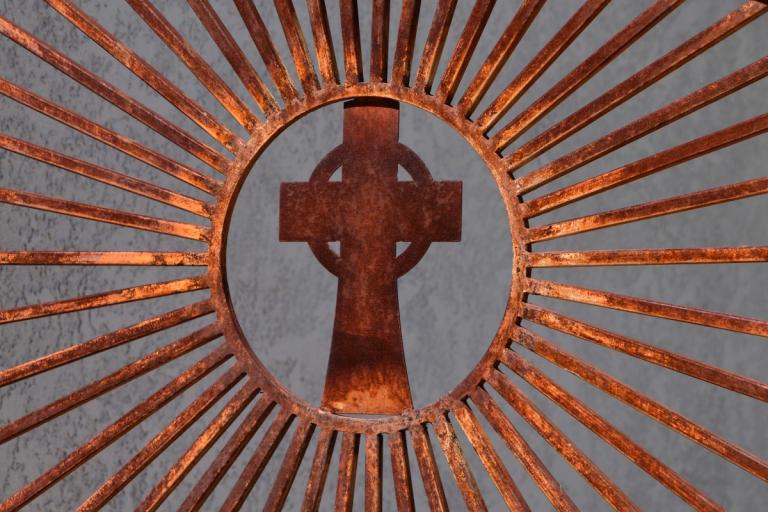
John Banks: Celtic Cross /pxhere
Before Christ, humanity could go so far on its own; it groped for, and often found, great elements of the truth, but in its groping, it did not know what to do with it all. The truth transcends human reason, and so it requires revelation, the revelation of the cross, in order for its expectations to be truly taught to the world. It is only with the cross that we are shown the true path toward peace, the path which ends violence and the cycle of violence. On it, God, who loves humanity, does not act as an aggressor, nor even as a violent defender against sin, but rather, as the perfectly humble lover of humanity, letting the aggression of sin come to its rightful and final conclusion before wearing itself out in the death of Christ. Then, sin, aggression is able to be overcome, and with it a new humanity can emerge, the new humanity of the resurrection, the humanity no longer constrained by and enslaved by sin.
That new humanity, of course, is the restoration of the integral goodness intended for humanity at its inception. As sin, and so the violence of sin, and the cycle of violence created by sin, comes to an end with the death of Christ, so those who embrace Christ can and should embrace the end of sin in themselves, and with it, the end of the cycle of violence. Christians must die to the self, to all the selfish egotism which prevents them from embracing universal love. This is their cross to bear, and when they do so, they can come out of that death to the self-resurrected with Christ, resurrected with a glory which knows no hate or violence.
Thus, the solution to violence, as Mo Tzu intuitively understood, is love, but that love must lead us to a radical abandonment of violence itself. By embracing such love, early Christians found themselves more powerful than their persecutors. They did not resist authorities by fighting against their enemies, but rather, they followed after Christ, willing to die instead of embracing the token of violence (sacrificing to Caesar) or taking on the path of brutality by becoming warriors fighting against the state. Through their heroic self-sacrifice, through their great acts of love, they lead many to realize the power of love, to realize the truth proclaimed by Christ, which is why many witnesses of the martyrs became Christians themselves. They were able to see that such love is more powerful than death. Paul understood this would be the way forward, the way of the Christian faith, when he wrote:
Put on then, as God’s chosen ones, holy and beloved, compassion, kindness, lowliness, meekness, and patience, forbearing one another and, if one has a complaint against another, forgiving each other; as the Lord has forgiven you, so you also must forgive. And above all these put on love, which binds everything together in perfect harmony. And let the peace of Christ rule in your hearts, to which indeed you were called in the one body. And be thankful (Col. 3:12-15 RSV).
Dorothy Day, in recent times, came to realize this and so taught that love, true love, is indeed the solution to the world’s problems:
Love and every more love is the only solution to every problem that comes up. If we love each other enough, we will bear with each other’s faults and burdens. If we love enough, we are going to light that fire in the hearts of others. And it is love that will burn out the sins and hatreds that sadden us. It is love that will make us want to do great things for each other. [13]
Doctor Who and Mo Tzu both present the ideal of pacificism, of non-violence. The Doctor, in many ways, can be seen as the greatest sage in the tradition of Mo Tzu. Looking to that tradition within its historical context, we can see the great, indeed, profound wisdom which inspired it. But it is a historical tradition; in many ways, what is seen in Doctor Who takes on and develops it, so that the Doctor transcends Mo Tzu, though it is clear, the Doctor does not entirely overcome the deficiencies Mo Tzu’s system. The Doctor still embraces violence. Christians can and should see the greatness involved with Mo Tzu and his successors. This should allow Christians to see much value coming from the stories of Doctor Who, for they, like Mo Tzu, point, in humanistic ways, to the teaching which transcends humanity; they point the way but cannot get there. But as they point out the way, they have much to offer. They remind us, in humanistic terms, why we cannot return to the way things were, to the path of violence. When Christians find themselves tempted to embracing and promoting war, especially aggressive wars against others, they find themselves regressing to a thought pattern which lies not only outside of Christ, but outside of the intuitions which prepared the way for Christ. They should reconsider their thoughts and actions. For them, especially, the moral lessons of Doctor Who, and Mo Tzu, can do some good, for they show the errors of violence, the errors of aggression, the errors which many Christians have embraced, putting to shame those Christians who have lost sight of the universal love which they are told they are to embrace by Christ (cf. Matt. 22:37-40).
[1] The Doctor speaking in the story, The Moonbase.
[2] This line of Davros is from the episode, Journey’s End.
[3] The Doctor speaking in The Zygon Inversion.
[4] The Doctor in Planet of the Daleks.
[5] This is from the story, Genesis of the Daleks.
[6] The Doctor speaking in The Zygon Inversion.
[7] Mo Tzu, Basic Writings. Trans. Burton Watson (New York: Columbia University Press, 1963), 39.
[8] Mo Tzu, Basic Writing, 39.
[9] Mo Tzu, Basic Writings, 60-61.
[10] Mo Tzu, Basic Writings, 49.
[11] The Doctor in Remembrance of the Daleks.
[12] Mo Tzu, Basic Writings, 40.
[13] Dorothy Day, The Reckless Way of Love. Notes on Following Jesus (Walden, NY: Plough Publishing House, 2017), 26 [From House of Hospitality, 267].
Stay in touch! Like A Little Bit of Nothing on Facebook.
If you liked what you read, please consider sharing it with your friends and family!
Previous Post

December 15, 2020
Outside The Box
Next Post

December 18, 2020 Following An Ideology Will Have Us Reject The Greater Good
Browse Our Archives
Select a Category Abortion Abraham abuse Aesthetics AI Aliens Ambrose Ancestors and Everything Andrew Angels Animals Anne Anthony Antisemitism apologetics Apophatic Apostle John Aquinas Artificial Intelligence Asanga Ascension Asceticism Assumption Atheism Attachment Augustine Authority Avarice Balthasar Baptism Beauty Biden birthright citizenship Bishops Black History Books Buddhism Bulgakov Byzantine Calendar C.S. Lewis Calcidius Catholic Catholicism Catholicism Celibacy Charity Chastity children Chrismation Christ Christmas Christology Church Climate Change Common Good Communion Confession Confirmation Conscience Constantine conventions conversion councils Covid Creation Cross Dead Death Death Penalty Debate Deception Demagogues Demons Desert Monks Desert Mothers Desire destruction development Dialogue Dignity Dionsyius Dionysius Discipline Diversity Division Doctor Who doctrine dogma Dormition Dualism Easter Easter Series Ecumenical Councils Ecumenism Education Election Empathy Environment Error Eschatology eschaton Eternity Ethics Eucharist Evangelism Eve Evil evolution Faeries Faith Fear femininity Ficino Florence Florensky Folktale Fools Forgiveness Freedom Future gender Gentile Gentiles Glory Gnostic God gods Good Samaritan Goodness Gospel Government Grace Great Fast Guns Hate healing Health Heaven Hell Hellenism Heresy Hierarchy Hildegard Hinduism History Holiness Holy Spirit Holy Week Hope Horror Human rights humanity Humility hypocrisy ICE icon icons Identification Identity Idol II Nicea Immigration incarnation Individualism Informal Reflections Inklings Intention Inter-Religious Interfaith Internet Interpretation Intrinsic evil Irenaeus Islam Israel Jacob Jerome Jesus Jews John Chrysostom John of Damascus John the Baptist Joseph Judaism justice Justification kenosis Kindnesss Kingdom of God Kingdom of Heaven Law Law of Moses Lazarus Leaf by Niggle Lent Lenten Reflection Liberation Theology Lies Life Listen Literature Liturgy locutions Logic Logos Love Marriage Martyrs Mary Mass Maximos The Confessor Meanness Meditation Mercy Middle Path Migrants Mind Miracles Miriam Morals Moses Movies Music Muslims Myths Names Nationalism Native Americans New Year Nicea Nicholas Nothing Novatian Obedience Occam's Razor Ordination Origen Original Sin Orthodox orthopraxis Pagans Palamas Palm Sunday Paradise Paschaltide Paul Peace Pentecost person Peter piety PKD Plato pluralism Plurality Poem Poetry Poiltics Politics Poor Pope Pope Francis Pope Leo XIV Post Office Prayer Pride Pro-life Prodigal Son propaganda Prophecy Prophets Providence Putin Racism Reading Reason Reflection Refugees Relationships Religion Religion Series Religious Liberty Repent Republicans Rest Resurrection Rich Rites Russia Sacraments Saints Salvation Salvian Santa Science Scripture Self-Giving Sexuality Sibyl Sick Silence Sin Singlehood Social Justice Society Sodom Solovyov Speculations Spiritual Reflection St. Cyril of Alexandria St. Justin Martyr Suffering Sunday of the Paralytic Man Sunday of the Samaritan Woman Superhero Supreme Court Teaching Technology Thanksgiving The Father the Universe Theological Reflection Theology Theosis Theotokos Thomas Timaeus Time Tolerenace Tolkien Tradition Transfiguration Trinity Trump Truth Uncategorized Unity Universities USCCB Value Vatican II Vegetarian Vices Violence Virtue Vocations War Water Welcome Wisdom Womanhood Women Work World View Worship Writing Zacchaeus
Select a Month October 2026 September 2026 August 2026 July 2026 June 2026 May 2026 April 2026 March 2026 February 2026 January 2026 December 2025 November 2025 October 2025 September 2025 August 2025 July 2025 June 2025 May 2025 April 2025 March 2025 February 2025 January 2025 December 2024 November 2024 October 2024 September 2024 August 2024 July 2024 June 2024 May 2024 April 2024 March 2024 February 2024 January 2024 December 2023 November 2023 October 2023 September 2023 August 2023 July 2023 June 2023 May 2023 April 2023 March 2023 February 2023 January 2023 December 2022 November 2022 October 2022 September 2022 August 2022 July 2022 June 2022 May 2022 April 2022 March 2022 February 2022 January 2022 December 2021 November 2021 October 2021 September 2021 August 2021 July 2021 June 2021 May 2021 April 2021 March 2021 February 2021 January 2021 December 2020 November 2020 October 2020 September 2020 August 2020 July 2020 June 2020 May 2020 April 2020 March 2020 February 2020 January 2020 December 2019 November 2019 October 2019 September 2019 August 2019 July 2019 June 2019 May 2019 April 2019 March 2019 February 2019 January 2019 December 2018 November 2018 October 2018 September 2018 August 2018 July 2018 June 2018 May 2018 April 2018 March 2018 February 2018 January 2018 December 2017 November 2017 October 2017 September 2017 August 2017 July 2017 June 2017 May 2017 April 2017 March 2017 February 2017 January 2017 December 2016 November 2016 October 2016 September 2016 August 2016 July 2016 June 2016 May 2016 April 2016 March 2016 February 2016
Follow Us!
TAKE THE
Religious Wisdom Quiz
What is the Christian attitude toward one's enemies?
Select your answer to see how you score.
Love them Fight them Mock them Ignore them
Related posts from A Little Bit of Nothing

Justice First, Charity Beyond It: Serving The Poor...

Why Clean Water Is a Moral Obligation For...

Compassion, Justice, And The Rights Of The Poor
The Unknown God Revealed In Christ
TRENDING AT PATHEOS Catholic

Rejecting Doom: Christian Hope And Human Action
Christianity is a religion of hope. We are to have hope and...

It’s What Comes From Within Which Matters
One of the most difficult things for us to understand is why...

Why I Choose the Eucharist Over the Sermon
Choose the Eucharist, Not the Sermon What are we supposed to get...

5 Design Elements Found in Spiritually Rooted Homes
Putting Spirituality Into Home Decor Our homes are more than our living...

Credo: A Story of God Told with the...
About 10 years ago, I began to imagine a personal "Credo" that...

The Anatomy of Divine Revelation in Catholic Thought
The claim that God has made Himself known to human beings is...
view all Catholic blogs
Ad-Free & Subscriber Log-In Subscription Support
- About Us
- 2026 Calendar
- Videos
- Podcasts
- Library of World Religions
- Faith In Media Tracker
- Advertise With Us
- Write for Us
- Privacy Policy
- Terms of Service
- Do Not Sell My Data
- Contact Us
- Radiant Digital
- Manage Newsletter Subscriptions
- Unsubscribe From Notifications
- Sitemap
Copyright 2008-2026, Patheos. All rights reserved.
Subscription Support Ad-Free & Subscriber Log-In
Follow Patheos