
BuddhistCatholicContemplativeEvangelicalGeneral ChristianHinduJewishLatter-day SaintMuslimNew VisionsProgressive Christian
Beliefs
- Buddhist
- Catholic
- Contemplative
- Evangelical
- General Christian
- Hindu
- Jewish
- Latter-day Saint
- More Voices
- Muslim
- New Visions
- Pagan
- Progressive Christian
Topics
- Religion News
- Food and Religion
- Sports and Religion
- Religious Art
- Religious Music and Entertainment
- Religious Events
- History and Religion
- Style and Religion
- Politics and Religion
- Women in Religion
- Recreation Outdoors and Religion
- Business Finance and Religion
- Careers Workplace and Religion
- Education and Religion
- Family Parenting and Religion
- Health Fitness and Religion
- Home and Religion
- Relationships and Religion
- Technology and Religion
- Travel and Religion
Columnists
- Buddhist Columnists
- Business Finance and Religion Columnists
- Careers Workplace and Religion Columnists
- Catholic Columnists
- Contemplative Columnists
- Education and Religion Columnists
- Evangelists Columnists
- Family Parenting and Religion Columnists
- General Christian Columnists
- Health Fitness and Religion Columnists
- Hindu Columnists
- History and Religion Columnists
- Home and Religion Columnists
- Jewish Columnists
- More Voices Columnists
- Latter Day Columnists
- Muslim Columnists
- New Visions Columnists
- Nonreligious Columnists
- Pagan Columnists
- Politics and Religion Columnists
- Progressive Columnists
- Recreation Outdoors and Religion Columnists
- Relationships and Religion Columnists
- Religion News Columnists
- Religious Art Columnists
- Religious Events Columnists
- Religious Music and Entertainment Columnists
- Sports and Religion Columnists
- Style and Religion Columnists
- Technology and Religion Columnists
- Travel and Religion Columnists
- Women in Religion Columnists
Resource Library
- 2026 Calendar
- Library of World Religions
- The 100 Most Holy Places on Earth
- Patheos Answers
- Podcasts
- Videos
- Faith Leaders Database
- Anglican Episcopalian
- Bahai
- Baptist
- Buddhism
- Christianity
- Confucianism
- Eastern Orthodoxy
- Hinduism
- Holiness and Pentecostal
- ISKCON
- Islam
- Judaism
- Lutheran
- Methodist
- The Church of Jesus Christ of Latter-day Saints
- New Age
- Paganism
- Presbytarian and Reformed
- Protestantism
- Religion Behind the Scenes
- Roman Catholic
- Scientology
- Shia Islam
- Sikhism
- Sufism
- Sunni Islam
- Taoism
- Zen
- See all religions
Research Tools
 Ad-Free & Subscriber Log-In Subscription Support
Ad-Free & Subscriber Log-In Subscription Support
Follow Patheos 

- Trending:
- Forgiveness
- |
- Marriage
- |
- Consciousness
- |
- Death Penalty
- |
- Election
- |
- Halloween

- Home
- Catholic
- Patience and the Paralytic Man
Patience and the Paralytic Man
Last updated on: May 3, 2020 at 3:29 am by Henry Karlson
Patience and the Paralytic Man 2020-05-03T03:29:05-05:00 Henry Karlson
Patheos Explore the world's faith through different perspectives on religion and spirituality! Patheos has the views of the prevalent religions and spiritualities of the world.
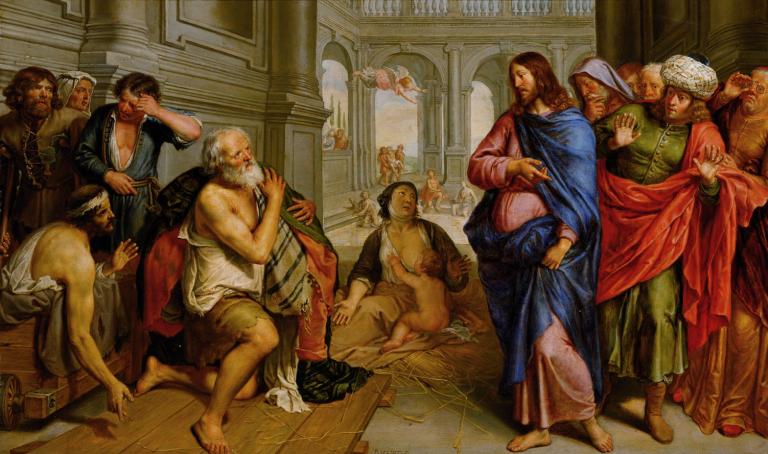
Pieter van Lint / Christ healing the lame man / Wikimedia Commons

Patience. For many of us, as we are used to getting most of what we want, whenever we want it, patience is a virtue which we have lost. We do not want to wait for anything. Waiting a week for something seems way too long. As a result, when things change, and we find ourselves dealing with a crisis in our lives, we not only have to cope with the crisis, we have to deal with our impatience in trying to deal with it as well. We think we should be able to solve any problem as fast and as easily as going out and picking up a meal to eat.
We never want to consider whether or not we create many of our own problems. We do not want to take responsibility for our actions and how they affect others. We think we should be free to do whatever we want, when we want, and anything which gets in our way is the problem. How many drunks think laws which forbid them from driving are the problem, not their inebriation? They do not want to wait, and so they get in a car, and drive. If they get in an accident killing or maiming an innocent for life, it is because they lacked patience. So many of us have the same attitude. We might not be drunk, but we are impatient, and through our impatience, we can and will harm others, such as those of us who want to ignore social distancing during a time of a pandemic. Such imprudence gets innocents killed.
In Jerusalem, Jesus met a truly patient man:
After this there was a feast of the Jews, and Jesus went up to Jerusalem. Now there is in Jerusalem by the Sheep Gate a pool, in Hebrew called Bethzatha, which has five porticoes. In these lay a multitude of invalids, blind, lame, paralyzed. One man was there, who had been ill for thirty-eight years. When Jesus saw him and knew that he had been lying there a long time, he said to him, “Do you want to be healed?” The sick man answered him, “Sir, I have no man to put me into the pool when the water is troubled, and while I am going another steps down before me.” Jesus said to him, “Rise, take up your pallet, and walk.” And at once the man was healed, and he took up his pallet and walked. Now that day was the sabbath. So the Jews said to the man who was cured, “It is the sabbath, it is not lawful for you to carry your pallet.” But he answered them, “The man who healed me said to me, `Take up your pallet, and walk.'” They asked him, “Who is the man who said to you, `Take up your pallet, and walk’?” Now the man who had been healed did not know who it was, for Jesus had withdrawn, as there was a crowd in the place. Afterward, Jesus found him in the temple, and said to him, “See, you are well! Sin no more, that nothing worse befall you.” The man went away and told the Jews that it was Jesus who had healed him (Jn. 5:1-15 RSV).
The paralyzed man waited for God to heal him. Some might have said he was lazy and should not have been left to live. Others might have suggested that it was because of some grave sin he was paralyzed, and so he should not be healed. Even others might have said that he got in the way of others, and authorities should have taken him away and locked him out of sight so that he would not hurt any commercial interests. Jesus, however, so a man he loved, and therefore, a man loved by God. The paralyzed man, in his patient endurance, demonstrated a heroic virtue which we should not only applaud but follow through in our own lives. And so, Jesus did as he often did with those needing healing: he healed the paralytic man. He had the man get up and walk. The man’s patience, his long-suffering endurance, had paid off. With his burdens lifted, he was truly able to experience the Sabbath rest.
The paralytic man excelled in the virtue of patience, which was also a part of his own calling in life; despite his lack of secular accomplishments, despite his lack of work, he was far from a slothful man. And though he got up and walked, taking his bed with him, far from breaking the Sabbath, he was able to properly fulfill it as he found his true rest in and with God. The Sabbath was made for us, not us for the Sabbath. This means there are many ways for us to fulfill the spirit of the Sabbath. The point of the Sabbath is to help us find our rest with God, that is, to join ourselves with the ever-active rest of God. His eternal rest is one with his eternal activity. This is why we can combine our activity with God’s activity and enjoy the true Sabbath of God. Thus, Augustine, understanding this, tells us that when Jesus was questioned about healing on the Sabbath, he pointed out the Father still works on the Sabbath:
I have told you how He is wont to answer concerning the healing of men on the Sabbath day, that they used not on the Sabbath day to slight their cattle, either in delivering or in feeding them. What does He answer concerning the carrying of the bed? A manifest corporal work was done before the eyes of the Jews; not a healing of the body, but a bodily work, which appeared not so necessary as the healing. Let the Lord, then, openly declare that the sacrament of the Sabbath, even the sign of keeping one day, was given to the Jews for a time, but that the fulfillment of the sacrament had come in Himself. “My Father,” says He, “works hitherto, and I work.” He sent a great commotion among them: the water is troubled by the coming of the Lord, but yet He that troubles is not seen. Yet one great sick one is to be healed by the troubled water, the whole world by the death of the Lord.[1]
God, Augustine says, does not rest in the way we think of rest, because God does not grow weary:
See, then, whether Moses did not mean it to be significant of something that “God rested on the seventh day.” For God had not become wearied in doing the work of His own creation, and needed rest as a man. How can He have been wearied, who made by a word? Yet is both that true, that “God rested from His works on the seventh day;” and this also is true that Jesus says, “My Father works hitherto.” [2]
We can rest and still be active. It is the kind of activity and the kind of rest which is important. Existence itself always comes with some sort of activity. What we are expected to do is take a break from those activities which distract us from our union with God. Because of the way we live our lives, we need a special time set aside so that we can regain our strength as well as refocus our relationship with God. That time can be found in and established in many ways. Some of them might confuse those who have a very limited understanding of the Sabbath rest. They might find some activities which follow the spirit of the Sabbath to violate it. They might then take the time to disrupt the lives of others by criticizing what others are doing; by engaging in such criticism, they themselves violate the Sabbath rest with their lack of charity. The paralyzed man was able to get up and walk, and so he fulfilled the Sabbath rest by resting from all the burdens he faced for so many years. He truly experienced the Sabbath rest while his critics continued their hateful labors.
But we must remember, it took the paralyzed man years of patient endurance, years of patient work, before he was healed and made free by Jesus. He labored long and hard in his paralysis. Many would have given up hope, but he did not. He endured it all. His patience is a marvel when we consider how impatient we get when we have to wait a month or two to get something which we want. What would our attitude be if we were told we would have to wait for years before we get any relief? If we would lack patience, then St. John Chrysostom suggests that we are slothful and should be ashamed:
Let us be ashamed then, beloved, let us be ashamed, and groan over our excessive sloth. “Thirty and eight years” had that man been waiting without obtaining what he desired, and withdrew not. And he had failed not through any carelessness of his own, but through being oppressed and suffering violence from others, and not even thus did he grow dull; while we if we have persisted for ten days to pray for anything and have not obtained it, are too slothful afterwards to employ the same zeal. [3]
It is common to see the paralytic man as representative of fallen humanity, that is, to see how humanity, as a result of its sins, lay spiritually paralyzed. St. Caesarius of Arles represents this tradition in his interpretation of the paralytic man:
The passage of the holy Gospel which speaks about the pool of Siloe, brethren, addresses us in particular, because we are freed from all listlessness of sin through the grace of Baptism. Just as that paralytic man whom the Lord cured was weak in all his members so that he could accomplish no good act, so before the coming of our Lord the entire human race was weakened interiorly in soul by the paralysis of sin. Before the coming of the Savior, the human race was so feeble that it could not nothing that was connected with faith and mercy or even justice. But just as that paralytic who was overwhelmed with weakness was lifted up at the word of the heavenly physician, so the entire human race which was sick interiorly in the soul, almost even to the point of death, was recalled to its former state of health at the coming of our Lord and Savior. [4]
This tradition, this interpretation, however, is not the only meaning which we can find in the passage. It is an important one with theological significance which we should not deny. However, this does not mean we cannot recognize the lessons of the paralytic man himself, to look to him as an example for how we should patiently endure the trials which come before us. This is especially important for us now, as people demonstrate their impatience and their sloth because of their unwillingness to work for and support the common good when it is inconvenient.
Certainly, there are many ways the common good is being destroyed today. Behind each of them we can find the various deadly sins at work, promoting apparent private goods at the expense of others. Thus, avarice suggests we should ignore the dignity of life, saying we are justified in sacrificing others for our own petty gain. Likewise, hatred has many willing to sacrifice their own wellbeing if they can also harm and destroy those they deem as their enemies. But it is clear, sloth, the rejection of true, honest spiritual work, is a key problem before us today. We find it in those who promote various forms of soul-destroying work. They are impatient with spiritual work, even as they are impatient with ventures which look for the common good over their own immediate desires.
We must have patience. We must be like the paralytic man and work out our own salvation, following the dictates of the Gospel, the dictates of love. We will love God by loving and caring for our neighbor as ourselves. “’Take up your bed’ — being yourself borne, bear your neighbor; ‘and walk,’ that you may come to the goal.”[5] Anything which gets in the way of loving our neighbor is not the work of Christ, not the work of a Christian, and must be rejected. But those who follow through with such spiritual work, joining in with the eternal work of God, will find true happiness as they experience the true Sabbath rest in God.
[1] St. Augustine, Tractates on the Gospel of St John in NPNF1(7):115 [Tractate 17].
[2] St. Augustine, Tractates on the Gospel of St John, 115.
[3] St. John Chrysostom, “Homilies on the Gospel of St John” in NPNF1(14): 126 [Homily 36].
[4] St. Caesarius of Arles, “Sermon 171: On the Pool of Siloe” in St. Caesarius of Arles: Sermons 81-186. Trans. Mary Magdeleine Mueller, OSF (Washington, DC: CUA Press, 1963), 422.
[5] St. Augustine, Tractates on the Gospel of St John, 115.
Stay in touch! Like A Little Bit of Nothing on Facebook.
If you liked what you read, please consider sharing it with your friends and family!
Previous Post
May 1, 2020
What Good Is There In Going To Church If We Do Not Love Our Neighbor?
Next Post

May 5, 2020 Meaning and Scripture
Browse Our Archives
Select a Category Abortion Abraham abuse Aesthetics AI Aliens Ambrose Ancestors and Everything Andrew Angels Animals Anne Anthony Antisemitism apologetics Apophatic Apostle John Aquinas Artificial Intelligence Asanga Ascension Asceticism Assumption Atheism Attachment Augustine Authority Avarice Balthasar Baptism Beauty Biden birthright citizenship Bishops Black History Books Buddhism Bulgakov Byzantine Calendar C.S. Lewis Calcidius Catholic Catholicism Catholicism Celibacy Charity Chastity children Chrismation Christ Christmas Christology Church Climate Change Common Good Communion Confession Confirmation Conscience Constantine conventions conversion councils Covid Creation Cross Dead Death Death Penalty Debate Deception Demagogues Demons Desert Monks Desert Mothers Desire destruction development Dialogue Dignity Dionsyius Dionysius Discipline Diversity Division Doctor Who doctrine dogma Dormition Dualism Easter Easter Series Ecumenical Councils Ecumenism Education Election Empathy Environment Error Eschatology eschaton Eternity Ethics Eucharist Evangelism Eve Evil evolution Faeries Faith Fear femininity Ficino Florence Florensky Folktale Fools Forgiveness Freedom Future gender Gentile Gentiles Glory Gnostic God gods Good Samaritan Goodness Gospel Government Grace Great Fast Guns Hate healing Health Heaven Hell Hellenism Heresy Hierarchy Hildegard Hinduism History Holiness Holy Spirit Holy Week Hope Horror Human rights humanity Humility hypocrisy ICE icon icons Identification Identity Idol II Nicea Immigration incarnation Individualism Informal Reflections Inklings Intention Inter-Religious Interfaith Internet Interpretation Intrinsic evil Irenaeus Islam Israel Jacob Jerome Jesus Jews John Chrysostom John of Damascus John the Baptist Joseph Judaism justice Justification kenosis Kindnesss Kingdom of God Kingdom of Heaven Law Law of Moses Lazarus Leaf by Niggle Lent Lenten Reflection Liberation Theology Lies Life Listen Literature Liturgy locutions Logic Logos Love Marriage Martyrs Mary Mass Maximos The Confessor Meanness Meditation Mercy Middle Path Migrants Mind Miracles Miriam Morals Moses Movies Music Muslims Myths Names Nationalism Native Americans New Year Nicea Nicholas Nothing Novatian Obedience Occam's Razor Ordination Origen Original Sin Orthodox orthopraxis Pagans Palamas Palm Sunday Paradise Paschaltide Paul Peace Pentecost person Peter piety PKD Plato pluralism Plurality Poem Poetry Poiltics Politics Poor Pope Pope Francis Pope Leo XIV Post Office Prayer Pride Pro-life Prodigal Son propaganda Prophecy Prophets Providence Putin Racism Reading Reason Reflection Refugees Relationships Religion Religion Series Religious Liberty Repent Republicans Rest Resurrection Rich Rites Russia Sacraments Saints Salvation Salvian Santa Science Scripture Self-Giving Sexuality Sibyl Sick Silence Sin Singlehood Social Justice Society Sodom Solovyov Speculations Spiritual Reflection St. Cyril of Alexandria St. Justin Martyr Suffering Sunday of the Paralytic Man Sunday of the Samaritan Woman Superhero Supreme Court Teaching Technology Thanksgiving The Father the Universe Theological Reflection Theology Theosis Theotokos Thomas Timaeus Time Tolerenace Tolkien Tradition Transfiguration Trinity Trump Truth Uncategorized Unity Universities USCCB Value Vatican II Vegetarian Vices Violence Virtue Vocations War Water Welcome Wisdom Womanhood Women Work World View Worship Writing Zacchaeus
Select a Month October 2026 September 2026 August 2026 July 2026 June 2026 May 2026 April 2026 March 2026 February 2026 January 2026 December 2025 November 2025 October 2025 September 2025 August 2025 July 2025 June 2025 May 2025 April 2025 March 2025 February 2025 January 2025 December 2024 November 2024 October 2024 September 2024 August 2024 July 2024 June 2024 May 2024 April 2024 March 2024 February 2024 January 2024 December 2023 November 2023 October 2023 September 2023 August 2023 July 2023 June 2023 May 2023 April 2023 March 2023 February 2023 January 2023 December 2022 November 2022 October 2022 September 2022 August 2022 July 2022 June 2022 May 2022 April 2022 March 2022 February 2022 January 2022 December 2021 November 2021 October 2021 September 2021 August 2021 July 2021 June 2021 May 2021 April 2021 March 2021 February 2021 January 2021 December 2020 November 2020 October 2020 September 2020 August 2020 July 2020 June 2020 May 2020 April 2020 March 2020 February 2020 January 2020 December 2019 November 2019 October 2019 September 2019 August 2019 July 2019 June 2019 May 2019 April 2019 March 2019 February 2019 January 2019 December 2018 November 2018 October 2018 September 2018 August 2018 July 2018 June 2018 May 2018 April 2018 March 2018 February 2018 January 2018 December 2017 November 2017 October 2017 September 2017 August 2017 July 2017 June 2017 May 2017 April 2017 March 2017 February 2017 January 2017 December 2016 November 2016 October 2016 September 2016 August 2016 July 2016 June 2016 May 2016 April 2016 March 2016 February 2016
Follow Us!
TAKE THE
Religious Wisdom Quiz
True or False: Boaz was Ruth's brother-in-law who married her.
Select your answer to see how you score.
TRUE FALSE
Related posts from A Little Bit of Nothing

Why Christians Can't Shrug Off Climate Change

How Christ Transformed The Meaning Of The Cross
Reflections for Paschaltide 2026: The Paralytic Man
Jesus’ Message To Pilate: A Kingdom Beyond The...
TRENDING AT PATHEOS Catholic

Rejecting Doom: Christian Hope And Human Action
Christianity is a religion of hope. We are to have hope and...

It’s What Comes From Within Which Matters
One of the most difficult things for us to understand is why...

Why I Choose the Eucharist Over the Sermon
Choose the Eucharist, Not the Sermon What are we supposed to get...

5 Design Elements Found in Spiritually Rooted Homes
Putting Spirituality Into Home Decor Our homes are more than our living...

Credo: A Story of God Told with the...
About 10 years ago, I began to imagine a personal "Credo" that...

The Anatomy of Divine Revelation in Catholic Thought
The claim that God has made Himself known to human beings is...
view all Catholic blogs
Ad-Free & Subscriber Log-In Subscription Support
- About Us
- 2026 Calendar
- Videos
- Podcasts
- Library of World Religions
- Faith In Media Tracker
- Advertise With Us
- Write for Us
- Privacy Policy
- Terms of Service
- Do Not Sell My Data
- Contact Us
- Radiant Digital
- Manage Newsletter Subscriptions
- Unsubscribe From Notifications
- Sitemap
Copyright 2008-2026, Patheos. All rights reserved.
Subscription Support Ad-Free & Subscriber Log-In
Follow Patheos