
BuddhistCatholicContemplativeEvangelicalGeneral ChristianHinduJewishLatter-day SaintMuslimNew VisionsProgressive Christian
Beliefs
- Buddhist
- Catholic
- Contemplative
- Evangelical
- General Christian
- Hindu
- Jewish
- Latter-day Saint
- More Voices
- Muslim
- New Visions
- Pagan
- Progressive Christian
Topics
- Religion News
- Food and Religion
- Sports and Religion
- Religious Art
- Religious Music and Entertainment
- Religious Events
- History and Religion
- Style and Religion
- Politics and Religion
- Women in Religion
- Recreation Outdoors and Religion
- Business Finance and Religion
- Careers Workplace and Religion
- Education and Religion
- Family Parenting and Religion
- Health Fitness and Religion
- Home and Religion
- Relationships and Religion
- Technology and Religion
- Travel and Religion
Columnists
- Buddhist Columnists
- Business Finance and Religion Columnists
- Careers Workplace and Religion Columnists
- Catholic Columnists
- Contemplative Columnists
- Education and Religion Columnists
- Evangelists Columnists
- Family Parenting and Religion Columnists
- General Christian Columnists
- Health Fitness and Religion Columnists
- Hindu Columnists
- History and Religion Columnists
- Home and Religion Columnists
- Jewish Columnists
- More Voices Columnists
- Latter Day Columnists
- Muslim Columnists
- New Visions Columnists
- Nonreligious Columnists
- Pagan Columnists
- Politics and Religion Columnists
- Progressive Columnists
- Recreation Outdoors and Religion Columnists
- Relationships and Religion Columnists
- Religion News Columnists
- Religious Art Columnists
- Religious Events Columnists
- Religious Music and Entertainment Columnists
- Sports and Religion Columnists
- Style and Religion Columnists
- Technology and Religion Columnists
- Travel and Religion Columnists
- Women in Religion Columnists
Resource Library
- 2026 Calendar
- Library of World Religions
- The 100 Most Holy Places on Earth
- Patheos Answers
- Podcasts
- Videos
- Faith Leaders Database
- Anglican Episcopalian
- Bahai
- Baptist
- Buddhism
- Christianity
- Confucianism
- Eastern Orthodoxy
- Hinduism
- Holiness and Pentecostal
- ISKCON
- Islam
- Judaism
- Lutheran
- Methodist
- The Church of Jesus Christ of Latter-day Saints
- New Age
- Paganism
- Presbytarian and Reformed
- Protestantism
- Religion Behind the Scenes
- Roman Catholic
- Scientology
- Shia Islam
- Sikhism
- Sufism
- Sunni Islam
- Taoism
- Zen
- See all religions
Research Tools
 Ad-Free & Subscriber Log-In Subscription Support
Ad-Free & Subscriber Log-In Subscription Support
Follow Patheos 

- Trending:
- Forgiveness
- |
- Marriage
- |
- Consciousness
- |
- Death Penalty
- |
- Election
- |
- Halloween

- Home
- Catholic
- Tolkien, Myth, And The Flexibility of Catholic Thought
Tolkien, Myth, And The Flexibility of Catholic Thought
Last updated on: February 13, 2020 at 6:45 pm by Henry Karlson
Tolkien, Myth, And The Flexibility of Catholic Thought 2020-02-13T18:45:49-05:00 Henry Karlson
Patheos Explore the world's faith through different perspectives on religion and spirituality! Patheos has the views of the prevalent religions and spiritualities of the world.
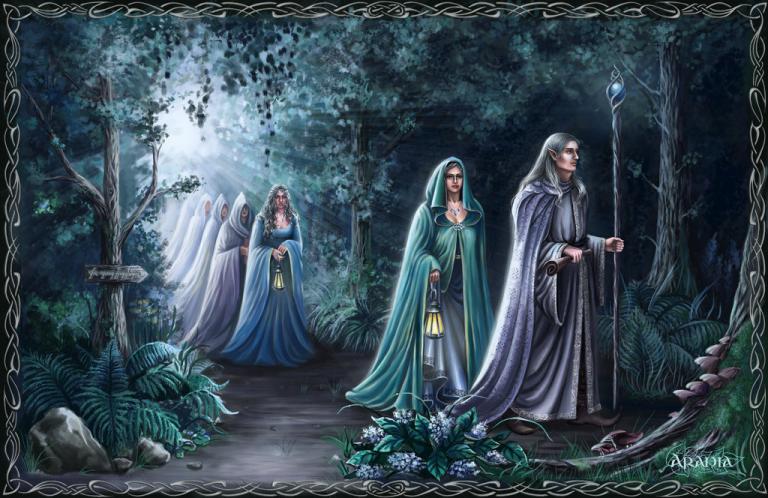
Araniart: Elves Leave Middle Earth / Wikimedia Commons

J.R.R. Tolkien, believing England did not possess a great myth of its own, wanted to write one for it. As with all such myths, he wanted it to be seen as semi-historical, that is, he wanted it to be seen as a possible pre-history for the world. In his writings and reflections, he treated it as if it were history, trying to reconcile what we know of recorded history with his myth, while recognizing that its mythic elements allowed it to transcend history and present universal truths in a way which only myths can do.
Tolkien was a devout Catholic, and many have noted various Catholic elements find themselves expressed in his works. On the other hand, many elements of his myth seem to contradict is Catholic beliefs. If Tolkien wanted his myth to be taken as a possible pre-history of the world (even if he knew it was not), it would seem that he would not want his Catholic faith to contradict what is found in his myth. Was there a way he could reconcile the two?
Tolkien could respond by pointing out that a part of the confusion lies in the difference between myth and theology. What is acceptable in myth, what is acceptable in poetry, is different from what one would expect from a systematic theological examination. Nonetheless, this does not mean Tolkien wasn’t challenged in trying to keep his mythic universe compatible with his Catholic faith. He was, but in many ways, he was following along the tradition of the great writers of myth and legends from the Middle Ages, because, like him, they assimilated non-Christian traditions and ideas into Christian stories (such as can be found in Beowulf or the legends surrounding King Arthur). Tolkien was trying to produce a great English myth which took into account not only his Christian faith but the pre-Christian and non-Christian tradition which helped create England.
There are certainly many places in his work in which the conflict between various non-Christian and Christian views shows up, but perhaps none make itself more apparent than the way reincarnation worked for Tolkien’s Elves. As Scull and Hammond’s Reader’s Guide explained, from the earliest stages of his writings, The Book of Lost Tales, Tolkien had established ways in which Elves which had been killed were able to be reborn in the world (with the caveat that Elves could and sometimes refused to do so):
From the writing of *The Book of Last Tales, for decades it was a firm tent of his mythology that the Elves who were killed might be reborn in their children, and this was still the case when Tolkien wrote *Laws and Customs among the Eldar in the late 1950s, in connection with the story of the Elf Miriel who ‘died’ and refused to reincarnate. [1]
Sometimes, Tolkien had the Valar make the new bodies for the Elves, but eventually he went forward with a more traditional approach in which the souls of the Elves, the fëa, made their own body for itself:
In Reincarnation of the Elves, as a second thought, Tolkien considered whether, rather than the Valar making the new body, the houseless fëa might be able to rebuild its body from memory. In the very late writings it is clear that this became his view of the matter.[2]
If Elves chose to forgo reincarnation, they could wander around “houseless” without a body, and thus become ghosts in the world. But it is clear, for Tolkien, the fate of the Elves tied them to the world, and so they were meant to be immortal and stay with the world throughout all time. Due to Melkor and the corruption he put into the world of creation, Elves could be killed, but because of their connection to the Earth, they were expected to eventually reincarnate (and those who did not do so were rebelling against their proper nature as well as the Valar).
Tolkien was very clear that such reincarnation was for the Elves, and not for humanity, keeping therefore with his Catholic faith about the fate of humanity. When asked to justify it, his response is that he didn’t think Catholic theological particularly rejected reincarnation for all life, just human life, as Verlyn Flieger explained in a discussion concerning reincarnation found in The Notion Club Papers:
For a practicing Catholic like Tolkien, the idea of reincarnation would have been theologically problematic, although on a purely intellectual basis he seems to have had no trouble with the concept. In answer to an inquiring reader who asked him about the practicality of the Elven-concept of reincarnation in Half-Elven offspring, he wrote, “I do not see how even in the Primary World any theologian or philosopher, unless very much better informed about the relation of spirit and body than I believe anyone to be, could deny the possibility of re-incarnation as a mode of existence prescribed for certain kinds of rational incarnate creatures” (Letters 189). Whether he acknowledged the possibility theologically or simply chose to accept it imaginatively, nevertheless, in the limited freedom that comes with being an imaginative world-maker, reincarnation offered him a viable means of entry into his “Mars.”[3]
Now, it might be asked, why did Tolkien feel the need to have Elves reincarnate? What brought about this aspect of his mythos, especially when it seemed to challenge if not run contrary to his Catholic beliefs?
Perhaps the answer lies in the fact that Tolkien was trying to write a myth for England, and in doing so, incorporate and acknowledge various folklore traditions into his work to help make it authentic. In doing so, we can find he had many sources of inspiration, from the Finnish Kalevala to the Nordic Sagas. But, more important for us here, we should note that this included Celtic lore, despite the ambivalent stand he took on it. For, as Scull and Hammond relate, Celtic influence can be found throughout his work:
Despite his denial to Stanley Unwin, elsewhere Tolkien admitted a certain Celtic influence on his writing. In a letter to Milton Waldman written in ?late 1951 he said that one element he wanted his mythology to possess was ‘the fair elusive beauty that some call Celtic (though it is rarely found in genuine ancient Celtic things)’ (Letters, p. 144). On 25 April 1954 he wrote to Naomi Mitchison that ‘the living language of the Western Elves’, Sindarin, had ‘a linguistic character very like (though not identical with) British-Welsh: because that character is one that I find, in some linguistic moods, very attractive, and because it seems to fit the rather “Celtic” type of legends and stories told of its speakers’ (Letters, p.176). [4]
The Elves, therefore, have a Celtic aspect to them. And this then brings us to why Tolkien would have them reincarnate: because folklore studies indicated a similar notion concerning Celtic fairies: that they, too, were known to reincarnate. In his extensive study, The Fairy Faith in Celtic Countries, published in 1911, W.Y. Evans-Wentz explained that belief in the reincarnation was a part of the Celtic fairy tradition:
We proceed now directly to show that there was also a belief, probably widespread, among the ancient Irish that divine personages, national heroes who are members of the Tuatha De Danann or Sidhe race, and great men, can be reincarnated, that is to say, can descend to this plane of existence and be as mortals more than once. This aspect of the Celtic Doctrine of Re-birth has been clearly set forth by the publications of such eminent Celtic folk-lorists as Alfred Nutt and Miss Eleanor Hull. Miss Hull, in her study of Old Irish Tabus, or Gesa, referring to the Cuchulainn Cycle of Irish literature and mythology, writes thus:–‘There is no doubt that all the chief personages of this cycle were regarded as the direct descendants, or it would be more correct to say, as avatars or reincarnations of the early gods. Not only are their pedigrees traced up to the Tuatha De Danann, but there are indications in the birth-stories of nearly all the principal personages that they are looked upon simply as divine beings reborn on the human plane of life. These indications are mysterious, and most of the tales which deal with them show signs of having been altered, perhaps intentionally, by the Christian transcribers. The doctrine of re-birth was naturally not one acceptable to them. . . . The goddess Etain becomes the mortal wife of a king of Ireland. . . . Conchobhar, moreover, is spoken of as a terrestrial god; and Dechtire, his sister, and the other of Cúchulainn, is called a goddess. In the case of Cúchulainn himself, it is distinctly noted that he is the avatar of Lugh lamhfada (long-hand), the sun-deity of the earliest cycle. Lugh appears to Dechtire, the mother of Cúchulainn, and tells her that he himself is her little child, i.e. that the child is a reincarnation of himself; and Cúchulainn when inquired of as to his birth, points proudly to his descent from Lugh. When, too, it is proposed to find a wife for the hero, the reason assigned is, that they knew “that this re-birth would be of himself” (i. e. that only from himself could another such as he have origin).’ We have in this last a clue to the popular Irish belief regarding the re-birth of beings of a god-like nature. D’Arbois de Jubainville has shown, also, that the grandfather of Cuchulainn, son of Sualtaim, was from the country of the Sidhe, and so was Ethné Ingubé, the sister of Sualtaim. And Dechtire, the mother of Cuchulainn, was the daughter of the Druid Cathba and the brother of King Conchobhar. Thus the ancestry of the great hero of the Red Branch Knights of Ulster is both royal and divine. And Conall Cernach, Cuchulainn’s comrade and avenger, apparently from a tale in the Cóir Anmann (Fitness of Names), composed probably during the twelfth century, was also a reincarnated Tuatha De Danann hero. [5]
Thus, by his inclination to include traditional mythic folklore into his own story, to help make for a myth for England, Tolkien’s Elves take on aspects found in the greater tradition. It helped authenticate his story by connecting it with the greater, and more wide-spread understanding of the Elvish tradition. It was, of course, to be carefully developed throughout is writings, so that he would create a lore all which transcended the sources which inspired him. Nonetheless, its roots remain within the classical tradition, a tradition which he knew about – and reflected upon – in his other writings and lectures, such as found in his On Fairy-Stories. Likewise, we know many of his own stories and poems incorporate this tradition more than others, showing his attempt to take historical events (like the Death of St. Brendan) and tie them into his own mythic history, showing that he was truly trying to write a myth which could include pre-Christian notions and Christian history and theology and relate them together.
It is, therefore, Tolkien’s inclusive view of myth, where myths represent the truth in a non-literal, non-positivistic fashion, that allowed Tolkien to develop notions concerning Middle Earth which represented ancient (and pre-Christian) views. But he was aware of the challenge it posed. He did not want to see his myth as fundamentally contrary to his faith, but on the other hand, he did not want to limit his mythic exploration by following the most simplistic (and literalistic) representations of the Catholic faith. He believed that within orthodox teaching there was a wide diversity of possibilities which could be used in his works. While reincarnation was denied for humanity, it was not entirely denied for others. Indeed, medieval Christians wrestled with these questions, as they took and adapted folklore people believed in, including Elvish folklore, as they tried to find a place for the Elves in the Christian tradition. Tolkien, following his predecessors’ inclinations that the Elves were tied to the Earth and its history, had to explain what happened to them if they were killed. His response was creative, even if it could be said to exist on the edge of Christian thought. His work, then, shows that Catholics are not bound to a very narrow worldview; of course, this is not to mean all possibilities are equally valid, but it does show the great diversity of thought possible once Catholics start thinking beyond what is dogmatically defined and into what is possible.
This is important because many Catholics, sadly, as with many critics of Catholic, have long thought Catholicism teaches a very narrow perspective and worldview, which all Catholics must follow. This is not the case. Catholicism allows for a great diversity of thought so long as that diversity can show itself compatible with revelation. And as Tolkien shows us, this leaves room for very creative notions. It is this creativity Catholics need to embrace as they engage not only literature and the arts, like Tolkien, but the sciences as well, for Catholics need to be able to develop their faith which fit the worldview they find themselves living in if they want to be able to have a voice in the development of that worldview for future generations.
[1] Christina Scull and Wayne G. Hammond, The J.R.R. Tolkien Companion and Guide: Reader’s Guide (London: HarperCollins, 2006), 827.
[2] Christina Scull and Wayne G. Hammond, The J.R.R. Tolkien Companion and Guide: Reader’s Guide, 827.
[3] Verlyn Flieger, A Question of Time: J.R.R. Tolkien’s Road to Faërie (Kent, OH: Kent State University Press, 1997), 134-5.
[4] Christina Scull and Wayne G. Hammond, The J.R.R. Tolkien Companion and Guide: Reader’s Guide, 150.
[5] W.Y.Evans-Wentz, The Fairy Faith in Celtic Countries (Glastonbury, UK: Lost Library, 2016), 368-9. Similarly, Evans-Wentz documented in his work the way many of those who believed in fairies thought of them to be wandering spirits of the dead, which fits Tolkien’s approach concerning those Elves who chose to forgo reincarnation.
There are elements of Evans-Wentz’s work which can help illuminate aspects of Tolkien’s approach to the fairy. For example, Tolkien, and Evans-Wentz agreed in theory that the reduction of Celtic belief in fairies to simply being some sort of memory of an ancient pygmy race was erroneous. Evans-Wentz thought such a theory was reductionistic and ignored many aspects of fairy lore, including the size of many of the faeries (see ibid., xxii-xxiii; 233-235). Tolkien, likewise, understood that the inhabitants of the fairy realm was not necessarily diminutive in size:
As for diminutive size: I do not deny that the notion is a leading one in modern use. I have often thought it would be interesting to try to find out how this has come to be; but my knowledge is not sufficient for a certain answer. Of old there were indeed some inhabitants of Faërie that were small (though hardly diminutive), but smallness was not characteristic of that people as a whole. The diminutive being, elf or fairy, is (I guess) in England largely a sophisticated product of literary fancy.
(J.R.R. Tolkien, “On Fairy-Stories” in The Monster & The Critics and Other Essays. Ed. Christopher Tolkien (London: HarperCollins 1997), 110-1).
And, in what might represent an indication of Tolkien thinking through the source material with some knowledge of Evans-Wentz, he explained that for those faerie who are small, it was not an essential feature of who they were, making pygmy theories ridiculous: “But smallness in Faërie, as in our world, is only an accident. Pygmies are not nearer to fairies than are Patagonians.”(J.R.R. Tolkien, “On Fairy-Stories,”115).
It would be interesting to see how much, if any, of Evans-Wentz’s work directly or indirectly influenced the development of Tolkien’s lore. To be sure, there will be parallels, because the two worked with much of the same material, but Evans-Wentz work was written for a Bachelor of Science degree at Oxford University in 1910, and so it would have been readily available for Tolkien to peruse.
Stay in touch! Like A Little Bit of Nothing on Facebook.
If you liked what you read, please consider sharing it with your friends and family!
Previous Post
February 6, 2020
The Eucharist and Eschatology
Next Post
February 9, 2020 The Prodigal Son and Us
Browse Our Archives
Select a Category Abortion Abraham abuse Aesthetics AI Aliens Ambrose Ancestors and Everything Andrew Angels Animals Anne Anthony Antisemitism apologetics Apophatic Apostle John Aquinas Artificial Intelligence Asanga Ascension Asceticism Assumption Atheism Attachment Augustine Authority Avarice Balthasar Baptism Beauty Biden birthright citizenship Bishops Black History Books Buddhism Bulgakov Byzantine Calendar C.S. Lewis Calcidius Catholic Catholicism Catholicism Celibacy Charity Chastity children Chrismation Christ Christmas Christology Church Climate Change Common Good Communion Confession Confirmation Conscience Constantine conventions conversion councils Covid Creation Cross Dead Death Death Penalty Debate Deception Demagogues Demons Desert Monks Desert Mothers Desire destruction development Dialogue Dignity Dionsyius Dionysius Discipline Diversity Division Doctor Who doctrine dogma Dormition Dualism Easter Easter Series Ecumenical Councils Ecumenism Education Election Empathy Environment Error Eschatology eschaton Eternity Ethics Eucharist Evangelism Eve Evil evolution Faeries Faith Fear femininity Ficino Florence Florensky Folktale Fools Forgiveness Freedom Future gender Gentile Gentiles Glory Gnostic God gods Good Samaritan Goodness Gospel Government Grace Great Fast Guns Hate healing Health Heaven Hell Hellenism Heresy Hierarchy Hildegard Hinduism History Holiness Holy Spirit Holy Week Hope Horror Human rights humanity Humility hypocrisy ICE icon icons Identification Identity Idol II Nicea Immigration incarnation Individualism Informal Reflections Inklings Intention Inter-Religious Interfaith Internet Interpretation Intrinsic evil Irenaeus Islam Israel Jacob Jerome Jesus Jews John Chrysostom John of Damascus John the Baptist Joseph Judaism justice Justification kenosis Kindnesss Kingdom of God Kingdom of Heaven Law Law of Moses Lazarus Leaf by Niggle Lent Lenten Reflection Liberation Theology Lies Life Listen Literature Liturgy locutions Logic Logos Love Marriage Martyrs Mary Mass Maximos The Confessor Meanness Meditation Mercy Middle Path Migrants Mind Miracles Miriam Morals Moses Movies Music Muslims Myths Names Nationalism Native Americans New Year Nicea Nicholas Nothing Novatian Obedience Occam's Razor Ordination Origen Original Sin Orthodox orthopraxis Pagans Palamas Palm Sunday Paradise Paschaltide Paul Peace Pentecost person Peter piety PKD Plato pluralism Plurality Poem Poetry Poiltics Politics Poor Pope Pope Francis Pope Leo XIV Post Office Prayer Pride Pro-life Prodigal Son propaganda Prophecy Prophets Providence Putin Racism Reading Reason Reflection Refugees Relationships Religion Religion Series Religious Liberty Repent Republicans Rest Resurrection Rich Rites Russia Sacraments Saints Salvation Salvian Santa Science Scripture Self-Giving Sexuality Sibyl Sick Silence Sin Singlehood Social Justice Society Sodom Solovyov Speculations Spiritual Reflection St. Cyril of Alexandria St. Justin Martyr Suffering Sunday of the Paralytic Man Sunday of the Samaritan Woman Superhero Supreme Court Teaching Technology Thanksgiving The Father the Universe Theological Reflection Theology Theosis Theotokos Thomas Timaeus Time Tolerenace Tolkien Tradition Transfiguration Trinity Trump Truth Uncategorized Unity Universities USCCB Value Vatican II Vegetarian Vices Violence Virtue Vocations War Water Welcome Wisdom Womanhood Women Work World View Worship Writing Zacchaeus
Select a Month October 2026 September 2026 August 2026 July 2026 June 2026 May 2026 April 2026 March 2026 February 2026 January 2026 December 2025 November 2025 October 2025 September 2025 August 2025 July 2025 June 2025 May 2025 April 2025 March 2025 February 2025 January 2025 December 2024 November 2024 October 2024 September 2024 August 2024 July 2024 June 2024 May 2024 April 2024 March 2024 February 2024 January 2024 December 2023 November 2023 October 2023 September 2023 August 2023 July 2023 June 2023 May 2023 April 2023 March 2023 February 2023 January 2023 December 2022 November 2022 October 2022 September 2022 August 2022 July 2022 June 2022 May 2022 April 2022 March 2022 February 2022 January 2022 December 2021 November 2021 October 2021 September 2021 August 2021 July 2021 June 2021 May 2021 April 2021 March 2021 February 2021 January 2021 December 2020 November 2020 October 2020 September 2020 August 2020 July 2020 June 2020 May 2020 April 2020 March 2020 February 2020 January 2020 December 2019 November 2019 October 2019 September 2019 August 2019 July 2019 June 2019 May 2019 April 2019 March 2019 February 2019 January 2019 December 2018 November 2018 October 2018 September 2018 August 2018 July 2018 June 2018 May 2018 April 2018 March 2018 February 2018 January 2018 December 2017 November 2017 October 2017 September 2017 August 2017 July 2017 June 2017 May 2017 April 2017 March 2017 February 2017 January 2017 December 2016 November 2016 October 2016 September 2016 August 2016 July 2016 June 2016 May 2016 April 2016 March 2016 February 2016
Follow Us!
TAKE THE
Religious Wisdom Quiz
Who cried out, "My God, my God, why have you forsaken me?" while dying?
Select your answer to see how you score.
Paul Jesus Stephen David
Related posts from A Little Bit of Nothing

AI, the Pope, and the Case for Responsible...
Tolkien Said He Did Not Like Or Write...
Pope Leo XIV’s Call To Stewardship Through Tolkien’s...
The Prophetic Warning Of Tolkien's Bovadium Fragments
TRENDING AT PATHEOS Catholic

Rejecting Doom: Christian Hope And Human Action
Christianity is a religion of hope. We are to have hope and...

It’s What Comes From Within Which Matters
One of the most difficult things for us to understand is why...

Why I Choose the Eucharist Over the Sermon
Choose the Eucharist, Not the Sermon What are we supposed to get...

5 Design Elements Found in Spiritually Rooted Homes
Putting Spirituality Into Home Decor Our homes are more than our living...

Credo: A Story of God Told with the...
About 10 years ago, I began to imagine a personal "Credo" that...

The Anatomy of Divine Revelation in Catholic Thought
The claim that God has made Himself known to human beings is...
view all Catholic blogs
Ad-Free & Subscriber Log-In Subscription Support
- About Us
- 2026 Calendar
- Videos
- Podcasts
- Library of World Religions
- Faith In Media Tracker
- Advertise With Us
- Write for Us
- Privacy Policy
- Terms of Service
- Do Not Sell My Data
- Contact Us
- Radiant Digital
- Manage Newsletter Subscriptions
- Unsubscribe From Notifications
- Sitemap
Copyright 2008-2026, Patheos. All rights reserved.
Subscription Support Ad-Free & Subscriber Log-In
Follow Patheos