
BuddhistCatholicContemplativeEvangelicalGeneral ChristianHinduJewishLatter-day SaintMuslimNew VisionsProgressive Christian
Beliefs
- Buddhist
- Catholic
- Contemplative
- Evangelical
- General Christian
- Hindu
- Jewish
- Latter-day Saint
- More Voices
- Muslim
- New Visions
- Pagan
- Progressive Christian
Topics
- Religion News
- Food and Religion
- Sports and Religion
- Religious Art
- Religious Music and Entertainment
- Religious Events
- History and Religion
- Style and Religion
- Politics and Religion
- Women in Religion
- Recreation Outdoors and Religion
- Business Finance and Religion
- Careers Workplace and Religion
- Education and Religion
- Family Parenting and Religion
- Health Fitness and Religion
- Home and Religion
- Relationships and Religion
- Technology and Religion
- Travel and Religion
Columnists
- Buddhist Columnists
- Business Finance and Religion Columnists
- Careers Workplace and Religion Columnists
- Catholic Columnists
- Contemplative Columnists
- Education and Religion Columnists
- Evangelists Columnists
- Family Parenting and Religion Columnists
- General Christian Columnists
- Health Fitness and Religion Columnists
- Hindu Columnists
- History and Religion Columnists
- Home and Religion Columnists
- Jewish Columnists
- More Voices Columnists
- Latter Day Columnists
- Muslim Columnists
- New Visions Columnists
- Nonreligious Columnists
- Pagan Columnists
- Politics and Religion Columnists
- Progressive Columnists
- Recreation Outdoors and Religion Columnists
- Relationships and Religion Columnists
- Religion News Columnists
- Religious Art Columnists
- Religious Events Columnists
- Religious Music and Entertainment Columnists
- Sports and Religion Columnists
- Style and Religion Columnists
- Technology and Religion Columnists
- Travel and Religion Columnists
- Women in Religion Columnists
Resource Library
- 2026 Calendar
- Library of World Religions
- The 100 Most Holy Places on Earth
- Patheos Answers
- Podcasts
- Videos
- Faith Leaders Database
- Anglican Episcopalian
- Bahai
- Baptist
- Buddhism
- Christianity
- Confucianism
- Eastern Orthodoxy
- Hinduism
- Holiness and Pentecostal
- ISKCON
- Islam
- Judaism
- Lutheran
- Methodist
- The Church of Jesus Christ of Latter-day Saints
- New Age
- Paganism
- Presbytarian and Reformed
- Protestantism
- Religion Behind the Scenes
- Roman Catholic
- Scientology
- Shia Islam
- Sikhism
- Sufism
- Sunni Islam
- Taoism
- Zen
- See all religions
Research Tools
 Ad-Free & Subscriber Log-In Subscription Support
Ad-Free & Subscriber Log-In Subscription Support
Follow Patheos 

- Trending:
- Forgiveness
- |
- Marriage
- |
- Consciousness
- |
- Death Penalty
- |
- Election
- |
- Halloween

- Home
- Catholic
- The Amazon Synod, Pletho and the Council of Florence
The Amazon Synod, Pletho and the Council of Florence
Last updated on: November 6, 2019 at 4:34 am by Henry Karlson
The Amazon Synod, Pletho and the Council of Florence 2019-11-06T04:34:09-05:00 Henry Karlson
Patheos Explore the world's faith through different perspectives on religion and spirituality! Patheos has the views of the prevalent religions and spiritualities of the world.

Benozzo Gozzoli : Procession of the Youngest King /Wikimedia Commons

The Amazon Synod has caused many to complain about the influence of pagan thought and practices on the Christian faith. They reject inculturation because they believe nothing with a pagan pedigree should be accepted by Christians. Likewise, many think the Western tradition can be and should be reduced to one kind of practice, one cultural norm, and any engagement of inculturation undermines the norm which they want to establish. Thus, they fight long and hard, with rhetorical flourish, against any action of the church which undermines their cultural preference; complaints about “pagan influences” are merely a red herring because Christianity has always had pagan influence inspiring and directing the transmission of the faith. The critics of the Amazon Synod often recognize this, but they put a limit to what those influences can be, to those which follow their own cultural preferences. This, however, goes against the spirit of the Council of Florence, and the lessons which can be and should be learned from it.
The Council of Florence in the fifteenth century is one of the most important, and yet must misunderstood (and sometimes abused) of the Ecumenical Councils of the second millennium. While some like to look upon a few of the secondary decrees, such as those with the Armenians, to judge and understand the council, the reality is far different. The spirit, the theological meaning, of the council transcends the means used to present it (as is always the case). We must realize what the decrees were pointing to and not look to the mere letter of the decrees, a letter which mixes a medieval systematic explanation upon a doctrinal and practical advance which went beyond the medieval framework used in those decrees. The council established, once and for all, the cultural diversity which is to be had within the church. The council affirmed the church’s ability to incorporate and engage a variety of cultural expressions.
While this should have been recognized since the Council of Jerusalem, the sad fact of the matter is that Christians slowly began to reduce Christianity to their own cultural norms. They began to fight one another for following a different praxis from each, practices which developed as a result of the diverging cultures which emerged within Christian history. From the debates surrounding what kind of bread should be used for the eucharist, to the debates as to whether or not clergy should possess beards, and all that can be found in between, shows Christians in the Latin and Greek tradition developed different disciplines based upon the cultural divide that separated the Latins from the Greeks. Florence cut through all of the mess and once and for all by stating that Christians can be united despite cultural differences; Christian practices do not have to be the same throughout the world, or throughout time. The church needs diversity, so that different rites are not only acceptable, but a good thing. In this way, Florence can be seen as the council which most anticipated the reforms of Vatican II, even if Vatican II went further because it was able to get out of the medieval mindset and the cultural prejudices which remained at Florence despite the spirit which presented itself at the council.
The Council of Florence, likewise, was revolutionary, not just for the church, but for Europe as a whole. When the Greeks came to the Council, they brought with them many great, learned men, some of which were laity:
The Greek party appointed the following persons to take part in the Council sitting: — the Metropolitans of Ephesus and Russia, the Archbishop of Nicea, and with them Gemistes the philosopher, the Chartophylax and Skeuophylax. [1]
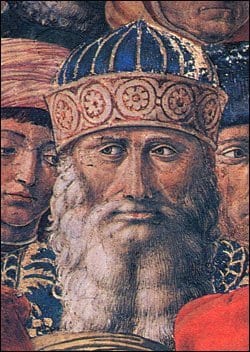
Benozzo Gozzoli : Gemistos Pletho /Wikimedia Commons

Gemistos Pletho, the philosopher, is a great enigma. He has been described by C.M. Woodhouse as the last of the “Hellenes,” following the indication of many, including many of his critics, that he was barely Christian, if he was a Christian at all, and rather a man who took to heart the Platonic (and therefore pagan) viewpoint. Thus, Theodore Zervas explained:
Gemistos was no doubt one of the great thinkers of his time, but his teachings were not without controversy. Gemistos outspokenly promoted reviving ancient Greek paganism and he is thought to have even worshiped the ancient Greek gods. He at one point declared to the Patriarch of Constantinople, “We over whom you rule and hold sway are Hellenes by race as is demonstrated by our language and ancestral education.” Christianity constituted the most important dimension of one’s personal identity during Gemistos’s time. To call yourself a Hellene often meant that you were not a Christian. Moreover, to learn about the world of the ancient Greeks meant walking a fine line between the righteous principles of Christianity and the heterodox practices of Greek paganism.[2]
However, not all scholars believe Pletho was entirely pagan. He did speak up for Christian doctrine, and indeed, he was asked to do so at the Council of Florence itself in defense of the Greek positions:
In private sessions of the Greek delegation his opinion was often invited, and given boldly, sometimes sardonically, but always with telling effect. He concentrated his attention on major matters of principle, ignoring what he may have considered conventional trivialities such as the use of leavened or unleavened bread or the cutting of hair and beards. His services had been enlisted as a philosopher rather than a theologian, so he confined his observations to matters which could be submitted to logical scrutiny: above all, the addition of the Filioque to the Creed, and the related doctrine of the Procession of the Holy Spirit.[3]
Indeed, it was specifically on the question of the filioque that Pletho directed most of his work at the council; afterward, he was still concerned with the subject: “Another philosopher, Gemistes Pletho, who had defended the orthodox doctrine at the Council, also published a defense of the orthodox doctrine on the procession of the Holy Ghost.” [4] Likewise, many of the most learned men of the time, including Mark of Ephesus and Bessarion, were students of Pletho, who, even Woodhouse pointed out, was known for his theological knowledge, even if it used it often in ironic ways:
Both Cardinal Bessarion, his former pupil, and the Patriarch Joseph II testified to Gemistos’ mastery of theology. That he was sufficiently familiar with the Greek fathers is shown by his references to John of Damascus, Dionysius the Areopagite, Justin Martyr, Gregory of Nazianzus, Cyril of Alexandria, and Theodoret of Cyrrhus. Of the later theologians, his only reference was to Thomas Aquinas, whose works he apparently knew from the fourteenth-century translations by Demetrious Kydones and others. But his attitude to Greek theology was generally ironic and polemical. He pretended, for example, to find a hint of the Arian heresy in one of Scholarios’ arguments, largely in a spirit of mockery rather than in condemnation. [5]
It is more than likely that Pletho held some level of Christian faith, though as a philosopher, he was eclectic, and was able to bridge in his mind the Christian faith with his developing philosophical opinions. He was doing, one could say, comparative theology long before it was a recognized discipline, often favoring employing ideas from the Hellenic tradition as the means by which he would express himself and his beliefs. As the first few points from Woodhouse’s summary of Pletho’s major work, the Laws, indicates, it is easy to think he held to some form of polytheism:
-
“The gods really exist; Zeus is chief among them and ‘altogether apart’; Poseidon is second; and the rest of the gods are produced by those two, without mothers but with the help of Hera.”[6]
-
“The gods provide for human affairs in accordance with the decrees of Zeus.”[7]
-
“The gods cause no evil and nothing but good.”[8]
-
“Everything that the gods do is in accordance with ‘irreversible and inexorable Fate proceeding from Zeus in the best of all possible ways’.”[9]
-
“The universe, including gods of the second and third rank, was created by Zeus and is eternal; it had no beginning in time, and will have no end.”[10]
It is easy to see how and why many of Pletho’s critics would then latch on to the notion that he was simply a pagan. This would be the way he would be presented after his death, as his teachings, found in works which had not been published while he was alive, would be examined and used to create a critical presentation of his thought. But those who would suggest Pletho held on to the Christian faith would likewise suggest his critics took what he said way too literally: they did not understand he was using the gods themselves in an allegorical fashion to represent various aspects of the one the divine reality. In this manner, Nicholas Goodrick-Clarke perhaps gives us a clue as to how to understand Pletho’s writings in a way which allows them to be viewed as Christian, and why many great Christian thinkers, like Bessarion (and even Mark of Ephesus), found in him a teacher they admired and they defended:
The elderly Plethon espoused a pagan Platonic philosophy that understood the ancient Greek gods as allegories of divine powers. Bessarion, who later became a cardinal, composed a defense of Plethon and Platonism against the Aristotelian George of Trebizond, who had attacked Plethon’s ideas. The ensuing wave of philosophical disputes, together with their translation and discussion among the humanists of Florence, prepared the ground for a major efflorescence of Platonism in the second half of the century.[11]
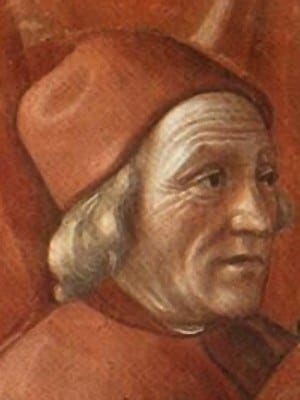
Domenico Ghirlandaio: Ficino / Wikimedia Commons

For Christian writers, it was not without precedent to look to pagan discussions of the gods, to pagan cosmologies, and finding in them allegories which point out some Christian truths. Before Pletho, Bernard Silvestris, Michael Psellos, John Tzetzes, and many others, can be found employing this kind of discourse in their writings. Marsilio Ficino, after Florence, continued this tradition in his writings. This is why it is important to take Pletho seriously, more seriously than Woodhouse, in saying that he did not write down his greatest teachings. Like many before him, his writings should be seen as riddles which need the proper key to interpret them. And without that key, then elements which were allegorical are easily mistaken as literal, leading people to assume Pletho was merely a pagan who somehow convinced many influential Christians to follow him as their teacher. His pupils, especially someone like Mark of Ephesus, would not have accepted him if they thought he was so profoundly unchristian.
It is clear Pletho was deeply influenced by pagan thought. He even wrote hymns which, even if they are allegories, show his desire to associate himself with the great pagan heritage he believed the Greek Christian tradition had assimilated in its wisdom. It was as a philosopher, as a Hellene, he was asked to go to the Council of Florence and help the Greeks explain their position against the Latins. It was also such a man who, finding his use at the official meetings limited, found himself often outside of the official council itself, lecturing those who were otherwise interested in Hellenic thought, giving them a solid introduction to the Platonic tradition:
Gemistos found himself immediately at home in this environment. He was little needed at the Council, for the Greek delegation was increasingly dominated by the Emperor, who now seldom sought the advice of laymen. So Gemistos spent his time instead among the Florentine humanists, discussing philosophy and correcting their misunderstandings of Plato and Aristotle. Eventually the discussions seem to have taken the form of lectures by Gemistos, which he later embodied in a summary version entitled On the Differences of Aristotle from Plato (literally, ‘with regard to Plato’), commonly known as De Differentiis. [12]
As the Council moved towards an official union between the Latins and the Greeks, Pletho was beginning a revolution in Europe, helping to inspire many within Florence as a result of the council to take on and explore the Hellenic tradition as a whole. That meant, taking on and accepting the wisdom of the pagan tradition. Though he was not the sole source of this inspiration, it is clear, he helped shape what was to come:
The impact of these lectures can be judged only from a few instances, but one of them is of decisive importance. Some twenty years afterwards, and less than ten years after Gemistos’ death, Cosimo de’ Medici founded what became known as the Platonic Academy. It was rather an intellectual dining club than a formal institution of learning. One of its principal functions was to celebrate Plato’s birthday every year. Continuity and direction were provided by Marsiilio Ficino (1433-99), the son of the Medici family doctor, who owed his education in Greek to the patronage of Cosimo.[13]
The advances that the Council of Florence brought to the church, with its ability to better appreciate and explore cultural diversity, found itself manifest in the Renaissance, with the great intellects following the example set by Florence by integrating the Christian imagination with the Hellenic tradition. The Renaissance was the fruit of the council, and that fruit showed that Christianity must broaden its thinking, must accept, learn from and adapt to wisdom wherever it is found, even from the pagans. The ambiguous status of Pletho was just what Christianity needed to kick itself back in gear and truly embrace its mission to integrate the truth into itself, no matter where it was found.
It should not be surprising, therefore, that many of the Greeks who later criticized the council focused on the influence of Pletho on his disciple, Bessarion, who was to become one of the greatest defenders of the council itself:
The attacks which these men launched on the reputation of Gemistos were bound also to touch Bessarion, directly or indirectly. In some cases they criticized him for defending Plato and his old tutor, in others for defecting to the Roman Catholic Church. Gemistos could be blamed for both for teaching him Platonism and for weakening his faith in Orthodoxy. Bessarion had stopped short of paganism, but in many other respects he exemplified the freedom of thought which was Gemistos’ most characteristic gift to his pupils. [14]
Similarly, then, many who objected to the Amazon Synod did so with the cultural adaptation promoted by it and those who came to the synod. They pointed out how many symbols, which were promoted in an enculturated form, came from various non-Christian, indigenous tradition, making them ambiguous in meaning. But they are acting like this was something new for the Christian faith. It has always been the way cultural symbols, such as the ankh, have been adapted by Christians. It is how the Council of Florence was able to kick-start the Renaissance and promote a broader understanding of the Christian faith.
Obviously, if the objection many presented about the ambiguous nature of the Amazon Synod had in relation to inculturation was valid, then it would be valid with the Council of Florence. But as the Council of Florence has long been established, at least by Catholics, as valid, then this calls into question the strategy of those who would attack the Amazon Synod. They must either deny the validity of the Council of Florence, because it did exactly what they objected to at the Amazon Synod, or they must accept that the synod’s approach had the Council of Florence as an example for how it engaged inculturation. Having Pletho speak at the Council of Florence, and teach outside of it with his philosophical (and therefore pagan wisdom) did not detract from the authority of the council nor its decrees: rather, it reinforced them by demonstrating the broad spectrum of thought which the Christian faith must address if it is to be true to itself. The church, when it follows its best nature, is inclusive of a diversity of cultures, even accepting non-Christian influences in that inclusivity; this is what we should get not only out of Florence, but the role that Pletho played at it, and it is exactly what we see promoted by the Amazon Synod.
[1] Ivan N. Ostroumoff, The History of the Council of Florence. Trans. Basil Popoff (Boston: MA: Holy Transfiguration Monastery, 1971),62-3.
[2] Theodore G Zervas, “Plato’s Influence on Gerogios Gemistos Plethon’s Teachings and Beliefs.” (Academia.edu), 2.
[3] C.M. Woodhouse, Gemistos Plethon: The Last of the Hellenes (Oxford: Clarendon Press, 1986), 137.
[4] Ivan N. Ostroumoff, The History of the Council of Florence, 173.
[5] C.M. Woodhouse, Gemistos Plethon, 69.
[6] C.M. Woodhouse, Gemistos Plethon, 319.
[7] C.M. Woodhouse, Gemistos Plethon, 319.
[8] C.M. Woodhouse, Gemistos Plethon, 319.
[9] C.M. Woodhouse, Gemistos Plethon, 319.
[10] C.M. Woodhouse, Gemistos Plethon, 319.
[11] Nicholas Goodrick-Clarke, The Western Esoteric Traditions: A Historical Introduction (Oxford: Oxford University Press, 2008), 35.
[12] C.M. Woodhouse, Gemistos Plethon, 155-6.
[13] C.M. Woodhouse, Gemistos Plethon, 156.
[14] C.M. Woodhouse, Gemistos Plethon, 15-16.
Stay in touch! Like A Little Bit of Nothing on Facebook.
If you liked what you read, please consider sharing it with your friends and family!
Previous Post

November 5, 2019
Eschatology and Probability
Next Post

November 7, 2019 The World Must Face the Reality Of Climate Change
Browse Our Archives
Select a Category Abortion Abraham abuse Aesthetics AI Aliens Ambrose Ancestors and Everything Andrew Angels Animals Anne Anthony Antisemitism apologetics Apophatic Apostle John Aquinas Artificial Intelligence Asanga Ascension Asceticism Assumption Atheism Attachment Augustine Authority Avarice Balthasar Baptism Beauty Biden birthright citizenship Bishops Black History Books Buddhism Bulgakov Byzantine Calendar C.S. Lewis Calcidius Catholic Catholicism Catholicism Celibacy Charity Chastity children Chrismation Christ Christmas Christology Church Climate Change Common Good Communion Confession Confirmation Conscience Constantine conventions conversion councils Covid Creation Cross Dead Death Death Penalty Debate Deception Demagogues Demons Desert Monks Desert Mothers Desire destruction development Dialogue Dignity Dionsyius Dionysius Discipline Diversity Division Doctor Who doctrine dogma Dormition Dualism Easter Easter Series Ecumenical Councils Ecumenism Education Election Empathy Environment Error Eschatology eschaton Eternity Ethics Eucharist Evangelism Eve Evil evolution Faeries Faith Fear femininity Ficino Florence Florensky Folktale Fools Forgiveness Freedom Future gender Gentile Gentiles Glory Gnostic God gods Good Samaritan Goodness Gospel Government Grace Great Fast Guns Hate healing Health Heaven Hell Hellenism Heresy Hierarchy Hildegard Hinduism History Holiness Holy Spirit Holy Week Hope Horror Human rights humanity Humility hypocrisy ICE icon icons Identification Identity Idol II Nicea Immigration incarnation Individualism Informal Reflections Inklings Intention Inter-Religious Interfaith Internet Interpretation Intrinsic evil Irenaeus Islam Israel Jacob Jerome Jesus Jews John Chrysostom John of Damascus John the Baptist Joseph Judaism justice Justification kenosis Kindnesss Kingdom of God Kingdom of Heaven Law Law of Moses Lazarus Leaf by Niggle Lent Lenten Reflection Liberation Theology Lies Life Listen Literature Liturgy locutions Logic Logos Love Marriage Martyrs Mary Mass Maximos The Confessor Meanness Meditation Mercy Middle Path Migrants Mind Miracles Miriam Morals Moses Movies Music Muslims Myths Names Nationalism Native Americans New Year Nicea Nicholas Nothing Novatian Obedience Occam's Razor Ordination Origen Original Sin Orthodox orthopraxis Pagans Palamas Palm Sunday Paradise Paschaltide Paul Peace Pentecost person Peter piety PKD Plato pluralism Plurality Poem Poetry Poiltics Politics Poor Pope Pope Francis Pope Leo XIV Post Office Prayer Pride Pro-life Prodigal Son propaganda Prophecy Prophets Providence Putin Racism Reading Reason Reflection Refugees Relationships Religion Religion Series Religious Liberty Repent Republicans Rest Resurrection Rich Rites Russia Sacraments Saints Salvation Salvian Santa Science Scripture Self-Giving Sexuality Sibyl Sick Silence Sin Singlehood Social Justice Society Sodom Solovyov Speculations Spiritual Reflection St. Cyril of Alexandria St. Justin Martyr Suffering Sunday of the Paralytic Man Sunday of the Samaritan Woman Superhero Supreme Court Teaching Technology Thanksgiving The Father the Universe Theological Reflection Theology Theosis Theotokos Thomas Timaeus Time Tolerenace Tolkien Tradition Transfiguration Trinity Trump Truth Uncategorized Unity Universities USCCB Value Vatican II Vegetarian Vices Violence Virtue Vocations War Water Welcome Wisdom Womanhood Women Work World View Worship Writing Zacchaeus
Select a Month October 2026 September 2026 August 2026 July 2026 June 2026 May 2026 April 2026 March 2026 February 2026 January 2026 December 2025 November 2025 October 2025 September 2025 August 2025 July 2025 June 2025 May 2025 April 2025 March 2025 February 2025 January 2025 December 2024 November 2024 October 2024 September 2024 August 2024 July 2024 June 2024 May 2024 April 2024 March 2024 February 2024 January 2024 December 2023 November 2023 October 2023 September 2023 August 2023 July 2023 June 2023 May 2023 April 2023 March 2023 February 2023 January 2023 December 2022 November 2022 October 2022 September 2022 August 2022 July 2022 June 2022 May 2022 April 2022 March 2022 February 2022 January 2022 December 2021 November 2021 October 2021 September 2021 August 2021 July 2021 June 2021 May 2021 April 2021 March 2021 February 2021 January 2021 December 2020 November 2020 October 2020 September 2020 August 2020 July 2020 June 2020 May 2020 April 2020 March 2020 February 2020 January 2020 December 2019 November 2019 October 2019 September 2019 August 2019 July 2019 June 2019 May 2019 April 2019 March 2019 February 2019 January 2019 December 2018 November 2018 October 2018 September 2018 August 2018 July 2018 June 2018 May 2018 April 2018 March 2018 February 2018 January 2018 December 2017 November 2017 October 2017 September 2017 August 2017 July 2017 June 2017 May 2017 April 2017 March 2017 February 2017 January 2017 December 2016 November 2016 October 2016 September 2016 August 2016 July 2016 June 2016 May 2016 April 2016 March 2016 February 2016
Follow Us!
TAKE THE
Religious Wisdom Quiz
Who dreamed of a ladder reaching to heaven?
Select your answer to see how you score.
Daniel Joseph Jacob Paul
Related posts from A Little Bit of Nothing
Christian Hellenism: An Example Of Catholicity

Uncreated Energies. Part Four: Divine Simplicity
Querida Amazonia and the Desert Fathers: The Wisdom...

Querida Amazonia And The Mission of the Catholic...
TRENDING AT PATHEOS Catholic

Creation, Preservation, and Teleology in Catholic Theology
As I write this, it is very early Monday morning. Like millions...

The Parable Of The Sower And The Word...
One of Christ’s most famous parables is that of the sower who...

Rejecting Doom: Christian Hope And Human Action
Christianity is a religion of hope. We are to have hope and...

Why I Choose the Eucharist Over the Sermon
Choose the Eucharist, Not the Sermon What are we supposed to get...

5 Design Elements Found in Spiritually Rooted Homes
Putting Spirituality Into Home Decor Our homes are more than our living...

Credo: A Story of God Told with the...
About 10 years ago, I began to imagine a personal "Credo" that...
view all Catholic blogs
Ad-Free & Subscriber Log-In Subscription Support
- About Us
- 2026 Calendar
- Videos
- Podcasts
- Library of World Religions
- Faith In Media Tracker
- Advertise With Us
- Write for Us
- Privacy Policy
- Terms of Service
- Do Not Sell My Data
- Contact Us
- Radiant Digital
- Manage Newsletter Subscriptions
- Unsubscribe From Notifications
- Sitemap
Copyright 2008-2026, Patheos. All rights reserved.
Subscription Support Ad-Free & Subscriber Log-In
Follow Patheos