
BuddhistCatholicContemplativeEvangelicalGeneral ChristianHinduJewishLatter-day SaintMuslimNew VisionsProgressive Christian
Beliefs
- Buddhist
- Catholic
- Contemplative
- Evangelical
- General Christian
- Hindu
- Jewish
- Latter-day Saint
- More Voices
- Muslim
- New Visions
- Pagan
- Progressive Christian
Topics
- Religion News
- Food and Religion
- Sports and Religion
- Religious Art
- Religious Music and Entertainment
- Religious Events
- History and Religion
- Style and Religion
- Politics and Religion
- Women in Religion
- Recreation Outdoors and Religion
- Business Finance and Religion
- Careers Workplace and Religion
- Education and Religion
- Family Parenting and Religion
- Health Fitness and Religion
- Home and Religion
- Relationships and Religion
- Technology and Religion
- Travel and Religion
Columnists
- Buddhist Columnists
- Business Finance and Religion Columnists
- Careers Workplace and Religion Columnists
- Catholic Columnists
- Contemplative Columnists
- Education and Religion Columnists
- Evangelists Columnists
- Family Parenting and Religion Columnists
- General Christian Columnists
- Health Fitness and Religion Columnists
- Hindu Columnists
- History and Religion Columnists
- Home and Religion Columnists
- Jewish Columnists
- More Voices Columnists
- Latter Day Columnists
- Muslim Columnists
- New Visions Columnists
- Nonreligious Columnists
- Pagan Columnists
- Politics and Religion Columnists
- Progressive Columnists
- Recreation Outdoors and Religion Columnists
- Relationships and Religion Columnists
- Religion News Columnists
- Religious Art Columnists
- Religious Events Columnists
- Religious Music and Entertainment Columnists
- Sports and Religion Columnists
- Style and Religion Columnists
- Technology and Religion Columnists
- Travel and Religion Columnists
- Women in Religion Columnists
Resource Library
- 2026 Calendar
- Library of World Religions
- The 100 Most Holy Places on Earth
- Patheos Answers
- Podcasts
- Videos
- Faith Leaders Database
- Anglican Episcopalian
- Bahai
- Baptist
- Buddhism
- Christianity
- Confucianism
- Eastern Orthodoxy
- Hinduism
- Holiness and Pentecostal
- ISKCON
- Islam
- Judaism
- Lutheran
- Methodist
- The Church of Jesus Christ of Latter-day Saints
- New Age
- Paganism
- Presbytarian and Reformed
- Protestantism
- Religion Behind the Scenes
- Roman Catholic
- Scientology
- Shia Islam
- Sikhism
- Sufism
- Sunni Islam
- Taoism
- Zen
- See all religions
Research Tools
 Ad-Free & Subscriber Log-In Subscription Support
Ad-Free & Subscriber Log-In Subscription Support
Follow Patheos 

- Trending:
- Forgiveness
- |
- Marriage
- |
- Consciousness
- |
- Death Penalty
- |
- Election
- |
- Halloween

- Home
- Catholic
- Marian Reflections VII: The Death and Assumption of Mary (Part 3)
Marian Reflections VII: The Death and Assumption of Mary (Part 3)
Last updated on: June 4, 2016 at 5:07 am by Henry Karlson
Marian Reflections VII: The Death and Assumption of Mary (Part 3) 2016-06-04T05:07:20-05:00 Henry Karlson
Patheos Explore the world's faith through different perspectives on religion and spirituality! Patheos has the views of the prevalent religions and spiritualities of the world.
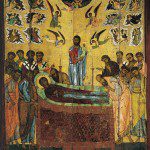
![By Anonymous Russian icon painter (before 1917) Public domain image (according to PD-RusEmpire) owned by the Tretyakov Gallery [Public domain], via Wikimedia Commons.](https://wp-media.patheos.com/blogs/sites/637/2016/05/DormitionIcon.jpg)
The dormition as represented by an anonymous Russian icon painter (before 1917) Public domain image (according to PD-RusEmpire) owned by the Tretyakov Gallery [Public domain], via Wikimedia Commons.
This post is the third in a series exploring Mary’s death and assumption into heaven. To read the first, click here and to read the second, click here.
The vision of the woman of the Apocalypse, the woman “clothed with the sun,” is the revelation of the eschatological glory Jesus rendered to humanity. The woman who gave birth to the messiah, to the king of kings and God-man, is seen in the heavens, indicating that she has been taken to her rightful place in eternity. With her as our representative, we are shown the glory we are to have in eternity as we become partakers of the divine nature (cf. 2 Ptr. 1:4). She has been taken up into the heavens, where, as the Psalms declare, we are to discern the glory of God:
The heavens are telling the glory of God; and the firmament proclaims his handiwork. Day to day pours forth speech, and night to night declares knowledge. There is no speech, nor are there words; their voice is not heard; yet their voice goes out through all the earth, and their words to the end of the world. In them he has set a tent for the sun, which comes forth like a bridegroom leaving his chamber, and like a strong man runs its course with joy (Ps. 19:1-5 RSV).
The glory of God in the heavens is shown to come down to us and be manifested in the tabernacle, the tent in which the Ark of the Covenant was placed before the construction of the Temple. That tent was placed in the midst of the sun, the light of which served as a figure of the light and glory of God (cf. Hab. 3:4), that is, of Jesus, the light of the world (cf. Jn. 8:12). From this, St. Augustine understood Psalm 19 as a prophetic witness, in figurative form, of the birth of Jesus:
“In the sun has He set His tabernacle.” Now that He might war against the powers of temporal error, the Lord, being about to send not peace but a sword on earth, in time, or in manifestation, set so to say His military dwelling, that is, the dispensation of His incarnation. “And He as a bridegroom coming forth out of His chamber” And He, coming forth out of the Virgin’s womb, where God was united to man’s nature as a bridegroom to a bride. “Rejoiced as a giant to run His way.” Rejoiced as One exceeding strong, and surpassing all other men in power incomparable, not to inhabit, but to run His way. For, “He stood not in the way of sinners.”[1]
What we see in Psalm 19, and its Augustinian interpretation, should allow us to understand its relationship of the glory of the tabernacle with the Ark of the Covenant in it to the woman clothed in the sun in the Apocalypse. The sun’s light clothed the tabernacle, revealing in typological form what would be fulfilled in and through the woman of the Apocalypse. God the Word has tabernacled, or made his tent, with us (cf. Jn 1:14), and in and with his dwelling with humanity, he has been glorified through his death, resurrection and ascension. But now, instead of the Ark of the Mosaic Covenant, his tabernacle, his flesh, contains what the Ark of the Covenant prefigured, the flesh and bloody of Mary. For Jesus took flesh from her flesh, blood from blood, and made it his own as he came to us and tabernacled with us in the incarnation. As the tabernacle was shown to be in the sun, so now the woman which it prefigured, is seen to be in the heavens, clothed in the sun, for by the ascent of Christ, the new Ark of the Covenant was also taken into glory.
By following this kind of typology, many patristic writers were able to explore the significance of Mary’s death and assumption into heaven. Once the feast of her dormition (death) had taken root in the liturgical cycle, this typology would then become reflected in the homilies which were written for the celebration. For example, we can read St. Andrew of Crete making such a connection in his homilies when he proclaimed: “Behold, the new ark of God’s glory, containing, ‘the golden vase, Aaron’s rod that blossomed, and the tabernacle of the covenant’ (Heb 9:4).” [2] With such a foundation, St. Andrew was then able to demonstrate the parallel between the Ark being taken into the Tabernacle with the way Mary was assumed into heaven:
This, O Mother of God, is the hidden meaning of your supernatural dormition. This is the funeral oration that shall accompany the sacred procession of the tent God raised as his tabernacle; the hymn for your passing, the record of the events both proceeding and following your burial, the memorial ode for that transition that surpasses all knowledge. These are but oblique, blurred images of the divine mysteries, the blessed revelations given us about you.[3]
What patristic writers understood concerning the relationship between the Old and New Covenants, between the Old and the New Testament, is important for our theological understanding of Mary. From them, we come to realize how the Old Testament prefigured in typology the glory which was to be fulfilled and given out in eternity through the New Covenant. This is why Jesus was able to say that he came not to destroy the law but to fulfill it, to complete what the whole law represented. For in the law and the prophets, in all that was written, Jesus was being represented (Lk 24:27 – 44; Jn 5:46; Heb 10:1). And because of her connection with Jesus, much of that typology therefore tells us something about Mary. Thus, as David danced around the Ark,[4] so John the Baptist danced with joy in his mother’s womb before the new Ark, Mary.[5] And just as Solomon had the Ark brought into Temple, with much joy and festivity,[6] he did this in anticipation of the true Solomon, Jesus, bringing his mother to the heavenly and eternal temple, as St. John of Damascus elucidated for us:
So now, to bring to its place the spiritual ark not the Lord’s covenant but of the very person of God the Word, the new Solomon himself, King of Peace and master-builder of the universe, called together on this day the sublime ranks of heavenly spirits, and the leaders of the new covenant – I mean the Apostles – with all the holy people in Jerusalem. And he solemnly led her soul, accompanied by angels, into the real and original Holy of Holies in heaven (see Heb 9:12; 10:20), resting on the very wings of the four “living creatures” (Ezek 1:6); he seated her next to his own throne, with the veil where Christ himself, our forerunner, has gone in his own body (cf. Heb 9:12; 10:20). [7]
We can even see the relationship between the funeral procession of Mary, and how her body was carried to her tomb, as similar to the way the Ark was to be carried, not directly, but with specially constructed poles. And just as the Ark was not to be touched, and those who touched it would suffer the consequences of their action, so Mary was not to be defiled as she was placed into her tomb. This, then, explains the legend of the Jewish man who tried to seize her found his hands cut off until he repented and was converted to the Christian faith: it fits with the typology connected to the Ark of the Covenant, and so its significance is best understood in this fashion, and not as an anti-Semitic sentiment.[8]
[1] St. Augustine “On the Psalms” in NPNF1(8): 54-5.
[2] St. Andrew of Crete, “Homily III on the Dormition” in On the Dormition: Early Patristic Homilies. trans. Brian E. Daley, S.J. (Crestwood, NY: St Vladimir’s Seminary Press, 1998), 147.
[3] Ibid., 148.
[4] 2 Sam 6:14
[5] See Joseph Raztinger, Daughter Zion. trans. John M. McDermott, S. J. (San Francisco: Ignatius Press, 1983), 81-2.
[6] See 1 King 8:1-20; 2 Chron 5:2-14.
[7] St John of Damascus, “Homily II on the Dormition” in On the Dormition: Early Patristic Homilies. trans. Brian E. Daley, S.J. (Crestwood, NY: St Vladimir’s Seminary Press, 1998), 216.
[8] See, for example, St John of Damascus, “Homily II on the Dormition,” 216-7.
Stay in touch! Like A Little Bit of Nothing on Facebook:
A Little Bit of Nothing
Previous Post

June 2, 2016
Reflection on the Death of Harambe
Next Post
June 11, 2016 Marian Reflections VII: The Death and Assumption of Mary (Part 4)
Browse Our Archives
Select a Category Abortion Abraham abuse Aesthetics AI Aliens Ambrose Ancestors and Everything Andrew Angels Animals Anne Anthony Antisemitism apologetics Apophatic Apostle John Aquinas Artificial Intelligence Asanga Ascension Asceticism Assumption Atheism Attachment Augustine Authority Avarice Balthasar Baptism Beauty Biden birthright citizenship Bishops Black History Books Buddhism Bulgakov Byzantine Calendar C.S. Lewis Calcidius Catholic Catholicism Catholicism Celibacy Charity Chastity children Chrismation Christ Christmas Christology Church Climate Change Common Good Communion Confession Confirmation Conscience Constantine conventions conversion councils Covid Creation Cross Dead Death Death Penalty Debate Deception Demagogues Demons Desert Monks Desert Mothers Desire destruction development Dialogue Dignity Dionsyius Dionysius Discipline Diversity Division Doctor Who doctrine dogma Dormition Dualism Easter Easter Series Ecumenical Councils Ecumenism Education Election Empathy Environment Error Eschatology eschaton Eternity Ethics Eucharist Evangelism Eve Evil evolution Faeries Faith Fear femininity Ficino Florence Florensky Folktale Fools Forgiveness Freedom Future gender Gentile Gentiles Glory Gnostic God gods Good Samaritan Goodness Gospel Government Grace Great Fast Guns Hate healing Health Heaven Hell Hellenism Heresy Hierarchy Hildegard Hinduism History Holiness Holy Spirit Holy Week Hope Horror Human rights humanity Humility hypocrisy ICE icon icons Identification Identity Idol II Nicea Immigration incarnation Individualism Informal Reflections Inklings Intention Inter-Religious Interfaith Internet Interpretation Intrinsic evil Irenaeus Islam Israel Jacob Jerome Jesus Jews John Chrysostom John of Damascus John the Baptist Joseph Judaism justice Justification kenosis Kindnesss Kingdom of God Kingdom of Heaven Law Law of Moses Lazarus Leaf by Niggle Lent Lenten Reflection Liberation Theology Lies Life Listen Literature Liturgy locutions Logic Logos Love Marriage Martyrs Mary Mass Maximos The Confessor Meanness Meditation Mercy Middle Path Migrants Mind Miracles Miriam Morals Moses Movies Music Muslims Myths Names Nationalism Native Americans New Year Nicea Nicholas Nothing Novatian Obedience Occam's Razor Ordination Origen Original Sin Orthodox orthopraxis Pagans Palamas Palm Sunday Paradise Paschaltide Paul Peace Pentecost person Peter piety PKD Plato pluralism Plurality Poem Poetry Poiltics Politics Poor Pope Pope Francis Pope Leo XIV Post Office Prayer Pride Pro-life Prodigal Son propaganda Prophecy Prophets Providence Putin Racism Reading Reason Reflection Refugees Relationships Religion Religion Series Religious Liberty Repent Republicans Rest Resurrection Rich Rites Russia Sacraments Saints Salvation Salvian Santa Science Scripture Self-Giving Sexuality Sibyl Sick Silence Sin Singlehood Social Justice Society Sodom Solovyov Speculations Spiritual Reflection St. Cyril of Alexandria St. Justin Martyr Suffering Sunday of the Paralytic Man Sunday of the Samaritan Woman Superhero Supreme Court Teaching Technology Thanksgiving The Father the Universe Theological Reflection Theology Theosis Theotokos Thomas Timaeus Time Tolerenace Tolkien Tradition Transfiguration Trinity Trump Truth Uncategorized Unity Universities USCCB Value Vatican II Vegetarian Vices Violence Virtue Vocations War Water Welcome Wisdom Womanhood Women Work World View Worship Writing Zacchaeus
Select a Month October 2026 September 2026 August 2026 July 2026 June 2026 May 2026 April 2026 March 2026 February 2026 January 2026 December 2025 November 2025 October 2025 September 2025 August 2025 July 2025 June 2025 May 2025 April 2025 March 2025 February 2025 January 2025 December 2024 November 2024 October 2024 September 2024 August 2024 July 2024 June 2024 May 2024 April 2024 March 2024 February 2024 January 2024 December 2023 November 2023 October 2023 September 2023 August 2023 July 2023 June 2023 May 2023 April 2023 March 2023 February 2023 January 2023 December 2022 November 2022 October 2022 September 2022 August 2022 July 2022 June 2022 May 2022 April 2022 March 2022 February 2022 January 2022 December 2021 November 2021 October 2021 September 2021 August 2021 July 2021 June 2021 May 2021 April 2021 March 2021 February 2021 January 2021 December 2020 November 2020 October 2020 September 2020 August 2020 July 2020 June 2020 May 2020 April 2020 March 2020 February 2020 January 2020 December 2019 November 2019 October 2019 September 2019 August 2019 July 2019 June 2019 May 2019 April 2019 March 2019 February 2019 January 2019 December 2018 November 2018 October 2018 September 2018 August 2018 July 2018 June 2018 May 2018 April 2018 March 2018 February 2018 January 2018 December 2017 November 2017 October 2017 September 2017 August 2017 July 2017 June 2017 May 2017 April 2017 March 2017 February 2017 January 2017 December 2016 November 2016 October 2016 September 2016 August 2016 July 2016 June 2016 May 2016 April 2016 March 2016 February 2016
Follow Us!
TAKE THE
Religious Wisdom Quiz
True or False: In Mark, Jesus healed a man with a withered hand on the Sabbath, which angered the Pharisees.
Select your answer to see how you score.
FALSE TRUE
Related posts from A Little Bit of Nothing
How Tradition Points Away From The Death Penalty
Born for This: The Nativity of Mary
Jesus And Mary: Models Of Self-Emptying Love

Misinterpretations Of Colbert’s Remarks On The Afterlife
TRENDING AT PATHEOS Catholic

Rejecting Doom: Christian Hope And Human Action
Christianity is a religion of hope. We are to have hope and...

It’s What Comes From Within Which Matters
One of the most difficult things for us to understand is why...

Why I Choose the Eucharist Over the Sermon
Choose the Eucharist, Not the Sermon What are we supposed to get...

5 Design Elements Found in Spiritually Rooted Homes
Putting Spirituality Into Home Decor Our homes are more than our living...

Credo: A Story of God Told with the...
About 10 years ago, I began to imagine a personal "Credo" that...

The Anatomy of Divine Revelation in Catholic Thought
The claim that God has made Himself known to human beings is...
view all Catholic blogs
Ad-Free & Subscriber Log-In Subscription Support
- About Us
- 2026 Calendar
- Videos
- Podcasts
- Library of World Religions
- Faith In Media Tracker
- Advertise With Us
- Write for Us
- Privacy Policy
- Terms of Service
- Do Not Sell My Data
- Contact Us
- Radiant Digital
- Manage Newsletter Subscriptions
- Unsubscribe From Notifications
- Sitemap
Copyright 2008-2026, Patheos. All rights reserved.
Subscription Support Ad-Free & Subscriber Log-In
Follow Patheos