
BuddhistCatholicContemplativeEvangelicalGeneral ChristianHinduJewishLatter-day SaintMuslimNew VisionsProgressive Christian
Beliefs
- Buddhist
- Catholic
- Contemplative
- Evangelical
- General Christian
- Hindu
- Jewish
- Latter-day Saint
- More Voices
- Muslim
- New Visions
- Pagan
- Progressive Christian
Topics
- Religion News
- Food and Religion
- Sports and Religion
- Religious Art
- Religious Music and Entertainment
- Religious Events
- History and Religion
- Style and Religion
- Politics and Religion
- Women in Religion
- Recreation Outdoors and Religion
- Business Finance and Religion
- Careers Workplace and Religion
- Education and Religion
- Family Parenting and Religion
- Health Fitness and Religion
- Home and Religion
- Relationships and Religion
- Technology and Religion
- Travel and Religion
Columnists
- Buddhist Columnists
- Business Finance and Religion Columnists
- Careers Workplace and Religion Columnists
- Catholic Columnists
- Contemplative Columnists
- Education and Religion Columnists
- Evangelists Columnists
- Family Parenting and Religion Columnists
- General Christian Columnists
- Health Fitness and Religion Columnists
- Hindu Columnists
- History and Religion Columnists
- Home and Religion Columnists
- Jewish Columnists
- More Voices Columnists
- Latter Day Columnists
- Muslim Columnists
- New Visions Columnists
- Nonreligious Columnists
- Pagan Columnists
- Politics and Religion Columnists
- Progressive Columnists
- Recreation Outdoors and Religion Columnists
- Relationships and Religion Columnists
- Religion News Columnists
- Religious Art Columnists
- Religious Events Columnists
- Religious Music and Entertainment Columnists
- Sports and Religion Columnists
- Style and Religion Columnists
- Technology and Religion Columnists
- Travel and Religion Columnists
- Women in Religion Columnists
Resource Library
- 2026 Calendar
- Library of World Religions
- The 100 Most Holy Places on Earth
- Patheos Answers
- Podcasts
- Videos
- Faith Leaders Database
- Anglican Episcopalian
- Bahai
- Baptist
- Buddhism
- Christianity
- Confucianism
- Eastern Orthodoxy
- Hinduism
- Holiness and Pentecostal
- ISKCON
- Islam
- Judaism
- Lutheran
- Methodist
- The Church of Jesus Christ of Latter-day Saints
- New Age
- Paganism
- Presbytarian and Reformed
- Protestantism
- Religion Behind the Scenes
- Roman Catholic
- Scientology
- Shia Islam
- Sikhism
- Sufism
- Sunni Islam
- Taoism
- Zen
- See all religions
Research Tools
 Ad-Free & Subscriber Log-In Subscription Support
Ad-Free & Subscriber Log-In Subscription Support
Follow Patheos 

- Trending:
- Forgiveness
- |
- Marriage
- |
- Consciousness
- |
- Death Penalty
- |
- Election
- |
- Halloween

- Home
- Catholic
- On the Sainthood of St. Constantine the Great
On the Sainthood of St. Constantine the Great
Last updated on: May 19, 2016 at 8:53 am by Henry Karlson
On the Sainthood of St. Constantine the Great 2016-05-19T08:53:46-05:00 Henry Karlson
Patheos Explore the world's faith through different perspectives on religion and spirituality! Patheos has the views of the prevalent religions and spiritualities of the world.
Who we as a person comes in part from our choices, from our actions, from the freedom God has given to us to shape our identity. We are able to write biographies because of this, for through the deeds someone has done, we know a little of the person behind the deeds.[1] We must of course realize that our freedom is a limited, contingent form of freedom. There are many things given over to us which are outside of our control, such as the place and time of our birth. They set the stage for us in which we can act.
One such foundation which we cannot get around is the person God intends us to be in our union with Christ. Although it might sound a bit cliché, God has intentions for everyone, that is, he has a purpose for everyone, a purpose which can be said to be the mission they are meant to achieve in their life. This mission is outside of our control; we cannot make it for ourselves, as Hans Urs von Balthasar said:
No one can give himself a mission. On the other hand, where a person is entrusted with a substantial mission that summons him to put his very existence at its disposal, the person thus sent [der Gesendete] can, as a result, become (to a degree) identified with the mission [Sendung]. [2]
Because God has granted us a form of free will, we have some freedom in the way we execute the mission and fulfill it, or, if we want, to deny it. Our fulfillment of that mission allows us to truly become a person in Christ, while its utter rejection depersonalizes us, so that the more we realize our mission, the more we can be said to be a truly free subject, while the more we fight against it, the less of a subject we become, until at last, we lose all freedom as we lose our face before God.
The saints are those who let the mission God has given them truly define them. That is, a saint is someone who gives themselves and their lives entirely over the fulfillment of their mission, and in the process, their sins do not get in the way so that by the time they have died, they achieved at least the bare minimum required by God for their mission to be said to be fulfilled. Because of the way they are free to choose how they realize their mission, they clearly make mistakes in its execution. Saints also are sinners who stumble along the path to God like the rest of us, and so even in the fulfillment of their mission, they can and likely will have many grave errors in its execution. Grace, however, perfects nature, and those who give themselves over to God in love, and seek to follow him in faith, will find that his grace will be able to take the mess they made of their mission and still allow it to be fulfilled. Thus, when we look to the lives of the saints, we find them to be all too human, with human faults, often acting in ways we disapprove. Their holiness affirms not their errors, but their person in Christ, and the mission which they fulfilled through grace.
![By File:Hagia_Sophia_Southwestern_entrance_mosaics.jpg: Photograph: Myrabella derivative work: Myrabella [Public domain or CC0], via Wikimedia Commons](https://wp-media.patheos.com/blogs/sites/637/2016/05/Constantine_I_Hagia_Sophia.jpg)
By File:Hagia_Sophia_Southwestern_entrance_mosaics.jpg: Photograph: Myrabella derivative work: Myrabella [Public domain or CC0], via Wikimedia Commons
This, then, should help us understand why Constantine was not just Constantine, the first Christian emperor of Rome, but Saint Constantine the Great.[3] He was far from perfect in the way he lived his life. There are serious questions which can be raised about many of his actions, for many of them we can easily say were vile, such as the way he is claimed to have treated his wife and son.[4] He was a man of his time, and yet he transcended the time with his vision for a better Rome, and he did a lot to change the structure of society for the better. As we can reject, in an objective way, the thoughts and actions of people who lived in the past while understanding the subjective culpability changes due to the circumstances they found themselves in, so this certainly holds true with Constantine who was raised in a far more violent and unjust society than he was to help establish.
St. Constantine had a very particular mission. He was called to have Rome conquered by the power and sign of the cross. That is, he was called to transform Rome, and with Rome, the world, to take in the implications of the incarnation in history and use them for the creation of a better society. He was in the middle of a military campaign, we are told, when he started to pray to God, asking for God’s help. He was then given a revelation of his mission, where he is said to have seen the sign of the cross in the heaven and told by it he shall conquer his enemies:
Accordingly he called on him with earnest prayer and supplications that he would reveal to him who he was, and stretch forth his right hand to help him in his present difficulties. And while he was thus praying with fervent entreaty, a most marvelous sign appeared to him from heaven, the account of which it might have been hard to believe had it been related by any other person. But since the victorious emperor himself long afterwards declared it to the writer of this history, when he was honored with his acquaintance and society, and confirmed his statement by an oath, who could hesitate to accredit the relation, especially since the testimony of after-time has established its truth? He said that about noon, when the day was already beginning to decline, he saw with his own eyes the trophy of a cross of light in the heavens, above the sun, and bearing the inscription, Conquer by this . At this sight he himself was struck with amazement, and his whole army also, which followed him on this expedition, and witnessed the miracle. [5]
Even with that revelation, he was not too sure what it meant until he later, through a dream, found the command was given to him again.[6] For this reason, some historians talk about the sign in the heavens, while others talked about the sign he received in his dream, such as we find in the writings of Lactantius:
Constantine was directed in a dream to cause the heavenly sign to be delineated on the shields of his soldiers, and so to proceed to battle. He did as he had been commanded, and he marked on their shields the letter Χ, with a perpendicular line drawn through it and turned round thus at the top, being the cipher of CHRIST. Having this sign, his troops stood to arms. The enemies advanced, but without their emperor they crossed the bridge. The armies met, and fought with the utmost exertions of valour, and firmly maintained their ground. In the meantime, a sedition arose at Rome, and Maxentius was reviled as one who had abandoned all concern for the safety of the commonweal; and suddenly, while he exhibited the Circensian games on the anniversary of his reign, the people cried with one voice, “Constantine cannot be overcome!” Dismayed at this, Maxentius burst from the assembly, and having called some senators together, ordered the Sibylline books to be searched. In them it was found that:—
“On the same day the enemy of the Romans should perish.”
Led by this response to the hopes of victory, he went to the field. The bridge in his rear was broken down. At sight of that the battle grew hotter. The hand of the Lord prevailed, and the forces of Maxentius were routed. He fled towards the broken bridge; but the multitude pressing on him, he was driven headlong into the Tiber.[7]
Constantine made the sign of the cross as the sign under which he would live out the rest of his life. After his victory in war, he made his new faith known, and asked for Christian authorities to come to him and help him understand his new faith better. Through Constantine, Christ was beginning to conquer the true enemies of the Romans, the dark powers which had come to rule over and direct the path of the Roman empire. Constantine gave authority, power and respect to the Christians and their churches, transforming Roman law through the guidance of the same Christians who had for so long been persecuted by the Roman state. Aided by his mother, he would literally set high up the cross, to make it a true sign of victory – the victory of the persecuted and abused over their abusers. Rome and the world would never be the same because he took the sign of the cross seriously, and he set forth with a desire to rule in a new way, to be led by the moral standards of his newfound faith. And despite how imperfectly he can be shown to live out those new standards, often not understanding their full implications, the change which took place in him and in Rome demonstrates the way his mission was lived out and fulfilled. By the time he died, though the battles between old Rome and the new Christian Rome were not yet over, the war was won, and no matter how some like Julian would like to go back to pre-Christian times, it was not possible. Constantine had changed the world as God had intended. There was no going back.[8]
This, then, is exemplified in the Troparion for his feast, where his mission is understood, and his glory in Christ praised:
Having seen the figure of the Cross in the heavens,
And like Paul not having received his call from men, O Lord,
Your apostle among rulers, the Emperor Constantine,
Has been set by Your hand as ruler over the Imperial City
That he preserved in peace for many years,
Through the prayers of the Theotokos, O only lover of mankind.
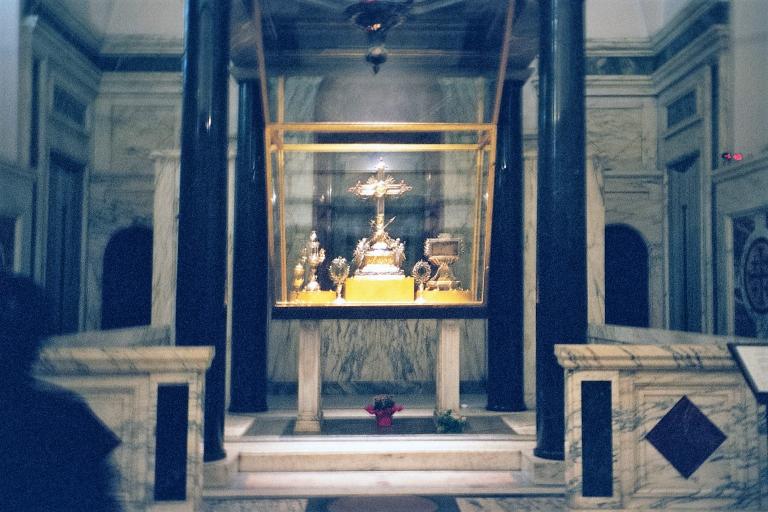
The Holy Cross at Holy Cross at Jerusalem, Rome. Photo by Henry Karlson
The feast of St. Constantine therefore is a feast of the cross, of the victory of life over death, of love over hate, of grace over sin. Constantine served the mission given to him in many ways, key of which, was to call the Church itself to needful self-reflection, through the calling of the first ecumenical council, Nicea. Christians during the times of persecution were not able to come together and reason out their faith together, but thanks to Constantine, a new era of intra-ecclesial relations formed, starting the path by which the Church could better present itself and its teachings to all. But of course, Constantine was not able to oversee what was to come after his death; his mission was to start the needful changes in society; after him, God would send others, with missions of their own, to continue that work, a work which continues to be with us to this day. Constantine fulfilled his mission and so justly is honored as a saint, despite whatever criticism can be rightfully pointed his way. Let us hope that we, too, can find our mission and fulfill it for the glory of God as well.
[1] This is also a foundation by which we can come to know God, that is, through his activities (energia) which we can comprehend.
[2] Hans Urs von Balthasar, Theo-Drama III. trans. Graham Harrison (San Francisco: Ignatius Press, 1992), 154.
[3] While the Western calendar ignores his feast, in the East, St. Constantine and his mother, St. Helen, are both celebrated on May the 21st. He is recognized as a saint by Eastern Catholics, and so through them, he is a Saint in the Catholic Church.
[4] The historian Sozomen believed that many things said against Constantine were questionable rumors made by his non-Christian subjects who sought to undermine his legacy through such gossip:
I am aware that it is reported by the pagans that Constantine, after slaying some of his nearest relations, and particularly after assenting to the murder of his own son Crispus, repented of his evil deeds, and inquired of Sopater, the philosopher, who was then master of the school of Plotinus, concerning the means of purification from guilt. The philosopher— so the story goes— replied that such moral defilement could admit of no purification. The emperor was grieved at this repulse, but happening to meet with some bishops who told him that he would be cleansed from sin, on repentance and on submitting to baptism, he was delighted with their representations, and admired their doctrines, and became a Christian, and led his subjects to the same faith. It appears to me that this story was the invention of persons who desired to vilify the Christian religion. Crispus, on whose account, it is said, Constantine required purification, did not die till the twentieth year of his father’s reign; he held the second place in the empire and bore the name of Cæsar and many laws, framed with his sanction in favor of Christianity, are still extant. That this was the case can be proved by referring to the dates affixed to these laws, and to the lists of the legislators. It does not appear likely that Sopater had any intercourse with Constantine whose government was then centered in the regions near the ocean and the Rhine; for his dispute with Maxentius, the governor of Italy, had created so much dissension in the Roman dominions, that it was then no easy matter to dwell in Gaul, in Britain, or in the neighboring countries, in which it is universally admitted Constantine embraced the religion of the Christians, previous to his war with Maxentius, and prior to his return to Rome and Italy: and this is evidenced by the dates of the laws which he enacted in favor of religion. But even granting that Sopater chanced to meet the emperor, or that he had epistolary correspondence with him, it cannot be imagined the philosopher was ignorant that Hercules, the son of Alcmena, obtained purification at Athens by the celebration of the mysteries of Ceres after the murder of his children, and of Iphitus, his guest and friend. That the Greeks held that purification from guilt of this nature could be obtained, is obvious from the instance I have just alleged, and he is a false calumniator who represents that Sopater taught the contrary.
Sozomen, Ecclesiastical History in NPNF2(2):242-3.
While this could be true for some things he is claimed to have done, we do know that at other times, he truly did act unjustly, such as in his treatment of St. Athanasius. We can object to many things he did, as we do with any saint, without rejecting the fact that they did fulfill their mission in life thanks to the grace of God.
[5] Eusebius, “The Life of Constantine” in NPNF2(1):490.
[6] See ibid., 490.
[7] Lactantius, “On the Manner in Which the Persecutors Died” in ANF(7): 318.
[8] This can be seen even in the way the pagans in Rome adapted themselves to imitate Christian ways, such as the way Julian tried to have Christian forms of charity copied by his pagan associates. Christ, and the imprint of Christ on Roman society after Constantine, made it impossible for thing to return to the way they were. Julian, moreover, found out that he could not turn back the change, so that when he died, he himself had to relent and admit Christ was victorious – the pagan past was over and any immediate attempt at its revival died with Julian.
Stay in touch! Like A Little Bit of Nothing on Facebook:
A Little Bit of Nothing
Previous Post

May 17, 2016
Nothing is Proven When Occam's Razor Cuts Up the World
Next Post
May 21, 2016 Marian Reflections VII: The Death and Assumption of Mary (Part 1)
Browse Our Archives
Select a Category Abortion Abraham abuse Aesthetics AI Aliens Ambrose Ancestors and Everything Andrew Angels Animals Anne Anthony Antisemitism apologetics Apophatic Apostle John Aquinas Artificial Intelligence Asanga Ascension Asceticism Assumption Atheism Attachment Augustine Authority Avarice Balthasar Baptism Beauty Biden birthright citizenship Bishops Black History Books Buddhism Bulgakov Byzantine Calendar C.S. Lewis Calcidius Catholic Catholicism Catholicism Celibacy Charity Chastity children Chrismation Christ Christmas Christology Church Climate Change Common Good Communion Confession Confirmation Conscience Constantine conventions conversion councils Covid Creation Cross Dead Death Death Penalty Debate Deception Demagogues Demons Desert Monks Desert Mothers Desire destruction development Dialogue Dignity Dionsyius Dionysius Discipline Diversity Division Doctor Who doctrine dogma Dormition Dualism Easter Easter Series Ecumenical Councils Ecumenism Education Election Empathy Environment Error Eschatology eschaton Eternity Ethics Eucharist Evangelism Eve Evil evolution Faeries Faith Fear femininity Ficino Florence Florensky Folktale Fools Forgiveness Freedom Future gender Gentile Gentiles Glory Gnostic God gods Good Samaritan Goodness Gospel Government Grace Great Fast Guns Hate healing Health Heaven Hell Hellenism Heresy Hierarchy Hildegard Hinduism History Holiness Holy Spirit Holy Week Hope Horror Human rights humanity Humility hypocrisy ICE icon icons Identification Identity Idol II Nicea Immigration incarnation Individualism Informal Reflections Inklings Intention Inter-Religious Interfaith Internet Interpretation Intrinsic evil Irenaeus Islam Israel Jacob Jerome Jesus Jews John Chrysostom John of Damascus John the Baptist Joseph Judaism justice Justification kenosis Kindnesss Kingdom of God Kingdom of Heaven Law Law of Moses Lazarus Leaf by Niggle Lent Lenten Reflection Liberation Theology Lies Life Listen Literature Liturgy locutions Logic Logos Love Marriage Martyrs Mary Mass Maximos The Confessor Meanness Meditation Mercy Middle Path Migrants Mind Miracles Miriam Morals Moses Movies Music Muslims Myths Names Nationalism Native Americans New Year Nicea Nicholas Nothing Novatian Obedience Occam's Razor Ordination Origen Original Sin Orthodox orthopraxis Pagans Palamas Palm Sunday Paradise Paschaltide Paul Peace Pentecost person Peter piety PKD Plato pluralism Plurality Poem Poetry Poiltics Politics Poor Pope Pope Francis Pope Leo XIV Post Office Prayer Pride Pro-life Prodigal Son propaganda Prophecy Prophets Providence Putin Racism Reading Reason Reflection Refugees Relationships Religion Religion Series Religious Liberty Repent Republicans Rest Resurrection Rich Rites Russia Sacraments Saints Salvation Salvian Santa Science Scripture Self-Giving Sexuality Sibyl Sick Silence Sin Singlehood Social Justice Society Sodom Solovyov Speculations Spiritual Reflection St. Cyril of Alexandria St. Justin Martyr Suffering Sunday of the Paralytic Man Sunday of the Samaritan Woman Superhero Supreme Court Teaching Technology Thanksgiving The Father the Universe Theological Reflection Theology Theosis Theotokos Thomas Timaeus Time Tolerenace Tolkien Tradition Transfiguration Trinity Trump Truth Uncategorized Unity Universities USCCB Value Vatican II Vegetarian Vices Violence Virtue Vocations War Water Welcome Wisdom Womanhood Women Work World View Worship Writing Zacchaeus
Select a Month October 2026 September 2026 August 2026 July 2026 June 2026 May 2026 April 2026 March 2026 February 2026 January 2026 December 2025 November 2025 October 2025 September 2025 August 2025 July 2025 June 2025 May 2025 April 2025 March 2025 February 2025 January 2025 December 2024 November 2024 October 2024 September 2024 August 2024 July 2024 June 2024 May 2024 April 2024 March 2024 February 2024 January 2024 December 2023 November 2023 October 2023 September 2023 August 2023 July 2023 June 2023 May 2023 April 2023 March 2023 February 2023 January 2023 December 2022 November 2022 October 2022 September 2022 August 2022 July 2022 June 2022 May 2022 April 2022 March 2022 February 2022 January 2022 December 2021 November 2021 October 2021 September 2021 August 2021 July 2021 June 2021 May 2021 April 2021 March 2021 February 2021 January 2021 December 2020 November 2020 October 2020 September 2020 August 2020 July 2020 June 2020 May 2020 April 2020 March 2020 February 2020 January 2020 December 2019 November 2019 October 2019 September 2019 August 2019 July 2019 June 2019 May 2019 April 2019 March 2019 February 2019 January 2019 December 2018 November 2018 October 2018 September 2018 August 2018 July 2018 June 2018 May 2018 April 2018 March 2018 February 2018 January 2018 December 2017 November 2017 October 2017 September 2017 August 2017 July 2017 June 2017 May 2017 April 2017 March 2017 February 2017 January 2017 December 2016 November 2016 October 2016 September 2016 August 2016 July 2016 June 2016 May 2016 April 2016 March 2016 February 2016
Follow Us!
TAKE THE
Religious Wisdom Quiz
Who threw Daniel into the lion’s den?
Select your answer to see how you score.
King Saul King Nebuchadnezzar King Darius Pharaoh
Related posts from A Little Bit of Nothing
Dying To Sin And Living In Christ

How Christ Transformed The Meaning Of The Cross

We Should Follow The Saints And Resist Tyranny
Reflections After Paschaltide 2026: All Saints
TRENDING AT PATHEOS Catholic

Rejecting Doom: Christian Hope And Human Action
Christianity is a religion of hope. We are to have hope and...

It’s What Comes From Within Which Matters
One of the most difficult things for us to understand is why...

Why I Choose the Eucharist Over the Sermon
Choose the Eucharist, Not the Sermon What are we supposed to get...

5 Design Elements Found in Spiritually Rooted Homes
Putting Spirituality Into Home Decor Our homes are more than our living...

Credo: A Story of God Told with the...
About 10 years ago, I began to imagine a personal "Credo" that...

The Anatomy of Divine Revelation in Catholic Thought
The claim that God has made Himself known to human beings is...
view all Catholic blogs
Ad-Free & Subscriber Log-In Subscription Support
- About Us
- 2026 Calendar
- Videos
- Podcasts
- Library of World Religions
- Faith In Media Tracker
- Advertise With Us
- Write for Us
- Privacy Policy
- Terms of Service
- Do Not Sell My Data
- Contact Us
- Radiant Digital
- Manage Newsletter Subscriptions
- Unsubscribe From Notifications
- Sitemap
Copyright 2008-2026, Patheos. All rights reserved.
Subscription Support Ad-Free & Subscriber Log-In
Follow Patheos