
BuddhistCatholicContemplativeEvangelicalGeneral ChristianHinduJewishLatter-day SaintMuslimNew VisionsProgressive Christian
Beliefs
- Buddhist
- Catholic
- Contemplative
- Evangelical
- General Christian
- Hindu
- Jewish
- Latter-day Saint
- More Voices
- Muslim
- New Visions
- Pagan
- Progressive Christian
Topics
- Religion News
- Food and Religion
- Sports and Religion
- Religious Art
- Religious Music and Entertainment
- Religious Events
- History and Religion
- Style and Religion
- Politics and Religion
- Women in Religion
- Recreation Outdoors and Religion
- Business Finance and Religion
- Careers Workplace and Religion
- Education and Religion
- Family Parenting and Religion
- Health Fitness and Religion
- Home and Religion
- Relationships and Religion
- Technology and Religion
- Travel and Religion
Columnists
- Buddhist Columnists
- Business Finance and Religion Columnists
- Careers Workplace and Religion Columnists
- Catholic Columnists
- Contemplative Columnists
- Education and Religion Columnists
- Evangelists Columnists
- Family Parenting and Religion Columnists
- General Christian Columnists
- Health Fitness and Religion Columnists
- Hindu Columnists
- History and Religion Columnists
- Home and Religion Columnists
- Jewish Columnists
- More Voices Columnists
- Latter Day Columnists
- Muslim Columnists
- New Visions Columnists
- Nonreligious Columnists
- Pagan Columnists
- Politics and Religion Columnists
- Progressive Columnists
- Recreation Outdoors and Religion Columnists
- Relationships and Religion Columnists
- Religion News Columnists
- Religious Art Columnists
- Religious Events Columnists
- Religious Music and Entertainment Columnists
- Sports and Religion Columnists
- Style and Religion Columnists
- Technology and Religion Columnists
- Travel and Religion Columnists
- Women in Religion Columnists
Resource Library
- 2026 Calendar
- Library of World Religions
- The 100 Most Holy Places on Earth
- Patheos Answers
- Podcasts
- Videos
- Faith Leaders Database
- Anglican Episcopalian
- Bahai
- Baptist
- Buddhism
- Christianity
- Confucianism
- Eastern Orthodoxy
- Hinduism
- Holiness and Pentecostal
- ISKCON
- Islam
- Judaism
- Lutheran
- Methodist
- The Church of Jesus Christ of Latter-day Saints
- New Age
- Paganism
- Presbytarian and Reformed
- Protestantism
- Religion Behind the Scenes
- Roman Catholic
- Scientology
- Shia Islam
- Sikhism
- Sufism
- Sunni Islam
- Taoism
- Zen
- See all religions
Research Tools
 Ad-Free & Subscriber Log-In Subscription Support
Ad-Free & Subscriber Log-In Subscription Support
Follow Patheos 

- Trending:
- Forgiveness
- |
- Marriage
- |
- Consciousness
- |
- Death Penalty
- |
- Election
- |
- Halloween
 Hellbound
- Home
- Progressive Christian
- Can we be scientific about theology?
Can we be scientific about theology?
Last updated on: January 23, 2014 at 9:43 am by Kevin Miller
Can we be scientific about theology? 2014-01-23T09:43:25-07:00 Kevin Miller
Patheos Explore the world's faith through different perspectives on religion and spirituality! Patheos has the views of the prevalent religions and spiritualities of the world.
 I say, “Yes!” But if we are going to be scientific about theology, it seems to me we need to proceed like scientists, with as few assumptions about the data under observation as possible, i.e. that the Spirit is somehow guiding us. Rather than proceed from that assumption, I would rather wait and see if it emerges from the data. The interplay between theory and observation is inevitable. However, I prefer to be data-driven, because more often than not, our pet theories blind us to the evidence that’s right in front of our face.
To that end, I think we need to cultivate what Frank Herbert (Dune) called “the naive mind,” the mind unhindered by preconceptions or prejudice. Theories can be powerful tools, but they are necessarily limiting, b/c they force us to view the data through a single lens. As anyone who understands photography knows, how an object appears varies considerably depending on what kind of lens you use. Lenses with a short focal length bring objects that are close up into focus, but they necessarily make distant objects blurry, and vice versa. Theories function in much the same way. Every theory conceals some things in order to reveal others. So we need to remind ourselves that we always have a lens attached to our “camera,” and, consequently, we are always missing things, either in the foreground, the background or somewhere outside of the frame, even though other objects are in sharp focus.
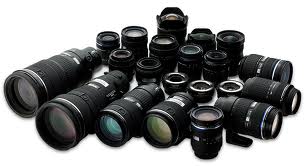 Therefore, I regard our relationship to theological traditions like this: Every point in history, and every set of political, economic, cultural, linguistic and religious circumstances is like a lens. It makes some things very clear, but it also conceals or blurs others. For example, in light of the Internet, cheap international travel, immigration, and the like, we are currently using a wide-angle lens. As a result, we view our place in the global village quite differently than people like Augustine (who lived in a geocentric universe) or Martin Luther (during whose lifetime America was “discovered”) or even Charles Darwin (who operated from some rather quaint and peculiar notions re: racial differences). Compared to the lens we are using today, these people had a rather narrow view of things, but they also had a deeper depth of field. Thanks in large part to their place in history, these men made some bold and radical discoveries. They were able to observe many things that aren’t so clear to us, b/c we are still grappling with the implications of our current, broader view. Meanwhile, they missed many other aspects of the universe b/c of the limitations of their lenses.
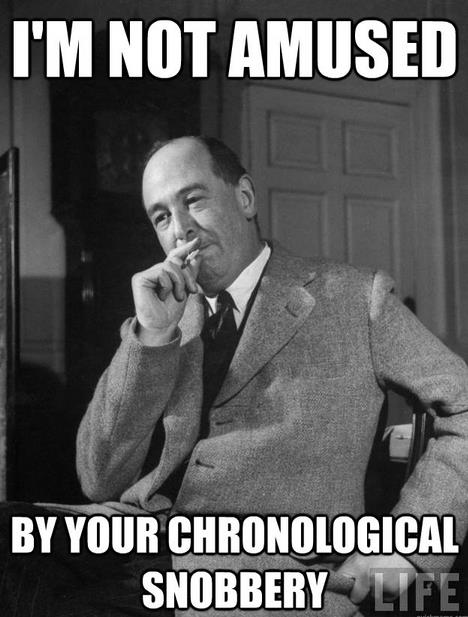 With that in mind, I see no reason why we should automatically venerate or reject what these (and thousands of others) observed just b/c it happened a long time ago or relatively recently. After all, chronological snobbery is a two-way street. We should be just as scientific about analyzing their theories and ideas as we are with any other kind of data, the key question being: how well do their ideas accord with our current experience of the world? After all, the universe is what it is no matter our theological or philosophical preferences. Clearly, as I’ve just pointed out, our current circumstances aren’t some sort of universal, objective the benchmark. However, we have a broader range of lenses available to us than our forebears, across which we can correlate huge amounts of data from a variety of perspectives. So I would argue we are actually in a much better position than any generation before us to make determinations re: which theories/ideas best accord with the universe “as it is,” or at least as we currently understand it to be.
Scientific research proceeds through a process of observation, hypothesis, experimentation and reflection on results. Ideally, through this process, conclusions emerge from the data rather than the other way around. Often, these results challenge rather than confirm our preconceptions, preferences and prejudices. This is where such research requires something more than logic and reason. It requires guts. Are we truly willing to follow the evidence wherever it leads, even if that means abandoning our precious theories? This is the difference between a scientific inference and a theological preference. I have all sorts of preferences re: how I would like the universe to be (e.g. I really, really hope God exists and that God is as good as think he is). But as much as it pains me, I am willing to let go of even that idea if it fails to correspond with the data. Like a poker player, if we are truly going to be scientific, I see no other way to do it than to be “all in” on every hand.
Previous Post

January 20, 2014
The NSA: From "No Such Agency" to "New Snowden Age"
Next Post
January 27, 2014 The first review of my new documentary is in -- and it's a doozy
Browse Our Archives
Select a Category Books environment Film Hell non-violence Philosophy Theology Uncategorized
Select a Month June 2016 May 2016 February 2015 January 2015 December 2014 November 2014 October 2014 September 2014 August 2014 July 2014 June 2014 May 2014 April 2014 March 2014 February 2014 January 2014 December 2013 November 2013 October 2013 September 2013 August 2013 July 2013 June 2013 May 2013 April 2013 March 2013 February 2013 January 2013 December 2012 October 2012 September 2012 August 2012
Follow Us!
TAKE THE
Religious Wisdom Quiz
We are the tribe assigned to carry the sacred objects and serve in worship. Who are we?
Select your answer to see how you score.
The Levites The Tribe of Judah The Danites The Tribe of Naphtali
Related posts from Hellbound

You go ahead and keep feeling; I'll do...

Why we love "The Walking Dead"
Just because something hurts doesn't mean it's the...

Why so many white evangelical Christians are incompetent...
TRENDING AT PATHEOS Progressive Christian

Why Christians Have a Sacred Duty to Vote:...
The Bible offers strong support for the sacred duty to vote. Here...

What Being a Modern-Day Apostle Means to Me
In my last column, I discussed the ins and outs of modern-day...

Did Ancient China Once Worship the God of...
Across human history, a common thread weaves through the origins of the...

Love Your Neighbor – Including Earth-Kin: Lev. 19,...
God’s command to love your neighbor means acting in an ethical and...

Lead a Church Study of “Jesus and Lao...
Guest writer Jack Thomas (The Irreverent Reverend) reflects on leading his church...

Principles for Understanding the Apostolic Ministry Today
Whenever people discover that my formal ministry title is "apostle," as in...
view all Progressive Christian blogs
Ad-Free & Subscriber Log-In Subscription Support
- About Us
- 2026 Calendar
- Videos
- Podcasts
- Library of World Religions
- Faith In Media Tracker
- Advertise With Us
- Write for Us
- Privacy Policy
- Terms of Service
- Do Not Sell My Data
- Contact Us
- Radiant Digital
- Manage Newsletter Subscriptions
- Unsubscribe From Notifications
- Sitemap
Copyright 2008-2026, Patheos. All rights reserved.
Subscription Support Ad-Free & Subscriber Log-In
Follow Patheos