
BuddhistCatholicContemplativeEvangelicalGeneral ChristianHinduJewishLatter-day SaintMuslimNew VisionsProgressive Christian
Beliefs
- Buddhist
- Catholic
- Contemplative
- Evangelical
- General Christian
- Hindu
- Jewish
- Latter-day Saint
- More Voices
- Muslim
- New Visions
- Pagan
- Progressive Christian
Topics
- Religion News
- Food and Religion
- Sports and Religion
- Religious Art
- Religious Music and Entertainment
- Religious Events
- History and Religion
- Style and Religion
- Politics and Religion
- Women in Religion
- Recreation Outdoors and Religion
- Business Finance and Religion
- Careers Workplace and Religion
- Education and Religion
- Family Parenting and Religion
- Health Fitness and Religion
- Home and Religion
- Relationships and Religion
- Technology and Religion
- Travel and Religion
Columnists
- Buddhist Columnists
- Business Finance and Religion Columnists
- Careers Workplace and Religion Columnists
- Catholic Columnists
- Contemplative Columnists
- Education and Religion Columnists
- Evangelists Columnists
- Family Parenting and Religion Columnists
- General Christian Columnists
- Health Fitness and Religion Columnists
- Hindu Columnists
- History and Religion Columnists
- Home and Religion Columnists
- Jewish Columnists
- More Voices Columnists
- Latter Day Columnists
- Muslim Columnists
- New Visions Columnists
- Nonreligious Columnists
- Pagan Columnists
- Politics and Religion Columnists
- Progressive Columnists
- Recreation Outdoors and Religion Columnists
- Relationships and Religion Columnists
- Religion News Columnists
- Religious Art Columnists
- Religious Events Columnists
- Religious Music and Entertainment Columnists
- Sports and Religion Columnists
- Style and Religion Columnists
- Technology and Religion Columnists
- Travel and Religion Columnists
- Women in Religion Columnists
Resource Library
- 2026 Calendar
- Library of World Religions
- The 100 Most Holy Places on Earth
- Patheos Answers
- Podcasts
- Videos
- Faith Leaders Database
- Anglican Episcopalian
- Bahai
- Baptist
- Buddhism
- Christianity
- Confucianism
- Eastern Orthodoxy
- Hinduism
- Holiness and Pentecostal
- ISKCON
- Islam
- Judaism
- Lutheran
- Methodist
- The Church of Jesus Christ of Latter-day Saints
- New Age
- Paganism
- Presbytarian and Reformed
- Protestantism
- Religion Behind the Scenes
- Roman Catholic
- Scientology
- Shia Islam
- Sikhism
- Sufism
- Sunni Islam
- Taoism
- Zen
- See all religions
Research Tools
 Ad-Free & Subscriber Log-In Subscription Support
Ad-Free & Subscriber Log-In Subscription Support
Follow Patheos 

- Trending:
- Forgiveness
- |
- Marriage
- |
- Consciousness
- |
- Death Penalty
- |
- Election
- |
- Halloween
 Hellbound
- Home
- Progressive Christian
- Love the sinner–period
Love the sinner–period
Last updated on: December 4, 2013 at 9:04 am by Kevin Miller
Love the sinner–period 2013-12-04T09:04:03-07:00 Kevin Miller
Patheos Explore the world's faith through different perspectives on religion and spirituality! Patheos has the views of the prevalent religions and spiritualities of the world.
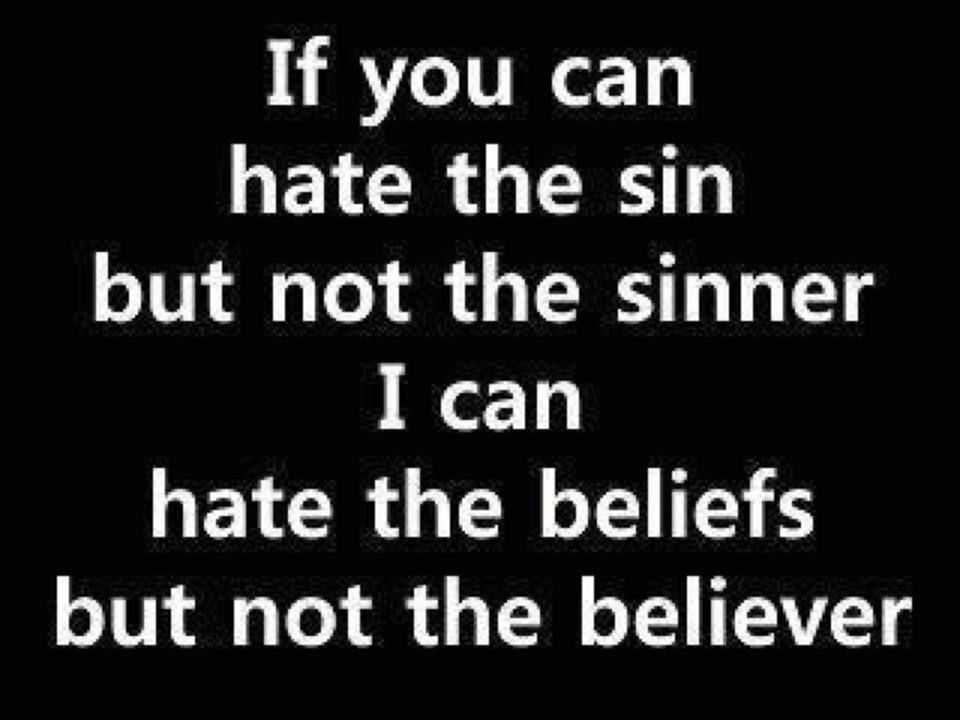 We’ve had an interesting discussion on the Hellbound? Facebook page and elsewhere lately about the saying, “Love the sinner, hate the sin.” (I’m more familiar with the reverse phrasing: “Hate the sin, love the sinner.”) The discussion was spurred by this comment from Wendy Thomas, one of our readers:
Love the sinner, hate the sin is a crock. It’s a copout that makes you in a different group as those “sinners.” LOVE, love the sinner. That’s where that sentence should end.
Her comment generated three main responses:
1) Yes! Totally agree.
2) Others suggested we follow Tony Campolo’s lead and change the phrase to: “Love the sinner, hate MY sin.”
3) A third group disputed the sentiment, arguing from Romans 12 that since God hates sin, so should we.
My response? I tend to agree with Wendy’s comment for a few reasons:
1) As Wendy points out, labeling anyone a “sinner” creates an us/them scenario, which is almost always a pretext for scapegoating them. It also implies that we occupy the moral high ground, that we have the inside edge on truth, and all sorts of other self-righteous thoughts. Like all scapegoating maneuvers, pointing out the sins of others–even in a benevolent way–conveniently blinds us to our own sin.
2) I don’t think we should hate anything, because hate tends to be a product of love spurned, so our level of hatred probably reflects our level of desire to indulge in the behavior we supposedly scorn. And as everyone knows, we tend to become what we hate the most. God’s “hatred” of sin leads to self-sacrifice. Ours tends to lead to sacrifice–of the sinner.
Case in point: I’m currently reading Dirty Wars, and I’m absolutely appalled not only by the extent of America’s black ops in the Middle East and elsewhere, but perhaps even more so by the fact they are closely presided over by a President who was given a Nobel Peace Prize (and who included a justification for war in his acceptance speech!). Do I hate this sort of behavior? Yes! In fact, I told my wife several times that if I was a young Muslim man and had read that book, I would probably be boarding a plane to Somalia or Yemen or Pakistan or anywhere else where I could join the jihad.
But as many young jihadists have learned, indulging such hatred would ultimately be my undoing–just as I believe America’s “hatred” or terrorism will ultimately be its undoing, b/c it is turning into a global terrorist organization, launching drone strikes and conducting assassinations anywhere, everywhere, and against anyone it feels might prove to be a threat. So while we can’t help but react emotionally against such abhorrent behavior, I don’t think it’s safe to indulge those feelings. Rather, I think the spiritual discipline is to seek to transform those feelings into something constructive by first of all acknowledging our own sin and temptation in the face of such evil so that we don’t unwittingly become a party to it. Then, rather than respond in kind, the truly creative and heroic act is to model a response to evil that doesn’t require us to mirror the evil we are countering.
3) Looked at another way, perhaps our level of hatred is a reflection of the level of pain we feel b/c we have been (or feel we have been) victimized by a particular behavior. Once again though, our hatred is merely the flip side of love. The intensity of our pain is a direct reflection of the perceived level of betrayal. However, indulging that hatred is counter-productive. I know many victims of childhood abuse, for example, and I have witnessed firsthand how such hatred becomes the “gateway drug” to obsession and, ultimately, self-destruction.
So, love the sinner, period–especially if that sinner is you!
(Or, as Robert Rodriguez put it, “If you hire Machete to kill the bad guy, you better make damn sure the bad guy isn’t you!)
Previous Post

November 27, 2013
The only exclusive truth claim you can make
Next Post
December 5, 2013 The Kinks got it right
Browse Our Archives
Select a Category Books environment Film Hell non-violence Philosophy Theology Uncategorized
Select a Month June 2016 May 2016 February 2015 January 2015 December 2014 November 2014 October 2014 September 2014 August 2014 July 2014 June 2014 May 2014 April 2014 March 2014 February 2014 January 2014 December 2013 November 2013 October 2013 September 2013 August 2013 July 2013 June 2013 May 2013 April 2013 March 2013 February 2013 January 2013 December 2012 October 2012 September 2012 August 2012
Follow Us!
TAKE THE
Religious Wisdom Quiz
What New Testament book is known for its chapter on charity?
Select your answer to see how you score.
Philippians Hebrews 1 Corinthians Romans
Related posts from Hellbound

You go ahead and keep feeling; I'll do...

Why we love "The Walking Dead"

Just because something hurts doesn't mean it's the...

Why so many white evangelical Christians are incompetent...
TRENDING AT PATHEOS Progressive Christian

Why Christians Have a Sacred Duty to Vote:...
The Bible offers strong support for the sacred duty to vote. Here...

What Being a Modern-Day Apostle Means to Me
In my last column, I discussed the ins and outs of modern-day...

Did Ancient China Once Worship the God of...
Across human history, a common thread weaves through the origins of the...

Love Your Neighbor – Including Earth-Kin: Lev. 19,...
God’s command to love your neighbor means acting in an ethical and...

Lead a Church Study of “Jesus and Lao...
Guest writer Jack Thomas (The Irreverent Reverend) reflects on leading his church...

Principles for Understanding the Apostolic Ministry Today
Whenever people discover that my formal ministry title is "apostle," as in...
view all Progressive Christian blogs
Ad-Free & Subscriber Log-In Subscription Support
- About Us
- 2026 Calendar
- Videos
- Podcasts
- Library of World Religions
- Faith In Media Tracker
- Advertise With Us
- Write for Us
- Privacy Policy
- Terms of Service
- Do Not Sell My Data
- Contact Us
- Radiant Digital
- Manage Newsletter Subscriptions
- Unsubscribe From Notifications
- Sitemap
Copyright 2008-2026, Patheos. All rights reserved.
Subscription Support Ad-Free & Subscriber Log-In
Follow Patheos