
BuddhistCatholicContemplativeEvangelicalGeneral ChristianHinduJewishLatter-day SaintMuslimNew VisionsProgressive Christian
Beliefs
- Buddhist
- Catholic
- Contemplative
- Evangelical
- General Christian
- Hindu
- Jewish
- Latter-day Saint
- More Voices
- Muslim
- New Visions
- Pagan
- Progressive Christian
Topics
- Religion News
- Food and Religion
- Sports and Religion
- Religious Art
- Religious Music and Entertainment
- Religious Events
- History and Religion
- Style and Religion
- Politics and Religion
- Women in Religion
- Recreation Outdoors and Religion
- Business Finance and Religion
- Careers Workplace and Religion
- Education and Religion
- Family Parenting and Religion
- Health Fitness and Religion
- Home and Religion
- Relationships and Religion
- Technology and Religion
- Travel and Religion
Columnists
- Buddhist Columnists
- Business Finance and Religion Columnists
- Careers Workplace and Religion Columnists
- Catholic Columnists
- Contemplative Columnists
- Education and Religion Columnists
- Evangelists Columnists
- Family Parenting and Religion Columnists
- General Christian Columnists
- Health Fitness and Religion Columnists
- Hindu Columnists
- History and Religion Columnists
- Home and Religion Columnists
- Jewish Columnists
- More Voices Columnists
- Latter Day Columnists
- Muslim Columnists
- New Visions Columnists
- Nonreligious Columnists
- Pagan Columnists
- Politics and Religion Columnists
- Progressive Columnists
- Recreation Outdoors and Religion Columnists
- Relationships and Religion Columnists
- Religion News Columnists
- Religious Art Columnists
- Religious Events Columnists
- Religious Music and Entertainment Columnists
- Sports and Religion Columnists
- Style and Religion Columnists
- Technology and Religion Columnists
- Travel and Religion Columnists
- Women in Religion Columnists
Resource Library
- 2026 Calendar
- Library of World Religions
- The 100 Most Holy Places on Earth
- Patheos Answers
- Podcasts
- Videos
- Faith Leaders Database
- Anglican Episcopalian
- Bahai
- Baptist
- Buddhism
- Christianity
- Confucianism
- Eastern Orthodoxy
- Hinduism
- Holiness and Pentecostal
- ISKCON
- Islam
- Judaism
- Lutheran
- Methodist
- The Church of Jesus Christ of Latter-day Saints
- New Age
- Paganism
- Presbytarian and Reformed
- Protestantism
- Religion Behind the Scenes
- Roman Catholic
- Scientology
- Shia Islam
- Sikhism
- Sufism
- Sunni Islam
- Taoism
- Zen
- See all religions
Research Tools
 Ad-Free & Subscriber Log-In Subscription Support
Ad-Free & Subscriber Log-In Subscription Support
Follow Patheos 

- Trending:
- Forgiveness
- |
- Marriage
- |
- Consciousness
- |
- Death Penalty
- |
- Election
- |
- Halloween
 Hedgerow
- Home
- Evangelical
- Politics and Religion
- Celebrating Hubble in space 30 years ago today, NASA shares images taken on your birthday
Celebrating Hubble in space 30 years ago today, NASA shares images taken on your birthday
Last updated on: April 17, 2020 at 8:00 am by Bethany Blankley
Celebrating Hubble in space 30 years ago today, NASA shares images taken on your birthday 2020-04-15T09:53:39-05:00 Bethany Blankley
Patheos Explore the world's faith through different perspectives on religion and spirituality! Patheos has the views of the prevalent religions and spiritualities of the world.
To celebrate the 30th birthday/anniversary of the Hubble Space Telescope operating in space this year, NASA published a new feature online to share images taken in space every day of the year– searchable by a person’a birthday.
NASA officially launched the space telescope April 24, 1990, during the Space Shuttle Discovery STS-31’s mission.
Friday, April 17, 2020, officially marks Hubble’s 30th year in space.

The Hubble Space Telescope, the world’s first space telescope which has revolutionized astronomy, as seen from the Space Shuttle Discovery. It is named after famed astronomer Edwin Hubble. Photo: NASA / NASA
NASA’s new online feature, “What Did Hubble See on Your Birthday?” gives users the opportunity to learn what image was taken in space by the telescope on a particular date. Each image is accompanied with information about star or galaxy depicted.
The image taken on my birthday, March 29, in 2006, is of Galaxy M82.
Galaxy M82 is known for its “bright blue disk, webs of shredded clouds, and fiery-looking plumes of glowing hydrogen blasting out of its central region,” NASA says. M82 stars are born 10 times faster than stars in the Milky Way galaxy.
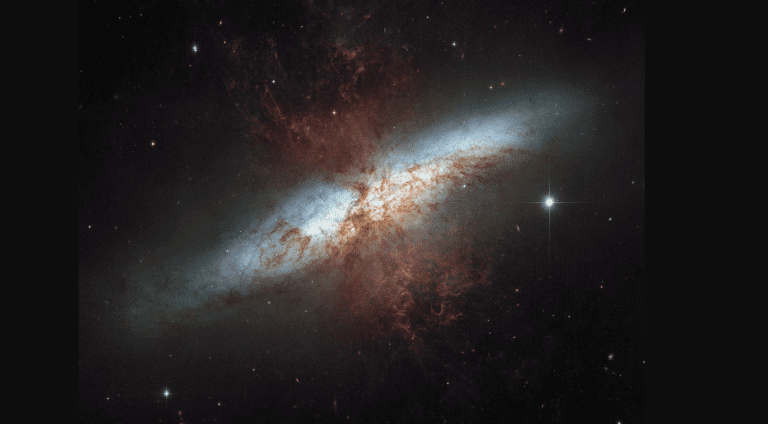
Image of Galaxy M82 taken by Hubble Space Telescope, NASA.
Messier 82 (M82) was published on April 24, 2006, to celebrate 16 years of Hubble Space Telescope operating in space. The image was released by NASA and the European Space Agency (ESA), which was the sharpest wide-angle view ever obtained of M82.
“Located 12 million light-years away, M82 appears high in the northern spring sky in the direction of the constellation Ursa Major, the Great Bear. It is also called the “Cigar Galaxy” because of the elliptical shape produced by the oblique tilt of its starry disk relative to our line of sight.
“The observation was made in March 2006, with the Advanced Camera for Surveys’ Wide Field Channel. Astronomers assembled this six-image composite mosaic by combining exposures taken with four colored filters that capture starlight from visible and infrared wavelengths as well as the light from the glowing hydrogen filaments.”
In the M82 galaxy center, young stars are born 10 times faster than they are inside the entire Milky Way Galaxy, NASA says. The result is a huge concentration of young stars are carved into the gas and dust at the galaxy’s center. These stars create a galactic superwind that compress enough gas to make millions of more stars. The new, young stars in M82 become condensed into massive star clusters.
The clusters create bright patches, or “starburst clumps,” in the central parts of M82 only visible through infrared technology used by Hubble. Most of the pale, white objects sprinkled around the body of M82, which look like fuzzy stars, NASA notes, are individual star clusters about 20 light-years across, containing up to a million stars.
Since April 24, 1990, Hubble has taken images in space 24 hours a day, seven days a week.
“Hubble explores the universe 24 hours a day, seven days a week. That means it has observed some fascinating cosmic wonder every day of the year, including on your birthday,” NASA said in a prepared statement.
“Spanning a little more than one million light-years, the galaxy is about 10 times the diameter of our Milky Way galaxy. The bloated galaxy is a member of an unusual class of galaxies with a diffuse core filled with a fog of starlight.”
The telescope is only supposed to last until 2030 or 2040, and will be officially replaced by the James Webb Space Telescope (JWST). The JWST is scheduled to launch on March 30, 2021.
To learn about the creator of the universe and the Gospel in the Stars, go here.
Previous Post

April 16, 2020
Ted Budd's bill would protect faith-based organizations

Browse Our Archives
Select a Category Christianity Islam politics Sexuality transgender Uncategorized
Select a Month January 2021 December 2020 November 2020 October 2020 September 2020 August 2020 July 2020 June 2020 May 2020 April 2020 March 2020 February 2020 January 2020 October 2019 September 2019 July 2019 May 2019 April 2019 March 2019 February 2019 January 2019 December 2018 November 2018 August 2018 July 2018 June 2018 May 2018 April 2018 March 2018 February 2018 January 2018 December 2017 November 2017 October 2017 June 2017 April 2017 March 2017 February 2017 January 2017 December 2016 October 2016 July 2016 June 2016 April 2016 February 2016 January 2016 December 2015 September 2015 August 2015 July 2015 June 2015 May 2015 April 2015 March 2015 February 2015 January 2015 November 2014 August 2014 July 2014 June 2014
Follow Us!
TAKE THE
Religious Wisdom Quiz
What does "Capernaum" mean in Hebrew?
Select your answer to see how you score.
Village of Comfort Holy Place House of God City of Light
Related posts from Hedgerow
Biden plans to reverse abortion policies of previous...

December 29 was the 850th Anniversary of the...

Fifth Circuit Court of Appeals rules Texas and...
The promise of five kernels of corn [video]
TRENDING AT PATHEOS Evangelical

How the author of the world's best hymn...
I've been working with John Newton for a while now. This makes...

Long before this Lectio Divina, Psalm 130 - the song - started...

What About the Trees? Another Living Parable
After I finished writing the last article about falling leaves as a...

Why Classical Education Is a Conversation, Not a...
Come and Read: Joy in Classical Education When I was a little...

Falling Leaves: A Living Parable on Letting Go
I’ve spent the vast majority of my life in the southeast corner...

Cornell University has received a great deal of negative publicity and intense...
view all Evangelical blogs
Ad-Free & Subscriber Log-In Subscription Support
- About Us
- 2026 Calendar
- Videos
- Podcasts
- Library of World Religions
- Faith In Media Tracker
- Advertise With Us
- Write for Us
- Privacy Policy
- Terms of Service
- Do Not Sell My Data
- Contact Us
- Radiant Digital
- Manage Newsletter Subscriptions
- Unsubscribe From Notifications
- Sitemap
Copyright 2008-2026, Patheos. All rights reserved.
Subscription Support Ad-Free & Subscriber Log-In
Follow Patheos