
BuddhistCatholicContemplativeEvangelicalGeneral ChristianHinduJewishLatter-day SaintMuslimNew VisionsProgressive Christian
Beliefs
- Buddhist
- Catholic
- Contemplative
- Evangelical
- General Christian
- Hindu
- Jewish
- Latter-day Saint
- More Voices
- Muslim
- New Visions
- Pagan
- Progressive Christian
Topics
- Religion News
- Food and Religion
- Sports and Religion
- Religious Art
- Religious Music and Entertainment
- Religious Events
- History and Religion
- Style and Religion
- Politics and Religion
- Women in Religion
- Recreation Outdoors and Religion
- Business Finance and Religion
- Careers Workplace and Religion
- Education and Religion
- Family Parenting and Religion
- Health Fitness and Religion
- Home and Religion
- Relationships and Religion
- Technology and Religion
- Travel and Religion
Columnists
- Buddhist Columnists
- Business Finance and Religion Columnists
- Careers Workplace and Religion Columnists
- Catholic Columnists
- Contemplative Columnists
- Education and Religion Columnists
- Evangelists Columnists
- Family Parenting and Religion Columnists
- General Christian Columnists
- Health Fitness and Religion Columnists
- Hindu Columnists
- History and Religion Columnists
- Home and Religion Columnists
- Jewish Columnists
- More Voices Columnists
- Latter Day Columnists
- Muslim Columnists
- New Visions Columnists
- Nonreligious Columnists
- Pagan Columnists
- Politics and Religion Columnists
- Progressive Columnists
- Recreation Outdoors and Religion Columnists
- Relationships and Religion Columnists
- Religion News Columnists
- Religious Art Columnists
- Religious Events Columnists
- Religious Music and Entertainment Columnists
- Sports and Religion Columnists
- Style and Religion Columnists
- Technology and Religion Columnists
- Travel and Religion Columnists
- Women in Religion Columnists
Resource Library
- 2026 Calendar
- Library of World Religions
- The 100 Most Holy Places on Earth
- Patheos Answers
- Podcasts
- Videos
- Faith Leaders Database
- Anglican Episcopalian
- Bahai
- Baptist
- Buddhism
- Christianity
- Confucianism
- Eastern Orthodoxy
- Hinduism
- Holiness and Pentecostal
- ISKCON
- Islam
- Judaism
- Lutheran
- Methodist
- The Church of Jesus Christ of Latter-day Saints
- New Age
- Paganism
- Presbytarian and Reformed
- Protestantism
- Religion Behind the Scenes
- Roman Catholic
- Scientology
- Shia Islam
- Sikhism
- Sufism
- Sunni Islam
- Taoism
- Zen
- See all religions
Research Tools
 Ad-Free & Subscriber Log-In Subscription Support
Ad-Free & Subscriber Log-In Subscription Support
Follow Patheos 

- Trending:
- Forgiveness
- |
- Marriage
- |
- Consciousness
- |
- Death Penalty
- |
- Election
- |
- Halloween
 Hedgerow
- Home
- Evangelical
- Politics and Religion
- Sagittarius: The Conqueror
Sagittarius: The Conqueror
Last updated on: February 13, 2020 at 11:12 am by Bethany Blankley
Sagittarius: The Conqueror 2020-02-13T11:12:43-05:00 Bethany Blankley
Patheos Explore the world's faith through different perspectives on religion and spirituality! Patheos has the views of the prevalent religions and spiritualities of the world.
Sagittarius (November 21-December 21) is the fourth of the first group of signs in the original Christian Zodiac. Its sign points to the person, work, and triumph of Jesus Christ as the Redeemer.
The hero of the story in the skies is Jesus, which Joseph Agustus Seiss says, is described in scripture as:
“‘beautiful, beautiful, above the sons of man,’ endowed with every grace and invested with all authority and power. When on earth He was meek and nonresistant, not breaking so much as a bruised reed; but here He is contemplated and addressed as a mounted warrior, riding as a king, armed with bow and arrows, shooting down His enemies. His character here is that of the Mighty One, girding himself with honor and majesty, and going forth to victory. John, in his visions of the future, beheld a ‘white horse; and He that sat on him had a bow; and He went forth conquering and to conquer.’
“It is the same divine Hero, in the same character, offices, and work, in both instances. He has a crown, a throne, and a cause– the cause of righteousness over against injustice, usurpation, and tyranny; which cause He enforces with invincible majesty. And in glory and triumph He rides forth unto victory …”
Sagittarious means archer in Hebrew and Syriac. The mighty warrior with bow and arrow has two natures, man and beast, similar to Virgo‘s Centaurus. The Greeks called the chief centaur Cheiron, who was the most righteous and just, and expressed goodness, strength and majesty. His arrows point at Scorpion, his war is against the serpent. The Greek poet Aratus wrote of him,
“‘Midst golden stars he stands refulgent now, and thrusts the scorpion with his bended bow.”
Cherion is thought to have occupied Apollo’s throne and was considered the “royal judge.”
In Indian mythology, a tenth avatar is predicted when Vishnu, who is the second highest in the Indian Triad, will come as a man on a white horse, overthrowing his enemies and eradicating evil from the planet, pointing to the sign of Sagittarious, Seiss notes.
But the true story of the rider on the horse who avenges is found in Revelation 19:11-16:
“I saw heaven standing open and there before me was a white horse, whose rider is called Faithful and True. With justice he judges and makes war. His eyes are like blazing fire, and on his head are many crowns. He has a name written on him that no one knows but he himself. He is dressed in a robe dipped in blood, and his name is the Word of God. The armies of heaven were following him, riding on white horses and ressed in fine linen, white and clean. Out of his mouth comes a sharp sword with which to strike down the nations. he willr ule them with an iron scepter. He treads the winepress of the fury of the wrath of God Almighty. On his robe and on his thigh he has this name written: KING OF KINGS AND LORD OF LORDS.”
Revelation goes on to explain that the rider of the white horse defeats the beast, the false prophet, his enemies, and throws the devil, the ancient serpent, into the abyss.
This is the story to which the stars tracing the sign of Sagittarius point: the final triumph of Jesus Christ over his enemies, including its three Decans.
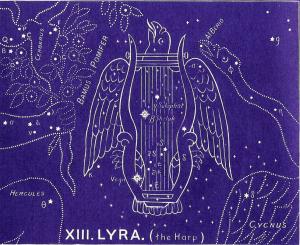
The first Decan, Lyra (Lyre), represents celebration and is embodied by a harp within an eagle. Seiss points to Psalm 45:4,5, and Psalm 21, noting that the harp within the eagle/hawk and first Decan of Sagittarius is Lyra, or Lyre, which represents celebration. God’s children sing and praise his power and majesty. Lyre, the Harp, is marked by one of the brightest stars in the north.
In Greek Mythology, the Lyre of Orpheus tells the story of how the harp, or lyre, is the oldest stringed instrument of music that was invented to worship the gods. (The harp is first mentioned in Gen. 4:21, 23, 24.) Orpheus, or Apollo, is called the father of songs who helps those who seek the Golden Fleece.
But the gospel story to which Lyra points is the song we sing to celebrate the achievement of Christ:
“To Him that sits on the throne, and to the Lamb, be blessing and honor and glory and power.” (Rev. 5:13)
The true jubilation of the universe, the joy to which the stars point, is Jesus.
Vega marks the constellation Lyra, which can be seen in the summer sky in the northern hemisphere. Its brightest star, Vega means “he shall be exalted, the warrior triumphant.” Seiss argues the root of Vega is found in the song Moses and the Israelites sang after they crossed the Red Sea (“I will sing unto the LORD, for he had triumphed gloriously.” (Ex. 15:1))
The second Decan, Ara, “the Burning Pyre,” refers to an altar. In Arabic it’s called Al Mugamra, in Hebrew, it points to what the Lord makes perfect. (Ps. 138:8) In the constellation, the pyre is turned over with fire pouring out. It is situated on the lowest point of the horizon of the south. Seiss argues it points to the Lake of Fire mentioned in Revelation, where the devil will ultimately be consumed.
The third Decan is Draco, the dragon and universal symbol of evil. The Devil is called “the Dragon, that old Serpent.” Worldwide the image of the dragon represents evil. Seiss points out, “No man ever saw a dragon, living or dead, yet all men talk of the dragon, and adopt it into all their religion, heraldry, and art as the symbol of some well-known reality.”
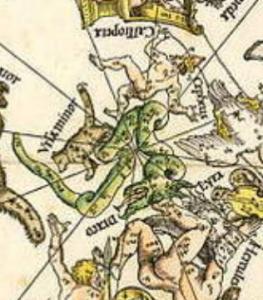
“So where did it come from?” Seiss asks. From God, the creator of the universe who named the stars.
In Revelation, John beheld a great red Dragon, with seven heads and ten horns, with seven diadems on its head, and a tail that covered one third of the stars in heaven. The Archangel Michael wars with the Dragon. But the warrior on the white horse ultimately destroys him. As the Psalmist sings, “God is my King of Old, working salvation in the midst of the earth, breaking the heads of the dragons in the waters, breaking the heads of Leviathan in pieces.” (Ps. 74; see also Isa. 26)
Within this Decan is the main star, Thuban, also called Al Waid and Al dib, which mean, “who is to be destroyed” and “the reptile,” respectively. The star is still used as a compass by sailors.
According to Roman and Greek Mythology, Hercules killed the dragon. Yet, Hercules is seen in the sign of Virgo, with his foot on the head of the dragon. Virgo– representing the seed of the woman, Jesus, is the one who ultimately crushes the serpant’s head.


Browse Our Archives
Select a Category Christianity Islam politics Sexuality transgender Uncategorized
Select a Month January 2021 December 2020 November 2020 October 2020 September 2020 August 2020 July 2020 June 2020 May 2020 April 2020 March 2020 February 2020 January 2020 October 2019 September 2019 July 2019 May 2019 April 2019 March 2019 February 2019 January 2019 December 2018 November 2018 August 2018 July 2018 June 2018 May 2018 April 2018 March 2018 February 2018 January 2018 December 2017 November 2017 October 2017 June 2017 April 2017 March 2017 February 2017 January 2017 December 2016 October 2016 July 2016 June 2016 April 2016 February 2016 January 2016 December 2015 September 2015 August 2015 July 2015 June 2015 May 2015 April 2015 March 2015 February 2015 January 2015 November 2014 August 2014 July 2014 June 2014
Follow Us!
TAKE THE
Religious Wisdom Quiz
What famous garden did God place Adam and Eve in?
Select your answer to see how you score.
Eden Bethel Gethsemane Sinai
Related posts from Hedgerow

Biden plans to reverse abortion policies of previous...
December 29 was the 850th Anniversary of the...

Fifth Circuit Court of Appeals rules Texas and...
The promise of five kernels of corn [video]
TRENDING AT PATHEOS Evangelical

The REST of Your Life: A Creative Wrestles...
This week I had a conversation with a good friend from church....

How the author of the world's best hymn...
I've been working with John Newton for a while now. This makes...

Long before this Lectio Divina, Psalm 130 - the song - started...

What About the Trees? Another Living Parable
After I finished writing the last article about falling leaves as a...

Why Classical Education Is a Conversation, Not a...
Come and Read: Joy in Classical Education When I was a little...

Cornell University has received a great deal of negative publicity and intense...
view all Evangelical blogs
Ad-Free & Subscriber Log-In Subscription Support
- About Us
- 2026 Calendar
- Videos
- Podcasts
- Library of World Religions
- Faith In Media Tracker
- Advertise With Us
- Write for Us
- Privacy Policy
- Terms of Service
- Do Not Sell My Data
- Contact Us
- Radiant Digital
- Manage Newsletter Subscriptions
- Unsubscribe From Notifications
- Sitemap
Copyright 2008-2026, Patheos. All rights reserved.
Subscription Support Ad-Free & Subscriber Log-In
Follow Patheos