
BuddhistCatholicContemplativeEvangelicalGeneral ChristianHinduJewishLatter-day SaintMuslimNew VisionsProgressive Christian
Beliefs
- Buddhist
- Catholic
- Contemplative
- Evangelical
- General Christian
- Hindu
- Jewish
- Latter-day Saint
- More Voices
- Muslim
- New Visions
- Pagan
- Progressive Christian
Topics
- Religion News
- Food and Religion
- Sports and Religion
- Religious Art
- Religious Music and Entertainment
- Religious Events
- History and Religion
- Style and Religion
- Politics and Religion
- Women in Religion
- Recreation Outdoors and Religion
- Business Finance and Religion
- Careers Workplace and Religion
- Education and Religion
- Family Parenting and Religion
- Health Fitness and Religion
- Home and Religion
- Relationships and Religion
- Technology and Religion
- Travel and Religion
Columnists
- Buddhist Columnists
- Business Finance and Religion Columnists
- Careers Workplace and Religion Columnists
- Catholic Columnists
- Contemplative Columnists
- Education and Religion Columnists
- Evangelists Columnists
- Family Parenting and Religion Columnists
- General Christian Columnists
- Health Fitness and Religion Columnists
- Hindu Columnists
- History and Religion Columnists
- Home and Religion Columnists
- Jewish Columnists
- More Voices Columnists
- Latter Day Columnists
- Muslim Columnists
- New Visions Columnists
- Nonreligious Columnists
- Pagan Columnists
- Politics and Religion Columnists
- Progressive Columnists
- Recreation Outdoors and Religion Columnists
- Relationships and Religion Columnists
- Religion News Columnists
- Religious Art Columnists
- Religious Events Columnists
- Religious Music and Entertainment Columnists
- Sports and Religion Columnists
- Style and Religion Columnists
- Technology and Religion Columnists
- Travel and Religion Columnists
- Women in Religion Columnists
Resource Library
- 2026 Calendar
- Library of World Religions
- The 100 Most Holy Places on Earth
- Patheos Answers
- Podcasts
- Videos
- Faith Leaders Database
- Anglican Episcopalian
- Bahai
- Baptist
- Buddhism
- Christianity
- Confucianism
- Eastern Orthodoxy
- Hinduism
- Holiness and Pentecostal
- ISKCON
- Islam
- Judaism
- Lutheran
- Methodist
- The Church of Jesus Christ of Latter-day Saints
- New Age
- Paganism
- Presbytarian and Reformed
- Protestantism
- Religion Behind the Scenes
- Roman Catholic
- Scientology
- Shia Islam
- Sikhism
- Sufism
- Sunni Islam
- Taoism
- Zen
- See all religions
Research Tools
 Ad-Free & Subscriber Log-In Subscription Support
Ad-Free & Subscriber Log-In Subscription Support
Follow Patheos 

- Trending:
- Forgiveness
- |
- Marriage
- |
- Consciousness
- |
- Death Penalty
- |
- Election
- |
- Halloween
 Hedgerow
- Home
- Evangelical
- Politics and Religion
- Virgo: First Zodiac Sign of the Virgin Whose Seed Saves
Virgo: First Zodiac Sign of the Virgin Whose Seed Saves
Last updated on: February 13, 2020 at 12:51 pm by Bethany Blankley
Virgo: First Zodiac Sign of the Virgin Whose Seed Saves 2020-02-13T12:51:08-05:00 Bethany Blankley
Patheos Explore the world's faith through different perspectives on religion and spirituality! Patheos has the views of the prevalent religions and spiritualities of the world.
Unlike the secular zodiac, which starts with Aries, the first sign in the Christian Zodiac “begins with Virgo and ends with Leo. Virgo (August 23-September 22) depicts “the virgin whose seed saves.”
Before understanding Virgo, it’s important to understand the context in which we find her. According to a lecture given by American Lutheran minister Joseph Agustus Seiss, entitled, “The Starry Worlds,” first published in 1882, God connected star groupings with:
“symbols and ideas he wished to convey, and transmitting and explaining to his posterity those names and figures thus conjoined with the stars, he would link with his astronomy a whole system of thoughts and hopes as clear as the stars themselves, and utterly imperishable as long as astronomy should remain in the knowledge of men.”
The star groups are “founded on indisputable astronomic truth, and hence form the groundwork of all maps and designations of the celestial presentations. They are in all the planispheres, celestial globes, and star-charts among all people, from one end of the earth to the other.”
Seiss attests that the stars and their groupings are not arbitrary; they are part of the “common and universal language of astronomical science.” Stars and their constellations are found in almanacs, books, and records worldwide– regardless of tradition or belief they are recognized by everyone. “Even those who have the most fault to find with them still employ them, and cannot get on without them,” he says.
God speaks through imagery of the stars– providing revelation of truth and hope. The stars tell a story in pictures of men, women, animals, monsters, and other cluster groups of stars, known as constellations, initially totaling 48. Beginning with the path the Earth takes around the Sun, the Moon and planets follow a similar pattern. The Sun moves roughly 30 degrees every month from west to east. The Moon revolves around the Earth 12 times every year.
Twelve divisions of 30 degrees each creates the Zodiac. The root word of Zodiac is “zoad,” which means to walk. Each movement around the Earth is a walk through God’s story, marked by 12 signs. Partnering with the Zodiac is the Lunar Zodiac– which coincides with the 28 days it takes for the Moon to revolve around the Earth.
Again, with mathematical precision, additional groups of stars are connected to each Zodiac sign. Arab and Hebrew scholars referred to these groups as “Decans,” meaning, a “part” or “piece.” Decans are 36 groups of stars with 3 in each of the 12 signs. Abu Masher, an Arab physician and astronomer, referred to them as “faces.” The Hebrew origin from Sehmitic Decah, means “to break.” Decans are pieces or parts contributing to the whole. Daniel referred to them as “dek.” (Dan. 2:45)
The first sign in the Zodiac and of prophetic revelation in the stars is Virgo. The Gospel of Jesus Christ, through the grace of God, tells of a virgin-born savior. Virgo is “the Virgin,” whose constellation depicts a woman holding an ear of wheat in one hand and a branch in the other. She prophesies of her coming Son.
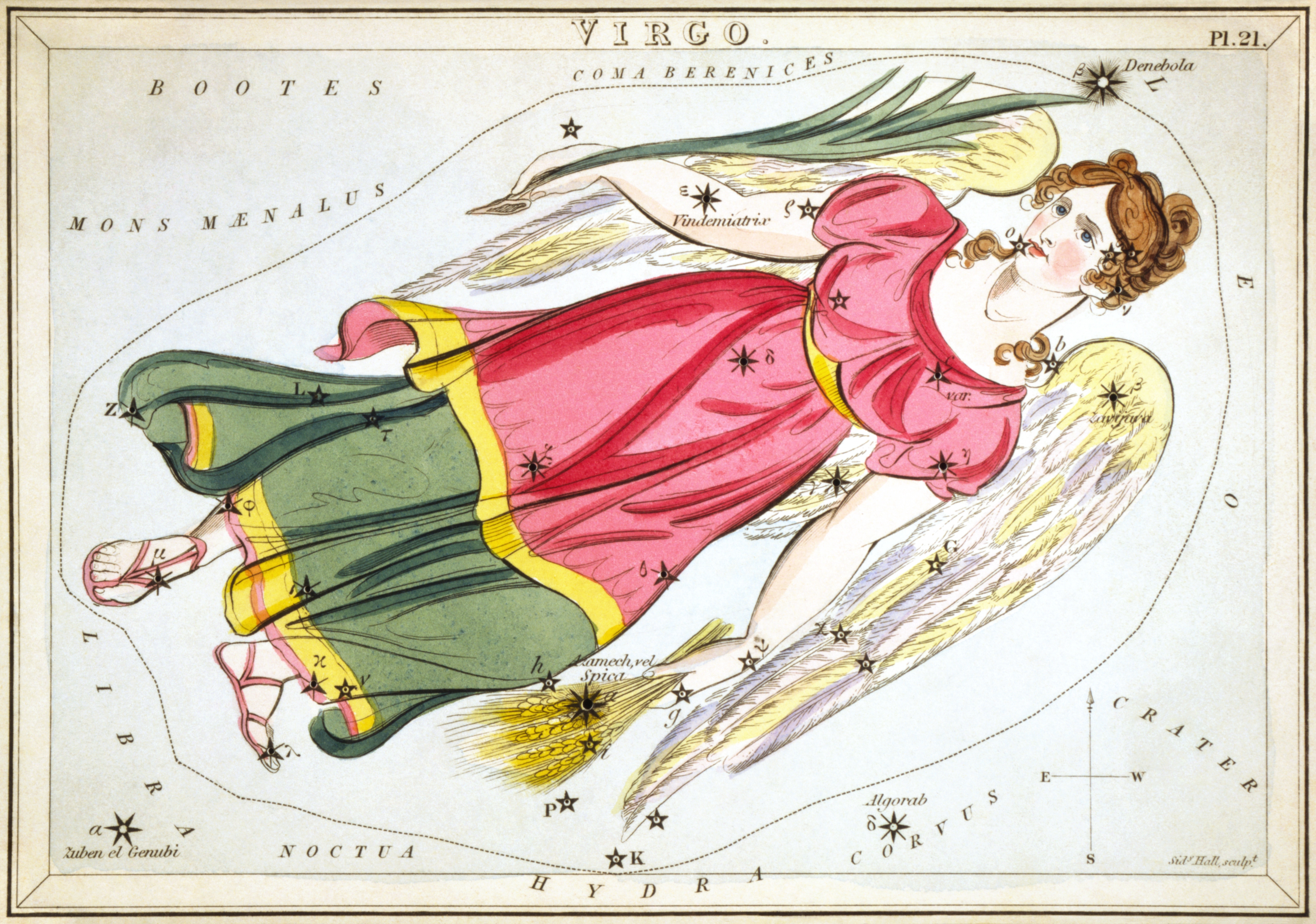
Virgo as depicted in Urania’s Mirror, a set of constellation cards published in London c.1825. wikimedia.
Virgo’s three decans also help tell her story.
The first decan, Coma, means, “the infant” or “the branch.” (Isa. 11:1, 4:2, 9:6; Matt. 1:23; Jer. 23: 5,6; Zech 3:8, 6:12; John 12:24; Hag. 2:7) Coma in Hebrew means “the desired” or “longed-for,” referring to the coming Messiah. Coma represents Virgo’s desired, longed-for Son.
The second decan, Centaurus (a centaur, half man and half beast), in Hebrew (Bezeh) means “the despised.” (Isa. 53:3, 10) The centaur is holding a spear, piercing his enemy over a cross, depicting salvation from life to death. More importantly, however, is the dual nature of Jesus Christ he represents. Christ, like the Centaur, is:
“two natures in one person,” which Seiss describes as: “to men repulsive and hateful, yet really great, powerful, and beneficent, pushing with his lance at the heart of some victim, and moving the while right over the constellation of the cross.”
This the brightest star in the group, which the Greeks called Cheiron. In Hebrew it means, “the mediation.” Centaurus represents her Son who will be an offering.
The third decan, Bootes, is the “great shepherd” holding a rod and sickle (most recognized in English as “the Big Dipper.” Job 9:9 mentions this star, as does Zechariah 12:10, which refers to the Hebrew root meaning of Bo, “the coming.” Greek poets referenced this star as well, which Paul referred to in Acts 17:28. The staff and sickle are comprised by Arcturus, which means, “he comes.” Virgo’s shepherd Son will come and guard his sheep.
The Zodiac begins with Virgo, the virgin whose seed is at the center of the story of the Universe. But the rest of the star signs and their meanings are interwoven in hers and all ultimately point to the One who is yet to come: Jesus.
Previous Post
February 3, 2016
The Original Christian Zodiac
Next Post

April 20, 2016 Watch New Franklin Graham 'My Hope' film
Browse Our Archives
Select a Category Christianity Islam politics Sexuality transgender Uncategorized
Select a Month January 2021 December 2020 November 2020 October 2020 September 2020 August 2020 July 2020 June 2020 May 2020 April 2020 March 2020 February 2020 January 2020 October 2019 September 2019 July 2019 May 2019 April 2019 March 2019 February 2019 January 2019 December 2018 November 2018 August 2018 July 2018 June 2018 May 2018 April 2018 March 2018 February 2018 January 2018 December 2017 November 2017 October 2017 June 2017 April 2017 March 2017 February 2017 January 2017 December 2016 October 2016 July 2016 June 2016 April 2016 February 2016 January 2016 December 2015 September 2015 August 2015 July 2015 June 2015 May 2015 April 2015 March 2015 February 2015 January 2015 November 2014 August 2014 July 2014 June 2014
Follow Us!
TAKE THE
Religious Wisdom Quiz
In the Parable of the Wise and Foolish Virgins, what did the wise bring?
Select your answer to see how you score.
Wine Extra oil Bread New clothes
Related posts from Hedgerow
Biden plans to reverse abortion policies of previous...
December 29 was the 850th Anniversary of the...

Fifth Circuit Court of Appeals rules Texas and...
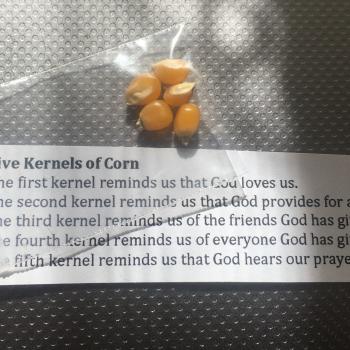
The promise of five kernels of corn [video]
TRENDING AT PATHEOS Evangelical

The REST of Your Life: A Creative Wrestles...
This week I had a conversation with a good friend from church....

How the author of the world's best hymn...
I've been working with John Newton for a while now. This makes...

Long before this Lectio Divina, Psalm 130 - the song - started...

What About the Trees? Another Living Parable
After I finished writing the last article about falling leaves as a...

Why Classical Education Is a Conversation, Not a...
Come and Read: Joy in Classical Education When I was a little...

Cornell University has received a great deal of negative publicity and intense...
view all Evangelical blogs
Ad-Free & Subscriber Log-In Subscription Support
- About Us
- 2026 Calendar
- Videos
- Podcasts
- Library of World Religions
- Faith In Media Tracker
- Advertise With Us
- Write for Us
- Privacy Policy
- Terms of Service
- Do Not Sell My Data
- Contact Us
- Radiant Digital
- Manage Newsletter Subscriptions
- Unsubscribe From Notifications
- Sitemap
Copyright 2008-2026, Patheos. All rights reserved.
Subscription Support Ad-Free & Subscriber Log-In
Follow Patheos