
BuddhistCatholicContemplativeEvangelicalGeneral ChristianHinduJewishLatter-day SaintMuslimNew VisionsProgressive Christian
Beliefs
- Buddhist
- Catholic
- Contemplative
- Evangelical
- General Christian
- Hindu
- Jewish
- Latter-day Saint
- More Voices
- Muslim
- New Visions
- Pagan
- Progressive Christian
Topics
- Religion News
- Food and Religion
- Sports and Religion
- Religious Art
- Religious Music and Entertainment
- Religious Events
- History and Religion
- Style and Religion
- Politics and Religion
- Women in Religion
- Recreation Outdoors and Religion
- Business Finance and Religion
- Careers Workplace and Religion
- Education and Religion
- Family Parenting and Religion
- Health Fitness and Religion
- Home and Religion
- Relationships and Religion
- Technology and Religion
- Travel and Religion
Columnists
- Buddhist Columnists
- Business Finance and Religion Columnists
- Careers Workplace and Religion Columnists
- Catholic Columnists
- Contemplative Columnists
- Education and Religion Columnists
- Evangelists Columnists
- Family Parenting and Religion Columnists
- General Christian Columnists
- Health Fitness and Religion Columnists
- Hindu Columnists
- History and Religion Columnists
- Home and Religion Columnists
- Jewish Columnists
- More Voices Columnists
- Latter Day Columnists
- Muslim Columnists
- New Visions Columnists
- Nonreligious Columnists
- Pagan Columnists
- Politics and Religion Columnists
- Progressive Columnists
- Recreation Outdoors and Religion Columnists
- Relationships and Religion Columnists
- Religion News Columnists
- Religious Art Columnists
- Religious Events Columnists
- Religious Music and Entertainment Columnists
- Sports and Religion Columnists
- Style and Religion Columnists
- Technology and Religion Columnists
- Travel and Religion Columnists
- Women in Religion Columnists
Resource Library
- 2026 Calendar
- Library of World Religions
- The 100 Most Holy Places on Earth
- Patheos Answers
- Podcasts
- Videos
- Faith Leaders Database
- Anglican Episcopalian
- Bahai
- Baptist
- Buddhism
- Christianity
- Confucianism
- Eastern Orthodoxy
- Hinduism
- Holiness and Pentecostal
- ISKCON
- Islam
- Judaism
- Lutheran
- Methodist
- The Church of Jesus Christ of Latter-day Saints
- New Age
- Paganism
- Presbytarian and Reformed
- Protestantism
- Religion Behind the Scenes
- Roman Catholic
- Scientology
- Shia Islam
- Sikhism
- Sufism
- Sunni Islam
- Taoism
- Zen
- See all religions
Research Tools
 Ad-Free & Subscriber Log-In Subscription Support
Ad-Free & Subscriber Log-In Subscription Support
Follow Patheos 

- Trending:
- Forgiveness
- |
- Marriage
- |
- Consciousness
- |
- Death Penalty
- |
- Election
- |
- Halloween
 Heavenly Creatures
- Home
- New Visions
- Some thoughts on modern slavery – refuse to do nothing but don’t be overwhelmed trying to do everything
Some thoughts on modern slavery – refuse to do nothing but don’t be overwhelmed trying to do everything
Last updated on: February 27, 2013 at 4:56 pm by Joanne Brokaw
Some thoughts on modern slavery – refuse to do nothing but don’t be overwhelmed trying to do everything 2013-02-27T16:56:33-05:00 Joanne Brokaw
Patheos Explore the world's faith through different perspectives on religion and spirituality! Patheos has the views of the prevalent religions and spiritualities of the world.
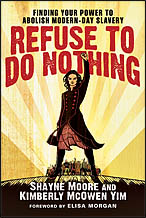 As I write, I’m sitting in a cafe in a small village that, in our area, was one of the last legs on the Underground Railroad. So it’s fitting that I’m writing about slavery and reflecting on the book “Refuse To Do Nothing”, by Shayne Moore and Kimberly McOwen Yim.
Modern day slavery. Human trafficking. The buying, selling, bondage, abuse and forced servitude of human beings.
Does it come as a surprise to you that there are slaves in the world today? Would you be surprised to know that the estimates are that 27 million people are enslaved today, more than during the Trans Atlantic slave trade? And would you be surprised to learn that, although sex trafficking accounts for about 5% of the world’s slave trade, it generates more than 39% of the profits from human trafficking? And that eighty percent of the human trafficking cases in the U.S. are for sexual slavery?
Looking back in history, people could recognize slavery and take up the cause because it was out in the open. Abhorrent, yes, but at the time, legal. The issue was visible, which made is possible to actually see the evil and work to right the wrongs. Every time I’ve sat down to write this post, I’ve tried to find a way to connect the facts of today’s modern slavery with reality. But I’ve been having a difficult time, because today’s slave trade is more secret, hidden. Forced labor, debt bondage, child labor. Unless you look for it, you wouldn’t see it. And even when it’s pointed out, sometimes it takes a while to understand how horrible it is.
But let’s try.
For example, would you eagerly reach for a chocolate bar if you knew that the cocoa beans used to make the candy were harvested by young children, forced into labor and held against their will? Child labor is used in almost 70% of the world’s cocoa production. As the sweet, chocolatey goodness melts on your fingers, imagine a young child, taken from his family and smuggled across the border to another country, working long hours with little food or pay, away from his family and threatened with violence. He made your treat possible.
Pick up your cell phone, and as you text, talk and surf the web, imagine a 6-year-old child in Africa – let’s say in the Democratic Republic of Congo, which boasts more than $20 trillion in natural resources at its disposal but is ranked by the United Nations as last in the world in human rights. This child is abducted by a militia group and given a machine gun, forced to kill his own parents (and likely rape and then horribly mutilate his own mother) and then instructed to burn down his entire village. That child soldier is now a pawn in ongoing conflict over the minerals used to make electronics. He made your LOLs possible.
Imagine a young girl of 13; she argues with her mother, decides to run away, and ends up at the house of a friend’s older brother. A man living there locks her in a room, beats her, drugs her and then forces her into prostitution. She is denied food, and threatened with more violence, against not only herself but also her family if she tries to leave. Now imagine that it’s your own daughter, right here in the U.S., because 83% of sex trafficking victims in the U.S. are U.S. citizens (based on confirmed cases of trafficking).
Imagine a man, born into a family with a debt owed to a sugar plantation owner. At birth, his life is already not his own. He, his children and his children’s children will toil under excrutiatingly horrible conditions, locked away from the outside world, bonded to a debt he didn’t incur but which continues to accrue – one step forward, ten steps back, forever working yet never getting closer to freedom.
Maybe these human trafficking facts piqued your interest or touched your heart. But with work, family, financial constraints and a multitude of other causes vying for your wallet and time, it may seem too overwhelming to think about getting involved. You don’t have time to take up a cause. And if you did, there are so many worthy ones, how would you choose? Slavery? Hurricane victims? Immigrants? Gun control? Abortion? Puppy mills? Hydrofracking? The list is endless and overwhelming.
Besides, you may ask, what can one person do?
Regardless of your religious beliefs, chances are you abide by some version of The Golden Rule: do unto others as you’d have done unto you, love your neighbor, what goes around comes around. If you take that seriously, the suffering of all humanity – from animals to humans – becomes important. You can care about all causes because you care about God and his creation.
But here’s something to remember: Refusing to do nothing is not the same as trying to do everything.
It’s simply not possible to give money to every charity or volunteer time with every cause, so put your efforts behind the cause God puts on your heart. Give your time and money where you feel God leads.
But also recognize that you have a responsibility to consider how everything you do affects everyone else. You don’t have to become a modern day abolitionist, hitting the lecture circuit or traveling to Cambodia to free young girls held in bondage. You can start by simply becoming an educated consumer. Read labels, look for “fair trade” symbols, ask questions about where your products were made. What we buy on the cheap often comes at the expense of someone else.
If God calls you to a more involved form of activism, go for it. But you can start by loving your neighbor; with that, compassion and charity will overflow to other areas of your life.
You can’t help but make a difference.
If you’re at all interested in learning more about human trafficking and how you can help, here are some resources to give you a little more information:
* Checkout the U.S. Department of State’s Trafficking In Persons Report, 2012 for more information about human trafficking, myths, personal stories, and statistics.
* Read the young adult novel, “Sold”, by Patricia McCormack, the fictional story of a young girl in Nepal forced by her stepfather to find a job to help support her family. In reality, she has been sold into slavery. If, like me, you’ve ever wondered how someone could be forced into prostitution – why don’t they just leave? – this book will help you understand.
* Check out the book “Where Are You Wearing” by Kelsey Timmerman. Kelsey traveled to several countries where his clothes were made – from his underwear to his flip flops – putting a human face behind the products we buy. (And watch for his new book, “Where Are You Eating,” a global journey across the food supply.) It’s a great way to start the discussion about how our buying decisions affect the global economy.
* Watch the documentary The Dark Side of Chocolate.
* Read “Refuse To Do Nothing”, which is filled with both information and practical things you can do every day to address the issue of human slavery.
Read what other Patheos bloggers are saying about “Refuse To Do Nothing”.
UPDATE: My friend Sam, who works with Not For Sale, sent me a list of other books he’d recommend for anyone interested in learning more about human trafficking. These are non-fiction, and accounts of slavery survivors. The reality is that human trafficking is such a complex, difficult, disturbing issue that it’s easy to get overwhelmed. Use these resources above and below to get started, and if you’re looking for more, let me know:
The Road of Lost Innocence, by Somaly Mam
Girls like us, by Rachel Lloyd
Slave: My True Story, by Mende Nazer
The War on Human Trafficking, by Anthony DeStefano
A Crime So Monstrous, by Benjamin Skinner
Disposable People, by Kevin Bales
Ending Slavery, by Kevin Bales
Not For Sale, by David Batstone
Escaping the Devil’s Bedroom, by Dawn Herzog Jewell
Enslaved, by Jesse Sage and Liora Kasten
Sold, by Patricia Mccormick
Nobodies, by John Bowe
Behind the Soiled Curtain, by David and Beth Grant
The Sacred Bath, by Theresa Flores
The Slave Next Door, by Kevin Bales
Previous Post

February 23, 2013
Bloodhounds, the most feared dogs on earth?
Next Post
March 23, 2013 Meggie the lost dog comes home - nine months after she disappeared
Browse Our Archives
Select a Category Animal behavior Animal health Animal history Animal rescue Animal research Animals and entertainment Animals and fashion Animals and food Animals and military Animals and science Animals and the law Animals in the news Be Nice Project Bears Bees Bible verses Birds Books cats Celebrities Christianity Circus Critters Dogs Elephants Farm animals Featured Shelter Pet Guest blogger Holidays Humor Interviews Movies Music National News Nature Ocean mammals Paganism Politics Quotes Reader photos Recalls Reviews Science Space Supernatural Technology Television Uncategorized Uncategorized video Wildlife Zoo
Select a Month November 2016 September 2016 August 2016 July 2016 June 2016 May 2016 November 2015 May 2015 October 2014 September 2014 July 2014 May 2014 April 2014 January 2014 November 2013 October 2013 September 2013 August 2013 July 2013 April 2013 March 2013 February 2013 January 2013 December 2012 November 2012 October 2012 September 2012 August 2012 July 2012 June 2012 May 2012 April 2012 March 2012 February 2012 January 2012 December 2011 November 2011 October 2011 July 2011 June 2011
Follow Us!
TAKE THE
Religious Wisdom Quiz
Who led the Israelites into the Promised Land?
Select your answer to see how you score.
Aaron Caleb Moses Joshua
Related posts from Heavenly Creatures
The election, fear, and an opportunity for change
Election 2016: What would Susan B. Anthony do?
Headstones, creativity, and National Novel Writing Month
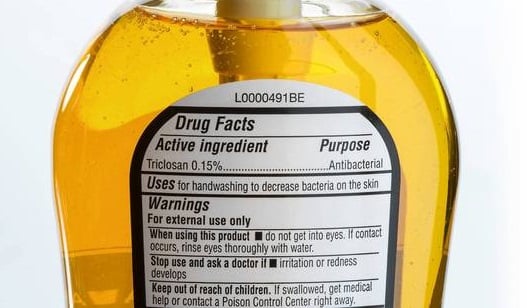
FDA bans chemicals in antibacterial soap
TRENDING AT PATHEOS New Visions

Did Prayer Cure His Cancer? Or Was It...
At 4 AM one morning, Joshua W. Brown’s wife awoke to a...

8 Ways a Near-Death Experience Rewires the Soul
Does Consciousness Survive Physical Death? After 50 Years of Research, Dr. Raymond...

Holy Longing: What Our Restlessness Is Telling Us
“One can find so many pains when the rain is falling.” -John...

What this is NOT about. This blog is definitely not about...

Who said the Israelites were God’s chosen? That’s right, they did. Who...

The Spirit World Is the Real World: God...
A Monk’s Wisdom on Body and Spirit I sit with Brother Martin...
view all New Visions blogs
Ad-Free & Subscriber Log-In Subscription Support
- About Us
- 2026 Calendar
- Videos
- Podcasts
- Library of World Religions
- Faith In Media Tracker
- Advertise With Us
- Write for Us
- Privacy Policy
- Terms of Service
- Do Not Sell My Data
- Contact Us
- Radiant Digital
- Manage Newsletter Subscriptions
- Unsubscribe From Notifications
- Sitemap
Copyright 2008-2026, Patheos. All rights reserved.
Subscription Support Ad-Free & Subscriber Log-In
Follow Patheos