
BuddhistCatholicContemplativeEvangelicalGeneral ChristianHinduJewishLatter-day SaintMuslimNew VisionsProgressive Christian
Beliefs
- Buddhist
- Catholic
- Contemplative
- Evangelical
- General Christian
- Hindu
- Jewish
- Latter-day Saint
- More Voices
- Muslim
- New Visions
- Pagan
- Progressive Christian
Topics
- Religion News
- Food and Religion
- Sports and Religion
- Religious Art
- Religious Music and Entertainment
- Religious Events
- History and Religion
- Style and Religion
- Politics and Religion
- Women in Religion
- Recreation Outdoors and Religion
- Business Finance and Religion
- Careers Workplace and Religion
- Education and Religion
- Family Parenting and Religion
- Health Fitness and Religion
- Home and Religion
- Relationships and Religion
- Technology and Religion
- Travel and Religion
Columnists
- Buddhist Columnists
- Business Finance and Religion Columnists
- Careers Workplace and Religion Columnists
- Catholic Columnists
- Contemplative Columnists
- Education and Religion Columnists
- Evangelists Columnists
- Family Parenting and Religion Columnists
- General Christian Columnists
- Health Fitness and Religion Columnists
- Hindu Columnists
- History and Religion Columnists
- Home and Religion Columnists
- Jewish Columnists
- More Voices Columnists
- Latter Day Columnists
- Muslim Columnists
- New Visions Columnists
- Nonreligious Columnists
- Pagan Columnists
- Politics and Religion Columnists
- Progressive Columnists
- Recreation Outdoors and Religion Columnists
- Relationships and Religion Columnists
- Religion News Columnists
- Religious Art Columnists
- Religious Events Columnists
- Religious Music and Entertainment Columnists
- Sports and Religion Columnists
- Style and Religion Columnists
- Technology and Religion Columnists
- Travel and Religion Columnists
- Women in Religion Columnists
Resource Library
- 2026 Calendar
- Library of World Religions
- The 100 Most Holy Places on Earth
- Patheos Answers
- Podcasts
- Videos
- Faith Leaders Database
- Anglican Episcopalian
- Bahai
- Baptist
- Buddhism
- Christianity
- Confucianism
- Eastern Orthodoxy
- Hinduism
- Holiness and Pentecostal
- ISKCON
- Islam
- Judaism
- Lutheran
- Methodist
- The Church of Jesus Christ of Latter-day Saints
- New Age
- Paganism
- Presbytarian and Reformed
- Protestantism
- Religion Behind the Scenes
- Roman Catholic
- Scientology
- Shia Islam
- Sikhism
- Sufism
- Sunni Islam
- Taoism
- Zen
- See all religions
Research Tools
 Ad-Free & Subscriber Log-In Subscription Support
Ad-Free & Subscriber Log-In Subscription Support
Follow Patheos 

- Trending:
- Forgiveness
- |
- Marriage
- |
- Consciousness
- |
- Death Penalty
- |
- Election
- |
- Halloween
 Heavenly Creatures
- Home
- New Visions
- Confessions of a non-recovering introvert
Confessions of a non-recovering introvert
Last updated on: May 26, 2016 at 2:08 pm by Joanne Brokaw
Confessions of a non-recovering introvert 2016-05-26T14:08:04-04:00 Joanne Brokaw
Patheos Explore the world's faith through different perspectives on religion and spirituality! Patheos has the views of the prevalent religions and spiritualities of the world.
 I’m an introvert. When I said it to friends a few times over the last couple of weeks, I’ve gotten responses like, “You? You’re so talkative” or “I remember you as so outgoing” but almost always, “You’re not an introvert.”
Really? How would you know?
You probably base your idea of who I am on what you see on the outside, without knowing what’s going on inside of me most of the time. Sure, I can put together a party and play the happy hostess. But inside, I’m usually freaking out, because I have a difficult time talking to lots of people at once. You see me as talkative because I try to go out into social situations only when I’ve built up enough social energy to carry on a conversation; you don’t see me in my alone times, just me and the dogs, walking in the cemetery and recharging my batteries.
I can talk at length, and even in front of a crowd, about a topic dear to my heart. But it’s impossible for me to speak when I don’t believe what I’m saying. Want to talk about human trafficking or positive dog training methods? I’m all about it. Which girl should get a rose on “The Bachelor”? I’m out – or rather, I end up musing about why women would value themselves so little that they’d compete for some guy on a game show and throw their emotions around so trivially; usually everyone else wants to talk about which girl is the biggest bitch.
I’m always asking questions to strangers, like “why do you believe that” and “how did that make you feel”, surrounding myself with gads of acquaintances but few real friends, avoiding conflict and loud noises (and people who wear copious amounts of perfume or cologne), always aware that there is a social line that, once crossed, can throw me into panic or drain me to the point of physical exhaustion.
I get it. I sound cuckoo. In fact, for years (and years) I thought there was something wrong with me. Let’s face it. In our culture, we revere the outgoing, bold, confident risk takers, those who set goals and go after them with wild abandon. Those of us who spend a lot of time thinking and wondering but not always doing are viewed as weak.
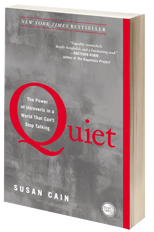
That’s why I was so relieved to read Susan Cain’s “Quiet: The Power of Introverts in a World That Can’t Stop Talking.” The book could have been subtitled “Joanne: An Owner’s Manual.”
For the first time, someone has taken the side of the introvert and shown how important they (we) are in an American culture, dispelling the myth that all introverts are recluses who avoid human interaction or that extrovertism is the ideal. And she uses neuroscience and research to back it all up.
Newsflash: there’s nothing wrong with me.
One of the things Cain talks about is the difference in the nervous systems of introverts and extroverts. Research has shown that introverts simply can’t handle too much stimulation, which is why we tend to shy away from … well, too much stimulation. It’s not that we don’t occasionally enjoy social outings, but the reality is that we can tolerate only so much before we’re overloaded: too much talking, too much music, too many smells or bright lights, too many people, too many conversations. I like a night out once in a while, but overall? I’d rather be in my jammies, watching PBS or reruns of my favorite comedies on Netflix, or reading an interesting book. I prefer coffee with one close friend over a large party of acquaintances. I try and maintain an even emotional state; not that I don’t feel emotions (I’m a wee bit of a crier, especially when it comes to my dogs) but too much up and down wears me out quickly.
It makes for some difficulties with personal relationships. Your typical introvert, Cain writes, “would rather spend her vacation reading on the beach than partying on a cruise ship.” Ironically, I’ve had family members try to get me to go on a cruise and they think they’re helping by extolling the virtues of a city on the sea – the activities, the stops at different ports, the various buffets, the shows, so much to do. But with every word they reinforce my belief that a cruise would simply be hell on the water.
The problem, of course, is that no one wants to plan a family vacation with the girl who wants to sit under a palm tree for a week, sipping pina coladas, reading a book, and contemplating the meaning of life. But for me? Heaven. I don’t need to be alone; I just need to be calm, peaceful, relaxed, left to enjoy one glorious thing at a time.
Introverts avoid conflict, so imagine being an introvert married to a spouse for whom cathartic emotional eruptions are a way of expressing everything from love to anger. The introvert tries to minimize the aggression, distancing herself from the situation. The extrovert sees it as closing off emotionally and so amps up the volume. “Pretty soon they’re locked in a destructive cycle from which they can’t escape,” writes Cain, “partly because both spouses believe they’re arguing in the appropriate manner.”
The key isn’t to determine which is better – introvert or extrovert – but to recognize that we’re all different people with different ways of dealing with the world, with different purposes and ways of fulfilling those purposes.
The problem, of course, is that in our culture we don’t recognize the value of the introvert, and so most of us are always trying to live up to the extrovert ideal. Just do it, we’re told. Be happy, set goals, live like there’s no tomorrow, speak up, put away the books. In other words, try not to be so damned introverted. The problem, though, is that “acting out of character for too long and without restorative niches” will eventually take a toll.
“When your conscientiousness impels you to take on more than you can really handle,” Cain writes, “you begin to lose interest, even in tasks that normally engage you.” She calls it “emotional labor”, or the effort we make to control and change our own emotions, and it’s associated with stress, burnout and other physical symptoms. Too much energy spent trying to naviagate the emotional storms, and wham. You’re sidelined with every tank on empty.
Been there, done that. “Empty” is how I spent the entire year of 2011.
Other introvert traits, according to Cain: they get sick more easily in highly stressful situations; don’t handle information overload well; are not good at multitasking (which is not doing two things at once but being able to quickly switch between multiple tasks); prefer deep, meaningful conversations to chit chat; are less driven by rewards like cash or “top dog” status; and are often exhausted after being around other people. Yup, that’s me.
But here’s the thing to remember: those are not bad traits to have. The world needs introverts. Cain talks a lot about the power of introverts in business and finance, citing the success of people like Bill Gates, Charles Schwab, Warren Buffet, and Steve Wozniak, introverted leaders and innovators often described as quiet, humble, shy, gracious, modest and understated.
Managers put a lot of emphasis on hiring employees who can multitask, but multitasking “reduces productivity and increases mistakes by up to 50 percent”. Cain suggests that managers “Make the most of introverts’ strengths – these are the people who can help you think deeply, strategize, solve complex problems, and spot canaries in your coal mines.”
The world needs those quiet innovators like Marie Curie, who work in solitude but make contributions from which we all benefit. Much can be accomplished with quiet strength – think Rosa Parks, Ghandi. There’s something to be said for people who are driven by internal gratification rather than external rewards.
And never forget that you can change the world without necessarily having to play host to everyone in it. Cain quotes Theodore Geisel, otherwise known as Dr. Seuss, an introvert who rarely ventured out to meet his merry bands of young fans. “In mass,” Geisel has said, “[children] terrify me.”
I don’t think I needed Cain to tell me that introverts are important or make significant contributions to society. I know that. What I did need was for someone to explain that being introverted is OK; that being shy in some situations and social in others is normal for someone like me; that it’s OK to not strive to be rich or famous (or want shiny new things); that someone understands that being alone is not the same as being lonely; that for people like me, solitude can be invigorating and shouldn’t be viewed as anti-social.
The key, writes Cain, is to “put yourself in the right lighting … Use your natural powers – of persistence, concentration, insight, sensitivity – to do work you love and work that matters. Solve problems, make art, think deeply. Figure out what you are meant to contribute to the world and make sure you contribute it.”
And that’s what I really needed to hear.
You can learn more about “Quiet: The Power of Introverts in a World That Won’t Stop Talking” on the book’s website.
Previous Post

February 2, 2013
We Are Not Alone - a quick visit to the Planetarium
Next Post
February 20, 2013 Can dogs be introverted or extroverted?
Browse Our Archives
Select a Category Animal behavior Animal health Animal history Animal rescue Animal research Animals and entertainment Animals and fashion Animals and food Animals and military Animals and science Animals and the law Animals in the news Be Nice Project Bears Bees Bible verses Birds Books cats Celebrities Christianity Circus Critters Dogs Elephants Farm animals Featured Shelter Pet Guest blogger Holidays Humor Interviews Movies Music National News Nature Ocean mammals Paganism Politics Quotes Reader photos Recalls Reviews Science Space Supernatural Technology Television Uncategorized Uncategorized video Wildlife Zoo
Select a Month November 2016 September 2016 August 2016 July 2016 June 2016 May 2016 November 2015 May 2015 October 2014 September 2014 July 2014 May 2014 April 2014 January 2014 November 2013 October 2013 September 2013 August 2013 July 2013 April 2013 March 2013 February 2013 January 2013 December 2012 November 2012 October 2012 September 2012 August 2012 July 2012 June 2012 May 2012 April 2012 March 2012 February 2012 January 2012 December 2011 November 2011 October 2011 July 2011 June 2011
Follow Us!
TAKE THE
Religious Wisdom Quiz
What does the name "Samuel" mean?
Select your answer to see how you score.
Saved by God Sent by God Heard by God Gifted by God
Related posts from Heavenly Creatures
Headstones, creativity, and National Novel Writing Month

Confessions of an office (and school) supply addict

FDA bans chemicals in antibacterial soap
Musing on pregnancy, abortion, and becoming a human
TRENDING AT PATHEOS New Visions

Did Prayer Cure His Cancer? Or Was It...
At 4 AM one morning, Joshua W. Brown’s wife awoke to a...

8 Ways a Near-Death Experience Rewires the Soul
Does Consciousness Survive Physical Death? After 50 Years of Research, Dr. Raymond...

Holy Longing: What Our Restlessness Is Telling Us
“One can find so many pains when the rain is falling.” -John...

What this is NOT about. This blog is definitely not about...

Who said the Israelites were God’s chosen? That’s right, they did. Who...

The Spirit World Is the Real World: God...
A Monk’s Wisdom on Body and Spirit I sit with Brother Martin...
view all New Visions blogs
Ad-Free & Subscriber Log-In Subscription Support
- About Us
- 2026 Calendar
- Videos
- Podcasts
- Library of World Religions
- Faith In Media Tracker
- Advertise With Us
- Write for Us
- Privacy Policy
- Terms of Service
- Do Not Sell My Data
- Contact Us
- Radiant Digital
- Manage Newsletter Subscriptions
- Unsubscribe From Notifications
- Sitemap
Copyright 2008-2026, Patheos. All rights reserved.
Subscription Support Ad-Free & Subscriber Log-In
Follow Patheos