
BuddhistCatholicContemplativeEvangelicalGeneral ChristianHinduJewishLatter-day SaintMuslimNew VisionsProgressive Christian
Beliefs
- Buddhist
- Catholic
- Contemplative
- Evangelical
- General Christian
- Hindu
- Jewish
- Latter-day Saint
- More Voices
- Muslim
- New Visions
- Pagan
- Progressive Christian
Topics
- Religion News
- Food and Religion
- Sports and Religion
- Religious Art
- Religious Music and Entertainment
- Religious Events
- History and Religion
- Style and Religion
- Politics and Religion
- Women in Religion
- Recreation Outdoors and Religion
- Business Finance and Religion
- Careers Workplace and Religion
- Education and Religion
- Family Parenting and Religion
- Health Fitness and Religion
- Home and Religion
- Relationships and Religion
- Technology and Religion
- Travel and Religion
Columnists
- Buddhist Columnists
- Business Finance and Religion Columnists
- Careers Workplace and Religion Columnists
- Catholic Columnists
- Contemplative Columnists
- Education and Religion Columnists
- Evangelists Columnists
- Family Parenting and Religion Columnists
- General Christian Columnists
- Health Fitness and Religion Columnists
- Hindu Columnists
- History and Religion Columnists
- Home and Religion Columnists
- Jewish Columnists
- More Voices Columnists
- Latter Day Columnists
- Muslim Columnists
- New Visions Columnists
- Nonreligious Columnists
- Pagan Columnists
- Politics and Religion Columnists
- Progressive Columnists
- Recreation Outdoors and Religion Columnists
- Relationships and Religion Columnists
- Religion News Columnists
- Religious Art Columnists
- Religious Events Columnists
- Religious Music and Entertainment Columnists
- Sports and Religion Columnists
- Style and Religion Columnists
- Technology and Religion Columnists
- Travel and Religion Columnists
- Women in Religion Columnists
Resource Library
- 2026 Calendar
- Library of World Religions
- The 100 Most Holy Places on Earth
- Patheos Answers
- Podcasts
- Videos
- Faith Leaders Database
- Anglican Episcopalian
- Bahai
- Baptist
- Buddhism
- Christianity
- Confucianism
- Eastern Orthodoxy
- Hinduism
- Holiness and Pentecostal
- ISKCON
- Islam
- Judaism
- Lutheran
- Methodist
- The Church of Jesus Christ of Latter-day Saints
- New Age
- Paganism
- Presbytarian and Reformed
- Protestantism
- Religion Behind the Scenes
- Roman Catholic
- Scientology
- Shia Islam
- Sikhism
- Sufism
- Sunni Islam
- Taoism
- Zen
- See all religions
Research Tools
 Ad-Free & Subscriber Log-In Subscription Support
Follow Patheos 

- Trending:
- Advent
- |
- Forgiveness
- |
- Thanksgiving
- |
- Election
- |
- Seasonal Holidays
- |
- Marriage
 Heathen at Heart
- Home
- Pagan
- Nehalennia, Goddess Lost to Time
Nehalennia, Goddess Lost to Time
Last updated on: August 11, 2019 at 4:03 pm by Molly Khan
Nehalennia, Goddess Lost to Time 2019-08-11T16:03:23-05:00 Molly Khan
Patheos Explore the world's faith through different perspectives on religion and spirituality! Patheos has the views of the prevalent religions and spiritualities of the world.

Photo by Karlunun, used via Creative Commons
Beginning sometime near the second century BC, the Goddess Nehalennia was honored where the Rhine river met the North Sea. Votive inscriptions and numerous altars were dedicated to Her, and temples built in Her honor. Sometime after the third century CE, Her temple was covered by the ocean, where it rested undisturbed for more than a thousand years.
In 1645, a storm on the coast of Zeeland eroded away the land and unearthed Her temple once again. Since then, the altars, inscriptions, and offerings to Her have been studied carefully, archaeologists attempting to rediscover Her secrets. Not only that, but She has managed to recapture the imagination of the local populace. A new temple to Her was built in the town of Colijnsplaat in 2005.
Nehalennia
 What’s in a name? Often, there’s some information about the attributes of a deity to be found in Their name. From Nehalennia, we know that She is likely either a Germanic or Celtic Goddess. That’s where the agreement of scholars ends. Rudolph Simek in his Dictionary of Northern Mythology gives a possible etymology as relating to the Latin verb ‘necare’ which means ‘to kill’.
Kauffmann believes it relates to *neu, a word for ship. This relates to many of the inscriptions found dedicated to Her, which tend to be merchants thanking Her or petitioning Her for safe passage across the sea. There are also frequently boats depicted on Her altars. There is no clear translation or etymology for Nehalennia, however.
Iconography
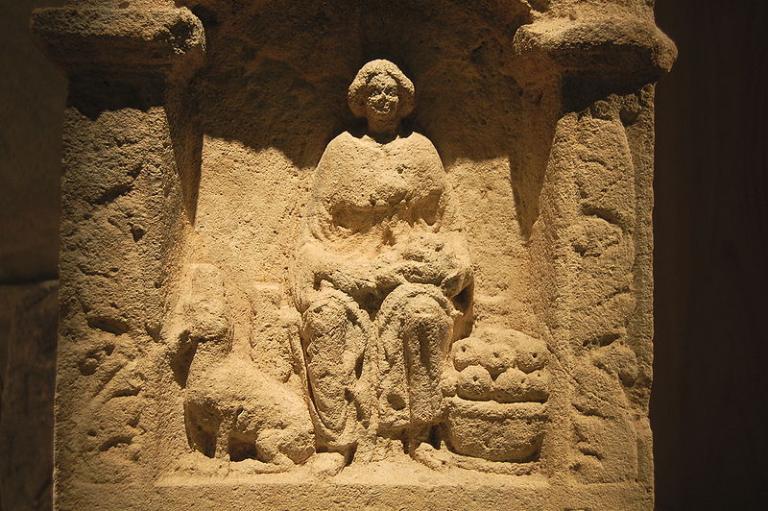
Photo by mystic_mabel, used via Creative Commons
On the votive inscriptions that have been unearthed, there is a great deal of symbolism associated with Nehalennia. The most popular seems to be fruits and verdant growing things. Baskets of apples frequently appear next to Her or in Her hands, and fruit trees and growing vines cover the sides of many of the votive altars. This fits with Her as a Goddess of merchants: peace and prosperity are ideal when your occupation is buying and selling goods.
Interestingly, there are a few other symbols frequently associated with Her. One of these is a dog, a greyhound-like animal. It is frequently depicted sitting at Her feet, looking up at the Goddess. Rudolph Simek connects this iconography with a goddess of the dead. Hilda Ellis Davidson in her Roles of the Northern Goddess argues that the dog is often depicted alongside mother Goddesses, particularly in the Roman period in Celtic areas. I personally believe this interpretation makes more sense with the rest of Her iconography, but there is an interesting connection there.
Nehalennia is sometimes depicted with Her foot on the bow of a ship. This makes sense with the inscriptions, She is clearly seen as having some authority over whether or not ships make it safely across the North Sea. The sea and specifically sea-trade is associated with prosperity in the same way Njord is associated with both prosperity and the sea.
Perhaps most interestingly, She is also sometimes depicted with loaves of bread. Not just any loaf of bread, however. Davidson identifies them as duivekater, a type of sweet bread that is made in the shape of a bone to approximate an animal sacrifice to a deity. It seems Nehalennia was a fan of this type of offering; raising again the question of Her connection with death.
Vanic Connections
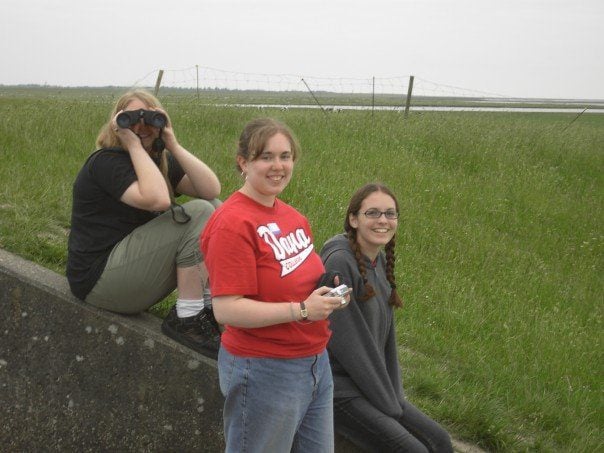
Some friends and I near the North Sea in 2007
As someone who honors primarily Vanic deities, I see many connections here. The association with ships and the sea is reminiscent of both Njord and Frey. Her additional links to prosperity bring Them both to mind as well. Nehalennia’s possible link to death through Her name and the hounds that accompany Her reminds me of both Freya and Nerthus. Freya, as chooser of the slain and Vanadis, and Nerthus, to whom slaves were offered by drowning, both have strong death connections.
Obviously, the only attested Vanir are Njord, Freya, and Frey. But there are interesting connections to other deities. If the distinction is important to you, it’s worth investigating Nehalennia.
Modern Day Worship

Reconstructed temple of Nehalennia, used via Creative Commons
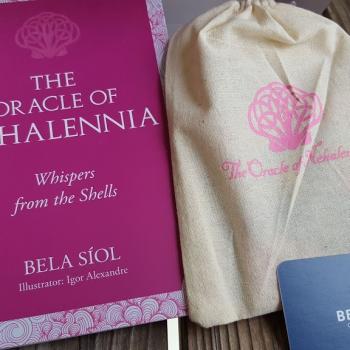
Nehalennia is certainly not as popular as the most recognized gods of the Germanic pantheons, but She has a following today. One of the more prominent figures is Bela Síol, a Pagan priestess from Brazil. She has had a relationship with Nehalennia for ten years now, and has created an oracle based on Her symbology specifically for communicating with Her.
There is also a temple to Her in Colijnsplaat in the Netherlands. The website is in Dutch, but there are many beautiful pictures of the reconstructed temple. If you’re ever in the area, it’d be a fantastic pilgrimage site for any who honor Nehalennia.
I have been honoring Her casually for a few years now. I’ve found that She appreciates gifts of fruits and other little sweet things. She was especially pleased the day I baked the duivekater and offered Her a slice. For me, She is strongly associated with the sea, especially the North Sea. I was lucky enough to visit there a long time ago, and when She speaks to me, it is always with the feel of that place. I find it interesting that it was an ocean storm that uncovered Her temple – perhaps She wanted the world to see Her once again.

About Molly Khan
Molly Khan is a Heathen and mother of five writing from the beautiful midwest prairie, primarily focused on regional cultus and the honor of gods of the natural world. A creator of many divination sets, she formerly acted as the elected Scribe for Prairie Shadow Grove, ADF. She has been Pagan for more than fifteen years, and a self-identifying Heathen for six. Check out her Etsy store SticksandStonesRunes to find runes and other ritual tools, and support inclusive Heathen writing! You can read more about the author here.
Previous Post

July 29, 2019
5 Simple Ways to Bring Lammas to Our Modern Lives
Next Post

August 15, 2019 Tarot Stones Won't Bend or Blow Away
Browse Our Archives
Select a Category ADF Ancestors Books Deities Divination Festivals Heathen Historical Holidays Land Wights Magic Midwest Pagan Parenting Polytheism Prayer Runes Uncategorized Vanatru
Select a Month September 2019 August 2019 July 2019 June 2019 May 2019 April 2019 March 2019 February 2019 June 2017 March 2017 February 2017 December 2015 October 2015 September 2015 August 2015 July 2015 June 2015 May 2015
Follow Us!
TAKE THE
Religious Wisdom Quiz
Who said, "Repent, for the kingdom of heaven is at hand"?
Select your answer to see how you score.
Jesus Peter Isaiah John the Baptist
Related posts from Heathen at Heart
How To Use Leaf Magic This Fall
Divination With Cranes (And Other Creatures)
A Heathen Fall Equinox Celebration
TRENDING AT PATHEOS Pagan

10 years of the Power Sigil & Moving...
Last week while reorganizing my studio space, I found the sketchbook that...

Here comes a rant (and TLDR: if you're a US citizen eligible...

Why are younger seekers drawn to Paganism and...
One of the things I've noticed the most is that I'm far...

When we talk about Greek religion, we often begin with the dodekatheion—the...

I was recently chatting with someone on Instagram. She asked me what...

On July 23, I saw Christopher Nolan's The Odyssey which is Homer’s...
view all Pagan blogs
Ad-Free & Subscriber Log-In Subscription Support
- About Us
- 2026 Calendar
- Videos
- Podcasts
- Library of World Religions
- Faith In Media Tracker
- Advertise With Us
- Write for Us
- Privacy Policy
- Terms of Service
- Do Not Sell My Data
- Contact Us
- Radiant Digital
- Manage Newsletter Subscriptions
- Unsubscribe From Notifications
- Sitemap
Copyright 2008-2026, Patheos. All rights reserved.
Subscription Support Ad-Free & Subscriber Log-In
Follow Patheos