
BuddhistCatholicContemplativeEvangelicalGeneral ChristianHinduJewishLatter-day SaintMuslimNew VisionsProgressive Christian
Beliefs
- Buddhist
- Catholic
- Contemplative
- Evangelical
- General Christian
- Hindu
- Jewish
- Latter-day Saint
- More Voices
- Muslim
- New Visions
- Pagan
- Progressive Christian
Topics
- Religion News
- Food and Religion
- Sports and Religion
- Religious Art
- Religious Music and Entertainment
- Religious Events
- History and Religion
- Style and Religion
- Politics and Religion
- Women in Religion
- Recreation Outdoors and Religion
- Business Finance and Religion
- Careers Workplace and Religion
- Education and Religion
- Family Parenting and Religion
- Health Fitness and Religion
- Home and Religion
- Relationships and Religion
- Technology and Religion
- Travel and Religion
Columnists
- Buddhist Columnists
- Business Finance and Religion Columnists
- Careers Workplace and Religion Columnists
- Catholic Columnists
- Contemplative Columnists
- Education and Religion Columnists
- Evangelists Columnists
- Family Parenting and Religion Columnists
- General Christian Columnists
- Health Fitness and Religion Columnists
- Hindu Columnists
- History and Religion Columnists
- Home and Religion Columnists
- Jewish Columnists
- More Voices Columnists
- Latter Day Columnists
- Muslim Columnists
- New Visions Columnists
- Nonreligious Columnists
- Pagan Columnists
- Politics and Religion Columnists
- Progressive Columnists
- Recreation Outdoors and Religion Columnists
- Relationships and Religion Columnists
- Religion News Columnists
- Religious Art Columnists
- Religious Events Columnists
- Religious Music and Entertainment Columnists
- Sports and Religion Columnists
- Style and Religion Columnists
- Technology and Religion Columnists
- Travel and Religion Columnists
- Women in Religion Columnists
Resource Library
- 2026 Calendar
- Library of World Religions
- The 100 Most Holy Places on Earth
- Patheos Answers
- Podcasts
- Videos
- Faith Leaders Database
- Anglican Episcopalian
- Bahai
- Baptist
- Buddhism
- Christianity
- Confucianism
- Eastern Orthodoxy
- Hinduism
- Holiness and Pentecostal
- ISKCON
- Islam
- Judaism
- Lutheran
- Methodist
- The Church of Jesus Christ of Latter-day Saints
- New Age
- Paganism
- Presbytarian and Reformed
- Protestantism
- Religion Behind the Scenes
- Roman Catholic
- Scientology
- Shia Islam
- Sikhism
- Sufism
- Sunni Islam
- Taoism
- Zen
- See all religions
Research Tools
 Ad-Free & Subscriber Log-In Subscription Support
Ad-Free & Subscriber Log-In Subscription Support
Follow Patheos 

- Trending:
- Forgiveness
- |
- Marriage
- |
- Consciousness
- |
- Death Penalty
- |
- Election
- |
- Halloween
 Hearth Witch Down Under
- Home
- Pagan
- Asteria of Happy Name, Mother of Hekate
Asteria of Happy Name, Mother of Hekate
Last updated on: January 24, 2018 at 1:30 pm by Bekah Evie Bel
Asteria of Happy Name, Mother of Hekate 2018-01-24T13:30:48+10:00 Bekah Evie Bel
Patheos Explore the world's faith through different perspectives on religion and spirituality! Patheos has the views of the prevalent religions and spiritualities of the world.
Asteria is, like so many of the Titans, not well known to the average Pagan. There is a bit of information about Her around, but most of it is more about other deities and the role She played in Their stories, rather than information about Her on Her own behalf. This can make it difficult to really know anything about Her, without direct connection to Her – and the fact we know of very little in the way of cultus to Her doesn’t help modern worship either.
Still we can take a look and learn a few things that may be of help.
Asteria the Titaness
Asteria is the daughter of the Titan Koios “The Inquiring” and Titaness Phoibe, Goddess of bright intellect. Her sister is Leto, the mother of Artemis and Apollon. Asteria Herself is the Goddess of the starry night, falling stars and night time divination such as astrology and dreams. Her name is translated as “starry” or “falling star”. She is the wife of the Titan Perses, the Destroyer and with Him She had one child – Hekate, most honoured by Zeus.
There isn’t much information that I can find regarding Asteria in the early myths, before the Titanomachy and the rise of the Olympians. She did fight in the Gigantomachy with the other Gods, as evidenced by Her position on the Pergamon Altar (image below), though She is not mentioned by name in any texts about this war. Given the story that is told about Asteria after the Titanomachy, it seems safe to assume that She was not one of those who fought against Zeus. She was seemingly welcome on Olympus and while there unfortunately attracted the attention of Zeus.
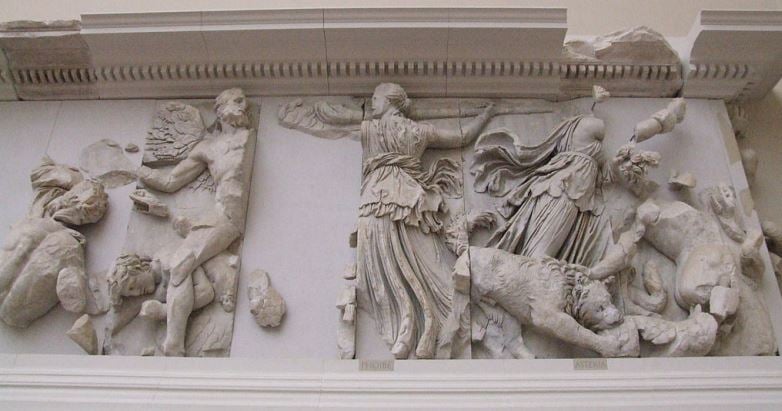
By Claus Ableiter (Own work) [GFDL, CC-BY-SA-3.0 or CC BY-SA 2.5-2.0-1.0], via Wikimedia Commons

The Island of Delos
In order to escape the attention of Zeus, Asteria transformed Herself into a quail, but Zeus transformed into an eagle and caught Her. To get away She threw Herself into the sea, where Poseidon decided to chase Her as well until finally She turned Herself into an island. Some versions of the myth, such as in Fabulae by Pseudo-Hyginus, tell that when She turned Zeus down He punished Her by turning Her into a quail and throwing Her into the sea, and from this She became an island.
The island that Asteria became has held a few different names, most notably Asteria and Ortygia (which can translate as Quail Island) and the final and current name, Delos.
“Of the daughters of Coeus, Asteria in the likeness of a quail flung herself into the sea in order to escape the amorous advances of Zeus, and a city was formerly called after her Asteria, but afterwards it was named Delos. ” – Apollodorus the library (Bibliotheca) v1
The Birth of the Twins
Asterias sister, Leto, had some drama and was chased around the world as well, again because of Zeus. In this case, Leto was actually pregnant to Zeus and it was an angry Hera who pursued Her all around. Leto was in need of a place to stop so She could give birth, but no place was safe, no place would welcome Her in the face of Heras wrath. Except one – the island of Delos.
Asteria, as Delos, agreed to allow Leto to give birth on Her soil in exchange for a promise that Letos soon to be born son would create a great temple on Her soil. The agreement was struck, sworn by the Styx Herself, and Leto then gave birth to Artemis (though some myths state Artemis was born on a nearby islet). Artemis then of course helped Her mother birth the God Apollon, who did indeed set up a great temple on Delian soil.
“And Leto sware the great oath of the gods: ‘Now hear this, Earth and wide Heaven above, and dropping water of Styx (this is the strongest and most awful oath for the blessed gods), surely Phoebus shall have here his fragrant altar and precinct, and you he shall honour above all.’ Now when Leto had sworn and ended her oath, Delos was very glad at the birth of the far-shooting lord. ” – Hymn to Delian Apollon, The Homeric Hymns.
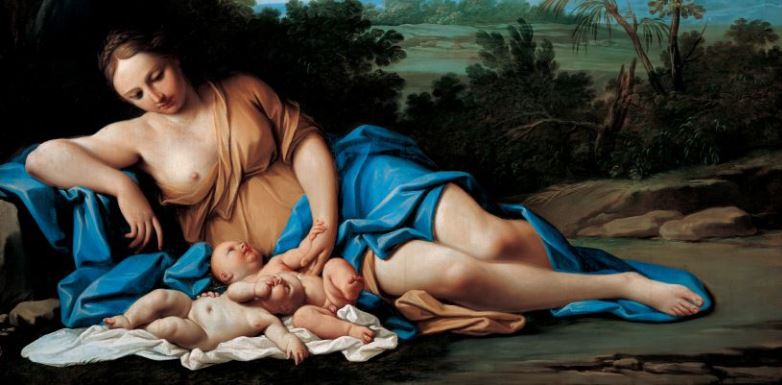
Birth of Apollo and Diana (Artemis) Marcantonio Franceschini [Public domain], via Wikimedia Commons

Miscellaneous
Asteria is sometimes conflated (or confused) with Nyx, which stands to reason – Nyx is the Night, Asteria is the Starry Night. Nyx is even listed as the mother of Hekate in some myths (Bacchylides and Apollonius Rhodius).
Theoi.com note that Asteria was perhaps worshipped under the name of Brizo (Slumber) on Delos itself, as a Goddess of dream oracles. She may also have been known as, the same as, or very similar to the Pasiphae of Thalamae, a Goddess of sky and ocean who sent prophetic dreams. Also She may have been conflated with the Mesopotamian Goddess Ishtar.
The island of Delos plays a role in many myths and stories from ancient Greece, but most of these fail to mention Asteria, or that Delos is a living island. Delos was, when Asteria first became the island, a floating island that had no fixed position. It was after the birth of Apollon that the island found a stable place on the Earth.
Callimachus, in his Hymn to Delos calls Her, “Asteria, lover of song” and “Nurse of Apollon”. He also refers to Her as the “Island of Incense”.
The symbols of Asteria are stars, falling stars (I would assume all sorts of meteors, comets etc), and quails – the image of an eagle grasping a quail would probably also be quite symbolic.
Thoughts on Asteria
One of the more interesting things about Asteria and Her history, is pointed out on Theoi.com: She and Her sister Leto appear to be two sides of the same coin. They both have children who are very similar and yet very different. Apollon is a God of light and day time prophecy, whereas Hekate while a light Goddess is also a night time Goddess and of night time magic and prophecy like Her mother. In essence, Leto births the day and Asteria births the night.
Leto also births Artemis who is often conflated with Hekate, which creates a further interesting connection between Asteria and Her daughter (or between Hekate and Artemis).
I also find it fascinating that Asteria is the wife of Perses the Destroyer. She is literally called, Asteria of happy name in the Homeric Hymns, and yet She is married to what could be deemed one of the more scary of the Hellenic Gods. But it makes a lot of sense as well, considering Their daughter is Hekate who is both dark and light, saviour and destroyer, Goddess of childbirth and of the dead. The seemingly opposing personalities of Asteria and Perses are well borne out in Their daughter.
My Worship of Asteria
As I began this post, there is very little in the way of information about Asteria other than Her status as Hekates mother and Her transformation into the island of Delos. This means that there is basically nothing I can find that tells us about Her cultus, Her worship, Her rituals, Her sacred days and festivals (if there were any). I cannot even find a good hymn, other than the ones to the island of Delos and to Delian Apollon – but those are not what I am after.
Despite Her status as a literal island on our planet, She is still the Starry Night and that is how I see Her and feel Her. I am not sure how to connect to an island on the other side of the world. But every time I go outside at night and view the stars, She fills my head and heart and I will always say a little something – generally a basic “Hail Asteria” or something similar.
I am not sure of other peoples opinions on this subject but when it comes to seeing the Gods by domain (earth, sky, ocean) I can’t help but see that Asteria is surely all three, just like Her daughter is. As the starry night, She is obviously a Ouranic deity, but as an island and one which used to float, She is surely also Oceanic and Cthonic.
On my own calendar I now honour Asteria every lunar month, on around the 19th day after the new waxing moon, but more precisely the 4th day after the full moon. According to Works and Days the 19th day (or the 9th of mid-month) improves the closer it gets to night, and so I thought it fitting for a night time Goddess (I also do a ritual to Nyx on this night). They didn’t disagree at all, even through divination, but this may be different for other people.
My rituals are fairly simple, involving a hymn to Asteria (and to Nyx), the burning of incense and a candle and of course a libation. This is all done outside, where possible, since it’s all about Goddesses of the night and should include views of the night sky.
A Hymn to Asteria
As I have said, I haven’t been able to find a hymn to Asteria so, I made a horrible attempt at one myself.
Hail Asteria of happy name,
Of Ortygian and Delian fame;
Goddess of the starry night,
mother of the bringer of light;
Birthplace, saviour, transformed one,
Nurse of your sisters gloried son;
Island drifting with ocean tides,
Bring us dreams, of all that hides;
Attend our rites, heed our pleas,
Help us view what no one sees.
Sources, Resources and Further Reading
- Homeric Hymns
- Hesiod, Theogony
- Theoi.com
- Ovid, Metamorphoses
- Apollodorus, The Library (Bibliotheca) v1
- Hesiod, Works and Days
- Callimachus, Hymn to Delos
Previous Post
October 30, 2017
Is it Wrong to Worship the Titans?
Next Post
November 17, 2017 To Culturally Appropriate or Not?
Browse Our Archives
Select a Category Australia Calendar, Events and Festivals General Hellenism Hellenismoz How To Lore and Myth Multimedia Pagan Blogosphere Pagan Community Pagan Parenting and Homeschooling Paganism 101 Personal Practice Religious Philosophy Resources and Material Ritual Uncategorized Witchcraft 101
Select a Month January 2018 December 2017 November 2017 October 2017 August 2017 July 2017 June 2017 May 2017 April 2017 March 2017 February 2017 January 2017 December 2016 November 2016 October 2016 September 2016 August 2016 July 2016 June 2016 May 2016 April 2016 July 2012 June 2012 May 2012 April 2012 March 2012 February 2012 January 2012 December 2011
Follow Us!
TAKE THE
Religious Wisdom Quiz
Which book is known as the "Weeping Prophet's" book?
Select your answer to see how you score.
Isaiah Jeremiah Lamentations Ezekiel
Related posts from Hearth Witch Down Under
2018 Pagan Wallpapers and Printables

Book Review - Circle for Hekate: History and...
Hekates Deipnon - Day 30 of My Sacred...
Hades Ritual - Day 29 of My Sacred...
TRENDING AT PATHEOS Pagan

I was recently chatting with someone on Instagram. She asked me what...

While there are many people who share their results, the end of...

On July 23, I saw Christopher Nolan's The Odyssey which is Homer’s...

As I write this two big events have just finished up. One...

Restoring the Watershed of Divine Love
Perhaps cooperation is not something we manufacture through legislation, ideology, or moral...

Many UUs don’t pray because of bad experiences in a previous religion,...
view all Pagan blogs
Ad-Free & Subscriber Log-In Subscription Support
- About Us
- 2026 Calendar
- Videos
- Podcasts
- Library of World Religions
- Faith In Media Tracker
- Advertise With Us
- Write for Us
- Privacy Policy
- Terms of Service
- Do Not Sell My Data
- Contact Us
- Radiant Digital
- Manage Newsletter Subscriptions
- Unsubscribe From Notifications
- Sitemap
Copyright 2008-2026, Patheos. All rights reserved.
Subscription Support Ad-Free & Subscriber Log-In
Follow Patheos