
BuddhistCatholicContemplativeEvangelicalGeneral ChristianHinduJewishLatter-day SaintMuslimNew VisionsProgressive Christian
Beliefs
- Buddhist
- Catholic
- Contemplative
- Evangelical
- General Christian
- Hindu
- Jewish
- Latter-day Saint
- More Voices
- Muslim
- New Visions
- Pagan
- Progressive Christian
Topics
- Religion News
- Food and Religion
- Sports and Religion
- Religious Art
- Religious Music and Entertainment
- Religious Events
- History and Religion
- Style and Religion
- Politics and Religion
- Women in Religion
- Recreation Outdoors and Religion
- Business Finance and Religion
- Careers Workplace and Religion
- Education and Religion
- Family Parenting and Religion
- Health Fitness and Religion
- Home and Religion
- Relationships and Religion
- Technology and Religion
- Travel and Religion
Columnists
- Buddhist Columnists
- Business Finance and Religion Columnists
- Careers Workplace and Religion Columnists
- Catholic Columnists
- Contemplative Columnists
- Education and Religion Columnists
- Evangelists Columnists
- Family Parenting and Religion Columnists
- General Christian Columnists
- Health Fitness and Religion Columnists
- Hindu Columnists
- History and Religion Columnists
- Home and Religion Columnists
- Jewish Columnists
- More Voices Columnists
- Latter Day Columnists
- Muslim Columnists
- New Visions Columnists
- Nonreligious Columnists
- Pagan Columnists
- Politics and Religion Columnists
- Progressive Columnists
- Recreation Outdoors and Religion Columnists
- Relationships and Religion Columnists
- Religion News Columnists
- Religious Art Columnists
- Religious Events Columnists
- Religious Music and Entertainment Columnists
- Sports and Religion Columnists
- Style and Religion Columnists
- Technology and Religion Columnists
- Travel and Religion Columnists
- Women in Religion Columnists
Resource Library
- 2026 Calendar
- Library of World Religions
- The 100 Most Holy Places on Earth
- Patheos Answers
- Podcasts
- Videos
- Faith Leaders Database
- Anglican Episcopalian
- Bahai
- Baptist
- Buddhism
- Christianity
- Confucianism
- Eastern Orthodoxy
- Hinduism
- Holiness and Pentecostal
- ISKCON
- Islam
- Judaism
- Lutheran
- Methodist
- The Church of Jesus Christ of Latter-day Saints
- New Age
- Paganism
- Presbytarian and Reformed
- Protestantism
- Religion Behind the Scenes
- Roman Catholic
- Scientology
- Shia Islam
- Sikhism
- Sufism
- Sunni Islam
- Taoism
- Zen
- See all religions
Research Tools
 Ad-Free & Subscriber Log-In Subscription Support
Ad-Free & Subscriber Log-In Subscription Support
Follow Patheos 

- Trending:
- Forgiveness
- |
- Marriage
- |
- Consciousness
- |
- Death Penalty
- |
- Election
- |
- Halloween
 Hearth Witch Down Under
- Home
- Pagan
- Agathos Daimon – Day 2 of My Sacred Month
Agathos Daimon – Day 2 of My Sacred Month
Last updated on: January 24, 2018 at 1:30 pm by Bekah Evie Bel
Agathos Daimon – Day 2 of My Sacred Month 2018-01-24T13:30:47+10:00 Bekah Evie Bel
Patheos Explore the world's faith through different perspectives on religion and spirituality! Patheos has the views of the prevalent religions and spiritualities of the world.
This November, 2017, is the first time I will be trying to observe every single ritual that I have added into my personalised Men Kata Theion, or Sacred Month.
The second day of the lunar month, that is the day after the new waxing moon, is dedicated to the Agathos Daimon. Unlike Noumenia, the day of the Agathos Daimon doesn’t involve too much work and the ritual itself needn’t be anything too complex. For this month the Agathos Daimon began on the evening of Monday the 20th and continued into the day of Tuesday the 21st.
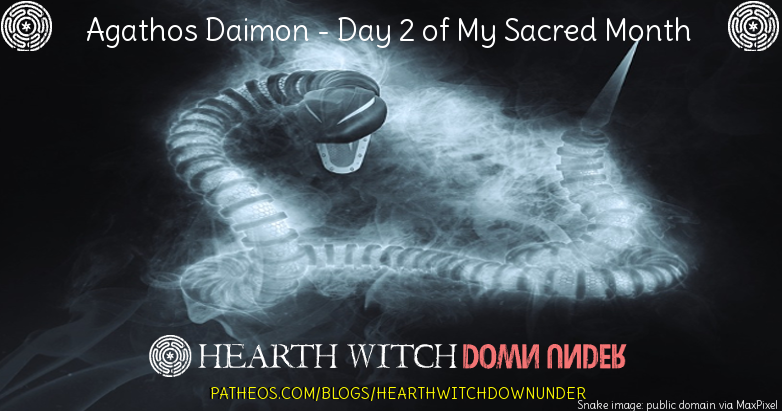
Public domain via Max Pixel.
The Agathos Daimon
Agathos Daimon translates as “good spirit” and can refer to many different types of spirits, but for this particular monthly observance it refers to one (or two) specifically. The Agathos Daimon is the friendly guardian spirit of the household, which generally takes the form of a serpent. It is said that every household, or perhaps every person, has their own Agathos Daimon. This daimon is responsible for guarding and protecting the home, guarding the pantry and food of the home, bringing good fortune into the home and of generally being a helpful spirit and guide to the individual. Of course, this is all dependent on whether you are on good terms with your daimon or not.
The Daimones are said to be the spirits of the first race of “men” or beings that existed during the golden age of Hellenism.
“(ll. 109-120) First of all the deathless gods who dwell on Olympus made a golden race of mortal men who lived in the time of Cronos when he was reigning in heaven. And they lived like gods without sorrow of heart, remote and free from toil and grief: miserable age rested not on them; but with legs and arms never failing they made merry with feasting beyond the reach of all evils. When they died, it was as though they were overcome with sleep, and they had all good things; for the fruitful earth unforced bare them fruit abundantly and without stint. They dwelt in ease and peace upon their lands with many good things, rich in flocks and loved by the blessed gods.
(ll. 121-139) But after earth had covered this generation—they are called pure spirits dwelling on the earth, and are kindly, delivering from harm, and guardians of mortal men; for they roam everywhere over the earth, clothed in mist and keep watch on judgements and cruel deeds, givers of wealth; for this royal right also they received;” – Hesiod, Works and Days.
Some of the ancient philosophers, healers, scholars etc spoke of their personal daimon, or similar spirit. Socrates for example spoke of his daimon in a way that many of us might describe our conscience – a small voice that would tell us to not do the thing we should not do.
“The familiar prophetic voice of my “spiritual guide” has manifested itself very frequently all my life and has opposed me, even in trivial matters, whenever I was about to do something wrong.” Plato, Apology of Socrates.
It seems to me that there must be two types of personal Agathos Daimones, the ones of the household for the family and home, and the one of the individual. Obviously this means there are countless personal Agathos Daimones, but only two at any given time per person. Whether one, two or many it matters not – the Agathos Daimon should perhaps be regarded as one of, if not the, most important being to be on good terms with.
What I am not clear on is whether a household Agathos Daimon moves with the family when they move house, or if each house has its own specific Agathos Daimon. In some ways, one for each house seems to make more sense – this way when the kids leave home the Daimon isn’t somehow split between the family members. But at the same time, this would mean that every time you move house you would need to connect to a new Daimon completely. It probably doesn’t really matter, and we should simply treat them all the same – with respect and honour.
Ritual for Agathos Daimon
We begin with the usual Hellenic ritual forms, preparation, procession and cleansing with Khernips. This is followed by the lighting of a ritual fire or candle/s, and the tossing of barley if you happen to do that. Then we call on the Gods to attend the ritual. Our first hymn and libation are to Hestia, then we recite our hymn to the Agathos Daimon, pour the libation and say any other prayers we need to. We end with a libation to Hestia.
Wine or honeyed milk are the suggested libations for the Agathos Daimon, but I find hot chocolate to be good as well – because it is kind of homely. For offerings I would suggest homely things, breads and cakes for the most part, or part of your own dinner. I also, for this days ritual, offered some fresh bottlebrush flowers. For the incense I chose lavendar, for no reason other than it felt right.
I call on the Gods of the Hellenes,
Deathless Ones, most glorious,
Chthonic, Oceanic, Ouranic,
Protogenoi, Titanic and Olympian.
Attend this rite and bear witness
Hail to Hestia, First and Last
Hearth Keeper, Guardian of the Home,
Accept this our first libation. Pour libation.
Glory to the Agathos Daimon, Kindly One
Without whom, this house would not run,
Snake formed spirit, beloved of Agatha Tyche,
Bringer of good fortune, the things we need and like,
Protect this home, and all who dwell within,
Hear this prayer, accept this my offering,
With fav’ring mind the sacred rites attend,
and grant my days a glorious, blessed end.*
Pour libation. Light incense, add any personalised prayers and give any other offerings (fruits, flowers, coins, cakes).
Glory to the Theoi,
I offer my thanks to you. Pour libation.
And to Hestia, first and last. Pour libation.
Drink whatever remains of the libation offering (if it is potable) and eat what is left of the offerings, it’s good to share a meal or drink with the Gods. Spend some time in after ritual practice, for the Agathos Daimon day it may be good to focus on household things like cleaning, decorating and the like. Since we also may be honouring our personal Daimones as well, it might be a good time for self-care, such as with some exercise.
More for the Daimon
The Agathos Daimon takes a special role on this day, the second of the lunar month, as well as during the Noumenia. However this isn’t the only time to honour this particular spirit. Some people choose to offer to the Daimon on a regular basis, in a similar way to how some honour Hestia. This is by pouring a small libation to the Agathos Daimon every time you drink wine (or another favourite drink perhaps) and/or offering a small amount of food to the Daimon during every meal.
The Agathos Daimones may not be Gods, Titans or Protogenoi but they are rather powerful spirits that could play a potentially important role in our lives. So it’s a good idea to take a few moments and create a good relationship with them.
** The last two lines of this hymn I borrowed from the Orphic Hymn 72 to the Daimon, but the rest I wrote myself.*
Previous Post
November 21, 2017
Noumenia - Day 1 of My Sacred Month
Next Post
November 24, 2017 Hermes - Day 4 of My Sacred Month
Browse Our Archives
Select a Category Australia Calendar, Events and Festivals General Hellenism Hellenismoz How To Lore and Myth Multimedia Pagan Blogosphere Pagan Community Pagan Parenting and Homeschooling Paganism 101 Personal Practice Religious Philosophy Resources and Material Ritual Uncategorized Witchcraft 101
Select a Month January 2018 December 2017 November 2017 October 2017 August 2017 July 2017 June 2017 May 2017 April 2017 March 2017 February 2017 January 2017 December 2016 November 2016 October 2016 September 2016 August 2016 July 2016 June 2016 May 2016 April 2016 July 2012 June 2012 May 2012 April 2012 March 2012 February 2012 January 2012 December 2011
Follow Us!
TAKE THE
Religious Wisdom Quiz
What separated the Holy Place from the Most Holy Place in the Tabernacle?
Select your answer to see how you score.
An incense altar A bronze door A curtain (veil) A stone wall
Related posts from Hearth Witch Down Under
2018 Pagan Wallpapers and Printables

Book Review - Circle for Hekate: History and...
Hekates Deipnon - Day 30 of My Sacred...
Hades Ritual - Day 29 of My Sacred...
TRENDING AT PATHEOS Pagan

I was recently chatting with someone on Instagram. She asked me what...

While there are many people who share their results, the end of...

On July 23, I saw Christopher Nolan's The Odyssey which is Homer’s...

As I write this two big events have just finished up. One...

Restoring the Watershed of Divine Love
Perhaps cooperation is not something we manufacture through legislation, ideology, or moral...

Many UUs don’t pray because of bad experiences in a previous religion,...
view all Pagan blogs
Ad-Free & Subscriber Log-In Subscription Support
- About Us
- 2026 Calendar
- Videos
- Podcasts
- Library of World Religions
- Faith In Media Tracker
- Advertise With Us
- Write for Us
- Privacy Policy
- Terms of Service
- Do Not Sell My Data
- Contact Us
- Radiant Digital
- Manage Newsletter Subscriptions
- Unsubscribe From Notifications
- Sitemap
Copyright 2008-2026, Patheos. All rights reserved.
Subscription Support Ad-Free & Subscriber Log-In
Follow Patheos