
BuddhistCatholicContemplativeEvangelicalGeneral ChristianHinduJewishLatter-day SaintMuslimNew VisionsProgressive Christian
Beliefs
- Buddhist
- Catholic
- Contemplative
- Evangelical
- General Christian
- Hindu
- Jewish
- Latter-day Saint
- More Voices
- Muslim
- New Visions
- Pagan
- Progressive Christian
Topics
- Religion News
- Food and Religion
- Sports and Religion
- Religious Art
- Religious Music and Entertainment
- Religious Events
- History and Religion
- Style and Religion
- Politics and Religion
- Women in Religion
- Recreation Outdoors and Religion
- Business Finance and Religion
- Careers Workplace and Religion
- Education and Religion
- Family Parenting and Religion
- Health Fitness and Religion
- Home and Religion
- Relationships and Religion
- Technology and Religion
- Travel and Religion
Columnists
- Buddhist Columnists
- Business Finance and Religion Columnists
- Careers Workplace and Religion Columnists
- Catholic Columnists
- Contemplative Columnists
- Education and Religion Columnists
- Evangelists Columnists
- Family Parenting and Religion Columnists
- General Christian Columnists
- Health Fitness and Religion Columnists
- Hindu Columnists
- History and Religion Columnists
- Home and Religion Columnists
- Jewish Columnists
- More Voices Columnists
- Latter Day Columnists
- Muslim Columnists
- New Visions Columnists
- Nonreligious Columnists
- Pagan Columnists
- Politics and Religion Columnists
- Progressive Columnists
- Recreation Outdoors and Religion Columnists
- Relationships and Religion Columnists
- Religion News Columnists
- Religious Art Columnists
- Religious Events Columnists
- Religious Music and Entertainment Columnists
- Sports and Religion Columnists
- Style and Religion Columnists
- Technology and Religion Columnists
- Travel and Religion Columnists
- Women in Religion Columnists
Resource Library
- 2026 Calendar
- Library of World Religions
- The 100 Most Holy Places on Earth
- Patheos Answers
- Podcasts
- Videos
- Faith Leaders Database
- Anglican Episcopalian
- Bahai
- Baptist
- Buddhism
- Christianity
- Confucianism
- Eastern Orthodoxy
- Hinduism
- Holiness and Pentecostal
- ISKCON
- Islam
- Judaism
- Lutheran
- Methodist
- The Church of Jesus Christ of Latter-day Saints
- New Age
- Paganism
- Presbytarian and Reformed
- Protestantism
- Religion Behind the Scenes
- Roman Catholic
- Scientology
- Shia Islam
- Sikhism
- Sufism
- Sunni Islam
- Taoism
- Zen
- See all religions
Research Tools
 Ad-Free & Subscriber Log-In Subscription Support
Ad-Free & Subscriber Log-In Subscription Support
Follow Patheos 

- Trending:
- Forgiveness
- |
- Marriage
- |
- Consciousness
- |
- Death Penalty
- |
- Election
- |
- Halloween
 Hearth Witch Down Under
- Home
- Pagan
- My Gods are Real and Independent Beings
My Gods are Real and Independent Beings
Last updated on: January 24, 2018 at 1:30 pm by Bekah Evie Bel
My Gods are Real and Independent Beings 2018-01-24T13:30:52+10:00 Bekah Evie Bel
Patheos Explore the world's faith through different perspectives on religion and spirituality! Patheos has the views of the prevalent religions and spiritualities of the world.
John Halstead recently published an interesting post that speaks of Polytheist insistence that the Gods are real, literal, distinct and independent beings and that in our doing so we are losing some kind of battle within our religions. Unlike John Beckett, I think I have used the word “literal” in reference to the Gods, but I am not sure I have used “distinct” before.
Halsteads post is a bit of a mixed bag for a polytheist like me, and certainly many others, to read. On the one hand he makes some rather fascinating points about various things, and I can’t deny that I enjoy apples being brought into the discussion again. On the other hand, he makes leaps and assumptions that are not only disappointing but are also a touch insulting on certain levels.
The main point of his post was regarding our use of the word “independent” in reference to our Gods, and how, in his view, this actually equals being disconnected.
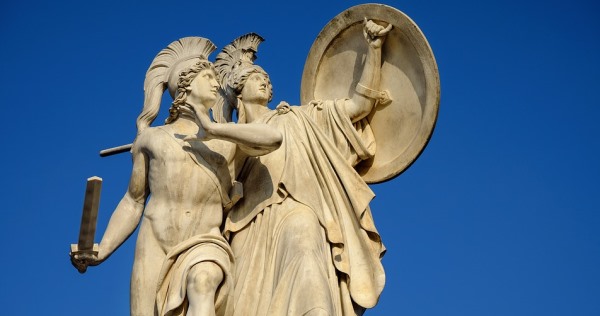
public domain via Pixabay
You Keep Using That Word
“The assumption of some polytheists seems to be that for a thing to be “real” it must exist in some reified form disconnected from every other thing.”
Perhaps the biggest problem with Johns post, is his conflation of independence with disconnectedness. It rests on some assumptions and leaps about what exactly we might mean when we use the word “independent”. He seems to be inferring that we believe our Gods are completely and utterly separate – to the point that They have no connection to us or the world in which we reside and They rule over.
But this is a rather extremist view of the idea of independence. Independence, in so many cases – Pagan or not – often refers not to being disconnected, but instead to not being reliant on another thing for your very existence, survival or, in human terms, happiness. To say the Gods are independent is to say They do not rely on our existence for Their existence. They are sovereign beings, They are not ruled by us, They are not dependent on us. If we humans destroy ourselves – the Gods will still be here.
This is opposed to the views some people hold – that the Gods do not exist independently of us and without our existence They would cease to exist. This can mean many things. Some people believe that the Gods are created by us through the vast power of mass belief – They are basically tulpas I suppose – if we cease to believe, They cease to exist. As an extension or alternative some believe that the Gods (however They came to exist at first) rely on us for Their very survival, feeding off our belief in Them, our worship of Them and what we offer Them*. Still others believe that the Gods only exist in our minds – which doesn’t necessarily imply They are not real – and if we cease to think about Them, then of course They cease to exist.
For many of us who use the word “independent” to describe our Gods, we are not using it as synonymous with disconnected, rather it is antonymous with dependent. Our Gods are not dependent on us, nor anything about us. They exist outside of us, without us, independently. Even if you follow the belief that we did create Them through some kind of massive thoughtform – Their creation was accomplished long ago and we have moved far past that stage. They have or have gained Their own Will and we haven’t the power to uncreate Them, no matter what we might do or not do.
Connection and Dependence Don’t Equal UnRealness
“The point is that these relationships, this interconnectedness, don’t make the apple unreal. In fact, these connections are the very things that make the apple real.”
Here John is right, but he is wrong as well. It is true that just because something is connected and dependent that doesn’t mean it is not real. But he is wrong that we polytheists believe otherwise. This is actually quite the strawman – we believe the Gods are independent, he decides independent means disconnected, and also decides we believe that a thing that is dependent on other things and is connected to other things is a thing that is not real and literal.
This is such an interesting leap that he has made. One can merely look at belief in Gaia Herself to see that independence is not the same as disconnectedness and that connection doesn’t equal being not real. She is the earth upon which we reside, She is connected to us in ways that are beyond a single blog posts ability to describe. Gaia is connected to everything we touch, smell, hear, taste, see and know. We are so deeply connected to Her that we don’t even realise we are connected to Her.
But She is still real, literal, distinct and independent. She exists without us, She does not depend on us – indeed She would likely be better off without us!
I’m Not Trying to Re-Enchant the World
“If we are to reenchant the world, it won’t be (re-)populating it with individual gods and spirits in nature. The disenchantment of the world happened, not when we stopped seeing gods and spirits in nature, but when we stopped seeing our essential connection to nature. Personifying rivers and trees with dryads is not going to accomplish this.”
In this John is making the same mistake so many Pagans make, assuming that polytheism in its various forms is one of those earth-centric nature religions that seemingly make up the bulk of modern Paganism. But, for many of us, that is not what we are about. We who are deemed Hard Polytheists are mostly not nature and earth-centric, instead we are deity-centric.
I am not trying to re-enchant the world, whatever that means. I am trying to enchant myself, and perhaps help others enchant themselves. I am trying to connect to my Gods. By extension this helps me connect to the earth and world around, but also the people around me, the animals, the ideas and ideals, and so much more. Even in worship of Gaia, Her surface is merely one part of Her and it is not necessarily the most important part of Her.
This Isn’t Theist vs Atheist Semantics
When we describe the Gods as “real independent beings” we aren’t necessarily always doing this in response to atheistic or non-theistic beliefs and assertions. On the contrary, there are many theistic beliefs wherein the Gods are not independent, even though They are real. So called soft-Polytheism for example would have, depending on the system, all Gods being mere aspects of a single deity – thus not independent of each other at all. But I also described three systems above that have the Gods dependent on humans for Their existence, and they are all three of them theistic beliefs. One of them is also a non-theistic belief.
Unfortunately it seems like John has maybe become stuck inside the kerfuffels of the past few years, seeing the “real independent beings” phrase as being a direct attack on non-theistic Pagan beliefs. But it’s not, sure sometimes it is said in that way but the truth is it has a much deeper reason for being said. Because we mean it, because it is true.
Our Gods are real. They are also independent. They are also literal, distinct, ancient, self-aware, powerful and so much more.
What They aren’t is a weapon in a petty little war on the internet. When we say They are real and independent, we say it because we mean it – not so we can win a war of words.
*If you’re interested in reading fictional explorations of such deities, I suggest Raymond E Feists Midkemia books and David Eddings Tamuli trilogy, both of which have brief encounters with “dead” Gods, and in the Tamuli actually includes a Goddess getting weaker and sicker as Her worshippers are slaughtered. It’s a fascinating concept, but even in these books, a dead God isn’t exactly fully dead.
Previous Post
May 29, 2017
On Comparing the Gods to Humans
Next Post
June 5, 2017 Using Wallpapers to Memorise Pagan Things
Browse Our Archives
Select a Category Australia Calendar, Events and Festivals General Hellenism Hellenismoz How To Lore and Myth Multimedia Pagan Blogosphere Pagan Community Pagan Parenting and Homeschooling Paganism 101 Personal Practice Religious Philosophy Resources and Material Ritual Uncategorized Witchcraft 101
Select a Month January 2018 December 2017 November 2017 October 2017 August 2017 July 2017 June 2017 May 2017 April 2017 March 2017 February 2017 January 2017 December 2016 November 2016 October 2016 September 2016 August 2016 July 2016 June 2016 May 2016 April 2016 July 2012 June 2012 May 2012 April 2012 March 2012 February 2012 January 2012 December 2011
Follow Us!
TAKE THE
Religious Wisdom Quiz
Who led the rebuilding of the Jerusalem temple after exile in the book of Ezra?
Select your answer to see how you score.
Nehemiah Haggai Zerubbabel Ezra
Related posts from Hearth Witch Down Under
2018 Pagan Wallpapers and Printables

Book Review - Circle for Hekate: History and...
Hekates Deipnon - Day 30 of My Sacred...
Hades Ritual - Day 29 of My Sacred...
TRENDING AT PATHEOS Pagan

I was recently chatting with someone on Instagram. She asked me what...

While there are many people who share their results, the end of...

On July 23, I saw Christopher Nolan's The Odyssey which is Homer’s...

As I write this two big events have just finished up. One...

Restoring the Watershed of Divine Love
Perhaps cooperation is not something we manufacture through legislation, ideology, or moral...

Many UUs don’t pray because of bad experiences in a previous religion,...
view all Pagan blogs
Ad-Free & Subscriber Log-In Subscription Support
- About Us
- 2026 Calendar
- Videos
- Podcasts
- Library of World Religions
- Faith In Media Tracker
- Advertise With Us
- Write for Us
- Privacy Policy
- Terms of Service
- Do Not Sell My Data
- Contact Us
- Radiant Digital
- Manage Newsletter Subscriptions
- Unsubscribe From Notifications
- Sitemap
Copyright 2008-2026, Patheos. All rights reserved.
Subscription Support Ad-Free & Subscriber Log-In
Follow Patheos