
BuddhistCatholicContemplativeEvangelicalGeneral ChristianHinduJewishLatter-day SaintMuslimNew VisionsProgressive Christian
Beliefs
- Buddhist
- Catholic
- Contemplative
- Evangelical
- General Christian
- Hindu
- Jewish
- Latter-day Saint
- More Voices
- Muslim
- New Visions
- Pagan
- Progressive Christian
Topics
- Religion News
- Food and Religion
- Sports and Religion
- Religious Art
- Religious Music and Entertainment
- Religious Events
- History and Religion
- Style and Religion
- Politics and Religion
- Women in Religion
- Recreation Outdoors and Religion
- Business Finance and Religion
- Careers Workplace and Religion
- Education and Religion
- Family Parenting and Religion
- Health Fitness and Religion
- Home and Religion
- Relationships and Religion
- Technology and Religion
- Travel and Religion
Columnists
- Buddhist Columnists
- Business Finance and Religion Columnists
- Careers Workplace and Religion Columnists
- Catholic Columnists
- Contemplative Columnists
- Education and Religion Columnists
- Evangelists Columnists
- Family Parenting and Religion Columnists
- General Christian Columnists
- Health Fitness and Religion Columnists
- Hindu Columnists
- History and Religion Columnists
- Home and Religion Columnists
- Jewish Columnists
- More Voices Columnists
- Latter Day Columnists
- Muslim Columnists
- New Visions Columnists
- Nonreligious Columnists
- Pagan Columnists
- Politics and Religion Columnists
- Progressive Columnists
- Recreation Outdoors and Religion Columnists
- Relationships and Religion Columnists
- Religion News Columnists
- Religious Art Columnists
- Religious Events Columnists
- Religious Music and Entertainment Columnists
- Sports and Religion Columnists
- Style and Religion Columnists
- Technology and Religion Columnists
- Travel and Religion Columnists
- Women in Religion Columnists
Resource Library
- 2026 Calendar
- Library of World Religions
- The 100 Most Holy Places on Earth
- Patheos Answers
- Podcasts
- Videos
- Faith Leaders Database
- Anglican Episcopalian
- Bahai
- Baptist
- Buddhism
- Christianity
- Confucianism
- Eastern Orthodoxy
- Hinduism
- Holiness and Pentecostal
- ISKCON
- Islam
- Judaism
- Lutheran
- Methodist
- The Church of Jesus Christ of Latter-day Saints
- New Age
- Paganism
- Presbytarian and Reformed
- Protestantism
- Religion Behind the Scenes
- Roman Catholic
- Scientology
- Shia Islam
- Sikhism
- Sufism
- Sunni Islam
- Taoism
- Zen
- See all religions
Research Tools
 Ad-Free & Subscriber Log-In Subscription Support
Ad-Free & Subscriber Log-In Subscription Support
Follow Patheos 

- Trending:
- Forgiveness
- |
- Marriage
- |
- Consciousness
- |
- Death Penalty
- |
- Election
- |
- Halloween
 Hearth Witch Down Under
- Home
- Pagan
- Heliogenna The Hellenic Winter Solstice
Heliogenna The Hellenic Winter Solstice
Last updated on: January 24, 2018 at 1:32 pm by Bekah Evie Bel
Heliogenna The Hellenic Winter Solstice 2018-01-24T13:32:05+10:00 Bekah Evie Bel
Patheos Explore the world's faith through different perspectives on religion and spirituality! Patheos has the views of the prevalent religions and spiritualities of the world.
One of the things that some, or perhaps many, Hellenes lament is the fact that we have no ancient festival (that we know of) for the winter solstice, to replace the commercial or Christian Christmas, and the Pagan Yule. This is probably what was in the mind of Hector Lugo when he created the Heliogenna festival.
Heliogenna is a thoroughly modern winter solstice festival created by Hector Lugo, whose website appears to no longer exist. I can’t say exactly how old this festival is, but I do know it is at least 6 years old – going by this blog post from 2010. According to various sources I have found, the Heliogenna festival was originally created to run for nine days, which were split into three parts. But it has been adapted to run over 3, 2 and even 1 days.
The basic premise of this festival is honouring Helios as He mourns the death of His son Phaethon, His mourning journey into the underworld and then finally His return to the world of the living (Helios, not Phaethon).
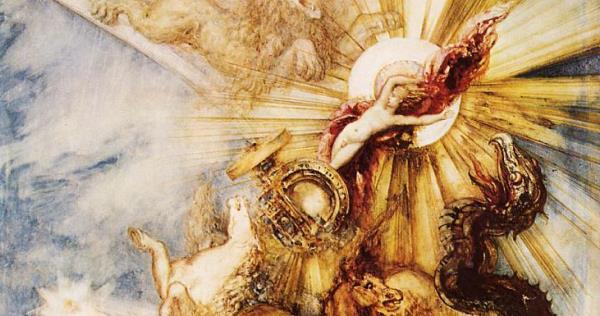
The fall of Phaeton. Gustave Moreau [Public domain], via Wikimedia Commons
Nine Day Outline
Part 1 – Sunset. Days 1-3.
Honour Helios, Selene and Eos.
On these days the focus is on Helios and the death of Phaethon.
Burn an orange or yellow candle from sunset of each of these days, let them burn out by themselves.
Part 2 – Night. Days 4-6 (day 5 is winter solstice).
Honour no deities, but think on the darker aspects of the Gods, namely Helios, Hades, Persephone, Hekate and Hermes.
On these days the focus is on Helios travelling to the Underworld. Burn black candles from sunset on days 4 and 6, letting them burn out on their own. On day 5, the solstice, have out a black candle but leave it unlit.
Part 3 – Sunrise. Days 7-9.
Honour Helios and the Protogenoi.
The focus here is on Helios returning to the world of the living and bringing the sun back with Him (as the days will begin to get longer from here on out). Light yellow or orange candles from sunset on these days, letting them burn themselves out.
– – – –
This is about all I can find of the original festival as outlined by Hector Lugo and most of that comes from Hellenion – who also have a nice outline for the two day version of the festival. Cara Schulz of Hellenion also shares her ritual outline in the 2009 Neokoroi newsletter, that you can find linked here.
Dates for 2016
Nine Day Festival
Sunset, Day 1-3: December 17-19
Night, Day 4-6: December 20-22 (Solstice on day 5, the 21st)
Sunrise, Day 7-9: December 23-25
Three Day Festival
Sunset, Day 1: December 20
Night, Day 2: December 21 (Solstice)
Sunrise, Day 3: December 22
Two Day Festival
Sunset: December 21, solstice day
Night: December 21, solstice evening and night
Sunrise: December 22, from sunrise
– – – –
Personally I have little interest in the festival, given that it is summer here in Aus in December, but I thought it might be of interest to those in the north. I should also mention that the festival itself is a little contentious, just in case you decide to celebrate this festival and someone says something. Forewarned is forearmed as they say.
Some people hate this festival simply because it is modern – which is unfortunate and I don’t really get that reasoning. But each to their own. The main problem though seems to arise from the fact that this festival is a bit counter to Hellenic myth and lore. Namely, the idea of Helios, who could possibly be seen as one of the most Ouranic of the Ouranic deities, entering the underworld. Entering the underworld is considered to be utterly miasmic for most Ouranic deities.
However I did find reference to the epithet Plouton Helios (which would be Hades as a solar deity or Helios as an underworld deity), which from what I can find out about it, comes from the inscription at Smyrnos. I don’t have access to that, and know basically nothing about it, so I’m not sure what to think. Still, several sites (including Wiki, ugh) do state that some people in ancient times did hold to the idea of Helios descending into the underworld at night. I can only think that, if true, this would have come after the syncretisation with Egypts pantheon, inspired by the journey of Ra through the Egyptian underworld at night.
It’s a bit of a confusing issue, I don’t know that I can trace this any further right now, I don’t have the right resources. But this leaves room for one to see some ancient precedence for the idea of Helios entering the underworld. Whether it is enough would be up to the individual. I do know that many Hellenes are fine with some syncretism with Egypt and Rome, so perhaps it doesn’t matter anyway.
If you choose to observe this festival, I hope it goes well and you enjoy it.
References regarding Plutoun Helios and the Smyrna inscriptions
- Corpus Monumentorum Religionis Dei Menis – by Eugene N Lane
- The Esoteric Codex: Deities of the Underworld – By William Klause
- Wikipedia
Calendar, Events and Festivals
Previous Post

December 8, 2016
Being Non-Christmas is Hard
Next Post

December 14, 2016 The War on Christmas
Browse Our Archives
Select a Category Australia Calendar, Events and Festivals General Hellenism Hellenismoz How To Lore and Myth Multimedia Pagan Blogosphere Pagan Community Pagan Parenting and Homeschooling Paganism 101 Personal Practice Religious Philosophy Resources and Material Ritual Uncategorized Witchcraft 101
Select a Month January 2018 December 2017 November 2017 October 2017 August 2017 July 2017 June 2017 May 2017 April 2017 March 2017 February 2017 January 2017 December 2016 November 2016 October 2016 September 2016 August 2016 July 2016 June 2016 May 2016 April 2016 July 2012 June 2012 May 2012 April 2012 March 2012 February 2012 January 2012 December 2011
Follow Us!
TAKE THE
Religious Wisdom Quiz
What does Siloam mean?
Select your answer to see how you score.
Love Sent Received Gift
Related posts from Hearth Witch Down Under
2018 Pagan Wallpapers and Printables

Book Review - Circle for Hekate: History and...
Hekates Deipnon - Day 30 of My Sacred...
Hades Ritual - Day 29 of My Sacred...
TRENDING AT PATHEOS Pagan

I was recently chatting with someone on Instagram. She asked me what...

While there are many people who share their results, the end of...

On July 23, I saw Christopher Nolan's The Odyssey which is Homer’s...

As I write this two big events have just finished up. One...

Restoring the Watershed of Divine Love
Perhaps cooperation is not something we manufacture through legislation, ideology, or moral...

Many UUs don’t pray because of bad experiences in a previous religion,...
view all Pagan blogs
Ad-Free & Subscriber Log-In Subscription Support
- About Us
- 2026 Calendar
- Videos
- Podcasts
- Library of World Religions
- Faith In Media Tracker
- Advertise With Us
- Write for Us
- Privacy Policy
- Terms of Service
- Do Not Sell My Data
- Contact Us
- Radiant Digital
- Manage Newsletter Subscriptions
- Unsubscribe From Notifications
- Sitemap
Copyright 2008-2026, Patheos. All rights reserved.
Subscription Support Ad-Free & Subscriber Log-In
Follow Patheos