
BuddhistCatholicContemplativeEvangelicalGeneral ChristianHinduJewishLatter-day SaintMuslimNew VisionsProgressive Christian
Beliefs
- Buddhist
- Catholic
- Contemplative
- Evangelical
- General Christian
- Hindu
- Jewish
- Latter-day Saint
- More Voices
- Muslim
- New Visions
- Pagan
- Progressive Christian
Topics
- Religion News
- Food and Religion
- Sports and Religion
- Religious Art
- Religious Music and Entertainment
- Religious Events
- History and Religion
- Style and Religion
- Politics and Religion
- Women in Religion
- Recreation Outdoors and Religion
- Business Finance and Religion
- Careers Workplace and Religion
- Education and Religion
- Family Parenting and Religion
- Health Fitness and Religion
- Home and Religion
- Relationships and Religion
- Technology and Religion
- Travel and Religion
Columnists
- Buddhist Columnists
- Business Finance and Religion Columnists
- Careers Workplace and Religion Columnists
- Catholic Columnists
- Contemplative Columnists
- Education and Religion Columnists
- Evangelists Columnists
- Family Parenting and Religion Columnists
- General Christian Columnists
- Health Fitness and Religion Columnists
- Hindu Columnists
- History and Religion Columnists
- Home and Religion Columnists
- Jewish Columnists
- More Voices Columnists
- Latter Day Columnists
- Muslim Columnists
- New Visions Columnists
- Nonreligious Columnists
- Pagan Columnists
- Politics and Religion Columnists
- Progressive Columnists
- Recreation Outdoors and Religion Columnists
- Relationships and Religion Columnists
- Religion News Columnists
- Religious Art Columnists
- Religious Events Columnists
- Religious Music and Entertainment Columnists
- Sports and Religion Columnists
- Style and Religion Columnists
- Technology and Religion Columnists
- Travel and Religion Columnists
- Women in Religion Columnists
Resource Library
- 2026 Calendar
- Library of World Religions
- The 100 Most Holy Places on Earth
- Patheos Answers
- Podcasts
- Videos
- Faith Leaders Database
- Anglican Episcopalian
- Bahai
- Baptist
- Buddhism
- Christianity
- Confucianism
- Eastern Orthodoxy
- Hinduism
- Holiness and Pentecostal
- ISKCON
- Islam
- Judaism
- Lutheran
- Methodist
- The Church of Jesus Christ of Latter-day Saints
- New Age
- Paganism
- Presbytarian and Reformed
- Protestantism
- Religion Behind the Scenes
- Roman Catholic
- Scientology
- Shia Islam
- Sikhism
- Sufism
- Sunni Islam
- Taoism
- Zen
- See all religions
Research Tools
 Ad-Free & Subscriber Log-In Subscription Support
Ad-Free & Subscriber Log-In Subscription Support
Follow Patheos 

- Trending:
- Forgiveness
- |
- Marriage
- |
- Consciousness
- |
- Death Penalty
- |
- Election
- |
- Halloween
 Hearth Witch Down Under
- Home
- Pagan
- Prometheus in Mythology
Prometheus in Mythology
Last updated on: January 24, 2018 at 1:32 pm by Bekah Evie Bel
Prometheus in Mythology 2018-01-24T13:32:08+10:00 Bekah Evie Bel
Patheos Explore the world's faith through different perspectives on religion and spirituality! Patheos has the views of the prevalent religions and spiritualities of the world.
Prometheus the Titan was born of Iapetus and, either, Gaia, Themis, Asia or Klymene – depending on what you’re reading. His wife is said to be either Pronoea, Hesione or even Themis or Asia (when They are not said to be His mother). He has one son, Deucalion, who, with his wife, was one of the only survivors of the great flood set upon us by Zeus.
In the war of the Titans against the younger Gods, Prometheus at first sided with His brethren. He attempted to counsel the other Titans on how to win the war with guile and trickery but They were unwilling to listen to Him. Thus, He turned His back on Them and gave His counsel to Zeus and the other younger Gods, making Him partially responsible for Their victory over the Titans. So of course Prometheus was not among those Titans who were punished or locked away and was welcomed (perhaps grudgingly) in Olympus.
Prometheus is generally seen as the creator of humanity. Depending on which lore you look at, He either fashioned us from the start, using clay of some form or He did so after the previous form of humanity was destroyed in a flood. Either way, He is our creator in myth and lore and is seen as our greatest patron and benefactor.
But this is not the only reason He is seen as such, for many times has He been on our side and worked in our favour – even to His own detriment.
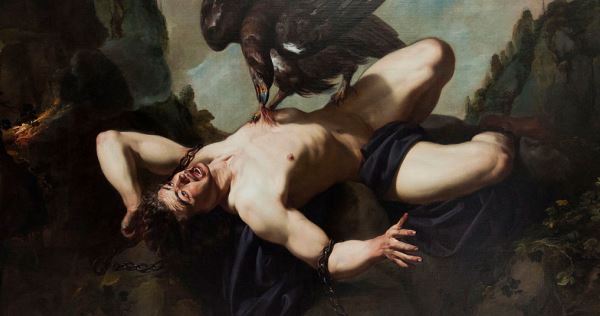
Theodoor Rombouts [Public domain], via Wikimedia Commons
In all cases Prometheus is the one who gifted us with fire. There are multiple versions of this story. In the one when humanity is first created, along with all of creation, the Gods gave all things gifts – such as wings for the birds. But when it came humanitys turn to receive a gift there was nothing left to give, or perhaps They simply didn’t want to give us anything.
Prometheus, feeling sorry for us stole fire from Hephaestus and/or Athena, hid it in a reed so the other Gods couldn’t see and taught us how to make fire, how to keep it flaming and not go out and even how to use it for various things including metal work. This is how Prometheus is honoured as not only a fire God but also a God of smiths and of science. He is also said to be the one to teach us other things such as writing.
The other story about His gift of fire to us begins in a much different way and includes another example of how Prometheus works in our favour. Zeus demanded that humans offer only the very best portion of our sacrifices and offerings to the Gods. Prometheus asked Zeus how we were to know which is best, unless He decides. Thus it was that Prometheus brought out an ox, killed it and divided it into two piles, asking Zeus to choose the best. Whichever Zeus chose is what we must give in our offerings and sacrifices.
Zeus knew Prometheus well enough to know that He was being tricky and guileful, but He thought the trick would be played on us and go in Zeus’ favour. Little did He know that Prometheus was plotting the other way. So Zeus chose the best looking pile of the ox, the one glistening with palatable looking clean white fat. Leaving the ugly looking pile covered with skin and paunch for us humans to consume.
Zeus soon discovered the trick however, under the glistening fat He had chosen for the Gods was bones and other useless things. But under the skin and paunch chosen for humans was all the most edible meat. But the trick was done, the choice was made and Prometheus won this deal for us – that we need only offer a portion of our foods to the Gods, and that we get to keep and eat that which is most palatable to us.
As we might imagine Zeus was enraged by this trickery and He sought to punish us for it. He took fire from us, so that we must eat our new won meat raw and shiver in the cold. But, and here the story goes the same – Prometheus felt sorry for us and did His best to steal fire back from the Gods and gift it to us again.
But of course, Zeus was even more enraged and there was no coming back from this one. For us, we were punished with Pandora, a story for another time. But Prometheus suffered perhaps more terribly than did we. Zeus had Prometheus bound and chained with the strong chains of Hephaestus, to a rock or pillar at the peak of a mountain in the Caucasus mountains. Here every day an eagle, said to be the offspring of Echidna and Typhous, would tear open Prometheus and devour His liver.
But every night His liver would regrow and regenerate, becoming whole again, so that in the new day the eagle could again tear Him open and devour the liver once more. And on and on over the centuries and perhaps even the millennia – some say 30 thousand years! – did Prometheus suffer this torment in our name.
Prometheus could still see far and hear much that happened in the world and in Olympus. So it was that He learned a secret that would one day come to be of great import to Zeus – the Goddess Thetis would one day bear a child who would supplant their father. Why should this matter? Because Zeus was soon planning to wed that very same Goddess, He would then become that father to be dethroned!
He spoke lightly of the matter once with Io, the woman who was once turned into a snowy white cow and who stumbled upon Prometheus on His mountain. There they spoke with each other at some length about various things, but most telling for Io was that Prometheus, who has the gift of foresight, was able to see into her future and her torment. He also, it is said, spoke to her of the one who would one day free Him, the one who would be a descendent of hers.
There are many stories on what happened next. In some tales Prometheus was entirely unwilling to share the knowledge He had about Thetis, wishing suffering upon Zeus. Hermes Himself tried to get the information from the Titan, but even His wily tongue could not bring it out of Prometheus. But some say that Prometheus gave up the information willingly, and in return He was freed from His torment.
Whatever the reason though, Prometheus was indeed freed. Most accounts agree that the one most responsible for His release was the son of Zeus, who was also a descendent of Io. Herakles, on His task to find the apples of Hesperides, came upon Prometheus. The Titan, being who He is, offered advice to the demi-God about the apples and thus helped Herakles in his quest. Herakles then returned the way he had come and shot dead the eagle which had so long devoured the liver of Prometheus.
Prometheus is credited with wearing the first ever ring. It is said that Zeus was proud of what Herakles for freeing Prometheus, but because He had once vowed to never let Prometheus go free He had to do something about what happened. Tricky as He can be, He devised the idea of Prometheus forever wearing a ring made from the chains and rock on which He had been chained – thus, technically, Prometheus is still bound.
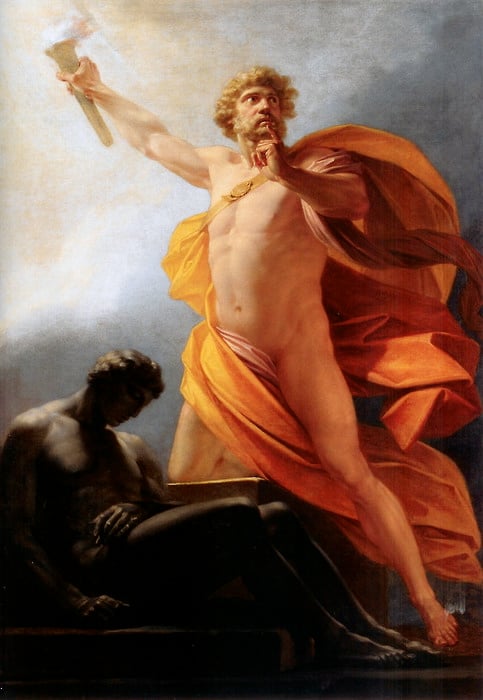
Prometheus brings us fire after we are punished for the ox trick. Public domain wikimedia.
Sources
- Hesiod, Theogony
- Hesiod, Works and Days
- Aeschylus, Prometheus Bound
- The Homeric Hymns
- Pliny the Elder, Natural History vol 6 (The Origin of Gold Rings)
- Theoi.com
Previous Post

October 31, 2016
Common Death Festival Practices and Beliefs
Next Post

November 4, 2016 That Priestly Title
Browse Our Archives
Select a Category Australia Calendar, Events and Festivals General Hellenism Hellenismoz How To Lore and Myth Multimedia Pagan Blogosphere Pagan Community Pagan Parenting and Homeschooling Paganism 101 Personal Practice Religious Philosophy Resources and Material Ritual Uncategorized Witchcraft 101
Select a Month January 2018 December 2017 November 2017 October 2017 August 2017 July 2017 June 2017 May 2017 April 2017 March 2017 February 2017 January 2017 December 2016 November 2016 October 2016 September 2016 August 2016 July 2016 June 2016 May 2016 April 2016 July 2012 June 2012 May 2012 April 2012 March 2012 February 2012 January 2012 December 2011
Follow Us!
TAKE THE
Religious Wisdom Quiz
What did Jesus say to calm the storm?
Select your answer to see how you score.
"Peace, be still!" "Let there be calm." "Cease, wind!" "Do not be afraid."
Related posts from Hearth Witch Down Under
2018 Pagan Wallpapers and Printables

Book Review - Circle for Hekate: History and...

Hekates Deipnon - Day 30 of My Sacred...
Hades Ritual - Day 29 of My Sacred...
TRENDING AT PATHEOS Pagan

I was recently chatting with someone on Instagram. She asked me what...

While there are many people who share their results, the end of...

On July 23, I saw Christopher Nolan's The Odyssey which is Homer’s...

As I write this two big events have just finished up. One...

Restoring the Watershed of Divine Love
Perhaps cooperation is not something we manufacture through legislation, ideology, or moral...

Many UUs don’t pray because of bad experiences in a previous religion,...
view all Pagan blogs
Ad-Free & Subscriber Log-In Subscription Support
- About Us
- 2026 Calendar
- Videos
- Podcasts
- Library of World Religions
- Faith In Media Tracker
- Advertise With Us
- Write for Us
- Privacy Policy
- Terms of Service
- Do Not Sell My Data
- Contact Us
- Radiant Digital
- Manage Newsletter Subscriptions
- Unsubscribe From Notifications
- Sitemap
Copyright 2008-2026, Patheos. All rights reserved.
Subscription Support Ad-Free & Subscriber Log-In
Follow Patheos