
BuddhistCatholicContemplativeEvangelicalGeneral ChristianHinduJewishLatter-day SaintMuslimNew VisionsProgressive Christian
Beliefs
- Buddhist
- Catholic
- Contemplative
- Evangelical
- General Christian
- Hindu
- Jewish
- Latter-day Saint
- More Voices
- Muslim
- New Visions
- Pagan
- Progressive Christian
Topics
- Religion News
- Food and Religion
- Sports and Religion
- Religious Art
- Religious Music and Entertainment
- Religious Events
- History and Religion
- Style and Religion
- Politics and Religion
- Women in Religion
- Recreation Outdoors and Religion
- Business Finance and Religion
- Careers Workplace and Religion
- Education and Religion
- Family Parenting and Religion
- Health Fitness and Religion
- Home and Religion
- Relationships and Religion
- Technology and Religion
- Travel and Religion
Columnists
- Buddhist Columnists
- Business Finance and Religion Columnists
- Careers Workplace and Religion Columnists
- Catholic Columnists
- Contemplative Columnists
- Education and Religion Columnists
- Evangelists Columnists
- Family Parenting and Religion Columnists
- General Christian Columnists
- Health Fitness and Religion Columnists
- Hindu Columnists
- History and Religion Columnists
- Home and Religion Columnists
- Jewish Columnists
- More Voices Columnists
- Latter Day Columnists
- Muslim Columnists
- New Visions Columnists
- Nonreligious Columnists
- Pagan Columnists
- Politics and Religion Columnists
- Progressive Columnists
- Recreation Outdoors and Religion Columnists
- Relationships and Religion Columnists
- Religion News Columnists
- Religious Art Columnists
- Religious Events Columnists
- Religious Music and Entertainment Columnists
- Sports and Religion Columnists
- Style and Religion Columnists
- Technology and Religion Columnists
- Travel and Religion Columnists
- Women in Religion Columnists
Resource Library
- 2026 Calendar
- Library of World Religions
- The 100 Most Holy Places on Earth
- Patheos Answers
- Podcasts
- Videos
- Faith Leaders Database
- Anglican Episcopalian
- Bahai
- Baptist
- Buddhism
- Christianity
- Confucianism
- Eastern Orthodoxy
- Hinduism
- Holiness and Pentecostal
- ISKCON
- Islam
- Judaism
- Lutheran
- Methodist
- The Church of Jesus Christ of Latter-day Saints
- New Age
- Paganism
- Presbytarian and Reformed
- Protestantism
- Religion Behind the Scenes
- Roman Catholic
- Scientology
- Shia Islam
- Sikhism
- Sufism
- Sunni Islam
- Taoism
- Zen
- See all religions
Research Tools
 Ad-Free & Subscriber Log-In Subscription Support
Ad-Free & Subscriber Log-In Subscription Support
Follow Patheos 

- Trending:
- Forgiveness
- |
- Marriage
- |
- Consciousness
- |
- Death Penalty
- |
- Election
- |
- Halloween
 Hearth Witch Down Under
- Home
- Pagan
- What to do After the Ritual
What to do After the Ritual
Last updated on: January 24, 2018 at 1:32 pm by Bekah Evie Bel
What to do After the Ritual 2018-01-24T13:32:15+10:00 Bekah Evie Bel
Patheos Explore the world's faith through different perspectives on religion and spirituality! Patheos has the views of the prevalent religions and spiritualities of the world.
One of the more common questions I see come up from Pagans, especially those with Hellenic leanings or a devotion to a Hellenic deity, is what to do after the ritual is done. Most specifically, what to do with the food offerings made during the ritual.
I have written about this briefly before, and if you haven’t read my posts on animal sacrifice, offerings to the Hellenic Gods and how to offer, then you may like to do so, in addition to this post. This post will be a little repetitive, I will pretty much be copy/pasting a segment of How to Offer – but there will also be some other stuff in this post that isn’t elsewhere, or not elaborated on properly in other posts.

Public domain via Pixabay.
Traditionally
In traditional Hellenism, which most of us Hellenes follow, even Revivalists like myself, there really shouldn’t be an offering left after the ritual. Offerings to the Ouranic (sky/heavenly) deities are meant to be burned while offerings to the Chthonic (earthly and underworld) deities should be buried or burned or both.
If you bury an offering, no aftercare to worry about. If you burn it, then you do have to deal with the ashes and whatever didn’t burn – simple to do actually, put it away in a container to leave for Hekate at the crossroads during the Deipnon.
The Modern Problem
Of course today we have a few problems that the ancients may not have had. Indoors, if you happen to live in an apartment building, a shared home or some other place with restrictions, then you may not be able to have open fires inside the home, or you may not be allowed to have anything that smokes (which really sucks, no incense either).
And of course many people do not have any yard to speak of, so burning or burying outside is out of the question. For those who do have a yard, burying may still be problematic if you rent or share, and if it is fire season and open fire restrictions are in play (as happens December through April where I am) no outdoor fires either.
What To Do Then?
Obviously this all means that burning or burying are simply not viable options for many people. There is nothing that can be done about it. You need to find a way to deal with whole foods that is respectful to the Gods you have offered to. Remembering that the offering now belongs to the Gods, you can’t take it back and reclaim it for yourself and you need to treat it with respect because it simply isn’t yours any more.
Now we get to the copy/paste part. There are options, suggestions, but in truth none of them are perfect and in the end it is up to the individual as to what they are able to do and are comfortable with. I will present some of them, and some of my thoughts on them.
Eat it yourself. Don’t. If you are offering to a Hellenic deity, They own the offering you give Them. Do. Not. Eat. It.
Throw it in the bin. Please don’t, it’s just so disrespectful.
Leave it on the altar. Well, I mean if you want. But yuck!
Leave it until later. Some people leave it until they can burn it, bury it or get someone else to do so for them. A viable option, unless it takes too long and it gets all yucky.
Compost it. If you have compost, then this could be an option. I guess I see no real problem with this one, but I am sure some would – so it is very much an individual choice here.
Leave it in nature. This is a favourite option, to leave the offering somewhere in nature. Some people even have a specific place for this in their yard, a square or something with plants where they leave offerings and make libations. Alternatively, some wild area would work if you have no yard. Both nice ideas. But be careful, not all deities may be okay with sharing Their foods with the animals. Also on a more practical note, be careful the offering isn’t poisonous to any wildlife and won’t attract the wrong type of wildlife.
Throw it in a blender. Throw the offering in a blender, mix with some water and turn it into a smoothie type thing. Pour that in nature (or on a pot plant), where there is little risk to animals, or to offending the Gods by sharing it with animals but it will also feed the plants. It is also less messy than having, say, whole loaves of bread sitting all around the place. This was an idea I thought of the other day, in truth I do not know how I feel about this idea, if it’s good or not – but I should present it as an option anyway.
Okay, copy/paste done, the rest is all new. Those are your options for what to do with the offering after the ritual, not a lot of great options, a few restrictions that I know many people ignore – I think unwittingly, as they know it is okay in other traditions and so don’t realise it isn’t okay in Hellenism.
I should note too, not all Hellenic deities are completely Hellenic, so, it is possible that some of Them, individually mind you, are okay if you eat the offering or throw it in the bin. But please, Ask First! Don’t just do it and hope the deity will be okay with it and will accept your apology – ask first so you don’t make mistakes and piss off a powerful being. Divination is your friend.
Public domain via Pixabay
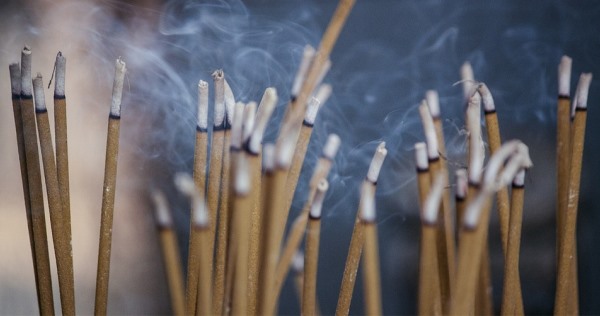
The Incense Has Burned Out
I used to wonder this myself, what do you do after a ritual? I mean, do you just do the ritual and then be all, “Bye! Have a nice day Gods, see you next time”? I never really felt okay with that sort of ending to a ritual, even if of course it would likely be a bit more formal than that. It just felt so, wrong, uncomfortable, yucky to be honest. None of my general Pagan books ever really touched on this sort of thing, nor even my witchy books. Do the thing and then, what? Nothing?
Be a Good Host. One of the best ways I have seen it explained, was in a Facebook group by, I think it was the Dionysian Artist but it may have been J Martinios. When you do a ritual to the Gods, make an offering to a deity you are inviting Them into your home, your personal space, offering Them a meal and praise. They are a guest in your home, and what do you do when you have a guest in your home?
Do you just praise them, give them some food and then kick them out? Or do you actually spend time with them, interact with them, speak with them or even just watch a movie with them? Though I can understand not wanting to actually spend time with some people you have invited into your home, I would hope this isn’t the case with the Gods you invite in – and if it is, why are you inviting those Gods in anyway?
Do Something to Continue it. Meditate. Contemplate. Do some divination. Write about the ritual in your journal, if you have one. Write some poetry, a story, a hymn about the deity or connected to the deity. Read some myths, poetry, stories or hymns about or connected to the deity.
Do Something Relevant. Do something mundane that is connected to the deity, like housework for Hestia, metalwork for Hephaistos, study for Athena, play poker for Hermes. Watch a movie or TV show that you think the deity may like or that reminds of Them, or play some music of the same sort. Dance, sing, play a game.
Whatever it is you choose to do, remember that someone is there with you. How long for? It depends on the God of course, but over time you will be able to tell you are alone again, just as you learn to tell when you aren’t alone during the ritual itself.
Previous Post

September 2, 2016
Here Comes Spring with Terror on Wings
Next Post
September 7, 2016 Why Pagans Homeschool
Browse Our Archives
Select a Category Australia Calendar, Events and Festivals General Hellenism Hellenismoz How To Lore and Myth Multimedia Pagan Blogosphere Pagan Community Pagan Parenting and Homeschooling Paganism 101 Personal Practice Religious Philosophy Resources and Material Ritual Uncategorized Witchcraft 101
Select a Month January 2018 December 2017 November 2017 October 2017 August 2017 July 2017 June 2017 May 2017 April 2017 March 2017 February 2017 January 2017 December 2016 November 2016 October 2016 September 2016 August 2016 July 2016 June 2016 May 2016 April 2016 July 2012 June 2012 May 2012 April 2012 March 2012 February 2012 January 2012 December 2011
Follow Us!
TAKE THE
Religious Wisdom Quiz
Who said, "Before Abraham was, I am"?
Select your answer to see how you score.
Peter Jesus Paul John
Related posts from Hearth Witch Down Under
2018 Pagan Wallpapers and Printables

Book Review - Circle for Hekate: History and...
Hekates Deipnon - Day 30 of My Sacred...
Hades Ritual - Day 29 of My Sacred...
TRENDING AT PATHEOS Pagan

I was recently chatting with someone on Instagram. She asked me what...

While there are many people who share their results, the end of...

On July 23, I saw Christopher Nolan's The Odyssey which is Homer’s...

As I write this two big events have just finished up. One...

Restoring the Watershed of Divine Love
Perhaps cooperation is not something we manufacture through legislation, ideology, or moral...

Many UUs don’t pray because of bad experiences in a previous religion,...
view all Pagan blogs
Ad-Free & Subscriber Log-In Subscription Support
- About Us
- 2026 Calendar
- Videos
- Podcasts
- Library of World Religions
- Faith In Media Tracker
- Advertise With Us
- Write for Us
- Privacy Policy
- Terms of Service
- Do Not Sell My Data
- Contact Us
- Radiant Digital
- Manage Newsletter Subscriptions
- Unsubscribe From Notifications
- Sitemap
Copyright 2008-2026, Patheos. All rights reserved.
Subscription Support Ad-Free & Subscriber Log-In
Follow Patheos