
BuddhistCatholicContemplativeEvangelicalGeneral ChristianHinduJewishLatter-day SaintMuslimNew VisionsProgressive Christian
Beliefs
- Buddhist
- Catholic
- Contemplative
- Evangelical
- General Christian
- Hindu
- Jewish
- Latter-day Saint
- More Voices
- Muslim
- New Visions
- Pagan
- Progressive Christian
Topics
- Religion News
- Food and Religion
- Sports and Religion
- Religious Art
- Religious Music and Entertainment
- Religious Events
- History and Religion
- Style and Religion
- Politics and Religion
- Women in Religion
- Recreation Outdoors and Religion
- Business Finance and Religion
- Careers Workplace and Religion
- Education and Religion
- Family Parenting and Religion
- Health Fitness and Religion
- Home and Religion
- Relationships and Religion
- Technology and Religion
- Travel and Religion
Columnists
- Buddhist Columnists
- Business Finance and Religion Columnists
- Careers Workplace and Religion Columnists
- Catholic Columnists
- Contemplative Columnists
- Education and Religion Columnists
- Evangelists Columnists
- Family Parenting and Religion Columnists
- General Christian Columnists
- Health Fitness and Religion Columnists
- Hindu Columnists
- History and Religion Columnists
- Home and Religion Columnists
- Jewish Columnists
- More Voices Columnists
- Latter Day Columnists
- Muslim Columnists
- New Visions Columnists
- Nonreligious Columnists
- Pagan Columnists
- Politics and Religion Columnists
- Progressive Columnists
- Recreation Outdoors and Religion Columnists
- Relationships and Religion Columnists
- Religion News Columnists
- Religious Art Columnists
- Religious Events Columnists
- Religious Music and Entertainment Columnists
- Sports and Religion Columnists
- Style and Religion Columnists
- Technology and Religion Columnists
- Travel and Religion Columnists
- Women in Religion Columnists
Resource Library
- 2026 Calendar
- Library of World Religions
- The 100 Most Holy Places on Earth
- Patheos Answers
- Podcasts
- Videos
- Faith Leaders Database
- Anglican Episcopalian
- Bahai
- Baptist
- Buddhism
- Christianity
- Confucianism
- Eastern Orthodoxy
- Hinduism
- Holiness and Pentecostal
- ISKCON
- Islam
- Judaism
- Lutheran
- Methodist
- The Church of Jesus Christ of Latter-day Saints
- New Age
- Paganism
- Presbytarian and Reformed
- Protestantism
- Religion Behind the Scenes
- Roman Catholic
- Scientology
- Shia Islam
- Sikhism
- Sufism
- Sunni Islam
- Taoism
- Zen
- See all religions
Research Tools
 Ad-Free & Subscriber Log-In Subscription Support
Ad-Free & Subscriber Log-In Subscription Support
Follow Patheos 

- Trending:
- Forgiveness
- |
- Marriage
- |
- Consciousness
- |
- Death Penalty
- |
- Election
- |
- Halloween
 Hearth Witch Down Under
- Home
- Pagan
- Wrong Belief
Wrong Belief
Last updated on: January 24, 2018 at 1:32 pm by Bekah Evie Bel
Wrong Belief 2018-01-24T13:32:49+10:00 Bekah Evie Bel
Patheos Explore the world's faith through different perspectives on religion and spirituality! Patheos has the views of the prevalent religions and spiritualities of the world.
Looking around on Facebook I noticed a few comments about my previous post about Questioning Beliefs that I don’t really disagree with, for the most part. But I wanted to address one of the ideas that was mentioned several times – that of, you cannot prove a belief wrong.
There are different types of belief that exist, but here I am going to look at two types of belief – Faith belief and Informational Belief.
Faith belief is all about what you believe inside of you, it is personal, perhaps experiential. It has nothing to do with other people. Faith belief is the one that is hardest to change because it doesn’t rely on evidence or proof, it relies on yourself and how you feel and think.
Faith belief is when we have no evidence of something existing, but we believe in it anyway. There is no way to prove it true, or prove it not true – it is reliant on belief, on faith. We have faith that it exists, we have faith that we are correct in believing in it. Or the opposite, we have faith in our belief that it doesn’t exist.
It can’t be proven either way, so whichever way you believe, it is faith. And it cannot be proven wrong. Perhaps.
Informational belief is, obviously, based on information. This is where we believe that something is true because that is what the evidence tells us is true. But we can only make decisions about what we believe based on what information we have – so if we are lacking information, our beliefs about a thing may differ from someone elses beliefs, because they have different or more expansive information than we do.
Thus it is that informational belief is the easiest to change because when we gain new information that contradicts our beliefs, we tend to follow the new information rather than stay with our beliefs. Perhaps.
It seems pretty obvious that informational beliefs can be proven wrong, with new information. So it is that if you believe all Pagans follow the rule of Harm None, then you can be proven wrong by simply talking to a bunch of Pagans who do not follow that rule.
So it is that if you have no knowledge of evidence that dinosaurs existed then you may not believe they existed. But once you are presented with all of the evidence, you may change your beliefs and realise your previously held beliefs were wrong.
Perhaps you believe that Hekate is the Crone aspect of the Triple Goddess, but after reading or participating in a discussion or debate about Her you come to realise, through various historical sources, that She is not the Crone.
Evidence and information changing beliefs and proving you wrong.
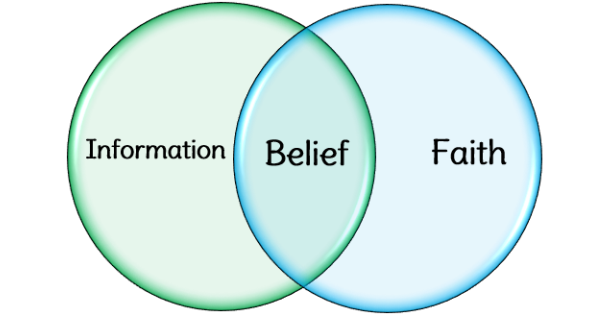
Not exact, but a general idea.
In truth, informational belief is a matter of faith was well – we have faith that the information we have is correct, thus our beliefs are true. But our faith can be misplaced, our beliefs can be wrong. But unlike pure faith belief, we have methods of discovering if our information is wrong or right.
Pure faith belief on the other hand cannot be proven wrong, at least not right now – can’t speak for the future. So we believe in the Gods, this is based on what? Nothing. We believe in Them, and that is it. We can give all sorts of reasons, but these reasons only have meaning to us personally and that’s why some people do not believe in the Gods. Because our reasons are not evidence.
Can faith belief be proven wrong? Well yes and no. We can’t prove it is wrong on a universal level, but we can prove or convince someone that their faith beliefs are wrong for them.
The threefold return is a good example. Some people believe in it, others do not. It is possible to enter a debate about it, hear someone talk about how imbalanced the threefold return is and decide they are right, and you no longer can believe in the threefold return. Or the opposite may happen, you enter the debate not believing in the threefold return, hear someone point out something that makes sense to you and now you do believe in it. And of course you can enter the debate either way and not change your beliefs at all.
In such cases, instead of getting new information that changes your beliefs, you are given a new perspective – a new way of looking at things that makes your previously held beliefs now wrong. For you. But not necessarily wrong for anyone else.
Of course it is not so easy as all that. Sometimes informational belief becomes purely faith based, and this is why some people do not believe the dinosaurs existed despite all evidence to the contrary. Some people still believe Hekate is the Crone despite knowing She wasn’t historically – in this case it is often based on experience. She shows Herself as Crone to that person, why should they believe history and other people over the Goddess Herself?
They aren’t necessarily wrong in their beliefs, but their beliefs are certainly wrong for me! Just as my beliefs are wrong for them.
So is it possible to prove beliefs wrong? Yes, and no. It depends on the type of belief and it depends on what you mean by wrong.
Previous Post

July 29, 2016
Question My Beliefs, Question Yours
Next Post

August 1, 2016 30 Days of Hekate: 1 - Basic Introduction
Browse Our Archives
Select a Category Australia Calendar, Events and Festivals General Hellenism Hellenismoz How To Lore and Myth Multimedia Pagan Blogosphere Pagan Community Pagan Parenting and Homeschooling Paganism 101 Personal Practice Religious Philosophy Resources and Material Ritual Uncategorized Witchcraft 101
Select a Month January 2018 December 2017 November 2017 October 2017 August 2017 July 2017 June 2017 May 2017 April 2017 March 2017 February 2017 January 2017 December 2016 November 2016 October 2016 September 2016 August 2016 July 2016 June 2016 May 2016 April 2016 July 2012 June 2012 May 2012 April 2012 March 2012 February 2012 January 2012 December 2011
Follow Us!
TAKE THE
Religious Wisdom Quiz
What does Jesus teach about forgiving others?
Select your answer to see how you score.
Forgive seventy times seven Never forgive Only forgive friends Once is enough
Related posts from Hearth Witch Down Under
2018 Pagan Wallpapers and Printables

Book Review - Circle for Hekate: History and...

Hekates Deipnon - Day 30 of My Sacred...
Hades Ritual - Day 29 of My Sacred...
TRENDING AT PATHEOS Pagan

I was recently chatting with someone on Instagram. She asked me what...

While there are many people who share their results, the end of...

On July 23, I saw Christopher Nolan's The Odyssey which is Homer’s...

As I write this two big events have just finished up. One...

Restoring the Watershed of Divine Love
Perhaps cooperation is not something we manufacture through legislation, ideology, or moral...

Many UUs don’t pray because of bad experiences in a previous religion,...
view all Pagan blogs
Ad-Free & Subscriber Log-In Subscription Support
- About Us
- 2026 Calendar
- Videos
- Podcasts
- Library of World Religions
- Faith In Media Tracker
- Advertise With Us
- Write for Us
- Privacy Policy
- Terms of Service
- Do Not Sell My Data
- Contact Us
- Radiant Digital
- Manage Newsletter Subscriptions
- Unsubscribe From Notifications
- Sitemap
Copyright 2008-2026, Patheos. All rights reserved.
Subscription Support Ad-Free & Subscriber Log-In
Follow Patheos