
BuddhistCatholicContemplativeEvangelicalGeneral ChristianHinduJewishLatter-day SaintMuslimNew VisionsProgressive Christian
Beliefs
- Buddhist
- Catholic
- Contemplative
- Evangelical
- General Christian
- Hindu
- Jewish
- Latter-day Saint
- More Voices
- Muslim
- New Visions
- Pagan
- Progressive Christian
Topics
- Religion News
- Food and Religion
- Sports and Religion
- Religious Art
- Religious Music and Entertainment
- Religious Events
- History and Religion
- Style and Religion
- Politics and Religion
- Women in Religion
- Recreation Outdoors and Religion
- Business Finance and Religion
- Careers Workplace and Religion
- Education and Religion
- Family Parenting and Religion
- Health Fitness and Religion
- Home and Religion
- Relationships and Religion
- Technology and Religion
- Travel and Religion
Columnists
- Buddhist Columnists
- Business Finance and Religion Columnists
- Careers Workplace and Religion Columnists
- Catholic Columnists
- Contemplative Columnists
- Education and Religion Columnists
- Evangelists Columnists
- Family Parenting and Religion Columnists
- General Christian Columnists
- Health Fitness and Religion Columnists
- Hindu Columnists
- History and Religion Columnists
- Home and Religion Columnists
- Jewish Columnists
- More Voices Columnists
- Latter Day Columnists
- Muslim Columnists
- New Visions Columnists
- Nonreligious Columnists
- Pagan Columnists
- Politics and Religion Columnists
- Progressive Columnists
- Recreation Outdoors and Religion Columnists
- Relationships and Religion Columnists
- Religion News Columnists
- Religious Art Columnists
- Religious Events Columnists
- Religious Music and Entertainment Columnists
- Sports and Religion Columnists
- Style and Religion Columnists
- Technology and Religion Columnists
- Travel and Religion Columnists
- Women in Religion Columnists
Resource Library
- 2026 Calendar
- Library of World Religions
- The 100 Most Holy Places on Earth
- Patheos Answers
- Podcasts
- Videos
- Faith Leaders Database
- Anglican Episcopalian
- Bahai
- Baptist
- Buddhism
- Christianity
- Confucianism
- Eastern Orthodoxy
- Hinduism
- Holiness and Pentecostal
- ISKCON
- Islam
- Judaism
- Lutheran
- Methodist
- The Church of Jesus Christ of Latter-day Saints
- New Age
- Paganism
- Presbytarian and Reformed
- Protestantism
- Religion Behind the Scenes
- Roman Catholic
- Scientology
- Shia Islam
- Sikhism
- Sufism
- Sunni Islam
- Taoism
- Zen
- See all religions
Research Tools
 Ad-Free & Subscriber Log-In Subscription Support
Ad-Free & Subscriber Log-In Subscription Support
Follow Patheos 

- Trending:
- Forgiveness
- |
- Marriage
- |
- Consciousness
- |
- Death Penalty
- |
- Election
- |
- Halloween
 Hearth Witch Down Under
- Home
- Pagan
- 30 Days of Hekate: 7 – Names and Epithets
30 Days of Hekate: 7 – Names and Epithets
Last updated on: January 24, 2018 at 1:32 pm by Bekah Evie Bel
30 Days of Hekate: 7 – Names and Epithets 2018-01-24T13:32:45+10:00 Bekah Evie Bel
Patheos Explore the world's faith through different perspectives on religion and spirituality! Patheos has the views of the prevalent religions and spiritualities of the world.
This post is part of a blog challenge series, 30 Days of Devotion to Hekate. It’s day 7 and we are looking at Hekates names and epithets.
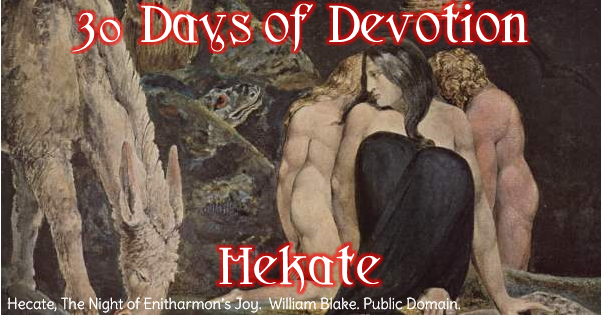
This is a really hard one. Hekate has a lot of names and epithets, and I mean a lot! There is nothing I can write, really, that hasn’t been done better by the lovely Sara Neheti who has devoted time and energy to researching every name and epithet she can find. She has listed hundreds of names, with sources cited where possible. And she is still in the process of writing individual posts about each of those names. It’s a massive project and none of us can do any better.
So today I will simply look at a couple of the names and epithets that I find interesting or that matter to me personally.
Propolos – Guide, Companion, Leader or She Who Leads.
This one is perhaps obvious to anyone who knows anything about Hekate, or has read my previous posts in this series – it refers of course to Hekate being the guide for Persephone each year, out of the Underworld. But She is also the guide for the dead, the ghosts on leaving the Underworld and wandering the world.
Trioditis and Enodia – Of the Crossroads
These epithets are also perhaps obvious, Hekate is often referenced with crossroads, especially threeway ones, but also fourway ones sometimes. She is commonly seen at the crossroads, and it is where we are meant to place Her Deipnon offerings. The crossroads are considered liminal places, obviously, being of no road, but of all roads at once.
Propylaia – The One Before the Gate & Kleidoukhos – Keeper of the Keys.
As the Keybearer Hekate is the one who opens the gates to the Elysian Fields, or not, it is She who is said to decide who can enter. Thus of course She is also the one before the gates. She has long been connected to various boundaries and entrances, doorways and gates being the prime example – people would keep small shrines to Her just outside of their doorways, these would, for the Deipnon, serve as makeshift crossroads as well.
The epithets above are all connected in my mind, and I think many devotees and worshippers of Hekate would agree with me for the most part. So let’s break down what they all mean on a more personal level and how they connect together.
I am not the only one to note that Hekate can be felt as an almost constant presence in your life, a constant companion who is always there, even if only lightly. It’s kind of like seeing someone out of the corner of your eye.
She is our Guide and She does lead us, but I note She seems to do so in a subtle kind of way. She doesn’t drive us on with a whip or anything, She pushes us, gently and subtly, trying to make sure we don’t get stuck where we shouldn’t be. When we are coming up to a time where we need to make a change, when we need to make a choice She will gently push us towards that choice.
Towards the crossroads that we must face, the place where we must choose our next path. She doesn’t, usually, ask us to make any specific choice, She pushes us to make a choice, any choice, but let us not stand there stagnating.
And She is always there, behind us and beside us, pushing us on, but She is there before us, before the gates. It is She who pushes us to take the keys and unlock the gate or door to our next stage – whether that is internal or external, it is She who helps us face what must come. It should be noted that Her epithet as Torchbearer also plays into all of this, as She lights our way forward.
As the Keybearer and Gatekeeper She also brings us something else though. For me, and I know this holds true for many Devotees of Hekate, these epithets also refer to knowledge, secrets, mysteries and wisdom. That which is hidden, is that which She guards and can unlock for us.
This is perhaps one of the things that many of us Hekateans have in common, indeed many of us Pagans and Polytheists in general – our pursuit of knowledge and unlocking the mysteries of the past, the present, the future, the world and the universe and even other worlds. I think this is one of the reasons why Hekate is so attractive to so many of us.
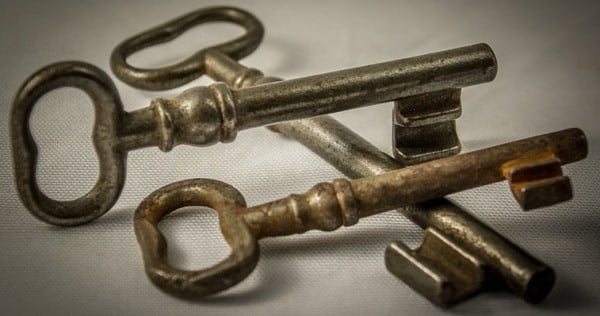
Keys. Public domain, via pixabay.
Kourotrophos – Nurse of the Young
As a mother first and foremost, Hekates nurturing and child protecting aspects are of course a standout point to me. I don’t know what else to add, I am a mum, I have kids, it’s a no brainer really.
Soteira – Saviour
In truth I never really paid much attention to this one before this year, I thought it looked and sounded nice (assuming I pronounce it right), but I didn’t really care about it. But I guess it’s a natural by-product of joining the Covenant of Hekate that I started to pay more attention to this epithet and what it means. So it has come to mean more to me, especially over most of Her other names and I am learning more about this aspect of Her – but I don’t know a lot yet.
Now that is done I suggest you go look at Sara’s blog posts on Hekates epithets, she includes sources too which is always fantastic.
30 Days of Deity Devotion
1 – A basic introduction of the deity
2 – How did you become first aware of this deity?
3 – Symbols and icons of this deity
4 – A favourite myth or myths of this deity
5 – Members of the family – genealogical connections
6 – Other related deities and entities associated with this deity
7 – Names and epithets
8 – Variations on this deity (aspects, regional forms, etc.)
9 & 27 – Common mistakes and worst misconceptions about this deity
10 – Offerings – historical and UPG
11 – Festivals, days, and times sacred to this deity
12 – Places associated with this deity and their worship
13 – What modern cultural issues are closest to this deity’s heart?
14 – Has worship of this deity changed in modern times?
15 – Any mundane practices that are associated with this deity?
16 – How do you think this deity represents the values of their pantheon and cultural origins?
17 – How does this deity relate to other gods and other pantheons?
18 – How does this deity stand in terms of gender and sexuality? (historical and/or UPG)
19 – What quality or qualities of this god do you most admire? And find the most troubling?
20 & 21 – Art and music that reminds you of this deity
22 – A quote, a poem, or piece of writing that you think this deity resonates strongly with
23 – Your own composition – a piece of writing about or for this deity
24 & 25 – A time when this deity has helped you, and refused to help
26 – How has your relationship with this deity changed over time?
28 – Something you wish you knew about this deity but don’t currently
29 – Any interesting or unusual UPG to share?
30 – Any suggestions for others just starting to learn about this deity?
Previous Post
August 6, 2016
30 Days of Hekate: 6 - Related and Associated Deities
Next Post
August 8, 2016 30 Days of Hekate: 8 - Variations and Aspects
Browse Our Archives
Select a Category Australia Calendar, Events and Festivals General Hellenism Hellenismoz How To Lore and Myth Multimedia Pagan Blogosphere Pagan Community Pagan Parenting and Homeschooling Paganism 101 Personal Practice Religious Philosophy Resources and Material Ritual Uncategorized Witchcraft 101
Select a Month January 2018 December 2017 November 2017 October 2017 August 2017 July 2017 June 2017 May 2017 April 2017 March 2017 February 2017 January 2017 December 2016 November 2016 October 2016 September 2016 August 2016 July 2016 June 2016 May 2016 April 2016 July 2012 June 2012 May 2012 April 2012 March 2012 February 2012 January 2012 December 2011
Follow Us!
TAKE THE
Religious Wisdom Quiz
What type of building was Jesus born in?
Select your answer to see how you score.
A tent A stable A castle A cave
Related posts from Hearth Witch Down Under
2018 Pagan Wallpapers and Printables

Book Review - Circle for Hekate: History and...
Hekates Deipnon - Day 30 of My Sacred...
Hades Ritual - Day 29 of My Sacred...
TRENDING AT PATHEOS Pagan

I was recently chatting with someone on Instagram. She asked me what...

While there are many people who share their results, the end of...

On July 23, I saw Christopher Nolan's The Odyssey which is Homer’s...

As I write this two big events have just finished up. One...

Restoring the Watershed of Divine Love
Perhaps cooperation is not something we manufacture through legislation, ideology, or moral...

Many UUs don’t pray because of bad experiences in a previous religion,...
view all Pagan blogs
Ad-Free & Subscriber Log-In Subscription Support
- About Us
- 2026 Calendar
- Videos
- Podcasts
- Library of World Religions
- Faith In Media Tracker
- Advertise With Us
- Write for Us
- Privacy Policy
- Terms of Service
- Do Not Sell My Data
- Contact Us
- Radiant Digital
- Manage Newsletter Subscriptions
- Unsubscribe From Notifications
- Sitemap
Copyright 2008-2026, Patheos. All rights reserved.
Subscription Support Ad-Free & Subscriber Log-In
Follow Patheos