
BuddhistCatholicContemplativeEvangelicalGeneral ChristianHinduJewishLatter-day SaintMuslimNew VisionsProgressive Christian
Beliefs
- Buddhist
- Catholic
- Contemplative
- Evangelical
- General Christian
- Hindu
- Jewish
- Latter-day Saint
- More Voices
- Muslim
- New Visions
- Pagan
- Progressive Christian
Topics
- Religion News
- Food and Religion
- Sports and Religion
- Religious Art
- Religious Music and Entertainment
- Religious Events
- History and Religion
- Style and Religion
- Politics and Religion
- Women in Religion
- Recreation Outdoors and Religion
- Business Finance and Religion
- Careers Workplace and Religion
- Education and Religion
- Family Parenting and Religion
- Health Fitness and Religion
- Home and Religion
- Relationships and Religion
- Technology and Religion
- Travel and Religion
Columnists
- Buddhist Columnists
- Business Finance and Religion Columnists
- Careers Workplace and Religion Columnists
- Catholic Columnists
- Contemplative Columnists
- Education and Religion Columnists
- Evangelists Columnists
- Family Parenting and Religion Columnists
- General Christian Columnists
- Health Fitness and Religion Columnists
- Hindu Columnists
- History and Religion Columnists
- Home and Religion Columnists
- Jewish Columnists
- More Voices Columnists
- Latter Day Columnists
- Muslim Columnists
- New Visions Columnists
- Nonreligious Columnists
- Pagan Columnists
- Politics and Religion Columnists
- Progressive Columnists
- Recreation Outdoors and Religion Columnists
- Relationships and Religion Columnists
- Religion News Columnists
- Religious Art Columnists
- Religious Events Columnists
- Religious Music and Entertainment Columnists
- Sports and Religion Columnists
- Style and Religion Columnists
- Technology and Religion Columnists
- Travel and Religion Columnists
- Women in Religion Columnists
Resource Library
- 2026 Calendar
- Library of World Religions
- The 100 Most Holy Places on Earth
- Patheos Answers
- Podcasts
- Videos
- Faith Leaders Database
- Anglican Episcopalian
- Bahai
- Baptist
- Buddhism
- Christianity
- Confucianism
- Eastern Orthodoxy
- Hinduism
- Holiness and Pentecostal
- ISKCON
- Islam
- Judaism
- Lutheran
- Methodist
- The Church of Jesus Christ of Latter-day Saints
- New Age
- Paganism
- Presbytarian and Reformed
- Protestantism
- Religion Behind the Scenes
- Roman Catholic
- Scientology
- Shia Islam
- Sikhism
- Sufism
- Sunni Islam
- Taoism
- Zen
- See all religions
Research Tools
 Ad-Free & Subscriber Log-In Subscription Support
Ad-Free & Subscriber Log-In Subscription Support
Follow Patheos 

- Trending:
- Forgiveness
- |
- Marriage
- |
- Consciousness
- |
- Death Penalty
- |
- Election
- |
- Halloween
 Hearth Witch Down Under
- Home
- Pagan
- 30 Days of Hekate: 4 – Favourite Myth
30 Days of Hekate: 4 – Favourite Myth
Last updated on: January 24, 2018 at 1:32 pm by Bekah Evie Bel
30 Days of Hekate: 4 – Favourite Myth 2018-01-24T13:32:47+10:00 Bekah Evie Bel
Patheos Explore the world's faith through different perspectives on religion and spirituality! Patheos has the views of the prevalent religions and spiritualities of the world.
This post is part of a blog challenge series, 30 Days of Devotion, to Hekate. Day 4 and we are looking at my favourite myths about Hekate.
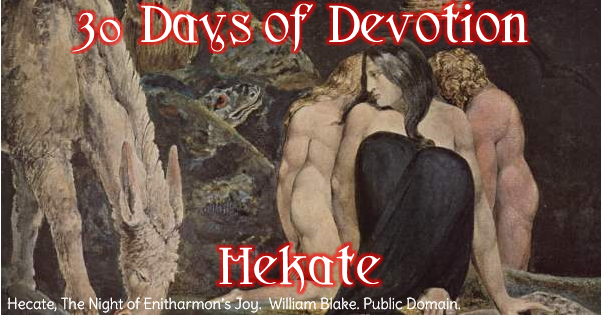
Today we are looking at my favourite myth/s of Hekate. This is a hard one, because in truth there are actually little in the ways of myths that are about Hekate. She is mentioned in various myths, of course, but She doesn’t really have any that are focused on Her specifically.
Best known perhaps is Hekates role in the Mysteries, for Hekate is instrumental in Demeters search for Kore/Persephone. The following is a few different passages from the Homeric Hymn to Demeter.
[…]But no one, either of the deathless gods or of mortal men, heard her voice, nor yet the olive-trees bearing rich fruit: only tender-hearted Hecate, bright-coiffed, the daughter of Persaeus, heard the girl from her cave, and the lord Helios, Hyperion’s bright son, as she cried to her father, the Son of Cronos. But he was sitting aloof, apart from the gods, in his temple where many pray, and receiving sweet offerings from mortal men. […]
But when the tenth enlightening dawn had come, Hecate, with a torch in her hands, met her, and spoke to her and told her news: ‘Queenly Demeter, bringer of seasons and giver of good gifts, what god of heaven or what mortal man has rapt away Persephone and pierced with sorrow your dear heart? For I heard her voice, yet saw not with my eyes who it was. But I tell you truly and shortly all I know.’
So, then, said Hecate. And the daughter of rich-haired Rhea answered her not, but sped swiftly with her, holding flaming torches in her hands. So they came to Helios, who is watchman of both gods and men, and stood in front of his horses[…]
Then bright-coiffed Hecate came near to them, and often did she embrace the daughter of holy Demeter: and from that time the lady Hecate was minister and companion to Persephone.[…]
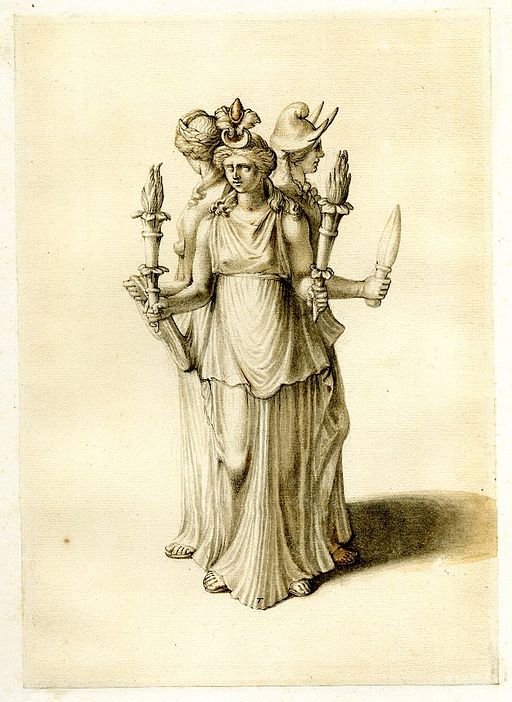
Hekate with Her torches. Public domain via wikimedia commons.
So we see that Hekate, along with Helios, is the only one to hear Kores cries, She tells Demeter what She heard and led Her to Helios, She was there at the end when mother and daughter were finally reunited and She becomes an Underworld Goddess due to Her association with Persephone.
I really like how it speaks of Her as being tender hearted, so much lore about Hekate today makes her out to be some harsh and forbidding Goddess – and She can be. But She is also extremely lovely and loving, and you don’t hear about that as much.
But I think my favourite myth about Hekate is actually from Theogony, which tells how Hekate is honoured by Zeus and the other Gods.
And she [Asteria] conceived and bare Hecate whom Zeus the son of Cronos honoured above all. He gave her splendid gifts, to have a share of the earth and the unfruitful sea. She received honour also in starry heaven, and is honoured exceedingly by the deathless gods. For to this day, whenever any one of men on earth offers rich sacrifices and prays for favour according to custom, he calls upon Hecate. Great honour comes full easily to him whose prayers the goddess receives favourably, and she bestows wealth upon him; for the power surely is with her.
For as many as were born of Earth and Ocean amongst all these she has her due portion. The son of Cronos did her no wrong nor took anything away of all that was her portion among the former Titan gods: but she holds, as the division was at the first from the beginning, privilege both in earth, and in heaven, and in sea. Also, because she is an only child, the goddess receives not less honour, but much more still, for Zeus honours her.
Whom she will she greatly aids and advances: she sits by worshipful kings in judgement, and in the assembly whom she will is distinguished among the people. And when men arm themselves for the battle that destroys men, then the goddess is at hand to give victory and grant glory readily to whom she will. Good is she also when men contend at the games, for there too the goddess is with them and profits them: and he who by might and strength gets the victory wins the rich prize easily with joy, and brings glory to his parents.
And she is good to stand by horsemen, whom she will: and to those whose business is in the grey discomfortable sea, and who pray to Hecate and the loud-crashing Earth-Shaker, easily the glorious goddess gives great catch, and easily she takes it away as soon as seen, if so she will. She is good in the byre with Hermes to increase the stock. The droves of kine and wide herds of goats and flocks of fleecy sheep, if she will, she increases from a few, or makes many to be less. So, then. albeit her mother’s only child, she is honoured amongst all the deathless gods. And the son of Cronos made her a nurse of the young who after that day saw with their eyes the light of all-seeing Dawn. So from the beginning she is a nurse of the young, and these are her honours.
While it’s not some fun and super exciting story from mythology, it is nonetheless my favourite piece about Her. Because it shows just how vast and powerful She is, with dominion over, well, almost everything it seems. This really shows a lot about Her, again outside of the commonly discussed ‘darker’ and scary aspects we see so much today. And I love that.
30 Days of Deity Devotion
1 – A basic introduction of the deity
2 – How did you become first aware of this deity?
3 – Symbols and icons of this deity
4 – A favourite myth or myths of this deity
5 – Members of the family – genealogical connections
6 – Other related deities and entities associated with this deity
7 – Names and epithets
8 – Variations on this deity (aspects, regional forms, etc.)
9 & 27 – Common mistakes and worst misconceptions about this deity
10 – Offerings – historical and UPG
11 – Festivals, days, and times sacred to this deity
12 – Places associated with this deity and their worship
13 – What modern cultural issues are closest to this deity’s heart?
14 – Has worship of this deity changed in modern times?
15 – Any mundane practices that are associated with this deity?
16 – How do you think this deity represents the values of their pantheon and cultural origins?
17 – How does this deity relate to other gods and other pantheons?
18 – How does this deity stand in terms of gender and sexuality? (historical and/or UPG)
19 – What quality or qualities of this god do you most admire? And find the most troubling?
20 & 21 – Art and music that reminds you of this deity
22 – A quote, a poem, or piece of writing that you think this deity resonates strongly with
23 – Your own composition – a piece of writing about or for this deity
24 & 25 – A time when this deity has helped you, and refused to help
26 – How has your relationship with this deity changed over time?
28 – Something you wish you knew about this deity but don’t currently
29 – Any interesting or unusual UPG to share?
30 – Any suggestions for others just starting to learn about this deity?
Previous Post

August 3, 2016
30 Days of Hekate: 3 - Symbols and Icons
Next Post

August 5, 2016 Opening Ritual for the Olympics
Browse Our Archives
Select a Category Australia Calendar, Events and Festivals General Hellenism Hellenismoz How To Lore and Myth Multimedia Pagan Blogosphere Pagan Community Pagan Parenting and Homeschooling Paganism 101 Personal Practice Religious Philosophy Resources and Material Ritual Uncategorized Witchcraft 101
Select a Month January 2018 December 2017 November 2017 October 2017 August 2017 July 2017 June 2017 May 2017 April 2017 March 2017 February 2017 January 2017 December 2016 November 2016 October 2016 September 2016 August 2016 July 2016 June 2016 May 2016 April 2016 July 2012 June 2012 May 2012 April 2012 March 2012 February 2012 January 2012 December 2011
Follow Us!
TAKE THE
Religious Wisdom Quiz
What prominent city did Paul visit, known for its altar to "an unknown god"?
Select your answer to see how you score.
Athens Corinth Rome Ephesus
Related posts from Hearth Witch Down Under

2018 Pagan Wallpapers and Printables

Book Review - Circle for Hekate: History and...
Hekates Deipnon - Day 30 of My Sacred...
Hades Ritual - Day 29 of My Sacred...
TRENDING AT PATHEOS Pagan

When we talk about Greek religion, we often begin with the dodekatheion—the...

I was recently chatting with someone on Instagram. She asked me what...

While there are many people who share their results, the end of...

On July 23, I saw Christopher Nolan's The Odyssey which is Homer’s...

As I write this two big events have just finished up. One...

Restoring the Watershed of Divine Love
Perhaps cooperation is not something we manufacture through legislation, ideology, or moral...
view all Pagan blogs
Ad-Free & Subscriber Log-In Subscription Support
- About Us
- 2026 Calendar
- Videos
- Podcasts
- Library of World Religions
- Faith In Media Tracker
- Advertise With Us
- Write for Us
- Privacy Policy
- Terms of Service
- Do Not Sell My Data
- Contact Us
- Radiant Digital
- Manage Newsletter Subscriptions
- Unsubscribe From Notifications
- Sitemap
Copyright 2008-2026, Patheos. All rights reserved.
Subscription Support Ad-Free & Subscriber Log-In
Follow Patheos