
BuddhistCatholicContemplativeEvangelicalGeneral ChristianHinduJewishLatter-day SaintMuslimNew VisionsProgressive Christian
Beliefs
- Buddhist
- Catholic
- Contemplative
- Evangelical
- General Christian
- Hindu
- Jewish
- Latter-day Saint
- More Voices
- Muslim
- New Visions
- Pagan
- Progressive Christian
Topics
- Religion News
- Food and Religion
- Sports and Religion
- Religious Art
- Religious Music and Entertainment
- Religious Events
- History and Religion
- Style and Religion
- Politics and Religion
- Women in Religion
- Recreation Outdoors and Religion
- Business Finance and Religion
- Careers Workplace and Religion
- Education and Religion
- Family Parenting and Religion
- Health Fitness and Religion
- Home and Religion
- Relationships and Religion
- Technology and Religion
- Travel and Religion
Columnists
- Buddhist Columnists
- Business Finance and Religion Columnists
- Careers Workplace and Religion Columnists
- Catholic Columnists
- Contemplative Columnists
- Education and Religion Columnists
- Evangelists Columnists
- Family Parenting and Religion Columnists
- General Christian Columnists
- Health Fitness and Religion Columnists
- Hindu Columnists
- History and Religion Columnists
- Home and Religion Columnists
- Jewish Columnists
- More Voices Columnists
- Latter Day Columnists
- Muslim Columnists
- New Visions Columnists
- Nonreligious Columnists
- Pagan Columnists
- Politics and Religion Columnists
- Progressive Columnists
- Recreation Outdoors and Religion Columnists
- Relationships and Religion Columnists
- Religion News Columnists
- Religious Art Columnists
- Religious Events Columnists
- Religious Music and Entertainment Columnists
- Sports and Religion Columnists
- Style and Religion Columnists
- Technology and Religion Columnists
- Travel and Religion Columnists
- Women in Religion Columnists
Resource Library
- 2026 Calendar
- Library of World Religions
- The 100 Most Holy Places on Earth
- Patheos Answers
- Podcasts
- Videos
- Faith Leaders Database
- Anglican Episcopalian
- Bahai
- Baptist
- Buddhism
- Christianity
- Confucianism
- Eastern Orthodoxy
- Hinduism
- Holiness and Pentecostal
- ISKCON
- Islam
- Judaism
- Lutheran
- Methodist
- The Church of Jesus Christ of Latter-day Saints
- New Age
- Paganism
- Presbytarian and Reformed
- Protestantism
- Religion Behind the Scenes
- Roman Catholic
- Scientology
- Shia Islam
- Sikhism
- Sufism
- Sunni Islam
- Taoism
- Zen
- See all religions
Research Tools
 Ad-Free & Subscriber Log-In Subscription Support
Ad-Free & Subscriber Log-In Subscription Support
Follow Patheos 

- Trending:
- Forgiveness
- |
- Marriage
- |
- Consciousness
- |
- Death Penalty
- |
- Election
- |
- Halloween
 Hearth Witch Down Under
- Home
- Pagan
- Offerings to the Hellenic Gods
Offerings to the Hellenic Gods
Last updated on: January 24, 2018 at 1:32 pm by Bekah Evie Bel
Offerings to the Hellenic Gods 2018-01-24T13:32:51+10:00 Bekah Evie Bel
Patheos Explore the world's faith through different perspectives on religion and spirituality! Patheos has the views of the prevalent religions and spiritualities of the world.
My last post was about animal sacrifice in Hellenism, both from history and mythology and from today. In this post we are going to look at other types of offerings.
In ancient Hellenism the act of sacrificing an animal was generally the job of the priesthood and usually not done by people within their own household practice. But household worship and honouring of the Gods was a daily practice, involving various levels of elaborateness. Animal sacrifice, and the offering of meat was not generally part of household practice – as we established in the previous post, meat was not a general commodity in ancient Greece so of course it wasn’t really part of common household practice. This means, that within household and personal practice, there must have been other offerings made and given, other things done.
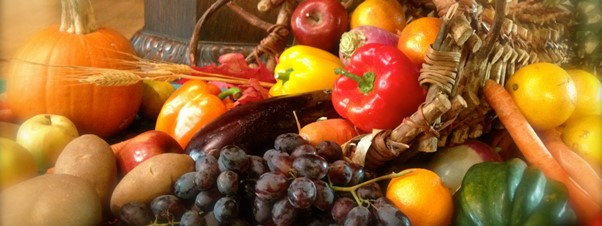
Cornucopia. Public domain pictures.
Non-Meat Meats
Though we consider fish to be meat, in much the same way we consider any animal meat, it seems to have been of a different calibre in the eyes of the ancient Hellenes. It’s not exactly something that could be sacrificed, getting a fish to survive long enough to take it to the altar and then go through the sacrificial procedure – well I don’t see that happening.
Fish was a regular staple in the Hellenic diet, at least for those who lived near to the sea or other fishy areas. So it was that fish was also a common offering in Hellenic worship – it was, in many cases, readily available and specific types of fish were sacred to specific deities, making them perfect as offerings to those deities. Poseidon of course was one who would be offered fish, and Hekate also was offered fish on the Deipnon.
In modern times fish is certainly a good offering for those who are okay with animal products, and given that the act of fishing is a pretty common pastime for many people, it is perhaps not too difficult an offering to manage. Whether it is okay to use frozen of tinned fish though is perhaps up to the individual. Personally, I can’t say how I feel about it, because I haven’t really thought about it. But I can see that some would be against it, and some would be okay with it – as seems to be the case with most such adaptations.
Another product that is meat like but not exactly meat and certainly cannot be offered in sacrifice is egg. Now I know that eggs are great offerings for Hekate, and they are also good to offer to various fertility deities – but I am not sure of how prevalent they were as offerings otherwise. I do know, however, that they weren’t much of a food staple and even when they did begin to be used for food, they weren’t in very high regard.
Natural Foods
Of course natural foods such as fruit, vegetables, grains and the like were the most common of offerings. To see what might have been considered common one need only look at the common Hellene diet to get an idea of what may have been offered to the Gods.
Olives, Grapes and Honey
Olives, grapes and honey seem, to me at least, to be of equal importance and popularity among the ancient Greeks. On a mundane level, they are obviously of great value for numerous reasons. They each have value in trade, of course but they also serve as food items. Olives of course create oil, grapes create wine and honey has some great medical properties. I suppose all three can also be used in beauty products as well, which just increases their value even more. Considering all of this, one can see why they were and continue to be of such import in Greece.
But of course, the mundane wasn’t the only reason these served to be important – they also have their places in mythology and they are sacred to the Gods, some Gods more than others, but in truth as offerings these three are pretty much universal and can be offered to any deity among the Theoi.
Honey was and still is often referred to as the “nectar of the Gods” and was considered to be ambrosia. Zeus Himself is said to have been fed honey and milk when He was growing and in hiding from His father, the titan Kronos. Grapes of course create wine, and we should all know the importance of wine to many of the Gods, most notably Dionysos.

Poseidon and Athena battle for Athens. Benvenuto Tisi [Public domain], via Wikimedia Commons
However, of the three, olives are perhaps the best known for their sacredness – probably because Athens is central to much of the history and mythology we know. The Goddess Athena and the God Poseidon vied with each other over who would have or own or be patron of a great city. Poseidon caused a great well to appear, which seems all well and good, however it did have the downside of being salt water and thus of little use to the people. Athena however cause a great tree to grow, an olive tree, the first of its kind. As outlined above, the fruit of the olive tree has multiple uses, and therefore Athenas gift was deemed the winner and She was given the city – which was, in Her honour, named Athens.
So, olives, grapes and honey are perfect Hellenic foods and products. When it comes to offerings they are, in essence, the go to foods. Honey by itself, mixed with anything, or cooked into things like cakes, breads and cookies. Olives by themselves or cooked into foods, like breads and cake or whatever you might conceive of and of course you can make a lot of foods with olive oil – olive oil is also used in libation. Grapes, again by themselves, or perhaps added into other foods, but best used in libation as wine, or grape juice for the teetotaller.
As a note, wine, when offered to most deities, should be mixed with water. Only when offered to Chthonic deities can it be offered straight – I suspect this partially because we are supposed to drink the remnants of libations to most deities, and drinking unmixed wine was considered barbaric, but we do not partake of anything when offering to Chthonic deities so it can be unmixed.
Barley
Though not as interesting as honey, grapes and olives, barley was also of great import to the ancient Greeks. It was their main grain crop and was a food staple as well as a great offering to the Gods, but perhaps of most importance, it was also a purifying product. Barley was not just common as a universal offering in Hellenism, it is also scattered over the altar and even on people (and sacrifices) to purify them in addition to khernips.
So we can use barley as a basic grain offering, and for purification purposes. We can also use barley flour in baking and cooking, to create more elaborate offerings in cookies, cakes and breads. Much like honey, grapes and olives, barley is versatile in our practice.
So Much More
I can’t go through and list everything that was and is offered regularly, along with the whys, as that would take way too long and in truth I think it is not really necessary. When it comes down to it, you can offer pretty much any natural food the Gods, any fruit or vegetable or grain should be perfectly okay.
But it should be noted that the Gods are more receptive to the foods that are considered sacred to Them in some way. So, whilst olives are a universal offering, they will have greater affect when offered to Athena specifically. Hekate is more receptive to Her specific foods such as garlic and leek. Pomegranates are said to be great for Persephone/Kore. It is also of course possible that the opposite can happen – that a specific food is, well, offensive to a specific deity. So, I certainly suggest checking up on the lore of the specific deities you are offering to before deciding to just offer whatever is at hand.
Previous Post

July 11, 2016
Animal Sacrifice in Hellenism
Next Post

July 15, 2016 How to Offer to the Gods
Browse Our Archives
Select a Category Australia Calendar, Events and Festivals General Hellenism Hellenismoz How To Lore and Myth Multimedia Pagan Blogosphere Pagan Community Pagan Parenting and Homeschooling Paganism 101 Personal Practice Religious Philosophy Resources and Material Ritual Uncategorized Witchcraft 101
Select a Month January 2018 December 2017 November 2017 October 2017 August 2017 July 2017 June 2017 May 2017 April 2017 March 2017 February 2017 January 2017 December 2016 November 2016 October 2016 September 2016 August 2016 July 2016 June 2016 May 2016 April 2016 July 2012 June 2012 May 2012 April 2012 March 2012 February 2012 January 2012 December 2011
Follow Us!
TAKE THE
Religious Wisdom Quiz
True or False: Noah's ark was made of cedar wood.
Select your answer to see how you score.
TRUE FALSE
Related posts from Hearth Witch Down Under

2018 Pagan Wallpapers and Printables

Book Review - Circle for Hekate: History and...

Hekates Deipnon - Day 30 of My Sacred...

Hades Ritual - Day 29 of My Sacred...
TRENDING AT PATHEOS Pagan

I was recently chatting with someone on Instagram. She asked me what...

While there are many people who share their results, the end of...

On July 23, I saw Christopher Nolan's The Odyssey which is Homer’s...

As I write this two big events have just finished up. One...

Restoring the Watershed of Divine Love
Perhaps cooperation is not something we manufacture through legislation, ideology, or moral...

Many UUs don’t pray because of bad experiences in a previous religion,...
view all Pagan blogs
Ad-Free & Subscriber Log-In Subscription Support
- About Us
- 2026 Calendar
- Videos
- Podcasts
- Library of World Religions
- Faith In Media Tracker
- Advertise With Us
- Write for Us
- Privacy Policy
- Terms of Service
- Do Not Sell My Data
- Contact Us
- Radiant Digital
- Manage Newsletter Subscriptions
- Unsubscribe From Notifications
- Sitemap
Copyright 2008-2026, Patheos. All rights reserved.
Subscription Support Ad-Free & Subscriber Log-In
Follow Patheos