
BuddhistCatholicContemplativeEvangelicalGeneral ChristianHinduJewishLatter-day SaintMuslimNew VisionsProgressive Christian
Beliefs
- Buddhist
- Catholic
- Contemplative
- Evangelical
- General Christian
- Hindu
- Jewish
- Latter-day Saint
- More Voices
- Muslim
- New Visions
- Pagan
- Progressive Christian
Topics
- Religion News
- Food and Religion
- Sports and Religion
- Religious Art
- Religious Music and Entertainment
- Religious Events
- History and Religion
- Style and Religion
- Politics and Religion
- Women in Religion
- Recreation Outdoors and Religion
- Business Finance and Religion
- Careers Workplace and Religion
- Education and Religion
- Family Parenting and Religion
- Health Fitness and Religion
- Home and Religion
- Relationships and Religion
- Technology and Religion
- Travel and Religion
Columnists
- Buddhist Columnists
- Business Finance and Religion Columnists
- Careers Workplace and Religion Columnists
- Catholic Columnists
- Contemplative Columnists
- Education and Religion Columnists
- Evangelists Columnists
- Family Parenting and Religion Columnists
- General Christian Columnists
- Health Fitness and Religion Columnists
- Hindu Columnists
- History and Religion Columnists
- Home and Religion Columnists
- Jewish Columnists
- More Voices Columnists
- Latter Day Columnists
- Muslim Columnists
- New Visions Columnists
- Nonreligious Columnists
- Pagan Columnists
- Politics and Religion Columnists
- Progressive Columnists
- Recreation Outdoors and Religion Columnists
- Relationships and Religion Columnists
- Religion News Columnists
- Religious Art Columnists
- Religious Events Columnists
- Religious Music and Entertainment Columnists
- Sports and Religion Columnists
- Style and Religion Columnists
- Technology and Religion Columnists
- Travel and Religion Columnists
- Women in Religion Columnists
Resource Library
- 2026 Calendar
- Library of World Religions
- The 100 Most Holy Places on Earth
- Patheos Answers
- Podcasts
- Videos
- Faith Leaders Database
- Anglican Episcopalian
- Bahai
- Baptist
- Buddhism
- Christianity
- Confucianism
- Eastern Orthodoxy
- Hinduism
- Holiness and Pentecostal
- ISKCON
- Islam
- Judaism
- Lutheran
- Methodist
- The Church of Jesus Christ of Latter-day Saints
- New Age
- Paganism
- Presbytarian and Reformed
- Protestantism
- Religion Behind the Scenes
- Roman Catholic
- Scientology
- Shia Islam
- Sikhism
- Sufism
- Sunni Islam
- Taoism
- Zen
- See all religions
Research Tools
 Ad-Free & Subscriber Log-In Subscription Support
Ad-Free & Subscriber Log-In Subscription Support
Follow Patheos 

- Trending:
- Forgiveness
- |
- Marriage
- |
- Consciousness
- |
- Death Penalty
- |
- Election
- |
- Halloween
 Hearth Witch Down Under
- Home
- Pagan
- 180 Degrees of Separation – The Cardinal Elements
180 Degrees of Separation – The Cardinal Elements
Last updated on: January 24, 2018 at 1:32 pm by Bekah Evie Bel
180 Degrees of Separation – The Cardinal Elements 2018-01-24T13:32:52+10:00 Bekah Evie Bel
Patheos Explore the world's faith through different perspectives on religion and spirituality! Patheos has the views of the prevalent religions and spiritualities of the world.
180 Degrees of Separation is a series I am doing about the differences between the Northern and Southern Hemispheres in Paganism, Witchcraft and related areas. I am Australian and like every Aussie Pagan (not a generalisation), I notice that the large majority of 101 resources for Pagans are quite north-centric, which can be a bit of a problem for us in certain cases. There are of course many Aussie bloggers who are trying to share how these things are different and what it means – but in my opinion, the more of us doing this, the easier the knowledge is for others to find. So, the more the merrier!
These posts are not only for us in the south though – I am sharing information for both hemispheres, about both hemispheres. So people in the northern hemisphere will hopefully find value in these posts as well – keeping mind these are a bit 101 so if you’re an experienced Pagan, you probably already know most of what’s here anyway. But you might not know about all the hemisphere differences, so you may still find this series a worthwhile read.
So far we have looked at The Moon in part 1 and part 2, The Wheel of the Year in Part 1 and Part 2 and Part 3.
By Nyo (Own work) [CC BY 2.0 (http://creativecommons.org/licenses/by/2.0)], via Wikimedia Commons
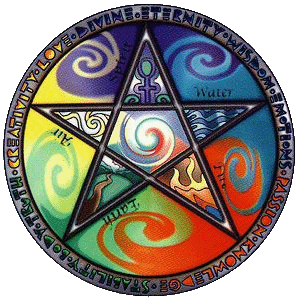
This weeks post is all about directions and the four, or five, elements – though we won’t be discussing the spirit element. You wouldn’t think so, but the cardinal directions, corresponding elements and the directions for casting a circle and similar things is actually the cause for a lot confusion down here in the southern hemisphere. We’ll begin with circle casting, which is perhaps the most confusing for all of us.
The Sun
Andreas Cellarius [Public domain], via Wikimedia Commons
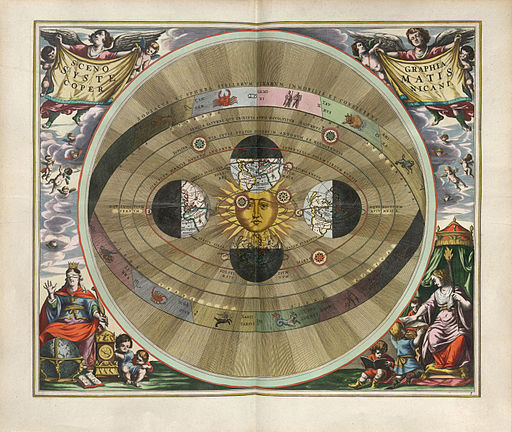
The sun seems to move along the equator, or near to depending on the time of year, so depending on which hemisphere you are in, the sun will appear to move in a different direction. Now of course the sun always moves from east to west, this unchangeable, but perspective matters. In the north when you look towards the equator, where the sun “travels” you are looking towards us down here, and we look towards you.
So while the sun seems to move from left to right for people in the northern hemisphere, it seems to move from right to left for us down south. To see this easily simply look at a map of earth, trace east to west – which way are you tracing? Bet it’s right to left – which by the way, kind of suggests that you up north are the ones who are upside down, since to get your perspective when looking at a map you have to turn the map upside down. Perspective is an interesting thing isn’t it?
But what difference does this make? It doesn’t seem like a big deal really, but in truth it is one of the most confusing things for us down here – and there is no way for us to answer this one completely and truly. The issue is something so simple and basic – circle casting and which way is which.
Witchcraft 101, for this spell, cast deosil, for this other spell cast widdershins. When you remember that deosil and widdershins refer to two different things you may understand the confusion – deosil and widdershins refer to the direction the sun travels and the direction the hands on the clock travel. Not so hard until you realise, from our perspective, the sun and the clock don’t match up like it does for everyone up north.
North
- Sun appears to cross the sky from left to right.
- Sun appears to travel in a clockwise direction.
- Sunwise is Deosil is Clockwise.
- Counter-sunwise is Widdershins is Counter-clockwise.
So the question becomes, for us here, what are deosil and widdershins? Are they solar directions, clock directions or something else. When we look for answers, we get no clear answer at all. Wikipedia seems to suggest that both words refer to the direction of the sun, which suggests for us deosil would be anti-clockwise and widdershins would be clockwise. Right?
Well, yes and no. Because then the Wiki entry on widdershins suggests that widdershins refers to “counter clockwise” or “left to right” specifically. But then, in that same entry it states that counter-clockwise is deosil in the southern hemisphere and widdershins is “running-counter to the direction of the Sun” despite earlier stating this cannot be the case!
Pagan/Wiccan About says “To move deosil is to move in a clockwise (or sunwise) direction. […] The opposite of deosil is widdershins, which means counterclockwise.” And mentions the south not at all. As is common, clockwise and sunwise are considered synonymous.
Etymology online, on Deosil states that deosil (or deasil) means “rightwise, turned toward the right; motion according to the apparent course of the sun…” But its root words all mean “right” in some way. But the same site, on Widdershins goes on to state, “contrary to the course of the sun or a clock” once again conflating the two movements. It also says, etymologically, that widdershins derives from things meaning, “in the opposite direction” and “to go against” – which doesn’t give us much really.
So what are we left with here? An understandable conflation between the words clockwise and sunwise (considering the sources of our originating languages, such conflations are completely normal). Unfortunately that conflation leaves us with nothing but confusion. Either we look to the sun and say deosil means sunwise, which means, for us down here, counter-clockwise. Or we say deosil means right, which means counter-sunwise. So which is it?
The answer comes to me in the most unexpected way. In the first instalment, the introduction, of this 180 Degrees series I was asked a question in the comments that I didn’t really think would be relevant to this series – nothing more than a matter of curiosity. I answered it, that was that. I didn’t really think of it again.
Yvonne Aburrow, from Dowsing for Divinity, asked, “Is it true that the water goes anti-clockwise down the plughole?” The answer was no, it doesn’t (though it can, and it can in the north too, it really depends on your plumbing, what its made of, the design etc). I said that it was a myth based on a misunderstanding of the Coriolis Effect which affects the spin direction of “tornadoes or something“. Yeh, I said “or something,” that’s how trivial that bit of, well, trivia was to me in that moment. A fun question, but not something that was a big deal to me. And yet…
Now we come to Under the Waning Moon, who makes the best case for the doesil/widdershins confusion I have ever seen – and I mean ever! Basically, the Coriolis Effect is caused by the rotation of the earth, but because the Earth rotates relatively slowly it only affects large things, like tornadoes and cyclones. What it does is cause such large things to rotate from left to right, in the northern hemisphere but right to left in the southern hemisphere. Considering the fact that the direction of casting a circle is not based on some arbitrary thing as right and left, but is actually more about the power being called on or used, then the Coriolis effect is actually the perfect example of power and raising energy. In the northern hemisphere the Coriolis Effect shows us that energy is raised in a clockwise direction, but it is raised in an anti-clockwise direction down here in the south.
And so I began this question by tracing the definition of words and the etymology of those same words and instead I end up finding my answer in the most random and kind of ironic way possible. If you can’t see the irony in me talking about the Coriolis Effect in the first instalment of this series and not realising it was actually the answer to one of the conundrums posed by this series – you need to learn about irony!
North
- Sun appears to cross the sky from left to right.
- Sun appears to travel in a clockwise direction.
- Sunwise is Deosil is Clockwise.
- Counter-sunwise is Widdershins is Counter-clockwise.
South
- Sun appears to cross the sky from left to right.
- Sun appears to travel in an anti-clockwise direction.
- The Coriolis Effect shows energy rising in an anti-clockwise direction.
- Coriolis is Sunwise is Deosil is Anti-Clockwise.
- Counter-sunwise is Widdershins is Clockwise.
Why do I say Deosil still equals sunwise? It’s mostly because of its usage in Paganism and Witchcraft. Read any spell and if it calls for Deosil it is because that is the direction for raising energy, whether it be sunwise or not, Deosil for us equals “raising energy” and Widdershins is more about banishing. This is good, because our general assumption has been the same as above (deosil = counter-clockwise) but we never knew if the author of a book meant sunwise or clockwise in their usage of the word deosil. By using the Coriolis Effect for our basis, it no longer matters. Energy Raising direction is what we need to think about, the rest is meaningless.
Previous Post
July 4, 2016
On Patron Deities
Next Post

July 8, 2016 Ethics - Intent vs Consent
Browse Our Archives
Select a Category Australia Calendar, Events and Festivals General Hellenism Hellenismoz How To Lore and Myth Multimedia Pagan Blogosphere Pagan Community Pagan Parenting and Homeschooling Paganism 101 Personal Practice Religious Philosophy Resources and Material Ritual Uncategorized Witchcraft 101
Select a Month January 2018 December 2017 November 2017 October 2017 August 2017 July 2017 June 2017 May 2017 April 2017 March 2017 February 2017 January 2017 December 2016 November 2016 October 2016 September 2016 August 2016 July 2016 June 2016 May 2016 April 2016 July 2012 June 2012 May 2012 April 2012 March 2012 February 2012 January 2012 December 2011
Follow Us!
TAKE THE
Religious Wisdom Quiz
What happened when Peter tried to walk on water?
Select your answer to see how you score.
He sank when he doubted The Spirit descended upon him He led other disciples out He ran ahead of Jesus
Related posts from Hearth Witch Down Under
2018 Pagan Wallpapers and Printables

Book Review - Circle for Hekate: History and...
Hekates Deipnon - Day 30 of My Sacred...
Hades Ritual - Day 29 of My Sacred...
TRENDING AT PATHEOS Pagan

I was recently chatting with someone on Instagram. She asked me what...

While there are many people who share their results, the end of...

On July 23, I saw Christopher Nolan's The Odyssey which is Homer’s...

As I write this two big events have just finished up. One...

Restoring the Watershed of Divine Love
Perhaps cooperation is not something we manufacture through legislation, ideology, or moral...

Many UUs don’t pray because of bad experiences in a previous religion,...
view all Pagan blogs
Ad-Free & Subscriber Log-In Subscription Support
- About Us
- 2026 Calendar
- Videos
- Podcasts
- Library of World Religions
- Faith In Media Tracker
- Advertise With Us
- Write for Us
- Privacy Policy
- Terms of Service
- Do Not Sell My Data
- Contact Us
- Radiant Digital
- Manage Newsletter Subscriptions
- Unsubscribe From Notifications
- Sitemap
Copyright 2008-2026, Patheos. All rights reserved.
Subscription Support Ad-Free & Subscriber Log-In
Follow Patheos