
BuddhistCatholicContemplativeEvangelicalGeneral ChristianHinduJewishLatter-day SaintMuslimNew VisionsProgressive Christian
Beliefs
- Buddhist
- Catholic
- Contemplative
- Evangelical
- General Christian
- Hindu
- Jewish
- Latter-day Saint
- More Voices
- Muslim
- New Visions
- Pagan
- Progressive Christian
Topics
- Religion News
- Food and Religion
- Sports and Religion
- Religious Art
- Religious Music and Entertainment
- Religious Events
- History and Religion
- Style and Religion
- Politics and Religion
- Women in Religion
- Recreation Outdoors and Religion
- Business Finance and Religion
- Careers Workplace and Religion
- Education and Religion
- Family Parenting and Religion
- Health Fitness and Religion
- Home and Religion
- Relationships and Religion
- Technology and Religion
- Travel and Religion
Columnists
- Buddhist Columnists
- Business Finance and Religion Columnists
- Careers Workplace and Religion Columnists
- Catholic Columnists
- Contemplative Columnists
- Education and Religion Columnists
- Evangelists Columnists
- Family Parenting and Religion Columnists
- General Christian Columnists
- Health Fitness and Religion Columnists
- Hindu Columnists
- History and Religion Columnists
- Home and Religion Columnists
- Jewish Columnists
- More Voices Columnists
- Latter Day Columnists
- Muslim Columnists
- New Visions Columnists
- Nonreligious Columnists
- Pagan Columnists
- Politics and Religion Columnists
- Progressive Columnists
- Recreation Outdoors and Religion Columnists
- Relationships and Religion Columnists
- Religion News Columnists
- Religious Art Columnists
- Religious Events Columnists
- Religious Music and Entertainment Columnists
- Sports and Religion Columnists
- Style and Religion Columnists
- Technology and Religion Columnists
- Travel and Religion Columnists
- Women in Religion Columnists
Resource Library
- 2026 Calendar
- Library of World Religions
- The 100 Most Holy Places on Earth
- Patheos Answers
- Podcasts
- Videos
- Faith Leaders Database
- Anglican Episcopalian
- Bahai
- Baptist
- Buddhism
- Christianity
- Confucianism
- Eastern Orthodoxy
- Hinduism
- Holiness and Pentecostal
- ISKCON
- Islam
- Judaism
- Lutheran
- Methodist
- The Church of Jesus Christ of Latter-day Saints
- New Age
- Paganism
- Presbytarian and Reformed
- Protestantism
- Religion Behind the Scenes
- Roman Catholic
- Scientology
- Shia Islam
- Sikhism
- Sufism
- Sunni Islam
- Taoism
- Zen
- See all religions
Research Tools
 Ad-Free & Subscriber Log-In Subscription Support
Ad-Free & Subscriber Log-In Subscription Support
Follow Patheos 

- Trending:
- Forgiveness
- |
- Marriage
- |
- Consciousness
- |
- Death Penalty
- |
- Election
- |
- Halloween
 Hearth Witch Down Under
- Home
- Pagan
- Book Review – Komos
Book Review – Komos
Last updated on: January 24, 2018 at 1:33 pm by Bekah Evie Bel
Book Review – Komos 2018-01-24T13:33:28+10:00 Bekah Evie Bel
Patheos Explore the world's faith through different perspectives on religion and spirituality! Patheos has the views of the prevalent religions and spiritualities of the world.
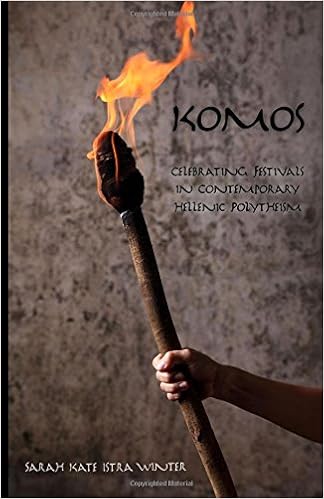
Komos: Celebrating Festivals in Contemporary Hellenic Polytheism, by Sarah Kate Istra Winter.
Festivals were one of the most important aspects of ancient Greek religion, and yet celebrating them – whether adaptations of historical rites or entirely new ones – can be difficult for contemporary Hellenic polytheists. We struggle to maintain an authentic connection to tradition while creating relevant practices which reflect our own relationships to the gods and spirits, as well as to the lands where we live now. Many of us are doing this alone or with only a few other people, unable to achieve the lavish processions, competitions or revels of times past. And yet our desire to honor the gods, explore themes such as purification, fertility and renewal, and mark the sacred progression of the year, remains as strong as ever.
Komos first explains the nature of ancient Greek festivals and the reasons they were observed, before moving forward to offer ways in which the same ideas and motivations can be expressed through modern celebrations. Special attention is given to crafting a localized and individualized practice that both fulfills religious obligations and results in personal enjoyment and spiritual connection. The lunar calendar is explained, along with other approaches to timing and selecting dates. All the significant elements of Hellenic festivals are discussed in detail with suggestions for how each can be included today. To educate and inspire the reader in the process of creating a complete festival calendar, many ancient examples are referenced, along with a few compatible modern folk festivals, and accounts of some of the author’s own experiences. Finally, advice is given for navigating issues such as budgetary restrictions, multi-tradition households, and what to do when things go wrong.
If you have been wanting to add festivals to your spiritual practice but weren’t sure where to begin, or if you just need some ideas to supplement your existing celebrations, this book can help. May you find within these pages the spark that lights your torches for many festivals to come.
So, Komos is a book that gives us some information, ideas and guidance in how to celebrate Hellenic festivals in the current day, or how to modify existing festivals to make them more Hellenic.
I am quickly become a fan of Sarah Kate Istra Winter. This is only the second book of hers I have read, but I really enjoyed it. Just like Kharis, this book is written in an approachable manner – it is talking to you, not at you. I really like how Winter writes.
The book itself is relatively small, but it is full of content – unlike Kharis this one is not one quarter appendices. It is all book, with a few pages at the end dedicated to “Troubleshooting” which was handy but may have benefited from more content.
Komos looks at both the ancient festivals of Athens and modern adaptations. It gives ideas on how to adapt old festivals to today – including your own area. It gives ideas on creating new festivals, or adapting modern festivals and holidays and making them Hellenic, dedicating them to the Gods. It also looks at the idea of creating your own calendar for the year – lunar year as the Greeks did, or Gregorian year, or even the more Pagan/Wiccan year that revolves around the seasons.
While Winter says, repeatedly, that you need to adapt things to your local area and personal practice – she can’t, of course, tell you the exact ways in which to do so. She doesn’t know where you live, and even if she did – she can’t aim the book at all of us in different areas. Her ideas are more tips and pointers on how we can go about figuring it out for ourselves – and that is as it should be. But she does give examples of her own personal festivals, an overall look at what she does for each one, how it’s set up, what it’s about and how it’s been adapted and why. You might think this isn’t relevant if you don’t live in an area like hers, but it is helpful because it shows ways someone has actually made the adaptations.
As pointed out in the book, the Greeks had different festivals for their own regions. Depending on where they lived, their festivals would be different. Some festivals existed only for specific villages/towns/cities because of some crisis that happened, the Gods fixed and the festival became an annual method of thanksgiving – totally not something we here and now need to even attempt doing, because it has nothing to do with us. But it does show, adapting our festivals to our own regions and lives is normal in Hellenic practice. So as Hellenics, we do not have to worry about offending the Gods by personalising our practices – so long as the Gods are more important in our festivals and rituals, it doesn’t matter how different it may be from the ancient versions.
And that is why I love this book. Pagans have a tendency to try to recreate a past that just doesn’t work with today – sure, if it does work in your life, that’s great, but changing our lives to fit an ancient world is not really all that easy or desirable for a lot of us. Winter, through Komos, shows us and explains why it’s okay for us, Hellenics that is, to make whatever changes we deem necessary.
In my opinion, the very act of thinking deeply about how to honour the Gods in our region and our modern world, giving so much thought and energy into it – that in itself is an act of devotion.
Overall Assessment
It’s a good book, small, I wish it were bigger really, but I can understand why it’s not. It has a lot of helpful information and I honestly think it’s invaluable – even if you don’t use the ideas within, it does provide a good jumping off point for thinking about how and why you do festivals, or don’t do them.
I Recommend This Book
Hellenics – New and Experienced. Like Kharis, just because you have been at this for a while, doesn’t mean you can’t learn new things.
Pagans – In general. Whilst non-Hellenics won’t necessarily use the more Hellenic ideas in this book, it may provide them with their own ideas for their own unique festivals or how to adapt their religion to their region and lives.
Curious – Those who are curious about or interested in modern or ancient Hellenism. This gives great information that may be of interest to the curious.
Eclectics – Those who work with at least one Hellenic deity on a more than rare basis may benefit from learning how that deity may like to be honoured in festivals. You don’t have to have a festival for that deity, necessarily, but you may like to learn how to incorporate more specific Hellenic elements into an existing festival to honour that deity.
I haven’t been able to find this for sale in ebook format, but the paperback price is not too high.
Amazon
Book Depository (the free shipping as always makes this the better option for us Aussies)
Previous Post

April 27, 2016
Of Mice and Gods
Next Post

April 30, 2016 Pagan Blogosphere Roundup - April 2016
Browse Our Archives
Select a Category Australia Calendar, Events and Festivals General Hellenism Hellenismoz How To Lore and Myth Multimedia Pagan Blogosphere Pagan Community Pagan Parenting and Homeschooling Paganism 101 Personal Practice Religious Philosophy Resources and Material Ritual Uncategorized Witchcraft 101
Select a Month January 2018 December 2017 November 2017 October 2017 August 2017 July 2017 June 2017 May 2017 April 2017 March 2017 February 2017 January 2017 December 2016 November 2016 October 2016 September 2016 August 2016 July 2016 June 2016 May 2016 April 2016 July 2012 June 2012 May 2012 April 2012 March 2012 February 2012 January 2012 December 2011
Follow Us!
TAKE THE
Religious Wisdom Quiz
Who was the priest that escaped Saul's massacre and joined David?
Select your answer to see how you score.
Abiathar Ahimelech Zadok Phinehas
Related posts from Hearth Witch Down Under
2018 Pagan Wallpapers and Printables

Book Review - Circle for Hekate: History and...
Hekates Deipnon - Day 30 of My Sacred...
Hades Ritual - Day 29 of My Sacred...
TRENDING AT PATHEOS Pagan

I was recently chatting with someone on Instagram. She asked me what...

While there are many people who share their results, the end of...

On July 23, I saw Christopher Nolan's The Odyssey which is Homer’s...

As I write this two big events have just finished up. One...

Restoring the Watershed of Divine Love
Perhaps cooperation is not something we manufacture through legislation, ideology, or moral...

Many UUs don’t pray because of bad experiences in a previous religion,...
view all Pagan blogs
Ad-Free & Subscriber Log-In Subscription Support
- About Us
- 2026 Calendar
- Videos
- Podcasts
- Library of World Religions
- Faith In Media Tracker
- Advertise With Us
- Write for Us
- Privacy Policy
- Terms of Service
- Do Not Sell My Data
- Contact Us
- Radiant Digital
- Manage Newsletter Subscriptions
- Unsubscribe From Notifications
- Sitemap
Copyright 2008-2026, Patheos. All rights reserved.
Subscription Support Ad-Free & Subscriber Log-In
Follow Patheos