
BuddhistCatholicContemplativeEvangelicalGeneral ChristianHinduJewishLatter-day SaintMuslimNew VisionsProgressive Christian
Beliefs
- Buddhist
- Catholic
- Contemplative
- Evangelical
- General Christian
- Hindu
- Jewish
- Latter-day Saint
- More Voices
- Muslim
- New Visions
- Pagan
- Progressive Christian
Topics
- Religion News
- Food and Religion
- Sports and Religion
- Religious Art
- Religious Music and Entertainment
- Religious Events
- History and Religion
- Style and Religion
- Politics and Religion
- Women in Religion
- Recreation Outdoors and Religion
- Business Finance and Religion
- Careers Workplace and Religion
- Education and Religion
- Family Parenting and Religion
- Health Fitness and Religion
- Home and Religion
- Relationships and Religion
- Technology and Religion
- Travel and Religion
Columnists
- Buddhist Columnists
- Business Finance and Religion Columnists
- Careers Workplace and Religion Columnists
- Catholic Columnists
- Contemplative Columnists
- Education and Religion Columnists
- Evangelists Columnists
- Family Parenting and Religion Columnists
- General Christian Columnists
- Health Fitness and Religion Columnists
- Hindu Columnists
- History and Religion Columnists
- Home and Religion Columnists
- Jewish Columnists
- More Voices Columnists
- Latter Day Columnists
- Muslim Columnists
- New Visions Columnists
- Nonreligious Columnists
- Pagan Columnists
- Politics and Religion Columnists
- Progressive Columnists
- Recreation Outdoors and Religion Columnists
- Relationships and Religion Columnists
- Religion News Columnists
- Religious Art Columnists
- Religious Events Columnists
- Religious Music and Entertainment Columnists
- Sports and Religion Columnists
- Style and Religion Columnists
- Technology and Religion Columnists
- Travel and Religion Columnists
- Women in Religion Columnists
Resource Library
- 2026 Calendar
- Library of World Religions
- The 100 Most Holy Places on Earth
- Patheos Answers
- Podcasts
- Videos
- Faith Leaders Database
- Anglican Episcopalian
- Bahai
- Baptist
- Buddhism
- Christianity
- Confucianism
- Eastern Orthodoxy
- Hinduism
- Holiness and Pentecostal
- ISKCON
- Islam
- Judaism
- Lutheran
- Methodist
- The Church of Jesus Christ of Latter-day Saints
- New Age
- Paganism
- Presbytarian and Reformed
- Protestantism
- Religion Behind the Scenes
- Roman Catholic
- Scientology
- Shia Islam
- Sikhism
- Sufism
- Sunni Islam
- Taoism
- Zen
- See all religions
Research Tools
 Ad-Free & Subscriber Log-In Subscription Support
Ad-Free & Subscriber Log-In Subscription Support
Follow Patheos 

- Trending:
- Forgiveness
- |
- Marriage
- |
- Consciousness
- |
- Death Penalty
- |
- Election
- |
- Halloween
 Happy Catholic Bookshelf
- Home
- Catholic
- Review: A Canticle for Leibowitz by Walter M. Miller, Jr.
Review: A Canticle for Leibowitz by Walter M. Miller, Jr.
Last updated on: January 22, 2019 at 2:54 pm by Joseph Reninger
Review: A Canticle for Leibowitz by Walter M. Miller, Jr. 2019-01-22T14:54:58-06:00 Joseph Reninger
Patheos Explore the world's faith through different perspectives on religion and spirituality! Patheos has the views of the prevalent religions and spiritualities of the world.
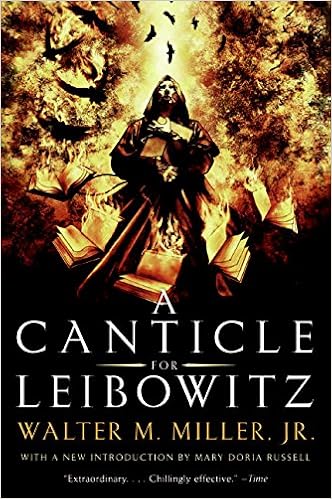 A Canticle for Leibowitz by Walter M. Miller, Jr.

In this post-nuclear-war future (centuries from now), education is something despised. Along with wiping out the government officials (all of whom were blamed for the war), the mobs killed as many intelligent people as they could (who were blamed for giving the government officials the power to wage such destructive war). In the aftermath, a small community of monks strives to preserve learning. One monk is on a Lenten retreat in the wilderness and discovers a fallout shelter with an incredible amount of information in it, some of it seemingly written by the hand of the scientist Leibowitz, one of the intelligent people martyred for being smart. The community is the Albertian Order of Leibowitz, named after that man. The rediscovery of his writings is a bit like the rediscovery of Aristotle in the Middle Ages.
The intellectual revival does not happen for a long time afterward. Once civilization is built up enough, a scholar named Thon Taddeo comes to the monastery to determine the authenticity of the documents. Taddeo is secular and a bit above the religious ideas of the monks but he comes to an uneasy understanding as he discovers the monks’ practical applications that dovetail nicely with his theoretical research. The intellectual renaissance ensues, bringing a new age where nuclear weapons are again available to government officials. Can mankind avoid a historical rerun?
The book is an odd blend of authentic Catholicism (including a generous amount of Latin), historical echoes (besides the Aristotle-like bit, there’s a sort of Protestant Revolt), and pessimistic predictions. For a while the book seems unfocused and rambling. The ending sort of pulls things together though its blend of optimism and pessimism falls too far on the pessimism side for me to find it enjoyable. A lot of interesting ideas pop up along the way, but not enough to get a whole-hearted endorsement from me.
Previous Post

March 22, 2016
Review: English Catholic Heroines ed. by Joanna Bogle
Next Post
April 5, 2016 Review: Thomas More: A Portrait of Courage by Gerard B. Wegemer
Browse Our Archives
Select a Category Art Bible Study Bulletin Board Catholic Church Excerpt Faith-y Stuff Funny Stuff Good Deals Listening Now Patheos Book Club Personal Reading Challenge Podcast Alert Random Bookishness Resources Review Uncategorized Well Said What I'm Reading
Select a Month January 2017 December 2016 November 2016 October 2016 September 2016 August 2016 July 2016 June 2016 May 2016 April 2016 March 2016 January 2016 December 2015 October 2015 September 2015 August 2015 July 2015 June 2015 May 2015 April 2015 March 2015 February 2015 January 2015 December 2014 November 2014 October 2014 September 2014 August 2014 July 2014 June 2014 May 2014 April 2014 March 2014 February 2014 January 2014 December 2013 November 2013 October 2013 September 2013 August 2013 July 2013 June 2013 May 2013 April 2013 March 2013 February 2013 January 2013 December 2012 November 2012 October 2012 September 2012 August 2012 July 2012 June 2012 May 2012 April 2012 March 2012 February 2012 January 2012 December 2011
TAKE THE
Religious Wisdom Quiz
How was Haman punished for his plot?
Select your answer to see how you score.
He was turned into a pillar of salt He was hanged on the gallows he built He was exiled He was beheaded
Related posts from Happy Catholic Bookshelf

Night's Bright Darkness - Review

Book Review - Advent with Saint Teresa of...

Book Review: Two from Jimmy Akin

Hostile Witnesses - Book Review
TRENDING AT PATHEOS Catholic

Creation, Preservation, and Teleology in Catholic Theology
As I write this, it is very early Monday morning. Like millions...

The Parable Of The Sower And The Word...
One of Christ’s most famous parables is that of the sower who...

Rejecting Doom: Christian Hope And Human Action
Christianity is a religion of hope. We are to have hope and...

Why I Choose the Eucharist Over the Sermon
Choose the Eucharist, Not the Sermon What are we supposed to get...

5 Design Elements Found in Spiritually Rooted Homes
Putting Spirituality Into Home Decor Our homes are more than our living...

Credo: A Story of God Told with the...
About 10 years ago, I began to imagine a personal "Credo" that...
view all Catholic blogs
Ad-Free & Subscriber Log-In Subscription Support
- About Us
- 2026 Calendar
- Videos
- Podcasts
- Library of World Religions
- Faith In Media Tracker
- Advertise With Us
- Write for Us
- Privacy Policy
- Terms of Service
- Do Not Sell My Data
- Contact Us
- Radiant Digital
- Manage Newsletter Subscriptions
- Unsubscribe From Notifications
- Sitemap
Copyright 2008-2026, Patheos. All rights reserved.
Subscription Support Ad-Free & Subscriber Log-In
Follow Patheos