
BuddhistCatholicContemplativeEvangelicalGeneral ChristianHinduJewishLatter-day SaintMuslimNew VisionsProgressive Christian
Beliefs
- Buddhist
- Catholic
- Contemplative
- Evangelical
- General Christian
- Hindu
- Jewish
- Latter-day Saint
- More Voices
- Muslim
- New Visions
- Pagan
- Progressive Christian
Topics
- Religion News
- Food and Religion
- Sports and Religion
- Religious Art
- Religious Music and Entertainment
- Religious Events
- History and Religion
- Style and Religion
- Politics and Religion
- Women in Religion
- Recreation Outdoors and Religion
- Business Finance and Religion
- Careers Workplace and Religion
- Education and Religion
- Family Parenting and Religion
- Health Fitness and Religion
- Home and Religion
- Relationships and Religion
- Technology and Religion
- Travel and Religion
Columnists
- Buddhist Columnists
- Business Finance and Religion Columnists
- Careers Workplace and Religion Columnists
- Catholic Columnists
- Contemplative Columnists
- Education and Religion Columnists
- Evangelists Columnists
- Family Parenting and Religion Columnists
- General Christian Columnists
- Health Fitness and Religion Columnists
- Hindu Columnists
- History and Religion Columnists
- Home and Religion Columnists
- Jewish Columnists
- More Voices Columnists
- Latter Day Columnists
- Muslim Columnists
- New Visions Columnists
- Nonreligious Columnists
- Pagan Columnists
- Politics and Religion Columnists
- Progressive Columnists
- Recreation Outdoors and Religion Columnists
- Relationships and Religion Columnists
- Religion News Columnists
- Religious Art Columnists
- Religious Events Columnists
- Religious Music and Entertainment Columnists
- Sports and Religion Columnists
- Style and Religion Columnists
- Technology and Religion Columnists
- Travel and Religion Columnists
- Women in Religion Columnists
Resource Library
- 2026 Calendar
- Library of World Religions
- The 100 Most Holy Places on Earth
- Patheos Answers
- Podcasts
- Videos
- Faith Leaders Database
- Anglican Episcopalian
- Bahai
- Baptist
- Buddhism
- Christianity
- Confucianism
- Eastern Orthodoxy
- Hinduism
- Holiness and Pentecostal
- ISKCON
- Islam
- Judaism
- Lutheran
- Methodist
- The Church of Jesus Christ of Latter-day Saints
- New Age
- Paganism
- Presbytarian and Reformed
- Protestantism
- Religion Behind the Scenes
- Roman Catholic
- Scientology
- Shia Islam
- Sikhism
- Sufism
- Sunni Islam
- Taoism
- Zen
- See all religions
Research Tools
 Ad-Free & Subscriber Log-In Subscription Support
Ad-Free & Subscriber Log-In Subscription Support
Follow Patheos 

- Trending:
- Forgiveness
- |
- Marriage
- |
- Consciousness
- |
- Death Penalty
- |
- Election
- |
- Halloween
 Happy Catholic Bookshelf
- Home
- Catholic
- Saint Peter: Flawed, Forgiven and Faithful by Stephen J. Binz
Saint Peter: Flawed, Forgiven and Faithful by Stephen J. Binz
Last updated on: August 19, 2015 at 1:51 pm by Julie Davis
Saint Peter: Flawed, Forgiven and Faithful by Stephen J. Binz 2015-08-19T13:51:00-05:00 Julie Davis
Patheos Explore the world's faith through different perspectives on religion and spirituality! Patheos has the views of the prevalent religions and spiritualities of the world.
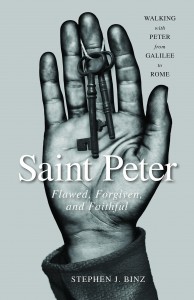
One of this book’s subtitles is “Walking with Peter from Galilee to Rome.”
It’s the perfect description of this book. When I’ve read about Peter in scripture I usually tend to relate it to myself. Am I acting like Peter or not? What lessons could I learn from his life? I’ve never stopped to ask myself what Peter himself experienced every step of the way with Jesus. Or to wonder what he learned as he went on “alone” after the Ascension.
Stephen J. Binz turns the spotlight on Peter so that we remember he was a real person, in unimaginable circumstances, traveling and learning from the Son of God, and then carrying on the ministry after Jesus’s ascension. I’ll certainly never think of Peter the same way now that Stephan Binz’s book made him and his journey come alive.
Like Capernaum, Bethsaida was a fishing village, and possibly a center for drying and salting fish to export. But unlike Capernaum, Bethsaida was a town in which Jews lived together with Gentiles.
This interesting detail of Peter’s background means that he would have associated freely with Greek-speaking Gentiles throughout his early life. It should also be noted that fishing was a profitable business in first-century Galilee, especially for those who owned boats and could hire help. These details indicate that Peter was not necessarily the poor, illiterate Jewish fisherman he is often made out to be. It is more likely that Peter was a middle-class entrepreneur. He certainly spoke Aramaic, probably read Hebrew, and quite possiblty also spoke and read Greek, the language of trade and commerce at the time.
Binz has us step back from the familiar interpretations of the scripture we often know so well that we have forgotten to think about it. He gives us new ways to understand what it meant to the people who wrote it, read it, and, most importantly, lived it. For example, speaking of Peter witnessing Jesus’ transfiguration, Binz points out:
Peter, who was unable to conceive of Jesus’ suffering and being put to death, is enlightened and uplifted through this vision of Jesus’ transfigured glory. Yet Peter has to learn that the moment of glory was not given to him for its own sake; it is to help him seek the presence and the will of God in all things. The vision on the mountain will helps him realize that his own walking the way of the cross can be filled with radiance. …
Weaving together pilgrimage experiences, spiritual reflections, and indepth knowledge of the Bible, Binz made me feel that I really have a personal knowledge, a connection, with Peter the man. He skillfully links this material with what Peter means for Catholics as the first pope and first leader of the Church.
I also especially enjoyed the way Binz would feature actual Holy Land descriptions in his explanations. It made me “feel” the place where these events took place and sometimes that too was important in understanding Peter and his journey.
I’ve been a long time fan of Stephen Binz’s books about lectio divina and bible study, but this one is different. It is far and away my favorite. “Take up and read,” as a mysterious voice told St. Augustine. This is a book that will enrich your life.
Previous Post

August 12, 2015
Dickens and the Sandwich
Next Post
August 28, 2015 The City by Dean Koontz
Browse Our Archives
Select a Category Art Bible Study Bulletin Board Catholic Church Excerpt Faith-y Stuff Funny Stuff Good Deals Listening Now Patheos Book Club Personal Reading Challenge Podcast Alert Random Bookishness Resources Review Uncategorized Well Said What I'm Reading
Select a Month January 2017 December 2016 November 2016 October 2016 September 2016 August 2016 July 2016 June 2016 May 2016 April 2016 March 2016 January 2016 December 2015 October 2015 September 2015 August 2015 July 2015 June 2015 May 2015 April 2015 March 2015 February 2015 January 2015 December 2014 November 2014 October 2014 September 2014 August 2014 July 2014 June 2014 May 2014 April 2014 March 2014 February 2014 January 2014 December 2013 November 2013 October 2013 September 2013 August 2013 July 2013 June 2013 May 2013 April 2013 March 2013 February 2013 January 2013 December 2012 November 2012 October 2012 September 2012 August 2012 July 2012 June 2012 May 2012 April 2012 March 2012 February 2012 January 2012 December 2011
TAKE THE
Religious Wisdom Quiz
What did Jesus turn water into at a wedding?
Select your answer to see how you score.
Milk Wine Bread Fish
Related posts from Happy Catholic Bookshelf


Night's Bright Darkness - Review

Book Review - Advent with Saint Teresa of...

Book Review: Two from Jimmy Akin
TRENDING AT PATHEOS Catholic

Rejecting Doom: Christian Hope And Human Action
Christianity is a religion of hope. We are to have hope and...

It’s What Comes From Within Which Matters
One of the most difficult things for us to understand is why...

Why I Choose the Eucharist Over the Sermon
Choose the Eucharist, Not the Sermon What are we supposed to get...

5 Design Elements Found in Spiritually Rooted Homes
Putting Spirituality Into Home Decor Our homes are more than our living...

Credo: A Story of God Told with the...
About 10 years ago, I began to imagine a personal "Credo" that...

The Anatomy of Divine Revelation in Catholic Thought
The claim that God has made Himself known to human beings is...
view all Catholic blogs
Ad-Free & Subscriber Log-In Subscription Support
- About Us
- 2026 Calendar
- Videos
- Podcasts
- Library of World Religions
- Faith In Media Tracker
- Advertise With Us
- Write for Us
- Privacy Policy
- Terms of Service
- Do Not Sell My Data
- Contact Us
- Radiant Digital
- Manage Newsletter Subscriptions
- Unsubscribe From Notifications
- Sitemap
Copyright 2008-2026, Patheos. All rights reserved.
Subscription Support Ad-Free & Subscriber Log-In
Follow Patheos