
BuddhistCatholicContemplativeEvangelicalGeneral ChristianHinduJewishLatter-day SaintMuslimNew VisionsProgressive Christian
Beliefs
- Buddhist
- Catholic
- Contemplative
- Evangelical
- General Christian
- Hindu
- Jewish
- Latter-day Saint
- More Voices
- Muslim
- New Visions
- Pagan
- Progressive Christian
Topics
- Religion News
- Food and Religion
- Sports and Religion
- Religious Art
- Religious Music and Entertainment
- Religious Events
- History and Religion
- Style and Religion
- Politics and Religion
- Women in Religion
- Recreation Outdoors and Religion
- Business Finance and Religion
- Careers Workplace and Religion
- Education and Religion
- Family Parenting and Religion
- Health Fitness and Religion
- Home and Religion
- Relationships and Religion
- Technology and Religion
- Travel and Religion
Columnists
- Buddhist Columnists
- Business Finance and Religion Columnists
- Careers Workplace and Religion Columnists
- Catholic Columnists
- Contemplative Columnists
- Education and Religion Columnists
- Evangelists Columnists
- Family Parenting and Religion Columnists
- General Christian Columnists
- Health Fitness and Religion Columnists
- Hindu Columnists
- History and Religion Columnists
- Home and Religion Columnists
- Jewish Columnists
- More Voices Columnists
- Latter Day Columnists
- Muslim Columnists
- New Visions Columnists
- Nonreligious Columnists
- Pagan Columnists
- Politics and Religion Columnists
- Progressive Columnists
- Recreation Outdoors and Religion Columnists
- Relationships and Religion Columnists
- Religion News Columnists
- Religious Art Columnists
- Religious Events Columnists
- Religious Music and Entertainment Columnists
- Sports and Religion Columnists
- Style and Religion Columnists
- Technology and Religion Columnists
- Travel and Religion Columnists
- Women in Religion Columnists
Resource Library
- 2026 Calendar
- Library of World Religions
- The 100 Most Holy Places on Earth
- Patheos Answers
- Podcasts
- Videos
- Faith Leaders Database
- Anglican Episcopalian
- Bahai
- Baptist
- Buddhism
- Christianity
- Confucianism
- Eastern Orthodoxy
- Hinduism
- Holiness and Pentecostal
- ISKCON
- Islam
- Judaism
- Lutheran
- Methodist
- The Church of Jesus Christ of Latter-day Saints
- New Age
- Paganism
- Presbytarian and Reformed
- Protestantism
- Religion Behind the Scenes
- Roman Catholic
- Scientology
- Shia Islam
- Sikhism
- Sufism
- Sunni Islam
- Taoism
- Zen
- See all religions
Research Tools
 Ad-Free & Subscriber Log-In Subscription Support
Ad-Free & Subscriber Log-In Subscription Support
Follow Patheos 

- Trending:
- Forgiveness
- |
- Marriage
- |
- Consciousness
- |
- Death Penalty
- |
- Election
- |
- Halloween
 Happy Catholic Bookshelf
- Home
- Catholic
- Book Review: St. Francis of Assisi by G. K. Chesterton
Book Review: St. Francis of Assisi by G. K. Chesterton
Last updated on: May 21, 2015 at 10:15 am by Joseph Reninger
Book Review: St. Francis of Assisi by G. K. Chesterton 2015-05-19T10:20:32-05:00 Joseph Reninger
Patheos Explore the world's faith through different perspectives on religion and spirituality! Patheos has the views of the prevalent religions and spiritualities of the world.
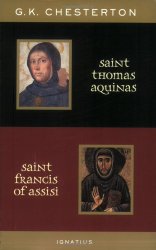 Chesterton takes on a challenging task in writing a biography of Saint Francis of Assisi. Francis was beloved in his own life time, so even the earliest sources are bound to exaggerate (if not make up) stories. Or at least skeptics can assume so. And Francis’s life was well over five hundred years ago leaving plenty of time for legends and misconceptions to grow. How can a modern, interested person get a true understanding of the man with so many obstacles in the way?
Chesterton flies over such hurdles by several methods. His first and least obvious solution is to eschew the typical biography’s strictly historical retelling of someone’s life, where they start with his birth on such and such a date at a certain place and recite all the famous historical and personal events up to his burial on such and such a date at a certain place. Instead, Chesterton focuses on a few key events in Francis’s life and meditates on how those events reveal Francis. In an early event, he was working for his father as a cloth merchant, negotiating with a purchaser while a beggar was also asking Francis for alms. Trying to please two supplicants at the same time was impossible for Francis though he clearly wanted to. When he was finished with the merchant, he turned to help the beggar who had left. Francis left his market stall (with presumably a lot of valuable stock unattended) to hunt down the beggar in the narrow byways of Assisi and give him the money he had just made. Chesterton points out that Francis always treated everyone equally, as a brother, whether they were from a high or low station. He didn’t play favorites, he was a true egalitarian. The incident also shows his unconcern for material things. Many other incidents are handled with the same depth and reflection.
Chesterton also avoids the ambiguities and misconceptions about Francis’s life by looking at the world as it was when Francis lived. Many modern people cherish Francis as the harbinger of the Renaissance–a man in love with nature and unconcerned with personal possessions. He’s considered a Flower Child and a proto-communist. Chesterton argues that Francis came immediately after the time known as the “Dark Ages” but those times were only “dark” in the sense of Europe being besieged by the paganism of Rome and the perpetual barbarian invasions. Paganism had finally been overthrown by Francis’s time; the barbarians had settled down to become locals and Christians. Monks no longer had to live in cloisters where they kept learning alive. Francis’s friars could live “on the road” as it were, relying entirely on the generosity of others for food and shelter. His call appealed to many in his day but clearly it couldn’t be heeded by all or society would collapse. His love of nature sprang from a simplicity of life that accepts the world with wonder. He’s fascinated by the God-given glory of animals, not just by the animals themselves. His context gives him a different view from what we might casually think today.
Chesterton writes for the modern reader who is uninformed yet curious about this romantic and fantastic character. Chesterton sets aside the skeptic’s doubt (if the reader denies the supernatural is even possible, Francis will forever remain inexplicable) and assumes the inquirer’s wonder (the reader is open to explanations beyond his or her own personal experience). Chesterton himself was in such a position before his conversion to Christianity and thus is possibly the best author to tackle St. Francis’s biography in this way. He gives a sense of Francis’s life and the sanctity he had on a level few of us experience. Francis was a true lover of God and men and lived out that love with a sense of humor and self-denial that will always fascinate the casual observer and may transform those who strive to look more closely.
This book is an unusual, fascinating, and well worth your while.
I was inspired to read this by that great podcast, A Good Story Is Hard to Find, and somehow have managed to read it before the episode posted! I may treat myself to ice cream.
Previous Post

May 11, 2015
The Lord by Romano Guardini
Browse Our Archives
Select a Category Art Bible Study Bulletin Board Catholic Church Excerpt Faith-y Stuff Funny Stuff Good Deals Listening Now Patheos Book Club Personal Reading Challenge Podcast Alert Random Bookishness Resources Review Uncategorized Well Said What I'm Reading
Select a Month January 2017 December 2016 November 2016 October 2016 September 2016 August 2016 July 2016 June 2016 May 2016 April 2016 March 2016 January 2016 December 2015 October 2015 September 2015 August 2015 July 2015 June 2015 May 2015 April 2015 March 2015 February 2015 January 2015 December 2014 November 2014 October 2014 September 2014 August 2014 July 2014 June 2014 May 2014 April 2014 March 2014 February 2014 January 2014 December 2013 November 2013 October 2013 September 2013 August 2013 July 2013 June 2013 May 2013 April 2013 March 2013 February 2013 January 2013 December 2012 November 2012 October 2012 September 2012 August 2012 July 2012 June 2012 May 2012 April 2012 March 2012 February 2012 January 2012 December 2011
TAKE THE
Religious Wisdom Quiz
Which Christian movement began with John Wesley in the 18th century?
Select your answer to see how you score.
Presbyterianism Lutheranism Methodism Calvinism
Related posts from Happy Catholic Bookshelf

Night's Bright Darkness - Review

Book Review - Advent with Saint Teresa of...

Book Review: Two from Jimmy Akin

Hostile Witnesses - Book Review
TRENDING AT PATHEOS Catholic

Creation, Preservation, and Teleology in Catholic Theology
As I write this, it is very early Monday morning. Like millions...

The Parable Of The Sower And The Word...
One of Christ’s most famous parables is that of the sower who...

Rejecting Doom: Christian Hope And Human Action
Christianity is a religion of hope. We are to have hope and...

Why I Choose the Eucharist Over the Sermon
Choose the Eucharist, Not the Sermon What are we supposed to get...

5 Design Elements Found in Spiritually Rooted Homes
Putting Spirituality Into Home Decor Our homes are more than our living...

Credo: A Story of God Told with the...
About 10 years ago, I began to imagine a personal "Credo" that...
view all Catholic blogs
Ad-Free & Subscriber Log-In Subscription Support
- About Us
- 2026 Calendar
- Videos
- Podcasts
- Library of World Religions
- Faith In Media Tracker
- Advertise With Us
- Write for Us
- Privacy Policy
- Terms of Service
- Do Not Sell My Data
- Contact Us
- Radiant Digital
- Manage Newsletter Subscriptions
- Unsubscribe From Notifications
- Sitemap
Copyright 2008-2026, Patheos. All rights reserved.
Subscription Support Ad-Free & Subscriber Log-In
Follow Patheos