
BuddhistCatholicContemplativeEvangelicalGeneral ChristianHinduJewishLatter-day SaintMuslimNew VisionsProgressive Christian
Beliefs
- Buddhist
- Catholic
- Contemplative
- Evangelical
- General Christian
- Hindu
- Jewish
- Latter-day Saint
- More Voices
- Muslim
- New Visions
- Pagan
- Progressive Christian
Topics
- Religion News
- Food and Religion
- Sports and Religion
- Religious Art
- Religious Music and Entertainment
- Religious Events
- History and Religion
- Style and Religion
- Politics and Religion
- Women in Religion
- Recreation Outdoors and Religion
- Business Finance and Religion
- Careers Workplace and Religion
- Education and Religion
- Family Parenting and Religion
- Health Fitness and Religion
- Home and Religion
- Relationships and Religion
- Technology and Religion
- Travel and Religion
Columnists
- Buddhist Columnists
- Business Finance and Religion Columnists
- Careers Workplace and Religion Columnists
- Catholic Columnists
- Contemplative Columnists
- Education and Religion Columnists
- Evangelists Columnists
- Family Parenting and Religion Columnists
- General Christian Columnists
- Health Fitness and Religion Columnists
- Hindu Columnists
- History and Religion Columnists
- Home and Religion Columnists
- Jewish Columnists
- More Voices Columnists
- Latter Day Columnists
- Muslim Columnists
- New Visions Columnists
- Nonreligious Columnists
- Pagan Columnists
- Politics and Religion Columnists
- Progressive Columnists
- Recreation Outdoors and Religion Columnists
- Relationships and Religion Columnists
- Religion News Columnists
- Religious Art Columnists
- Religious Events Columnists
- Religious Music and Entertainment Columnists
- Sports and Religion Columnists
- Style and Religion Columnists
- Technology and Religion Columnists
- Travel and Religion Columnists
- Women in Religion Columnists
Resource Library
- 2026 Calendar
- Library of World Religions
- The 100 Most Holy Places on Earth
- Patheos Answers
- Podcasts
- Videos
- Faith Leaders Database
- Anglican Episcopalian
- Bahai
- Baptist
- Buddhism
- Christianity
- Confucianism
- Eastern Orthodoxy
- Hinduism
- Holiness and Pentecostal
- ISKCON
- Islam
- Judaism
- Lutheran
- Methodist
- The Church of Jesus Christ of Latter-day Saints
- New Age
- Paganism
- Presbytarian and Reformed
- Protestantism
- Religion Behind the Scenes
- Roman Catholic
- Scientology
- Shia Islam
- Sikhism
- Sufism
- Sunni Islam
- Taoism
- Zen
- See all religions
Research Tools
 Ad-Free & Subscriber Log-In Subscription Support
Ad-Free & Subscriber Log-In Subscription Support
Follow Patheos 

- Trending:
- Forgiveness
- |
- Marriage
- |
- Consciousness
- |
- Death Penalty
- |
- Election
- |
- Halloween
 Happy Catholic Bookshelf
- Home
- Catholic
- More or Less
More or Less
Last updated on: May 13, 2013 at 1:00 pm by Sarah Reinhard
More or Less 2013-05-13T05:31:46-05:00 Sarah Reinhard
Patheos Explore the world's faith through different perspectives on religion and spirituality! Patheos has the views of the prevalent religions and spiritualities of the world.
It was the Saturday before Easter, as I recall. I had rolled out of bed to work on my honors project, and I was putting the coffee into the coffeemaker when it struck me that it was VERY STRANGE that someone was having a cookout at 8 (or was it 7? or 9?) in the morning.
I opened my apartment door to a wall of smoke.
What happened next is a blur in my memory, but it seemed to happen in slow motion, even as my non-athletic self set some serious records for speed.
I called 9-1-1. And then I went to my bedroom, grabbed my bookbag with my new text books, honors project paperwork, and wallet, put on my shoes, and walked to the window. Nope. Second story and no way I was breaking a limb. No one else was awake in our neighborhood (and I wouldn’t have been either, had it not been for that dratted honors project).
I took a deep breath, said goodbye to all of my belongings (and those of my roommates’), and left, not knowing what was coming next.
It turns out one of my sorority sisters was home and I ended up bunking with her for almost a week. We got off easy: only smoke damage, and I still have a few books that bear the marks of that apartment building fire.
I threw away a LOT of stuff after that adventure. And I learned a lesson I’ve never forgotten: it’s just STUFF.
When my roommates came back, there were tears and discussions of how much it HURT to lose stuff. Me, I was grateful to be alive at a time in my life when I didn’t really believe in anything except my own intellect and the superiority of science. I knew that the stuff didn’t matter. I was alive. (And it hurt, when I look back, that my one roommate in particular could not seem to see that I was alive and her stuff was just stuff.)
Not so long ago (in the last five years), I was inspired by a few wise women’s blogging efforts (Elizabeth Foss among them). They were talking about simplifying and de-cluttering. They were talking about how much your stuff can weigh you down. They were sharing ideas for how much is enough and ways to make do with less and less and less.
I have a lot of stuff, despite my efforts not to. And I let myself off the hook, because I know my kids don’t have as many toys as the Joneses and our house isn’t anything fancy next to the Watkinses and we don’t spend money like the Finches. Even so, the idea of not having more than you need has been something I’ve been trying to live for quite some time.
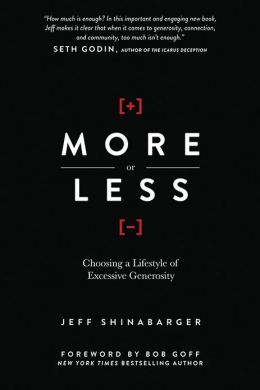
So the idea behind More or Less: Choosing a Life of Excessive Generosity, by Jeff Shinabarger, appealed to me.
That is, until I started reading it.
Last week, in my weekly reading update, I wrote, “This book is another life-changer and game-changer for me. (I’m not exactly thrilled about that, because I wasn’t necessarily LOOKING to have things go all changey-changey on me!)”
Yeah. That times ten.
I was struck, first, by the challenge that we have enough food. I think I’ll be attacking my cupboards soon. And my freezer. But meal-planning did cure me of a lot of that, to be honest.
And the clothes thing is something that I’ve been on top of. I need to do some more weeding through, true enough, but not something that made me do more than think more deeply about my other excess.
And then, then, there was the chapter on time.
There was a time, not so long ago, when the polite answer to the question “How are you?” was, “Fine.” It seems that busy is the new fine. We look at one another with that shake of the head, sideways smirk, and glossy eyes, proclaiming our busyness. This shared response succinctly identifies a recent cultural shift: we now determine the significance of a person by how busy they are. Somehow, busy has become better than fine. It seems especially highlighted since the economic downturn. Busy shows that we still have a job and things to do, which is a positive answer amidst the endlessly looping, negative news cycle.
The problem is this: busy is not better than fine. Just because I’m busy does not mean I’m fine. And when it comes right down to it, often busy means that I’m not fine at all. What we’re really saying with one simple word is, “I can’t keep up with everything in my life. I actually can’t keep up with any of the things in my life. But that makes me important, doesn’t it?”
Oh. Wow. But there’s more…
Often the first ball we drop is our relationships. Being “busy” quickly becomes a barrier or excuse in the way of true community. I am busy, and many of my friends know that I am busy. When the only answer I ever give them in response to the question “How are you?” is, “Busy,” this communicates that I don’t have time for them. When I constantly say, “I’m busy,” I communicate to others that “I don’t need you right now.” Most of our friends pick up this subtle message and stay away.
What we often realize too late is that our “busy” answer is actually a choice not to engage in our community. We choose to do other stuff over hanging out with our friends. If I continue to tell myself the lie that busy is good, I slowly enter into more of an isolated and a self-centered existence.
And here’s the kicker:
…if we are too busy to engage in relationships, we face a larger problem. When I respond and tell you I am too busy, too often I actually need your help. Often in those times when we most need a deep relationship, instead of pursuing that relationship, we embrace our task list and avoid the comfort and support that true friendship can offer. And the result of being extra busy, ironically, is loneliness and depression.
Time is worth more than money to so many people I know, and yes, even to me. I’ve been working hard over the last five years especially to hone in my “here’s what can be done” approach to my life. And yet…and yet I feel like I fail.
Why does there have to be so much to do?
Part of it’s having kids, part of it’s having a lot of small project work, part of it’s that I have to be at a certain level of busy to function well.
But what Shinabarger is outlining in this chapter so well is a different approach to time, one that I’ve been flirting with and haven’t yet been able to articulate. In fact, just a few paragraphs later, he talks about something that has been on my heart since the smartphone explosion all around me (nope, I’m NOT getting one) and since my kids have gotten older: presence.
Presence is not fast, big, or cheap. You cannot replace presence with someone or something else. Presence is an essential element that we all need and desire in our deepest relationships. It’s unspoken. It’s true. It’s the greatest encouragement anyone can ever receive or give. Presence is a physical expression of love in the midst of a culture that never stops—it is to stop and be with someone that matters.
He goes on to define and outline some time indicators and that may help you, as they helped me, to further consider how my time spent reflects on what my priorities truly are.
There are 14 chapters in More or Less, covering virtually everything in your life, from your kitchen pantry to your closet to your time, from your transportation to your presents to your access. I didn’t find it a fast read, though it’s a VERY good read. I found I could only manage so much before my brain sort of stopped. I needed to noodle a bit before I could read more.
It’s practical and applicable and it doesn’t just leave you with a good idea. Shinaberger outlines a general plan of action after he shares how he or others approached what he calls Enough Experiments. In fact, he went so far as to build a pretty rockin website that has links to the videos mentioned in the book, a discussion guide, and a worksheet to help you with your closet.
What makes this an incredible book isn’t just that it’s tightly written, that it has a thread of story running through the whole thing, that Jeff sounds like the kind of guy you would probably like. What makes this a remarkable read is the challenge it leaves in your heart, the way it forces you to acknowledge your role in the world at large, whether you choose to engage or not. It reminds me, in fact, of how I felt and continue to feel after reading Refuse to Do Nothing.
Read this book. And then share it with someone close to you.
Previous Post

May 10, 2013
3 Great New Catholic Books for Kids
Next Post

May 14, 2013 The Church Building as a Sacred Place by Duncan G. Stroik
Browse Our Archives
Select a Category Art Bible Study Bulletin Board Catholic Church Excerpt Faith-y Stuff Funny Stuff Good Deals Listening Now Patheos Book Club Personal Reading Challenge Podcast Alert Random Bookishness Resources Review Uncategorized Well Said What I'm Reading
Select a Month January 2017 December 2016 November 2016 October 2016 September 2016 August 2016 July 2016 June 2016 May 2016 April 2016 March 2016 January 2016 December 2015 October 2015 September 2015 August 2015 July 2015 June 2015 May 2015 April 2015 March 2015 February 2015 January 2015 December 2014 November 2014 October 2014 September 2014 August 2014 July 2014 June 2014 May 2014 April 2014 March 2014 February 2014 January 2014 December 2013 November 2013 October 2013 September 2013 August 2013 July 2013 June 2013 May 2013 April 2013 March 2013 February 2013 January 2013 December 2012 November 2012 October 2012 September 2012 August 2012 July 2012 June 2012 May 2012 April 2012 March 2012 February 2012 January 2012 December 2011
TAKE THE
Religious Wisdom Quiz
Who were Esther's adversaries in the Persian court?
Select your answer to see how you score.
Sanherib and Nabonidus Haman and his family Sanballat and Tobiah Geshem and Tobiah
Related posts from Happy Catholic Bookshelf

Night's Bright Darkness - Review

Book Review - Advent with Saint Teresa of...

Book Review: Two from Jimmy Akin

Hostile Witnesses - Book Review
TRENDING AT PATHEOS Catholic

The Parable Of The Sower And The Word...
One of Christ’s most famous parables is that of the sower who...

Rejecting Doom: Christian Hope And Human Action
Christianity is a religion of hope. We are to have hope and...

Why I Choose the Eucharist Over the Sermon
Choose the Eucharist, Not the Sermon What are we supposed to get...

5 Design Elements Found in Spiritually Rooted Homes
Putting Spirituality Into Home Decor Our homes are more than our living...

Credo: A Story of God Told with the...
About 10 years ago, I began to imagine a personal "Credo" that...

The Anatomy of Divine Revelation in Catholic Thought
The claim that God has made Himself known to human beings is...
view all Catholic blogs
Ad-Free & Subscriber Log-In Subscription Support
- About Us
- 2026 Calendar
- Videos
- Podcasts
- Library of World Religions
- Faith In Media Tracker
- Advertise With Us
- Write for Us
- Privacy Policy
- Terms of Service
- Do Not Sell My Data
- Contact Us
- Radiant Digital
- Manage Newsletter Subscriptions
- Unsubscribe From Notifications
- Sitemap
Copyright 2008-2026, Patheos. All rights reserved.
Subscription Support Ad-Free & Subscriber Log-In
Follow Patheos