
BuddhistCatholicContemplativeEvangelicalGeneral ChristianHinduJewishLatter-day SaintMuslimNew VisionsProgressive Christian
Beliefs
- Buddhist
- Catholic
- Contemplative
- Evangelical
- General Christian
- Hindu
- Jewish
- Latter-day Saint
- More Voices
- Muslim
- New Visions
- Pagan
- Progressive Christian
Topics
- Religion News
- Food and Religion
- Sports and Religion
- Religious Art
- Religious Music and Entertainment
- Religious Events
- History and Religion
- Style and Religion
- Politics and Religion
- Women in Religion
- Recreation Outdoors and Religion
- Business Finance and Religion
- Careers Workplace and Religion
- Education and Religion
- Family Parenting and Religion
- Health Fitness and Religion
- Home and Religion
- Relationships and Religion
- Technology and Religion
- Travel and Religion
Columnists
- Buddhist Columnists
- Business Finance and Religion Columnists
- Careers Workplace and Religion Columnists
- Catholic Columnists
- Contemplative Columnists
- Education and Religion Columnists
- Evangelists Columnists
- Family Parenting and Religion Columnists
- General Christian Columnists
- Health Fitness and Religion Columnists
- Hindu Columnists
- History and Religion Columnists
- Home and Religion Columnists
- Jewish Columnists
- More Voices Columnists
- Latter Day Columnists
- Muslim Columnists
- New Visions Columnists
- Nonreligious Columnists
- Pagan Columnists
- Politics and Religion Columnists
- Progressive Columnists
- Recreation Outdoors and Religion Columnists
- Relationships and Religion Columnists
- Religion News Columnists
- Religious Art Columnists
- Religious Events Columnists
- Religious Music and Entertainment Columnists
- Sports and Religion Columnists
- Style and Religion Columnists
- Technology and Religion Columnists
- Travel and Religion Columnists
- Women in Religion Columnists
Resource Library
- 2026 Calendar
- Library of World Religions
- The 100 Most Holy Places on Earth
- Patheos Answers
- Podcasts
- Videos
- Faith Leaders Database
- Anglican Episcopalian
- Bahai
- Baptist
- Buddhism
- Christianity
- Confucianism
- Eastern Orthodoxy
- Hinduism
- Holiness and Pentecostal
- ISKCON
- Islam
- Judaism
- Lutheran
- Methodist
- The Church of Jesus Christ of Latter-day Saints
- New Age
- Paganism
- Presbytarian and Reformed
- Protestantism
- Religion Behind the Scenes
- Roman Catholic
- Scientology
- Shia Islam
- Sikhism
- Sufism
- Sunni Islam
- Taoism
- Zen
- See all religions
Research Tools
 Ad-Free & Subscriber Log-In Subscription Support
Ad-Free & Subscriber Log-In Subscription Support
Follow Patheos 

- Trending:
- Forgiveness
- |
- Marriage
- |
- Consciousness
- |
- Death Penalty
- |
- Election
- |
- Halloween
 Happy Catholic Bookshelf
- Home
- Catholic
- What Jesus Really Said about the End of the World
What Jesus Really Said about the End of the World
Last updated on: December 21, 2012 at 11:44 am by Jeff Miller
What Jesus Really Said about the End of the World 2012-12-21T11:44:49-06:00 Jeff Miller
Patheos Explore the world's faith through different perspectives on religion and spirituality! Patheos has the views of the prevalent religions and spiritualities of the world.
It is rather understandable when nonbelievers and skeptics look at the New Testament and come to an understanding that follows from a framework of doubt and skepticism. It is quite another for believers to take the exact same approach and to undermine reasons for faith. There is certainly a role to play for Christians as St. Paul said to “Test all things” and as St. Peter said to “Always be prepared to offer a reason for the hope that is within you.” Yet we get things like Jesus didn’t know he was God, that the miracle of the feeding of the multitude was one of sharing, and that Jesus and the Apostles expected the end if the world within their generation.
What flows from such misunderstandings is that doubt is cast onto Jesus and his Church as a result. Author David Currie had heard a Catholic college women saying that since Jesus was wrong about the time of the second advent that Jesus and thus the Church was wrong about other things such as abortion and contraception. The only good thing about such a serious misunderstanding is that it one of the impetus that caused David Currie to write a book on the subject.
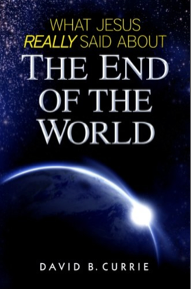
It is one of those wonderful ironies of life that I finished David Currie’s new book What Jesus Really Said about the End of the World
This book illustrates how both the skeptics such as Bertrand Russell and the believers such C.S. Lewis could come to believe that Jesus and the Apostles were wrong about this specific subject. I have heard this idea multiple times myself and certain scriptural passages in isolation can appear to bear this out. I had already come to understand the idea that scripture can have multiple fulfillments such as in the book of Revelation where some events were relating to the persecution of that time and to the final eschaton. Multiple fulfillments really are quite common in scripture and I had thought that this same understanding would also apply to what Jesus and the Apostles said in this regard.
This book certainly has this understanding, but it really goes into detail to show how this is true and to break out when Jesus was talking about the destruction of the Temple in Jerusalem and when we was talking about his second coming. I was enthralled from the beginning and David Currie brought out components of scripture that really put these ideas into perspective and focus.
A large part of the book deals with the Gospel of Matthew and the olivet discourse where much of what we know on this topic is found. One of the errors we often make is to bring our ideas of learning and teaching and assume that the same had always been true. This error leads us to miss things that would have been apparent to a culture with primarily an oral teaching tradition that relied on a practiced memory since written forms of communication were both time consuming and expensive. I was fascinated to learn of things like bracketing were used where a subject would be bracketed by the same phrase to draw attention to what was in between and to set it apart. The whole structure of the olivet discourse and the somewhat parallels readings in Luke are rather amazing and once you understand this structure it provides the key to when Jesus was talking about the destruction of the Temple or the end of the world.
I would go into more technical details of this structure, but really I could only provide a poor summary and I would really encourage you to read it in this book. What you do find though is that Jesus answered the Apostles regarding these two questions and the two answers can be totally separated out leaving no doubt as to which scriptural replies matched up to what event. There were also other keys provided as to understand that there are really multiple comings of Christ which this book lays out. In fact the case is so destructive to the skeptics and the points made make it difficult to see how people could be confused about Jesus saying his second advent would be delayed.
While this book takes almost totally a scriptural approach there are references to the understanding of the Early Church Fathers which match and provide emphasis on how the ideas presented in this book are not new ones. So much of what the Church already knew gets lost over the years as people come up with ideas divorced from the past. I remember Scott Hahn once talking about coming up with a thrilling interpretation only to find it taught by the Church all along.
I thought David Currie did a masterful presentation on the subject and it will forever change the way I look at these passages now with greater insight. I highly recommend this book to a general audience as it is not just some dry scholarly tome. Scholarly certainly, but well worthwhile reading. The final summary also brings these ideas down to a personal level and how we are to relate to them.
<Insert mandatory REM reference to ” I read What Jesus Really Said about the End of the World and I feel fine”>
Previous Post

December 20, 2012
Magnificat Year of Faith Companion - review
Next Post
December 27, 2012 Julie's Favorite Books of 2012
Browse Our Archives
Select a Category Art Bible Study Bulletin Board Catholic Church Excerpt Faith-y Stuff Funny Stuff Good Deals Listening Now Patheos Book Club Personal Reading Challenge Podcast Alert Random Bookishness Resources Review Uncategorized Well Said What I'm Reading
Select a Month January 2017 December 2016 November 2016 October 2016 September 2016 August 2016 July 2016 June 2016 May 2016 April 2016 March 2016 January 2016 December 2015 October 2015 September 2015 August 2015 July 2015 June 2015 May 2015 April 2015 March 2015 February 2015 January 2015 December 2014 November 2014 October 2014 September 2014 August 2014 July 2014 June 2014 May 2014 April 2014 March 2014 February 2014 January 2014 December 2013 November 2013 October 2013 September 2013 August 2013 July 2013 June 2013 May 2013 April 2013 March 2013 February 2013 January 2013 December 2012 November 2012 October 2012 September 2012 August 2012 July 2012 June 2012 May 2012 April 2012 March 2012 February 2012 January 2012 December 2011
TAKE THE
Religious Wisdom Quiz
Who was the Roman emperor during Jesus’ birth?
Select your answer to see how you score.
Herod Tiberius Nero Caesar Augustus
Related posts from Happy Catholic Bookshelf

Night's Bright Darkness - Review

Book Review - Advent with Saint Teresa of...

Book Review: Two from Jimmy Akin

Hostile Witnesses - Book Review
TRENDING AT PATHEOS Catholic

Creation, Preservation, and Teleology in Catholic Theology
As I write this, it is very early Monday morning. Like millions...

The Parable Of The Sower And The Word...
One of Christ’s most famous parables is that of the sower who...

Rejecting Doom: Christian Hope And Human Action
Christianity is a religion of hope. We are to have hope and...

Why I Choose the Eucharist Over the Sermon
Choose the Eucharist, Not the Sermon What are we supposed to get...

5 Design Elements Found in Spiritually Rooted Homes
Putting Spirituality Into Home Decor Our homes are more than our living...

Credo: A Story of God Told with the...
About 10 years ago, I began to imagine a personal "Credo" that...
view all Catholic blogs
Ad-Free & Subscriber Log-In Subscription Support
- About Us
- 2026 Calendar
- Videos
- Podcasts
- Library of World Religions
- Faith In Media Tracker
- Advertise With Us
- Write for Us
- Privacy Policy
- Terms of Service
- Do Not Sell My Data
- Contact Us
- Radiant Digital
- Manage Newsletter Subscriptions
- Unsubscribe From Notifications
- Sitemap
Copyright 2008-2026, Patheos. All rights reserved.
Subscription Support Ad-Free & Subscriber Log-In
Follow Patheos