
BuddhistCatholicContemplativeEvangelicalGeneral ChristianHinduJewishLatter-day SaintMuslimNew VisionsProgressive Christian
Beliefs
- Buddhist
- Catholic
- Contemplative
- Evangelical
- General Christian
- Hindu
- Jewish
- Latter-day Saint
- More Voices
- Muslim
- New Visions
- Pagan
- Progressive Christian
Topics
- Religion News
- Food and Religion
- Sports and Religion
- Religious Art
- Religious Music and Entertainment
- Religious Events
- History and Religion
- Style and Religion
- Politics and Religion
- Women in Religion
- Recreation Outdoors and Religion
- Business Finance and Religion
- Careers Workplace and Religion
- Education and Religion
- Family Parenting and Religion
- Health Fitness and Religion
- Home and Religion
- Relationships and Religion
- Technology and Religion
- Travel and Religion
Columnists
- Buddhist Columnists
- Business Finance and Religion Columnists
- Careers Workplace and Religion Columnists
- Catholic Columnists
- Contemplative Columnists
- Education and Religion Columnists
- Evangelists Columnists
- Family Parenting and Religion Columnists
- General Christian Columnists
- Health Fitness and Religion Columnists
- Hindu Columnists
- History and Religion Columnists
- Home and Religion Columnists
- Jewish Columnists
- More Voices Columnists
- Latter Day Columnists
- Muslim Columnists
- New Visions Columnists
- Nonreligious Columnists
- Pagan Columnists
- Politics and Religion Columnists
- Progressive Columnists
- Recreation Outdoors and Religion Columnists
- Relationships and Religion Columnists
- Religion News Columnists
- Religious Art Columnists
- Religious Events Columnists
- Religious Music and Entertainment Columnists
- Sports and Religion Columnists
- Style and Religion Columnists
- Technology and Religion Columnists
- Travel and Religion Columnists
- Women in Religion Columnists
Resource Library
- 2026 Calendar
- Library of World Religions
- The 100 Most Holy Places on Earth
- Patheos Answers
- Podcasts
- Videos
- Faith Leaders Database
- Anglican Episcopalian
- Bahai
- Baptist
- Buddhism
- Christianity
- Confucianism
- Eastern Orthodoxy
- Hinduism
- Holiness and Pentecostal
- ISKCON
- Islam
- Judaism
- Lutheran
- Methodist
- The Church of Jesus Christ of Latter-day Saints
- New Age
- Paganism
- Presbytarian and Reformed
- Protestantism
- Religion Behind the Scenes
- Roman Catholic
- Scientology
- Shia Islam
- Sikhism
- Sufism
- Sunni Islam
- Taoism
- Zen
- See all religions
Research Tools
 Ad-Free & Subscriber Log-In Subscription Support
Ad-Free & Subscriber Log-In Subscription Support
Follow Patheos 

- Trending:
- Forgiveness
- |
- Marriage
- |
- Consciousness
- |
- Death Penalty
- |
- Election
- |
- Halloween

- Home
- General Christian
- Women in Religion
- Explaining the Traditional Gifts of the Holy Spirit
Explaining the Traditional Gifts of the Holy Spirit
Last updated on: August 27, 2024 at 1:38 pm by Michele Gunn
Explaining the Traditional Gifts of the Holy Spirit 2024-08-27T13:38:08-05:00 Michele Gunn
Patheos Explore the world's faith through different perspectives on religion and spirituality! Patheos has the views of the prevalent religions and spiritualities of the world.
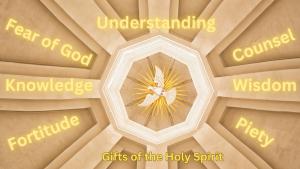
Created in Canva-Holy Spirit surrounded by His Gifts!
Last week I shared the Fruits of the Holy Spirit in my column entitled, “ Do You Desire the Fruits of the Holy Spirit.” I may have put the cart before the horse, so to speak! Afterall, the Fruits come from the Gifts of the Holy Spirit.
1 Corinthians 12:7-11 talks about these gifts (www.usccb.org):
“To each individual, the manifestation of the Spirit is given for some benefit.
To one is given through the Spirit the expression of wisdom; to another the expression of knowledge according to the same Spirit;
to another faith by the same Spirit; to another gifts of healing by the one Spirit;
to another mighty deeds; to another prophecy; to another discernment of spirits; to another varieties of tongues; to another interpretation of tongues.
But one and the same Spirit produces all of these, distributing them individually to each person as he wishes.”
These nine gifts are often simply referred to as Wisdom, Knowledge, Faith, Healing, Miracles, Prophecy, Discernment of Spirits, Tongues, and Interpretation of Tongues
Are There Seven or Nine Gifts of the Holy Spirit?
Most common texts list seven Gifts of the Holy Spirit: Wisdom, Understanding, Counsel, Knowledge, Fortitude, Piety, and Fear of the Lord. I have no theological or laity education that explains this. Although Isaiah 11:2 reads:
“The spirit of the LORD shall rest upon him:
a spirit of wisdom and of understanding,
A spirit of counsel and of strength,
a spirit of knowledge and of fear of the LORD,” (www.usccb.org)
From personal experience, many people shy away from the Gifts of Tongues and Interpretation of Tongues. Maybe the answer is that some are combined to make the list seven.
In researching seven versus nine, Catholic Answers provided an answer for me, well, all of us. The Catholic Church has taught the seven traditional Gifts (although nine are also clearly listed in the Bible) as the Gifts received by all Christians. They go on to state that as of early last century, some Protestant Christians have focused on the charismatic Gifts given to particular individuals for the good of the Church as mentioned in 1 Corinthians 12:7-11. I consider myself more of a Charismatic Catholic, embracing the Holy Spirit. We prayed for Gifts of the Holy Spirit during Prayer Group meetings. I do know that all of the Gifts require a lot of prayer, faith and discernment.
Today, I will focus on the seven Gifts of the Holy Spirit: Wisdom, Understanding, Counsel, Knowledge, Fortitude, Piety, and Fear of the Lord.
Wisdom (Gift of the Holy Spirit)
Wisdom as a Gift of the Holy Spirit is an understanding of what is true and right. It helps us to discern from what appears to be evil or wrong, but is actually truly good because the person or thing is a creation of God. We are then moved to pray for or provide help instead of judging and passing along disdain.
Understanding (Gift of the Holy Spirit)
Understanding as a Gift of the Holy Spirit allows us to see as God sees, providing understanding beyond mere humanity. It may help us understand our God-given talents and how to use them. Understanding offers insights on how the Holy Spirit is active in our everyday routines.
As stated in the April 30, 2014 general address of Pope Fracis in St. Peter’s Square:
“understanding allows us to “intus legere”, or “to read inwardly”: this gift enables us to understand things as God understands them, with the mind of God.”
Counsel (Gift of the Holy Spirit)
Counsel as a Gift of the Holy Spirit brings you closer to your conscience. The Gift of Counsel helps you to be directed by God in life’s decisions, many of which affect your salvation. It also helps you to decipher between right and wrong as well as good and evil.
Remember that it is important to stay in communication with God, utilizing the Holy Spirit and the Gifts provided. This will help you lead a holier life.
Knowledge (Gift of the Holy Spirit)
Knowledge as a Gift of the Holy Spirit is the ability to judge correctly the matters of faith and right action. Whereas Counsel is God guiding you, Knowledge is an innate Gift.
“Knowledge allows you to understand the meaning and purpose God has” for you. (www.stjmod.com)
Fortitude (Gift of the Holy Spirit)
Fortitude as a Gift of the Holy Spirit is similar to strength, but more than that, it is faith-based strength. It is the strength to conquer with good over evil. It is the strength to keep moving forward while overcoming obstacles in your path to righteousness.
This article from CatholicWomeninBusiness.com shares how our hearts are made for God. The author further explains that Fortitude provides us with an internal desire to do what is right.
Piety (Gift of the Holy Spirit)
Piety as a Gift of the Holy Spirit is simply revering God with filial affection. It involves worshipping, praying and honoring God. Piety is something we are called to do by our beliefs, convictions and our Baptism.
In the article from fromtheabbey.com, Piety is the Gift that moves us to love God as a child loves his or her father.
Fear of the Lord (Gift of the Holy Spirit)
Fear of the Lord as a Gift of the Holy Spirit is the need to stay connected. We avoid separating from God. This is not the same as being frightened of something. It is better defined as a loving reverence with an eager to please because we know it is right.
Which Gift of the Holy Spirit do You need Most?
As Christians, we should desire all of the Gifts of the Holy Spirit. You may already have one or all.
Come back next week as I share more about the Holy Spirit, Gifts and Fruits.
Catholic
Relationships and Religion
Previous Post

August 18, 2024
Do You Desire the Fruits of the Holy Spirit
Next Post

September 1, 2024 Have You Met the Holy Spirit?
Recent Comments
Browse Our Archives
Select a Category Uncategorized
Select a Month October 2026 September 2026 August 2026 July 2026 June 2026 May 2026 April 2026 March 2026 February 2026 January 2026 December 2025 November 2025 October 2025 September 2025 August 2025 July 2025 June 2025 May 2025 April 2025 March 2025 February 2025 January 2025 December 2024 November 2024 October 2024 September 2024 August 2024 July 2024 June 2024
Follow Us!
TAKE THE
Religious Wisdom Quiz
Which mountain did this Abraham's near-sacrifice event occur on?
Select your answer to see how you score.
Mount Ararat Mount Carmel Mount Sinai Mount Moriah
Related posts from Graceful Awakening

Personal Evangelization: Your Faith Story Matters

Do You Really Know Your Catholic Faith?

What Will You Do With What God Is...

Becoming Who God Created You to Be Through...
TRENDING AT PATHEOS General Christian

The Real AI Story Is Adoption Without Trust
Artificial intelligence has crossed a political threshold. It is no longer a...

A new article, written by Jeff Lindsay and Gale L. Pooley,...

Swimfan: Forgotten Aughts Pleasures
This is a recovery effort. In 2002, My Big Fat Greek Wedding...

Top Three Anti-Catholic Lies About Catholicism
This is my initial transcript for the video, "THE 3 WORST...

Pope Leo Celebrates Mass for Nurses & Docs...
I don't have any idea how he did it, but Pope Leo...

The Sermon on the Mount, Part I: Matthew...
The Sermon on the Mount, Part I (Matthew 4:12-5:12) St. Matthew moves...
view all General Christian blogs
What Are Your Thoughts?leave a comment
Ad-Free & Subscriber Log-In Subscription Support
- About Us
- 2026 Calendar
- Videos
- Podcasts
- Library of World Religions
- Faith In Media Tracker
- Advertise With Us
- Write for Us
- Privacy Policy
- Terms of Service
- Do Not Sell My Data
- Contact Us
- Radiant Digital
- Manage Newsletter Subscriptions
- Unsubscribe From Notifications
- Sitemap
Copyright 2008-2026, Patheos. All rights reserved.
Subscription Support Ad-Free & Subscriber Log-In
Follow Patheos