
BuddhistCatholicContemplativeEvangelicalGeneral ChristianHinduJewishLatter-day SaintMuslimNew VisionsProgressive Christian
Beliefs
- Buddhist
- Catholic
- Contemplative
- Evangelical
- General Christian
- Hindu
- Jewish
- Latter-day Saint
- More Voices
- Muslim
- New Visions
- Pagan
- Progressive Christian
Topics
- Religion News
- Food and Religion
- Sports and Religion
- Religious Art
- Religious Music and Entertainment
- Religious Events
- History and Religion
- Style and Religion
- Politics and Religion
- Women in Religion
- Recreation Outdoors and Religion
- Business Finance and Religion
- Careers Workplace and Religion
- Education and Religion
- Family Parenting and Religion
- Health Fitness and Religion
- Home and Religion
- Relationships and Religion
- Technology and Religion
- Travel and Religion
Columnists
- Buddhist Columnists
- Business Finance and Religion Columnists
- Careers Workplace and Religion Columnists
- Catholic Columnists
- Contemplative Columnists
- Education and Religion Columnists
- Evangelists Columnists
- Family Parenting and Religion Columnists
- General Christian Columnists
- Health Fitness and Religion Columnists
- Hindu Columnists
- History and Religion Columnists
- Home and Religion Columnists
- Jewish Columnists
- More Voices Columnists
- Latter Day Columnists
- Muslim Columnists
- New Visions Columnists
- Nonreligious Columnists
- Pagan Columnists
- Politics and Religion Columnists
- Progressive Columnists
- Recreation Outdoors and Religion Columnists
- Relationships and Religion Columnists
- Religion News Columnists
- Religious Art Columnists
- Religious Events Columnists
- Religious Music and Entertainment Columnists
- Sports and Religion Columnists
- Style and Religion Columnists
- Technology and Religion Columnists
- Travel and Religion Columnists
- Women in Religion Columnists
Resource Library
- 2026 Calendar
- Library of World Religions
- The 100 Most Holy Places on Earth
- Patheos Answers
- Podcasts
- Videos
- Faith Leaders Database
- Anglican Episcopalian
- Bahai
- Baptist
- Buddhism
- Christianity
- Confucianism
- Eastern Orthodoxy
- Hinduism
- Holiness and Pentecostal
- ISKCON
- Islam
- Judaism
- Lutheran
- Methodist
- The Church of Jesus Christ of Latter-day Saints
- New Age
- Paganism
- Presbytarian and Reformed
- Protestantism
- Religion Behind the Scenes
- Roman Catholic
- Scientology
- Shia Islam
- Sikhism
- Sufism
- Sunni Islam
- Taoism
- Zen
- See all religions
Research Tools
 Ad-Free & Subscriber Log-In Subscription Support
Ad-Free & Subscriber Log-In Subscription Support
Follow Patheos 

- Trending:
- Forgiveness
- |
- Marriage
- |
- Consciousness
- |
- Death Penalty
- |
- Election
- |
- Halloween

- Home
- Progressive Christian
- Politics and Religion
- Reflections on “O Come O Come Emmanuel”
Reflections on “O Come O Come Emmanuel”
Last updated on: December 13, 2021 at 7:50 am by Kathryn Shihadah
Reflections on “O Come O Come Emmanuel” 2021-12-13T07:50:46-05:00 Kathryn Shihadah
Patheos Explore the world's faith through different perspectives on religion and spirituality! Patheos has the views of the prevalent religions and spiritualities of the world.
After half a century of evangelical Christian Christmases, I’m still finding my way through the season as an exvangetical. As a former choir director, my heart holds a special, often-conflicted place for the songs of Advent and Christmas. The lyrics resonate deep in my soul, since I learned many of them as a very young child – but I find some a bit unsettling.
This Christmas season, I want to dig into a few well-known hymns to understand their traditional message, and perhaps find new meaning in their beloved texts.
First up is “O Come O Come Emmanuel.” The text comes from an eighth century poem.
If you want some background music for this post, here is a lovely vocal performance of today’s hymn; if like me, you prefer instrumental-only background, this is really nice.)
As an ally of the Palestinian people in their struggle, I’ve always been a little uncomfortable with this hymn’s insistence on identifying with Israel, but I keep reminding myself that it’s ancient Israel – which has nothing in common with modern Israel, except a name. (Someday I’d like to write new text for this hymn that reframe it just a bit.)
Here are the four verses that I’m familiar with (there are more, but these are the ones in my denomination’s hymnal):
O come, O come, Emmanuel,
And ransom captive Israel,
That mourns in lonely exile here,
Until the Son of God appear.
Rejoice! Rejoice! Emmanuel shall come to thee, O Israel.
In this verse, we are expressing the imagined cries of the Israelites as they wander in the wilderness. Here, they recognize that even though they have been freed from slavery in Egypt, they are still “captive” and in need of a savior. They mourn, but in hope that “Emmanuel (God with us) shall come” eventually.
As we move to verse 2, we find ourselves out of the wilderness, but now we strive to overcome temptation:
O come, Thou Rod of Jesse, free thine own from Satan’s tyranny;
From depths of hell Thy people save,
And give them victory o’er the grave.
Rejoice! Rejoice! Emmanuel shall come to thee, O Israel.
Here we identify with Israel’s struggle against “Satan’s tyranny,” and the apparent struggle to stay out of hell and eventually make our way to heaven.
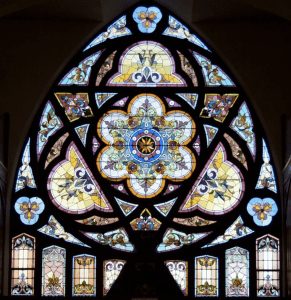
“Church Stained Glass” by DeaPeaJay is licensed under CC BY-SA 2.0
They’re interesting lines, especially since today, we tend to operate from a place of absolute certainty about heaven and hell (a topic that I’ve dealt with and will return to). There is no struggle for “us” – we’ve already arrived in the center of God’s will, simply by being “saved.” There is no hope for “them” – original sin means they’re doomed (unless they become one of “us”).
We’ve forgotten what Jesus said in Matthew 7:21-23 –
“Not everyone who says to me, ‘Lord, Lord,’ will enter the kingdom of heaven, but only the one who does the will of my Father who is in heaven. Many will say to me on that day, ‘Lord, Lord, did we not prophesy in your name and in your name drive out demons and in your name perform many miracles?’ Then I will tell them plainly, ‘I never knew you. Away from me, you evildoers!’
As I’ve said often, Jesus told us clearly what qualifies us to spend eternity in God’s presence (spoiler: it’s not praying the Sinner’s Prayer). We could stand to be more attentive to his teaching.
In verse 3, we no longer fear “Satan’s tyranny” or the “depths of hell” – but we battle against human despair:
O come, Thou Dayspring, from on high,
And cheer us by Thy drawing nigh;
Disperse the gloomy clouds of night,
And death’s dark shadows put to flight.
Rejoice! Rejoice! Emmanuel shall come to thee, O Israel.
(This verse is a reference to Luke 1:78-79, which is actually a prophecy by Zacharias, presumably about his son, John.)
Today, this verse might ring more true to us than the others, as many of us struggle with depression. We are reminded to look toward the horizon and eagerly await the sunrise (the meaning of “dayspring”). We can rejoice in anticipation – Emmanuel shall come. (We can also take our Zoloft.)
The next verse takes to the threshold of eternity:
O come, Thou Key of David, come
And open wide our heav’nly home;
Make safe the way that leads on high,
And close the path to misery.
Rejoice! Rejoice! Emmanuel shall come to thee, O Israel.
This is the final anticipation – the ultimate end of the misery of wandering, temptation, and despair, and the gates unlocked and flung wide to heaven.
In this image, Emmanuel is not coming to us. We’re going to Emmanuel. Not so much “God with us” as “us with God.”
Ultimately, “O Come O Come Emmanuel” is a song of assurance in the faithfulness of God. Even when I feel like I’m lost in a wilderness, or oppressed or depressed, even when God doesn’t seem to be here, he is near in our struggles. He shall come, and in that assurance, I can rejoice. I like that.
My exvangetical take.
(If you are energized by challenges to the evangelical status quo, you’d enjoy my blog. Sign up for my free newsletter here!)
(If you would like to comment, please pop over to my Facebook page. All of my posts are there and open to constructive comment! I welcome your thoughts. And don’t forget to subscribe to my newsletter!)
OTHER POSTS THAT YOU MIGHT LIKE:
Ramadan for Christians: then sings my soul, “subhanallah”
The significance of Baby Jesus as a person of color
White Savior Syndrome: a brief case study
We’ve made God in our image, and we’re answering our own prayers
FEATURED IMAGE: “Church Stained Glass” by DeaPeaJay is licensed under CC BY-SA 2.0
Previous Post

December 6, 2021
White Savior Syndrome: a brief case study
Next Post

December 13, 2021 Reflections on Let All Mortal Flesh Keep Silence
Browse Our Archives
Select a Category abortion becoming progressive christmas exvangelical Gaza family injustice interfaith islam Palestine and Israel parable politics Ramadan rohr sexual orientation ten commandments Uncategorized upside-down bible women
Select a Month October 2026 July 2026 May 2026 April 2026 September 2025 August 2025 May 2025 April 2025 March 2025 September 2024 August 2024 July 2024 June 2024 May 2024 March 2024 February 2024 January 2024 December 2023 November 2023 October 2023 September 2023 August 2023 July 2023 June 2023 May 2023 April 2023 March 2023 February 2023 January 2023 August 2022 July 2022 June 2022 May 2022 April 2022 March 2022 February 2022 January 2022 December 2021 November 2021 October 2021 September 2021 August 2021 July 2021 June 2021 May 2021 April 2021 March 2021 February 2021 January 2021 December 2020 November 2020 October 2020 September 2020 August 2020
Follow Us!
TAKE THE
Religious Wisdom Quiz
What Christian group is known for singing acapella during worship?
Select your answer to see how you score.
Methodists Catholics Churches of Christ Baptists
Related posts from Grace-Colored Glasses

The Biblical Case For Supporting Israel is Rock...

South Africa v. Israel, and power without competence

3 simple questions guaranteed to make your pro-birth...

I wanna know what love is – I...
TRENDING AT PATHEOS Progressive Christian

Letters on Living the Faith by C.S. Lewis
Most of us met C.S. Lewis as a public intellectual. Mere Christianity....

When Halloween Unmasks Married Hearts
Written by Dr. David K. Ewen from Eternal Truth Bible College Behind...

Aristotle. He’s been called the father of logic, the father of the...

Methodist Central Hall and Westminster Abbey
Situated on the same square is Methodist Central Hall and Westminster Abbey. ...

57th Dove Awards Honor Dolly Parton, Crown New...
On gospel music’s biggest night, the 57th annual GMA Dove Awards honored...

The First Eucharistic Controversy: Christ’s Real Presence
For Catholics, the Eucharist is the source and summit of the Christian...
view all Progressive Christian blogs
Ad-Free & Subscriber Log-In Subscription Support
- About Us
- 2026 Calendar
- Videos
- Podcasts
- Library of World Religions
- Faith In Media Tracker
- Advertise With Us
- Write for Us
- Privacy Policy
- Terms of Service
- Do Not Sell My Data
- Contact Us
- Radiant Digital
- Manage Newsletter Subscriptions
- Unsubscribe From Notifications
- Sitemap
Copyright 2008-2026, Patheos. All rights reserved.
Subscription Support Ad-Free & Subscriber Log-In
Follow Patheos