
BuddhistCatholicContemplativeEvangelicalGeneral ChristianHinduJewishLatter-day SaintMuslimNew VisionsProgressive Christian
Beliefs
- Buddhist
- Catholic
- Contemplative
- Evangelical
- General Christian
- Hindu
- Jewish
- Latter-day Saint
- More Voices
- Muslim
- New Visions
- Pagan
- Progressive Christian
Topics
- Religion News
- Food and Religion
- Sports and Religion
- Religious Art
- Religious Music and Entertainment
- Religious Events
- History and Religion
- Style and Religion
- Politics and Religion
- Women in Religion
- Recreation Outdoors and Religion
- Business Finance and Religion
- Careers Workplace and Religion
- Education and Religion
- Family Parenting and Religion
- Health Fitness and Religion
- Home and Religion
- Relationships and Religion
- Technology and Religion
- Travel and Religion
Columnists
- Buddhist Columnists
- Business Finance and Religion Columnists
- Careers Workplace and Religion Columnists
- Catholic Columnists
- Contemplative Columnists
- Education and Religion Columnists
- Evangelists Columnists
- Family Parenting and Religion Columnists
- General Christian Columnists
- Health Fitness and Religion Columnists
- Hindu Columnists
- History and Religion Columnists
- Home and Religion Columnists
- Jewish Columnists
- More Voices Columnists
- Latter Day Columnists
- Muslim Columnists
- New Visions Columnists
- Nonreligious Columnists
- Pagan Columnists
- Politics and Religion Columnists
- Progressive Columnists
- Recreation Outdoors and Religion Columnists
- Relationships and Religion Columnists
- Religion News Columnists
- Religious Art Columnists
- Religious Events Columnists
- Religious Music and Entertainment Columnists
- Sports and Religion Columnists
- Style and Religion Columnists
- Technology and Religion Columnists
- Travel and Religion Columnists
- Women in Religion Columnists
Resource Library
- 2026 Calendar
- Library of World Religions
- The 100 Most Holy Places on Earth
- Patheos Answers
- Podcasts
- Videos
- Faith Leaders Database
- Anglican Episcopalian
- Bahai
- Baptist
- Buddhism
- Christianity
- Confucianism
- Eastern Orthodoxy
- Hinduism
- Holiness and Pentecostal
- ISKCON
- Islam
- Judaism
- Lutheran
- Methodist
- The Church of Jesus Christ of Latter-day Saints
- New Age
- Paganism
- Presbytarian and Reformed
- Protestantism
- Religion Behind the Scenes
- Roman Catholic
- Scientology
- Shia Islam
- Sikhism
- Sufism
- Sunni Islam
- Taoism
- Zen
- See all religions
Research Tools
 Ad-Free & Subscriber Log-In Subscription Support
Ad-Free & Subscriber Log-In Subscription Support
Follow Patheos 

- Trending:
- Forgiveness
- |
- Marriage
- |
- Consciousness
- |
- Death Penalty
- |
- Election
- |
- Halloween

- Home
- Progressive Christian
- Politics and Religion
- Ramadan for Christians: a few words about Muslim prayer
Ramadan for Christians: a few words about Muslim prayer
Last updated on: April 14, 2021 at 8:59 pm by Kathryn Shihadah
Ramadan for Christians: a few words about Muslim prayer 2021-04-14T20:59:45-04:00 Kathryn Shihadah
Patheos Explore the world's faith through different perspectives on religion and spirituality! Patheos has the views of the prevalent religions and spiritualities of the world.
Prayer is an integral part of the Muslim lifestyle – as I mentioned yesterday, prayer (salat) is one of the five pillars of Islam, and for many, the practice of prayer takes on a special significance during Ramadan. So if we want to understand Islam a little better, it’s worth taking a minute to learn a little about it.
When I lived in Jeddah, Saudi Arabia, the whole rhythm of every day was built around the five prayer times. Fajr is the dawn prayer; dhuhr is midday; asr is afternoon, maghrib is evening, and isha is the night prayer. The call to prayer comes on loudspeakers from every mosque (and there’s one on practically every block) – here’s what it sounds like:
The sound fills the air, and every shop – from the smallest mom-and-pop bakery to the megamalls – closes down and shuts off its lights to encourage shoppers and employees to go and pray.
During Ramadan, the city grows very quiet just before the sunset prayer call. The streets, usually packed with rush hour traffic, are deserted (except for a few overachievers like my husband, who stayed too long at work and are rushing home). Just now, listening to this prayer call video, actually makes me very homesick.
After fasting for 12 or 14 or 16 hours, when at last it’s time to eat, the traditional way to break the fast is with a glass of water and a couple of dates – but before digging into the serious food, many Muslims will go and pray. Yes, as hungry as they are, they stop after a couple of bites and go spend time before God.
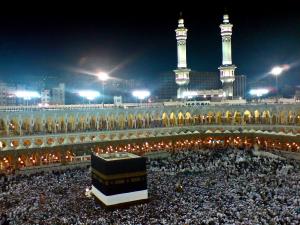
The words for the five prayers, and the positions or “prostrations,” are all predetermined, and replicate the way the prophet Mohammad used to pray. Every Muslim around the world faces in the direction of Mecca (about 50 miles from where we lived in Jeddah).
I’ve seen my husband pray countless times, watched prayers performed in Mecca via video cameras trained on the inside of the Grand Mosque. I’ve observed prayers in mosques in Jerusalem, Istanbul, Casablanca, and several places in the US – and I can say with certainty that it’s the same everywhere.
Fun story: my mother-in-law spent time with us when we lived in Saudi Arabia. She had back troubles, so when she prayed, she used to do modified prostrations. She remained seated on the floor with her legs crossed for the whole prayer, and bowed her head to touch the ground from this position. Once I remember there was a can of Pif-Paf (bug spray) just in front of where her head touched the floor – so it looked like she was praying to the can of Pif-Paf. I had to restrain myself from giggling.
 Apples and oranges
I used to think that Christian prayer was waaaaayyy better than Muslim prayer because “we” talk freely to God about whatever we want to, while “they” are under obligation to say the same things every day. I assumed that such repetition was bound to make the mind wander, and that many people probably just go through the motions.
I felt like Christian prayer was more evolved – even though Jesus gave us a standard prayer too, which I had recited for my whole life (with varying degrees of attentiveness):
“This, then, is how you should pray: ‘Our Father who art in heaven, hallowed be thy name…’ (Matt. 6:9)
More recently, I’ve come to understand that it’s really apples and oranges, and I’ve begun to appreciate the unique spirit of each type of prayer.
Muslims know that no matter what time of day it is, they are going to stand before God soon and say something like,
“O God, how perfect You are and praise be to You. Blessed is Your name, and exalted is Your majesty. There is no god but You. Guide us along the straight path.”
Checking in with the Creator of the universe five times every day might have a positive effect on one’s life, don’t you think?
Many Christians make a routine of Quiet Time in between our Sunday visits to the house of God, and/or we attend a midweek Bible study, and/or listen to worship music during the day. These practices help keep us mindful of God throughout the week. That’s our spiritual discipline. That’s our salat.
By the way, if you are concerned that Muslims have no freedom to speak their hearts to God, know this: at the end of the standard Muslim prayer, one is welcome to linger before God indefinitely to make du’a, or supplication – five times a day (and anytime at all in between).
The ideal of Christian prayer is wonderful: coming to God with adoration, confession, thanksgiving, and supplication (the famous A.C.T.S. format); talking to God with our whole heart and our full attention. But we all know that we don’t live up to this ideal.
Of course, Muslims’ minds wander too – probably at about the same rate as ours. I’m ashamed now for looking down on others because they prayed differently.
Each of us relates to God according to our upbringing, our experiences, and countless influences in our lives. I’m thankful for the diversity in how we worship and honor God.
Is there something you wonder about, about Ramadan, or Islam? I’m not an expert, but I’ve spent much of the last 35 years with at least one foot in the Muslim world, and my husband has spent his whole life a Muslim (Sunni mostly, but he has moved into progressive Islam in recent years). If you have a question, you’re welcome to send it to [email protected], and we may take a stab at answering it. We don’t have all the answers, or presume to speak for all Muslims, but we will do our best.
OTHER POSTS TO CHECK OUT:
Ramadan for Christians: fasting is jihad
Ramadan for Christians: the basics of Ramadan
We’ve made God in our image, and we’re answering our own prayers
Christianity and Covid: “freedom” shouldn’t be deadly
FEATURED IMAGE: “Mecca” by ♥ForUrEyeZOnly♥ is licensed under CC BY-NC-ND 2.0
Previous Post

April 13, 2021
Ramadan for Christians: fasting is jihad
Next Post
April 15, 2021 Ramadan for Christians: what do our holy books really say?
Browse Our Archives
Select a Category abortion becoming progressive christmas exvangelical Gaza family injustice interfaith islam Palestine and Israel parable politics Ramadan rohr sexual orientation ten commandments Uncategorized upside-down bible women
Select a Month October 2026 July 2026 May 2026 April 2026 September 2025 August 2025 May 2025 April 2025 March 2025 September 2024 August 2024 July 2024 June 2024 May 2024 March 2024 February 2024 January 2024 December 2023 November 2023 October 2023 September 2023 August 2023 July 2023 June 2023 May 2023 April 2023 March 2023 February 2023 January 2023 August 2022 July 2022 June 2022 May 2022 April 2022 March 2022 February 2022 January 2022 December 2021 November 2021 October 2021 September 2021 August 2021 July 2021 June 2021 May 2021 April 2021 March 2021 February 2021 January 2021 December 2020 November 2020 October 2020 September 2020 August 2020
Follow Us!
TAKE THE
Religious Wisdom Quiz
Who was David's oldest brother, critical of him at the battlefield?
Select your answer to see how you score.
Shammah Abinadab Eliab Jesse
Related posts from Grace-Colored Glasses
Tokenizing Christians in Israel
Persecution of Christians in the Holy Land is...
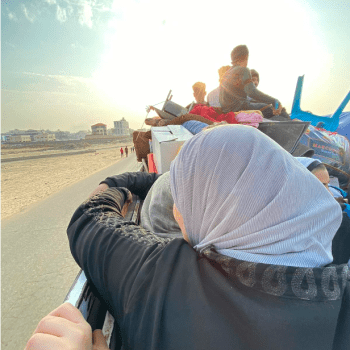
Follow this refugee family's quest for survival in...

Can followers of the Prince of Peace support...
TRENDING AT PATHEOS Progressive Christian

Emotion in Early Christianity by Andrew Crislip
Andrew Crislip’s Emotion in Early Christianity examines an often overlooked dimension of...

16 Spiritual Touchstones for a More Grounded Life
After decades of spiritual study, here are 16 principles I try...

Catholic Evangelization: Sharing Your Faith Every Day
Welcome back to the Graceful Awakening mini-series called, “From Faith to Mission.” ...

The Pillar of the Boatmen: the Ancient Monument...
The Pillar of the Boatmen is a Romano-Gaulish sculpture that dates from...

In one sense walking into Westminster Abbey is like walking down the...

'Super Scam Me' Exposes AI Jon Bon Jovi...
Leslie Pickett believed she was in a relationship with Jon Bon Jovi....
view all Progressive Christian blogs
Ad-Free & Subscriber Log-In Subscription Support
- About Us
- 2026 Calendar
- Videos
- Podcasts
- Library of World Religions
- Faith In Media Tracker
- Advertise With Us
- Write for Us
- Privacy Policy
- Terms of Service
- Do Not Sell My Data
- Contact Us
- Radiant Digital
- Manage Newsletter Subscriptions
- Unsubscribe From Notifications
- Sitemap
Copyright 2008-2026, Patheos. All rights reserved.
Subscription Support Ad-Free & Subscriber Log-In
Follow Patheos