
BuddhistCatholicContemplativeEvangelicalGeneral ChristianHinduJewishLatter-day SaintMuslimNew VisionsProgressive Christian
Beliefs
- Buddhist
- Catholic
- Contemplative
- Evangelical
- General Christian
- Hindu
- Jewish
- Latter-day Saint
- More Voices
- Muslim
- New Visions
- Pagan
- Progressive Christian
Topics
- Religion News
- Food and Religion
- Sports and Religion
- Religious Art
- Religious Music and Entertainment
- Religious Events
- History and Religion
- Style and Religion
- Politics and Religion
- Women in Religion
- Recreation Outdoors and Religion
- Business Finance and Religion
- Careers Workplace and Religion
- Education and Religion
- Family Parenting and Religion
- Health Fitness and Religion
- Home and Religion
- Relationships and Religion
- Technology and Religion
- Travel and Religion
Columnists
- Buddhist Columnists
- Business Finance and Religion Columnists
- Careers Workplace and Religion Columnists
- Catholic Columnists
- Contemplative Columnists
- Education and Religion Columnists
- Evangelists Columnists
- Family Parenting and Religion Columnists
- General Christian Columnists
- Health Fitness and Religion Columnists
- Hindu Columnists
- History and Religion Columnists
- Home and Religion Columnists
- Jewish Columnists
- More Voices Columnists
- Latter Day Columnists
- Muslim Columnists
- New Visions Columnists
- Nonreligious Columnists
- Pagan Columnists
- Politics and Religion Columnists
- Progressive Columnists
- Recreation Outdoors and Religion Columnists
- Relationships and Religion Columnists
- Religion News Columnists
- Religious Art Columnists
- Religious Events Columnists
- Religious Music and Entertainment Columnists
- Sports and Religion Columnists
- Style and Religion Columnists
- Technology and Religion Columnists
- Travel and Religion Columnists
- Women in Religion Columnists
Resource Library
- 2026 Calendar
- Library of World Religions
- The 100 Most Holy Places on Earth
- Patheos Answers
- Podcasts
- Videos
- Faith Leaders Database
- Anglican Episcopalian
- Bahai
- Baptist
- Buddhism
- Christianity
- Confucianism
- Eastern Orthodoxy
- Hinduism
- Holiness and Pentecostal
- ISKCON
- Islam
- Judaism
- Lutheran
- Methodist
- The Church of Jesus Christ of Latter-day Saints
- New Age
- Paganism
- Presbytarian and Reformed
- Protestantism
- Religion Behind the Scenes
- Roman Catholic
- Scientology
- Shia Islam
- Sikhism
- Sufism
- Sunni Islam
- Taoism
- Zen
- See all religions
Research Tools
 Ad-Free & Subscriber Log-In Subscription Support
Ad-Free & Subscriber Log-In Subscription Support
Follow Patheos 

- Trending:
- Forgiveness
- |
- Marriage
- |
- Consciousness
- |
- Death Penalty
- |
- Election
- |
- Halloween

-
Social Media
- Home
- Evangelical
- 100 Million Missing Women – The Aftermath of Acute Gender Imbalance (Part #3)
100 Million Missing Women – The Aftermath of Acute Gender Imbalance (Part #3)
Last updated on: August 12, 2022 at 10:26 pm by GFA Staff Writer
100 Million Missing Women – The Aftermath of Acute Gender Imbalance (Part #3) 2022-08-12T22:26:53+00:00 GFA Staff Writer
Patheos Explore the world's faith through different perspectives on religion and spirituality! Patheos has the views of the prevalent religions and spiritualities of the world.
WILLS POINT, TX – Gospel for Asia (GFA) Part#3 Special Report on the aftermath of acute gender imbalance: Discussing the horrendous reality of 100 million missing women worldwide.
A Little Girl’s Future Transformed
A beautiful story from Gospel for Asia’s archives tells about the day a cook at a Gospel for Asia (GFA)-supported Bridge of Hope center noticed an elderly woman begging on the street. The cook was distressed because the older woman had a little girl, filthy and dressed in rags, in tow.
Knowing that adult beggars will often use children as bait to receive monies, then pocket the funds and do nothing for the child, the cook challenged the older woman, “Why are you exploiting this child?”
To the cook’s surprise, the older woman broke into tears and wept.
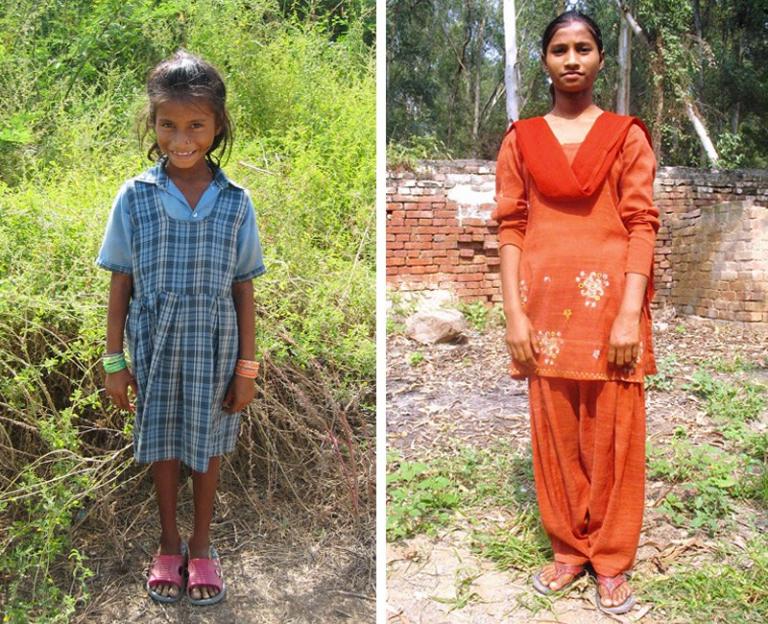
Daya, pictured at age 8 and age 15. Once among beggars in the street, she is now a thriving teen finding her place in this world and walking in her faith.
She wasn’t a professional beggar at all, but the grandmother of the little girl, Daya, who had been abandoned by both her mother and father. Without income and desperate, the grandmother had begun begging at bus stops, train stations and on the streets. With a change of heart, the cook invited the grandmother to enroll Daya in the Bridge of Hope center, which was in a building wedged between a railway station and a slum, conveniently available to children without a future.
The little girl was enrolled in the center but was so filthy that other parents complained. The Bridge of Hope staff conducted an intensive scrub session to relieve the child of dirt and germs and to replace the same filthy clothes she wore each day with clean clothes. They introduced her to soap and taught her to use it when she washed.
As the report states, “Daya’s future hung in the balance. If rejected from the Bridge of Hope center, she would return to the streets as one of the hundreds of thousands of child beggars in Asia. At some point, she would likely join the 20 to 30 million other boys and girls who are exploited as child laborers.”
The staff was determined to see that Daya thrived in Bridge of Hope, and she grew up to be an educated young woman. However, millions of other children never get that chance.
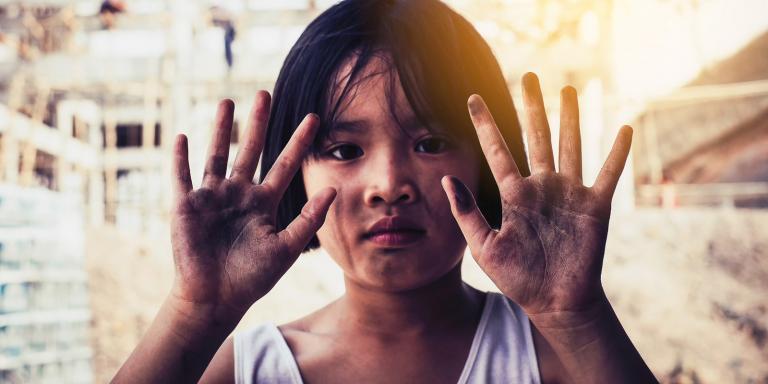
These are the hands of a child, covered in filth from doing construction work. Thousands of children, just like this one, can’t go to school because they are caught in bonded labor. Some 31 million girls of primary-school age are not in school. Seventeen million of these are expected to never enter school.
Child Exploitation
In a fact sheet on girls’ education, UNESCO (United Nations Educational, Scientific and Cultural Organization) explains:
- Some 31 million girls of primary-school age are not in school. Seventeen million of these are expected to never enter school.
- Some 34 million female adolescents are missing from secondary schools, which often offer vocational skills that are essential for procuring future jobs.
- Two-thirds of the 774 million illiterate people in the world are female.
Thousands of these children can’t go to school because they are caught in bonded labor.
“It is doubtful they’ve ever held a toothbrush or a bar of soap; they’ve probably never eaten an ice-cream cone or cradled a doll,” Gospel for Asia (GFA) states. “The child laborers of Asia toil in fireworks, carpet and match factories; quarries and coal mines; rice fields, tea plantations and pastures; and even brothels. Because they are exposed to dust, toxic fumes, pesticides and disease, their health is compromised, and their bodies can be crippled from carrying heavy weights.”
Worse still, these children could be entrapped in prostitution.
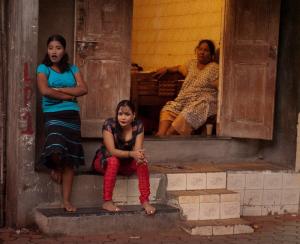
These young women are prostitutes in the red-light district; some most likely entrapped since childhood.
According to Reuters, “Of an estimated 20 million commercial prostitutes in India, 16 million women and girls are victims of sex trafficking, according to [data gatherers].”
Prostitution is not illegal in India so the chances of victimization are mind-blowing. In addition, many impoverished families sell their daughters to opportunists who promise a better life for their children.
ABC News reports, “Aid organizations estimate that 20 to 65 million Indians have already passed through the hands of human traffickers at one point in their lives. Ninety percent of them remain within India’s national borders, and the majority are female and under the age of 18.”
One social worker, Palavi, explained, “Human trafficking works because the victims are afraid and cannot communicate. … Many of them have children who live in constant danger of also being sold or sexually abused. They grow up under the beds where their mothers were robbed of their dignity.”
When census data is gathered, these women, mothers and little girls are not in their villages, local communities or urban settlements. They are hidden by sex slave traders (but made available to the men who seek them out).
Let me ask again the question Jesus asked Simon the Pharisee, “Do you see this woman (or child, or little girl or teenager)?”
I have a granddaughter named Eliana who is 10 years old. Four mornings a week, I pick up Eliana and her brother, Nehemiah (8), to drive them to school. Their younger sister, Anelise (5), is picked up by the preschool bus. My driving effort is to help out their mother, who was married to our son Jeremy Mains. Our son, her husband and the children’s father, died five years ago at age 42 of blastic mantle cell lymphoma.
Angela, my daughter-in-law, is raising the children by herself while holding a full-time job as the director of a local community-outreach organization. She has just completed her dissertation and received a doctorate in adult education. Nevertheless, even with remarkable mothers, studies show that children raised without fathers are vulnerable. So my husband and I live close, are on call when babysitters fall through and try to do a lot of one-on-ones with our grandchildren.
Though I watch these grandchildren grow with an attentive heart, I am certain my granddaughter Eliana will never worry about entering bonded labor or be forced to go begging on the streets. It is impossible for me, even for the sake of achieving a frightening empathy, to impose through my imagination the horror of the lives of some 20 to 65 million trafficked females on these precious little girls I love.
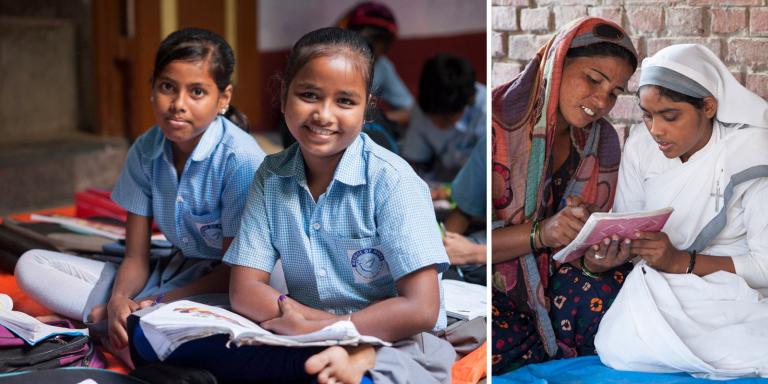
These Bridge of Hope students look happy during class time at GFA’s Bridge of Hope program. Education can protect a girl from exploitation—and redirect her future. This is a primary solution to begin changing the statistics of 100 million missing women.
Education as a Deterrent
Education can protect a girl from exploitation—and redirect her future. An educated girl can read. She can find work. She can get training to become a teacher, a doctor or a policewoman, for instance. She can tutor other children. A social system begins to change slowly, very slowly, one educated girl by one educated girl.
The latest statistics regarding GFA’s supported work with women in 2018 include:
290,753
women received free health care training
8,812
sewing machines distributed as a means to obtain work as a seamstress
61,880
illiterate women learned to read and write
11,000+
women desperate for jobs received vocational training
Educating girls is a primary solution to begin changing the statistics of 100 million missing women. The Global Partnership for Education maintains, “The power of girls’ education on national economic growth is undeniable: a one percentage point increase in female education raises the average gross domestic product (GDP) by 0.3 percentage points and raises annual GDP growth rates by 0.2 percentage points.”
The World Bank stresses that girls’ education goes beyond getting into school. It is also about ensuring they learn and feel safe in school. One research study in Haiti indicated, “One in three Haitian women (ages 15 to 49) has experienced physical and/or sexual violence, and that of women who received money for sex before turning 18 years old, 27 percent reported schools to be the most common location for solicitation.”
Through Bridge of Hope, Gospel for Asia (GFA) offers child sponsorships for the neediest impoverished children whose families are caught in the cycle of poverty and are unable to provide education for their offspring. The sponsorship amount is $35 per month per child. This educational ministry sees that some 70,000 children (both boys and girls) are given a daily meal, regular medical checkups and training in basic hygiene.
What Can We Do? How Can We Conquer the Horrific 100 Million Missing Women Statistic?
What can we—those of us who have hearts that beat with concern about the unbelievable evils of this world—do about the 100 million missing women worldwide who face discrimination and violence? How can anyone make a dent in a problem with such magnified proportionality? How can that horrific statistic—100 million missing women—be conquered, overcome, defeated, reduced or even eliminated?
Well, there are some things we can do, small as they seem, but mighty nevertheless in their possibility:
 We can sponsor girls (and boys) so they get educated through programs like GFA’s Bridge of Hope Program. And if $35 a month is too much for you (and it is for some compassionate people), invite your small group, Sunday School class, men’s softball league, neighborhood coffee-klatch or members of your extended family to pool funds.
 Think about this question: Why do more people not see this inequality and neglect, not grieve for the 100 million missing women and girls who have experienced such hardships and take action to be part of the solution? Then read the book of Luke and think about the societal shift that begins with women’s encounters with Jesus.
 Remind yourself of Christ’s question: “Do you see this woman?” Write it out on a card, and then use it as a bookmark in the books you read or paste it on your bathroom mirror. Write out a prayer, like the one I included in the beginning of this article, but adapt it to this horrific dilemma: Lord, what do You want me to do about the masses of women? And if you are not a praying person, send some discontented energy into the atmosphere any way you feel fit. Just don’t forget.
Let us conclude by going back to Jesus, except now He is not eating at the table of the VIPs. He is bloody, tortured, hanging from a cross and nearing death. The Gospel of John describes the inhumanity of the Roman soldiers and the crowds standing beneath the cross.
“Now there stood by the cross of Jesus His mother, and His mother’s sister, Mary the wife of Clopas, and Mary Magdalene. When Jesus therefore saw His mother, and the disciple whom He loved standing by, He said to His mother, ‘Woman, behold your son!’ Then He said to the disciple, ‘Behold your mother!’ And from that hour the disciple took her to his own home.”
Concern for the widow. Concern for the women.
“Look at this woman. Do you now see your mother?”
So, let us also be about this work in the world.
Oh, Lord, help us to care for every human with hearts that beat like Your heart beats for them. And help us, please help us, no matter our gender, to see the women.
Read the rest of Gospel for Asia’s Special Report on 100 Million Missing Women & the Aftermath of Acute Gender Imbalance here: Part 1 | Part 2
Learn more about Gospel for Asia’s programs to combat the 100 million missing women reality by helping women through Vocational Training, Sewing Machines and Literacy Training.
This Special Report article originally appeared on GFA.org
Read more on the 100 million missing women dilemma on gender imbalance and violence against women on Patheos.
Click here, to read more blogs on Patheos from Gospel for Asia.
Go here to know more about Gospel for Asia: Facebook | Sourcewatch | Integrity | Flickr | GFA | Lawsuit
Domestic Violence Against Women
GFA-Supported Children's Ministry
Gospel for Asia's Bridge of Hope Program
Previous Post
June 11, 2019
From Discrimination and Dehumanization, Treasure is Found in a Slum
Next Post
June 12, 2019 From Death to Life at the Hands of a Good Samaritan
Browse Our Archives
Select a Category About Gospel for Asia Bishop Daniel Children's Education Clean Water Daniel Yohannan Disaster Relief GFA World Guest Writer Humanitarian Services Inspiration Leprosy Medical Ministry Mission Support Team Modern Slavery National Missions Poverty Alleviation Powerful Prayer School of Discipleship Special Report Spiritual Growth Uncategorized Women's Issues
Select a Month April 2026 March 2026 December 2025 September 2025 June 2025 May 2025 March 2025 December 2024 November 2024 October 2024 June 2024 May 2024 April 2024 December 2023 November 2023 October 2023 September 2023 May 2023 April 2023 March 2023 February 2023 January 2023 December 2022 November 2022 October 2022 September 2022 August 2022 July 2022 June 2022 May 2022 April 2022 March 2022 February 2022 January 2022 December 2021 November 2021 October 2021 September 2021 August 2021 July 2021 June 2021 May 2021 April 2021 March 2021 February 2021 December 2020 November 2020 October 2020 September 2020 August 2020 July 2020 June 2020 May 2020 April 2020 March 2020 February 2020 January 2020 December 2019 November 2019 October 2019 September 2019 August 2019 July 2019 June 2019 May 2019 April 2019 March 2019 February 2019 January 2019 December 2018 November 2018 October 2018 September 2018 August 2018 July 2018 June 2018 May 2018 April 2018 March 2018 February 2018 January 2018 December 2017 November 2017 October 2017 September 2017
Follow Us!
TAKE THE
Religious Wisdom Quiz
Which disciple brought his brother to Jesus, saying, 'We have found the Messiah'?
Select your answer to see how you score.
Peter James Andrew John
Related posts from What Motivates Us.
Christian Generosity: An Antidote to Selfishness
GFA World Partners with South Asia Flood Relief...
World’s Widows Endure Shame, Abandonment, Exploitation
GFA World Responds to Hurricane Helene-Scale Flood in...
TRENDING AT PATHEOS Evangelical

The Problem with False Prophets
Miller’s Station UMC| 10/18/26| Anchor Verse: Jeremiah 23: 1, 9-23 I...

Emotion in Early Christianity by Andrew Crislip
Andrew Crislip’s Emotion in Early Christianity examines an often overlooked dimension of...

16 Spiritual Touchstones for a More Grounded Life
After decades of spiritual study, here are 16 principles I try...

Catholic Evangelization: Sharing Your Faith Every Day
Welcome back to the Graceful Awakening mini-series called, “From Faith to Mission.” ...

The Pillar of the Boatmen: the Ancient Monument...
The Pillar of the Boatmen is a Romano-Gaulish sculpture that dates from...

In one sense walking into Westminster Abbey is like walking down the...
view all Evangelical blogs
Ad-Free & Subscriber Log-In Subscription Support
- About Us
- 2026 Calendar
- Videos
- Podcasts
- Library of World Religions
- Faith In Media Tracker
- Advertise With Us
- Write for Us
- Privacy Policy
- Terms of Service
- Do Not Sell My Data
- Contact Us
- Radiant Digital
- Manage Newsletter Subscriptions
- Unsubscribe From Notifications
- Sitemap
Copyright 2008-2026, Patheos. All rights reserved.
Subscription Support Ad-Free & Subscriber Log-In
Follow Patheos