
BuddhistCatholicContemplativeEvangelicalGeneral ChristianHinduJewishLatter-day SaintMuslimNew VisionsProgressive Christian
Beliefs
- Buddhist
- Catholic
- Contemplative
- Evangelical
- General Christian
- Hindu
- Jewish
- Latter-day Saint
- More Voices
- Muslim
- New Visions
- Pagan
- Progressive Christian
Topics
- Religion News
- Food and Religion
- Sports and Religion
- Religious Art
- Religious Music and Entertainment
- Religious Events
- History and Religion
- Style and Religion
- Politics and Religion
- Women in Religion
- Recreation Outdoors and Religion
- Business Finance and Religion
- Careers Workplace and Religion
- Education and Religion
- Family Parenting and Religion
- Health Fitness and Religion
- Home and Religion
- Relationships and Religion
- Technology and Religion
- Travel and Religion
Columnists
- Buddhist Columnists
- Business Finance and Religion Columnists
- Careers Workplace and Religion Columnists
- Catholic Columnists
- Contemplative Columnists
- Education and Religion Columnists
- Evangelists Columnists
- Family Parenting and Religion Columnists
- General Christian Columnists
- Health Fitness and Religion Columnists
- Hindu Columnists
- History and Religion Columnists
- Home and Religion Columnists
- Jewish Columnists
- More Voices Columnists
- Latter Day Columnists
- Muslim Columnists
- New Visions Columnists
- Nonreligious Columnists
- Pagan Columnists
- Politics and Religion Columnists
- Progressive Columnists
- Recreation Outdoors and Religion Columnists
- Relationships and Religion Columnists
- Religion News Columnists
- Religious Art Columnists
- Religious Events Columnists
- Religious Music and Entertainment Columnists
- Sports and Religion Columnists
- Style and Religion Columnists
- Technology and Religion Columnists
- Travel and Religion Columnists
- Women in Religion Columnists
Resource Library
- 2026 Calendar
- Library of World Religions
- The 100 Most Holy Places on Earth
- Patheos Answers
- Podcasts
- Videos
- Faith Leaders Database
- Anglican Episcopalian
- Bahai
- Baptist
- Buddhism
- Christianity
- Confucianism
- Eastern Orthodoxy
- Hinduism
- Holiness and Pentecostal
- ISKCON
- Islam
- Judaism
- Lutheran
- Methodist
- The Church of Jesus Christ of Latter-day Saints
- New Age
- Paganism
- Presbytarian and Reformed
- Protestantism
- Religion Behind the Scenes
- Roman Catholic
- Scientology
- Shia Islam
- Sikhism
- Sufism
- Sunni Islam
- Taoism
- Zen
- See all religions
Research Tools
 Ad-Free & Subscriber Log-In Subscription Support
Ad-Free & Subscriber Log-In Subscription Support
Follow Patheos 

- Trending:
- Forgiveness
- |
- Marriage
- |
- Consciousness
- |
- Death Penalty
- |
- Election
- |
- Halloween

-
Social Media
- Home
- Evangelical
- Saving Lives at Risk from Open Defecation (Part 3)
Saving Lives at Risk from Open Defecation (Part 3)
Last updated on: April 30, 2021 at 8:37 am by Karen Mains
Saving Lives at Risk from Open Defecation (Part 3) 2021-04-30T08:37:21+00:00 Karen Mains
Patheos Explore the world's faith through different perspectives on religion and spirituality! Patheos has the views of the prevalent religions and spiritualities of the world.
Wills Point, Texas – Gospel for Asia Special Report (GFA) – Discussing the troubling problem of the lack of toilets – basic sanitation, and open defecation for millions throughout the world.
What If You Didn’t Have a Toilet?
So I remind myself of toilet scenarios I do know about, then extrapolate some personal situations out to extreme what-ifs. Our home, in which we have lived for 38 years, has its own septic system. During that time, when we had extreme storms, the power would go out. This meant that no water could be pumped from our underground well, and this electric outage disabled our showers, our faucets and our toilets.
I used to store plastic bottles of water so when things went black we could brush our teeth, get dressed by candlelight (since there are no windows in any of our bathrooms), and—get this—flush our toilets. If the power did not come back on for a couple days, the frozen food thawed and an excess of detritus threatened to overflow the toilet basin.

A well-cleaned squat toilet in Asia.
So I extrapolate—what if this happened all the time? What if sewer lines broke, became clogged and backed up regularly? What if I lived in poverty and there were no plumbers and no money and no electric company to call to fix our difficulties? What if I had to stand in line to use a communal latrine where flies buzzed, the floor was filthy, someone had evacuated due to acute diarrhea, and no one wanted to clean the mess? Now we’re getting closer.
In the refugee camps of the world, my travel companions and I held ridiculous discussions as to who had invented squat toilets—men or women? Someone shot a photo of me holding a rickety latrine toilet door upright while a woman co-worker trusted me to guard her privacy while she did her business inside. I am laughing, howling with laughter really, at a ridiculous situation, but this is, for most of the world, not a laughing matter.
Extrapolate. What if there was no female friend to hold the door? What if the floor around the squat toilet inside was filthy and you had to pull up your sari and rest the top half of the door against your forehead to keep it from falling? What if you believed that the little structures, dark and dank and scary inside, were really inhabited by demons?
Smelling an overflowing latrine from 20 feet away might persuade even a Westerner to think similarly, even if only metaphorically. In truth, I don’t like the few outhouses I’ve been forced to use in the States, nor many of the spooky national park public facilities, and I certainly avoid, if I can help it, those portable potties hauled in on trucks for public events or construction work sites.
When Your Septic Tank Problems Bring Embarrassment
My last attempt at toilet empathy. About 10 years after we had moved into our home in West Chicago, Illinois, our neighbor across the back yard knocked on the door and apologized for needing to complain about the standing, stinking water that was seeping into his property.
“I think you may be having trouble with your septic system,” he reported, embarrassed to have to point this out.
I called two septic companies. One told me I needed to have the whole septic field replaced; it would cost us $10,000. The other service man diagnosed another problem, but his estimate was about the same as the first. Then I went to the DuPage County Health Department and asked what septic firms they would recommend. I called Black Gold, whose reps complained about the septic map drawn by the original company that laid our field that was now leaking.
“Would the health department let us get away with a layout like this?” he asked his partner. They both obviously thought the field plan had been rendered by some septic idiot. Sure enough, after spending about 45 minutes prodding our three-quarters-of-an-acre lot with long poles, I was informed: “Lady, you don’t need no new septic field. The lines of what’s there ain’t connected to the tank.” His fee was $3,000. I made a garden out of the areas that were torn up by their repairs.
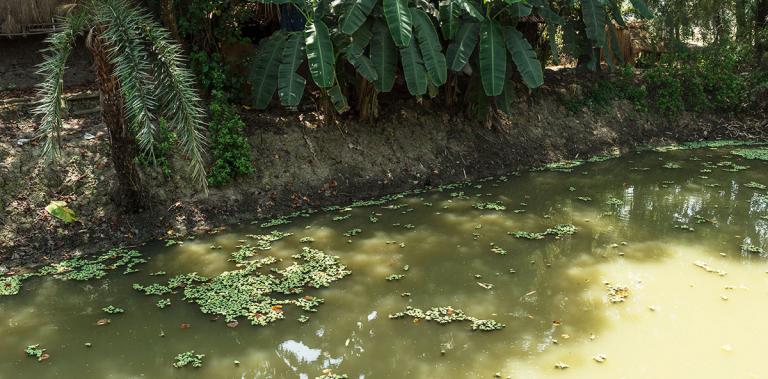
Vile, brown liquid that some in Asia count on as their water source.
So what if I lived somewhere that permanently seeped smelly, vile, germ-ridden, brown liquid? What if the river at the back of the land was a running sewer, and my grandchildren couldn’t romp and splash in it? (As one writer vividly describes: “In stagnant reaches, methane bubbles up through the grey-green water, and the stench of rotten eggs—hydrogen sulfide—wafts into homes.”) What if the fields were filled not only with animal feces but the excreta of some 300 neighbors?
You come up with your own empathy-building stories.
Communities Band Together to Improve Sanitation
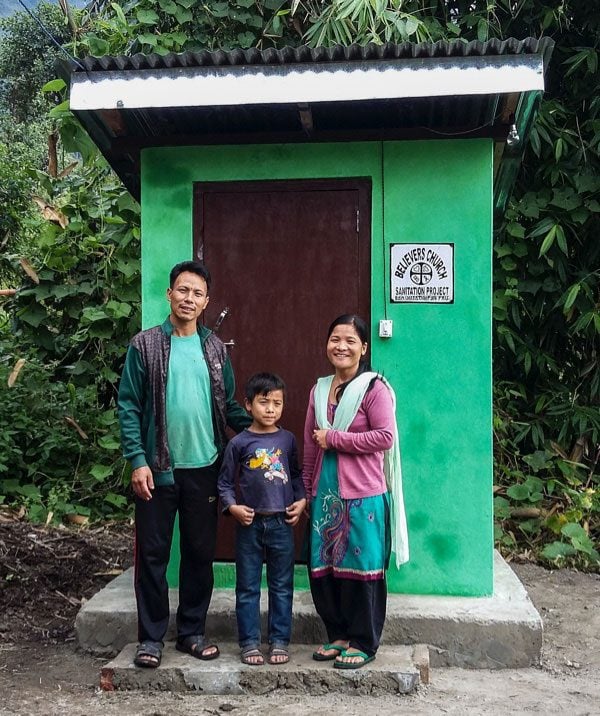
A family in front of a GFA-provided local sanitation facility.
Prime Minister Modi and his teams are sold on community-led initiatives, and so should they be. Change works best when a whole population is committed to seeing it happen.
Elizabeth Royte wrote: “The Indian government is rewarding certified ODF villages by moving them to the front of the line for road or drinking-water improvements. It has launched an advertising campaign that exalts Swachh Bharat mascots, like the 106-year-old woman in Chhattisgarh state who sold seven goats to build two toilets. It has enlisted cricket and Bollywood stars to exhort people to use the new latrines.”
Community development often works best when it is exactly that: an idea that grows out of the mind of some visionary who lives within the locality that has a need, a visionary who is not only capable of strategic thinking but also feels empathy and who is moved by compassion by the people nearby—his or her neighbors. And when a whole community becomes involved in “cleaning up its act,” there are few powers on earth that can withstand such initiative.
Now what’s interesting about Gospel for Asia‘s stories surrounding sanitation is that it is the local pastor in the village, who out of concern and knowing that open defecation is a deadly disease-breeding potential, exercises his compassion to love his neighbors by being concerned about the availability of latrines.
This is an excerpt from one of Gospel for Asia (GFA)‘s stories called “Welcome to Their Toilet” that talks about how one community was forced to use the open fields to defecate because they had no other proper place.
The local GFA pastor, Vidur, understood the villagers’ struggle. He himself had been ministering in the area for more than 10 years. Knowing people’s lives were at risk whenever they used the fields as their toilet, he wished there were a way to help them.
Then he found out Gospel for Asia had started a program to promote sanitation in underprivileged areas. Excited about the opportunity to help his community, he asked his leaders to build four toilets in the village.
That’s when Janya and her husband, Lalan, gladly offered some of their land for one toilet.
In January 2013, when the villagers saw a concrete outhouse rise out of the dusty ground, they poured out their gratitude to Pastor Vidur and the church.
“[This] saved the lives of people from illness,” shared one villager.
Even the village leader expressed thanks. “[The church] is always concerned about the need of people and works hard for a brilliant life for the community,” he said.
What an extraordinary example of love in practical action.
“Love the Lord your God with all your heart and mind and strength. And love your neighbor as yourself.” —Luke 10:27
For women like this tea estate laborer, having no outdoor toilet facility could mean risking assault as they go out into an open field in the dark.
“It’s not safe to send our people, our children, our wives or our daughters to the tea garden at night to use the toilet,” Iniyavan said.
Iniyavan made only 2,400 rupees a month, which was equivalent to about $37 (USD) a month. He wasn’t able to save enough money to construct a toilet.
Open defecation means there’s the risk of disease as families continually return to communal waste grounds.
GFA-supported Compassion Services teams construct outdoor toilets, also known as sanitation facilities, for people who, like Iniyavan, do not have the means to do so on their own.
“Now, since I have this toilet built in my house, I don’t have to worry. My family and I don’t have to go to the tea garden for toilet, and it is very safe here,” Iniyavan said.
On the Brink of Innovations, Change in Sanitation
Toilet technology is on the edge of remarkable, cost-effective, ecologically friendly frontiers. They’re becoming self-cleaning and solar-powered. A solar-powered toilet that converts waste into charcoal that could then be used as fertilizer.
An indoor toilet that works like a garden composter, spinning the contents and reducing odor and the number of dangerous pathogens. Portable rickshaw toilets. A community bio-digester toilet designed to convert human waste into gases and manure. Once ideas begin flourishing, there is no limit to what can happen.
I’m banking on Prime Minister Modi’s ODF Campaign to be successful. The hardest pull of any new effort is most always at the beginning, but once new ideas start rolling, they gather momentum. Some of the new toilet technologies may become catalysts as well.
In addition, there are hundreds of international organizations working on sanitation solution. They understand that one size does not fit all the variables that make up the particulars in this vast discussion, but added all together, it is a prohibitive association with evidence of remarkable dedication.
“And when a whole community becomes involved in ‘cleaning up its act,’ there are few powers on earth that can withstand such initiative.”
A Canadian doctor, one of those “creative renegades” unhappy with the condition of the world and one whom I have come to admire and love, was appointed as a Provincial Health Officer in the highlands of Papua, New Guinea.
While making an aerial survey, he and his team discovered one village that was distinctly cleaner and healthier. Far below them was the evidence of what turned out to be a pastor with some basic health training who had taught his people those lessons, and the difference could be seen from the air. That one flight changed their lives. They began to search for a more integral way of ministering and soon began using and teaching a community health evangelism methodology, which had been developed in Africa.
Sometimes we get lost in the details on the ground. We need to stand back, take deep breaths and find some way to gather broader assessments—some kind of aerial view. Progress is being made; it’s just a little harder in some places than in others. I’m proud that Gospel for Asia is one of the players. Last year, GFA helped provide 10,512 toilets for needy communities throughout Asia.
Shout Out to Toilets!
Christianity has everything to do with sanitation. We serve a God who is expecting us to help restore the world He created to its original design. That is a world, among many other things, without rampaging diseases. One day, Scripture promises, it will be a world without death and suffering. So in this interim, let’s hear a shout out for all the toilets in the world!
Saving Lives at Risk from Open Defecation: Part 1 | Part 2
This article originally appeared on gfa.org
To read more on Patheos on the problem of open defecation, go here.
Go here to know more about Gospel for Asia: Youtube | Twitter | GFA Reports | My GFA | Instagram
For more information about this, click here.
Previous Post
October 21, 2018
Saving Lives at Risk from Open Defecation (Part 2)
Next Post

October 23, 2018 Gospel for Asia: Widows Worldwide Face Tragedy, Discrimination (Part 1)
Browse Our Archives
Select a Category About Gospel for Asia Bishop Daniel Children's Education Clean Water Daniel Yohannan Disaster Relief GFA World Guest Writer Humanitarian Services Inspiration Leprosy Medical Ministry Mission Support Team Modern Slavery National Missions Poverty Alleviation Powerful Prayer School of Discipleship Special Report Spiritual Growth Uncategorized Women's Issues
Select a Month April 2026 March 2026 December 2025 September 2025 June 2025 May 2025 March 2025 December 2024 November 2024 October 2024 June 2024 May 2024 April 2024 December 2023 November 2023 October 2023 September 2023 May 2023 April 2023 March 2023 February 2023 January 2023 December 2022 November 2022 October 2022 September 2022 August 2022 July 2022 June 2022 May 2022 April 2022 March 2022 February 2022 January 2022 December 2021 November 2021 October 2021 September 2021 August 2021 July 2021 June 2021 May 2021 April 2021 March 2021 February 2021 December 2020 November 2020 October 2020 September 2020 August 2020 July 2020 June 2020 May 2020 April 2020 March 2020 February 2020 January 2020 December 2019 November 2019 October 2019 September 2019 August 2019 July 2019 June 2019 May 2019 April 2019 March 2019 February 2019 January 2019 December 2018 November 2018 October 2018 September 2018 August 2018 July 2018 June 2018 May 2018 April 2018 March 2018 February 2018 January 2018 December 2017 November 2017 October 2017 September 2017
Follow Us!
TAKE THE
Religious Wisdom Quiz
Which sea did God part for the Israelites to escape Egypt?
Select your answer to see how you score.
Red Sea Sea of Galilee Dead Sea Jordan River
Related posts from What Motivates Us.

GFA World ‘Epicenter’ for Faith-Based Healthcare in Africa

Father's Day Without My Father

Your Hunger for God CAN Be Satisfied |...

Christmas Chicken Challenge Helps Families Fly Poverty Coop
TRENDING AT PATHEOS Evangelical

In one sense walking into Westminster Abbey is like walking down the...

'Super Scam Me' Exposes AI Jon Bon Jovi...
Leslie Pickett believed she was in a relationship with Jon Bon Jovi....

The Brazilian Remake of Kendricks' 'Flywheel' Opens in...
“Flywheel,” the story that launched the Kendrick Brothers’ filmmaking career is getting...

The Dangers of Gradual Accommodation (Winking at Sin)
Recently, the “law of gradualness” resurfaced during the opening of a weeklong,...

The Iron Gates and the Lion of the...
Yesterday, I didn't finish my report about, well, yesterday. So I'll...

The Image: On the Horror of Capitalism and...
The Image Then went the Pharisees, and took counsel how they might...
view all Evangelical blogs
Ad-Free & Subscriber Log-In Subscription Support
- About Us
- 2026 Calendar
- Videos
- Podcasts
- Library of World Religions
- Faith In Media Tracker
- Advertise With Us
- Write for Us
- Privacy Policy
- Terms of Service
- Do Not Sell My Data
- Contact Us
- Radiant Digital
- Manage Newsletter Subscriptions
- Unsubscribe From Notifications
- Sitemap
Copyright 2008-2026, Patheos. All rights reserved.
Subscription Support Ad-Free & Subscriber Log-In
Follow Patheos