
BuddhistCatholicContemplativeEvangelicalGeneral ChristianHinduJewishLatter-day SaintMuslimNew VisionsProgressive Christian
Beliefs
- Buddhist
- Catholic
- Contemplative
- Evangelical
- General Christian
- Hindu
- Jewish
- Latter-day Saint
- More Voices
- Muslim
- New Visions
- Pagan
- Progressive Christian
Topics
- Religion News
- Food and Religion
- Sports and Religion
- Religious Art
- Religious Music and Entertainment
- Religious Events
- History and Religion
- Style and Religion
- Politics and Religion
- Women in Religion
- Recreation Outdoors and Religion
- Business Finance and Religion
- Careers Workplace and Religion
- Education and Religion
- Family Parenting and Religion
- Health Fitness and Religion
- Home and Religion
- Relationships and Religion
- Technology and Religion
- Travel and Religion
Columnists
- Buddhist Columnists
- Business Finance and Religion Columnists
- Careers Workplace and Religion Columnists
- Catholic Columnists
- Contemplative Columnists
- Education and Religion Columnists
- Evangelists Columnists
- Family Parenting and Religion Columnists
- General Christian Columnists
- Health Fitness and Religion Columnists
- Hindu Columnists
- History and Religion Columnists
- Home and Religion Columnists
- Jewish Columnists
- More Voices Columnists
- Latter Day Columnists
- Muslim Columnists
- New Visions Columnists
- Nonreligious Columnists
- Pagan Columnists
- Politics and Religion Columnists
- Progressive Columnists
- Recreation Outdoors and Religion Columnists
- Relationships and Religion Columnists
- Religion News Columnists
- Religious Art Columnists
- Religious Events Columnists
- Religious Music and Entertainment Columnists
- Sports and Religion Columnists
- Style and Religion Columnists
- Technology and Religion Columnists
- Travel and Religion Columnists
- Women in Religion Columnists
Resource Library
- 2026 Calendar
- Library of World Religions
- The 100 Most Holy Places on Earth
- Patheos Answers
- Podcasts
- Videos
- Faith Leaders Database
- Anglican Episcopalian
- Bahai
- Baptist
- Buddhism
- Christianity
- Confucianism
- Eastern Orthodoxy
- Hinduism
- Holiness and Pentecostal
- ISKCON
- Islam
- Judaism
- Lutheran
- Methodist
- The Church of Jesus Christ of Latter-day Saints
- New Age
- Paganism
- Presbytarian and Reformed
- Protestantism
- Religion Behind the Scenes
- Roman Catholic
- Scientology
- Shia Islam
- Sikhism
- Sufism
- Sunni Islam
- Taoism
- Zen
- See all religions
Research Tools
 Ad-Free & Subscriber Log-In Subscription Support
Ad-Free & Subscriber Log-In Subscription Support
Follow Patheos 

- Trending:
- Forgiveness
- |
- Marriage
- |
- Consciousness
- |
- Death Penalty
- |
- Election
- |
- Halloween

-
Social Media
- Home
- Evangelical
- Since 1993, I Have Learned to Observe Good Friday on My Knees
Since 1993, I Have Learned to Observe Good Friday on My Knees
Last updated on: March 31, 2018 at 1:20 am by Karen Mains
Since 1993, I Have Learned to Observe Good Friday on My Knees 2018-03-31T01:20:09+00:00 Karen Mains
Patheos Explore the world's faith through different perspectives on religion and spirituality! Patheos has the views of the prevalent religions and spiritualities of the world.
Holding the Broken Body of Christ, by Karen Burton Mains
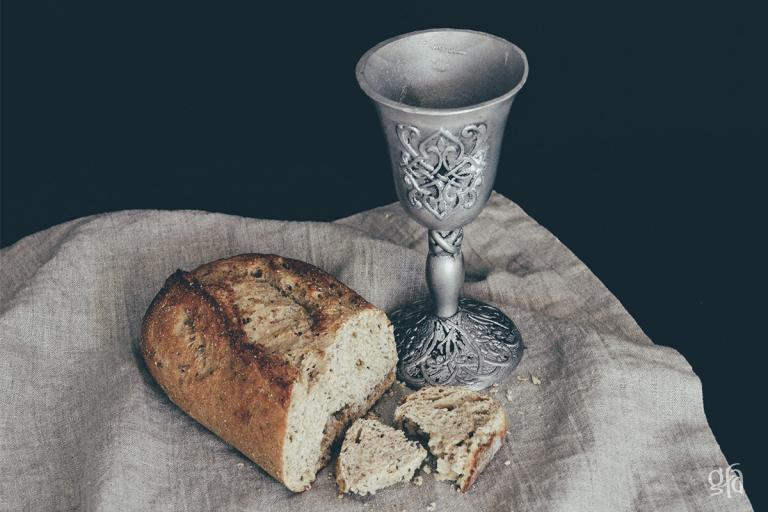
On Good Friday, 1993, around noon, I slipped into the chapel of the nearby Episcopal church where I prayed weekly for an hour or so and was surprised by something I saw. Someone had positioned a low table before the altar. On it was set a linen cloth, a small crucifix, a pottery chalice filled with wine, and an earthenware plate holding Communion wafers.
A woman bustled in the nearby sacristy.
I called out to her, “What a wonderful aid to prayer!”
Often when my mind is wandering, it helps to have some token on which to fix my eyes. Postcards sent by friends are tucked in my desk organizer, a fixed point of beauty from which to build a center for concentration.
“Did you arrange this?” I asked.
Still finishing her tasks, she paused, calling back that the Communion elements were brought from the previous evening’s Maundy Thursday service as a reminder to keep vigil over the broken body of Christ. Then, her work completed, she left me to the silence.
At several points in our lives, my husband, David Mains, and I found ourselves between churches. For six years we attended a black suburban congregation, and before that, we became members at an Episcopal church in the nearby town west of where we live. Since nearly 25 percent of the radio audience of the media ministry my husband headed—broadcasting some 500 times a day, some six days a week—were from liturgical churches (and we knew nothing about liturgy or the Episcopal church), we decided that we needed to expose ourselves in some way to these branches of Christendom.
The rector (pastor) of a nearby Episcopal church was evangelical and an excellent biblical communicator who welcomed our attendance and our participation. He was also an attentive liturgical coach for those of us who had not before been exposed to living by the church calendar, for instance, or with no sacramental understanding of the Eucharistic service. We became part of a small group with him—all of us involved in ministry in some way. So I became exposed to regular healing services and the anointing with oil, to personal confession with a spiritual advisor, to the three-year cycle of Scripture readings called the Lectionary and to the services of feasting and fasting and saints’ days and high holy days included in the Book of Common Prayer. I learned that the Episcopal church, or the Anglican church worldwide, was predominately evangelical and black.
In time, I became moved by the thought that the Sunday liturgy I had experienced that very week also had participants in time zones after time zones after time zones who, because of the uniformity of The Book of Common Prayer, had read the same words and prayers as had I.
This liturgical learning expanded the truths I had absorbed in the Conservative Baptist upbringing of my past. In a way, each informed the other. For instance, the Protestantism of my past sort of rushes into Easter. Yet churches that observe the calendar year of holy remembrances traditionally begin to “set their faces” toward Jerusalem with a Maundy Thursday meal and a foot-washing ceremony—this based on Christ’s last supper with His disciples in the Upper Room.
Somehow, during our hiatus at St. Mark’s Episcopal Church, I never was able to make these services; the subway train of crammed living always jostled aside my good intentions. So my crucifixion vigil usually begins not in the Upper Room, but in the Garden of Gethsemane. I will not pretend that I didn’t rush, somewhat breathless, to the observation of this point on the church calendar. However, in the years since 1993, I have learned to observe Good Friday on my knees.
During that moment of prayer in the little chapel of St. Mark’s, a few people came and went, but I was pinned to the thought, How can I leave and go on with my regular routines if there is no one else who will keep vigil over the body of Christ? And after a while, all my prayer companions slipped away*. If I leave,* I thought*, who will keep vigil over this broken body of Christ? Could I not watch one more hour*? So because of the quiet, because of the uninterrupted time, because of the elements on the little table before the alter—a goblet holding wine, a basket holding bread wrapped in a white napkin—I felt impelled to stay and watch. I had no place I needed to be, no responsibilities haunting me. My college-age children were all occupied; my husband was away from home traveling.
Yes, I decided. I could watch. I could pray until someone came to take my place. I recalled the Scripture of that first Good Friday.
He went a little farther and fell on His face, and prayed saying,
“O My Father, if it is possible, let this cup pass from Me;
Nevertheless, not as I will, but as You will.” Then He came to
The disciples and found them sleeping, and said to Peter,
“What? Could you not watch with Me one hour?”
—Matthew 26:39–40
So the quick half hour of prayer stretched into an hour and the hour stretched into the whole afternoon. I was a solitary woman, for the most part, keeping lonely vigil beside the body of Christ. The reality of this event—the Crucifixion—and the impact on my understanding took me into a kind of nearness and closeness that are not easily described. I began to think of all the people I knew whose souls were close to Golgotha. Friends—one whose wife was dying from cancer, another whose mother was terminally ill.
Who was it I held in my arms? My husband, certainly, with too much work and too little funding. I also held in my arms the new generation, my infant grandchildren, for whom I felt more terror than I ever had for my own children, knowing now how hazardous life really is.
More than these, I entered into a profound reality that I was one of the women, though centuries stood between me and that actual time, at the foot of the Cross who on that first Good Friday, then down through the ages, have kept lonely and prayerful vigils. Believe me, Easter celebrations are always more meaningful when I have held the Broken Body of Christ on the Friday before.
This year, a week before Good Friday, I notice that nearby Wheaton College is offering a Bach Vigil. Cellist Leonardo Altino will perform the six cello suites of J.S. Bach. Suites 1 & 2 will be held at St. Michael Catholic Church; Suites 3 & 4 will be held at St. John Lutheran Church; and Suites 5 & 6 will be held at the College Church. These musical meditations a week before Good Friday should put me in the way of the Cross. Let me just say that ever since that afternoon on Good Friday 1993, I have attempted to spend Good Friday on my knees. Personal suffering since 1993 has made me tender. My own pain has made it easier to enter into the pain of Christ.
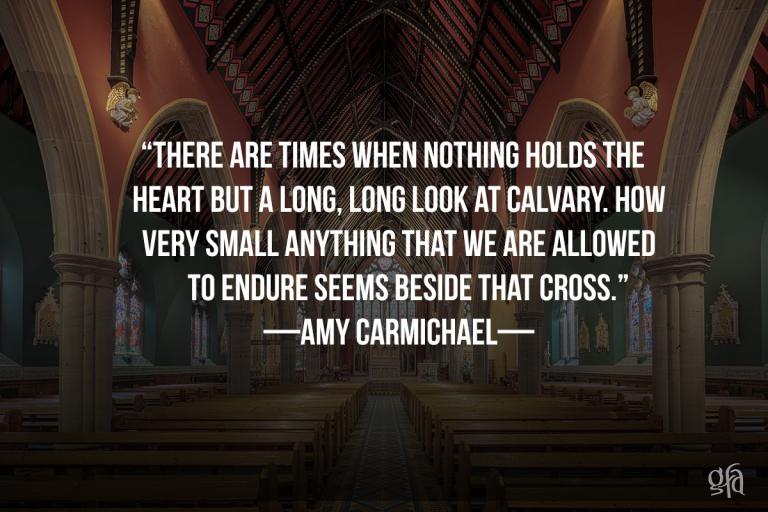
“There are times when nothing holds the heart but a long, long look at Calvary. How very small anything that we are allowed to endure seems beside that Cross.” —Amy Carmichael, missionary to India
Let me repeat: Easter celebrations are always more meaningful when I have held the Broken Body of Christ on Good Friday.
=====
Click here, to read more blogs on Patheos from Gospel for Asia.
Go here to know more about Gospel for Asia: Youtube | Twitter | GFA Reports
Previous Post
March 25, 2018
Palm Sunday - Preparing Our Hearts for Jesus
Next Post
March 29, 2018 It Was the Very First Time They Ever Experienced God’s Presence
Browse Our Archives
Select a Category About Gospel for Asia Bishop Daniel Children's Education Clean Water Daniel Yohannan Disaster Relief GFA World Guest Writer Humanitarian Services Inspiration Leprosy Medical Ministry Mission Support Team Modern Slavery National Missions Poverty Alleviation Powerful Prayer School of Discipleship Special Report Spiritual Growth Uncategorized Women's Issues
Select a Month April 2026 March 2026 December 2025 September 2025 June 2025 May 2025 March 2025 December 2024 November 2024 October 2024 June 2024 May 2024 April 2024 December 2023 November 2023 October 2023 September 2023 May 2023 April 2023 March 2023 February 2023 January 2023 December 2022 November 2022 October 2022 September 2022 August 2022 July 2022 June 2022 May 2022 April 2022 March 2022 February 2022 January 2022 December 2021 November 2021 October 2021 September 2021 August 2021 July 2021 June 2021 May 2021 April 2021 March 2021 February 2021 December 2020 November 2020 October 2020 September 2020 August 2020 July 2020 June 2020 May 2020 April 2020 March 2020 February 2020 January 2020 December 2019 November 2019 October 2019 September 2019 August 2019 July 2019 June 2019 May 2019 April 2019 March 2019 February 2019 January 2019 December 2018 November 2018 October 2018 September 2018 August 2018 July 2018 June 2018 May 2018 April 2018 March 2018 February 2018 January 2018 December 2017 November 2017 October 2017 September 2017
Follow Us!
TAKE THE
Religious Wisdom Quiz
Which prophet lamented over Israel's oppression of the poor?
Select your answer to see how you score.
Joel Obadiah Hosea Amos
Related posts from What Motivates Us.
Father's Day Without My Father
Your Hunger for God CAN Be Satisfied |...
GFA World & Ministry Leaders Celebrate KP Yohannan...
K.P. Yohannan (Metropolitan Yohan) Laid to Rest
TRENDING AT PATHEOS Evangelical

Emotion in Early Christianity by Andrew Crislip
Andrew Crislip’s Emotion in Early Christianity examines an often overlooked dimension of...

16 Spiritual Touchstones for a More Grounded Life
After decades of spiritual study, here are 16 principles I try...

Catholic Evangelization: Sharing Your Faith Every Day
Welcome back to the Graceful Awakening mini-series called, “From Faith to Mission.” ...

The Pillar of the Boatmen: the Ancient Monument...
The Pillar of the Boatmen is a Romano-Gaulish sculpture that dates from...

In one sense walking into Westminster Abbey is like walking down the...

'Super Scam Me' Exposes AI Jon Bon Jovi...
Leslie Pickett believed she was in a relationship with Jon Bon Jovi....
view all Evangelical blogs
Ad-Free & Subscriber Log-In Subscription Support
- About Us
- 2026 Calendar
- Videos
- Podcasts
- Library of World Religions
- Faith In Media Tracker
- Advertise With Us
- Write for Us
- Privacy Policy
- Terms of Service
- Do Not Sell My Data
- Contact Us
- Radiant Digital
- Manage Newsletter Subscriptions
- Unsubscribe From Notifications
- Sitemap
Copyright 2008-2026, Patheos. All rights reserved.
Subscription Support Ad-Free & Subscriber Log-In
Follow Patheos