
BuddhistCatholicContemplativeEvangelicalGeneral ChristianHinduJewishLatter-day SaintMuslimNew VisionsProgressive Christian
Beliefs
- Buddhist
- Catholic
- Contemplative
- Evangelical
- General Christian
- Hindu
- Jewish
- Latter-day Saint
- More Voices
- Muslim
- New Visions
- Pagan
- Progressive Christian
Topics
- Religion News
- Food and Religion
- Sports and Religion
- Religious Art
- Religious Music and Entertainment
- Religious Events
- History and Religion
- Style and Religion
- Politics and Religion
- Women in Religion
- Recreation Outdoors and Religion
- Business Finance and Religion
- Careers Workplace and Religion
- Education and Religion
- Family Parenting and Religion
- Health Fitness and Religion
- Home and Religion
- Relationships and Religion
- Technology and Religion
- Travel and Religion
Columnists
- Buddhist Columnists
- Business Finance and Religion Columnists
- Careers Workplace and Religion Columnists
- Catholic Columnists
- Contemplative Columnists
- Education and Religion Columnists
- Evangelists Columnists
- Family Parenting and Religion Columnists
- General Christian Columnists
- Health Fitness and Religion Columnists
- Hindu Columnists
- History and Religion Columnists
- Home and Religion Columnists
- Jewish Columnists
- More Voices Columnists
- Latter Day Columnists
- Muslim Columnists
- New Visions Columnists
- Nonreligious Columnists
- Pagan Columnists
- Politics and Religion Columnists
- Progressive Columnists
- Recreation Outdoors and Religion Columnists
- Relationships and Religion Columnists
- Religion News Columnists
- Religious Art Columnists
- Religious Events Columnists
- Religious Music and Entertainment Columnists
- Sports and Religion Columnists
- Style and Religion Columnists
- Technology and Religion Columnists
- Travel and Religion Columnists
- Women in Religion Columnists
Resource Library
- 2026 Calendar
- Library of World Religions
- The 100 Most Holy Places on Earth
- Patheos Answers
- Podcasts
- Videos
- Faith Leaders Database
- Anglican Episcopalian
- Bahai
- Baptist
- Buddhism
- Christianity
- Confucianism
- Eastern Orthodoxy
- Hinduism
- Holiness and Pentecostal
- ISKCON
- Islam
- Judaism
- Lutheran
- Methodist
- The Church of Jesus Christ of Latter-day Saints
- New Age
- Paganism
- Presbytarian and Reformed
- Protestantism
- Religion Behind the Scenes
- Roman Catholic
- Scientology
- Shia Islam
- Sikhism
- Sufism
- Sunni Islam
- Taoism
- Zen
- See all religions
Research Tools
 Ad-Free & Subscriber Log-In Subscription Support
Ad-Free & Subscriber Log-In Subscription Support
Follow Patheos 

- Trending:
- Forgiveness
- |
- Marriage
- |
- Consciousness
- |
- Death Penalty
- |
- Election
- |
- Halloween

-
Social Media
- Home
- Evangelical
- Instead of Praying for My Body When it Hurts, I Will Pray for the Body
Instead of Praying for My Body When it Hurts, I Will Pray for the Body
Last updated on: March 2, 2018 at 12:23 am by Karen Mains
Instead of Praying for My Body When it Hurts, I Will Pray for the Body 2018-03-02T00:23:06+00:00 Karen Mains
Patheos Explore the world's faith through different perspectives on religion and spirituality! Patheos has the views of the prevalent religions and spiritualities of the world.
When I was younger, I promised myself that I would never sit around and bore people about my increasing aches and pains. Now that I am older, I am naturally more empathetic to my age-set’s varying degrees of ills. Not that I make evidence of my own physical decline a subject for conversation, but ailments, aches and pains are part of the way our bodies remind us that there is an eventual life terminus in the offing. Such as this is, I am learning that ailments are a useful gift for the elderly (and for those of any age, actually) as a prod to intercede for the suffering church worldwide. How can this be?
I confess that it is all too easy for me to forget to pray for those who are struggling physically. I confess that I am often negligent in my intercession for those who are ill.

So at the risk of breaking my own vow not to bore others with discussions of personal physical ailments, let me nevertheless share about the wrestling match I had with my digestive system one whole night (and the rest of that week) and the lesson I learned about interceding for the sick from that unpleasant marathon event.
Years ago, on vacation with my husband, I ended up in the Emergency Room of a little town in Tennessee. I thought I was having a heart attack—the pain was so severe—but instead, after an EKG and a CAT-scan (Computerized Axial Tomography), the ER doctor announced there was nothing wrong with my heart, but it appeared that I had a hiatal hernia.
He didn’t flap his hands about it but suggested that the intrusion of part of my stomach through the diaphragm might be a condition that I would need to monitor. It appears that instead of having a heart attack, I was suffering from the late dinner we had enjoyed (rather too much country fried chicken). I learned my lesson, have avoided deep fried foods of any kind in the 20 years since this incident, researched the topic and have basically controlled the impact of the hernia by eating smaller portions, avoiding late-night meals, and finishing eating before my stomach had filled. Though over-the-counter medication for stomach ailments are seemingly endless in their variety (a recent shopping trip to Wal-Mart revealed a whole aisle of beautifully designed boxes dedicated to the cause of relieving stomach pain and intestinal discomfort), our medicine cabinet held a 20-year old bottle of Milk of Magnesia and a comparatively aging box of laxatives. The need for management of stomach issues has, obviously, been few and far between.
Every once in a while, if I experienced some discomfort, a feeling of being too full after eating, I learned if I paced in the house some, waiting for an hour or so for the food to pass through the digestive track, again making mental reminders all the while to 1.) Not eat too much at night, and 2.) To not eat after 5 o’clock or thereabouts at all, my hiatal hernia condition and I would get along just fine.
Every once in a while, a random X-ray would evoke a medical response: “You’ve got quite a large hiatal hernia!” This happened when I tripped over the open dishwasher door in my kitchen, fell headfirst against a cabinet, dislocated my right shoulder and consequently was scheduled for corrective arthroscopic surgery. Perhaps I was more concentrated on the ER doctor’s exclamation, “You mean you hauled yourself off the floor and up the stairs with a dislocated shoulder to get your husband to drive you to the hospital? What a woman!” Consequently, patting myself on the back in agreement with the doctor’s evaluation (he had to call in another doctor to help him reset my shoulder—a little tug-of-war going on there), I didn’t pay too much attention to the “large hiatal hernia” remark.
However, my relationship with my hiatal hernia changed drastically last month when, after a regular checkup, my general physician referred me to a gastroenterologist. This, ostensibly, was for the purpose of scheduling a routine colonoscopy. I personally think when one has survived decades and reached one’s 70s, one should not have to worry any longer about such diagnostic interventions.
I mentioned to the gastroenterologist that I had a hiatal hernia, and that it had never been examined. This led to an endoscopy, which led to an appointment with a referred surgeon, who professionally informed me that my hiatal hernia was actually a rather large paraesophageal hernia. A paraesophageal hernia could torque= and cut off the blood supply to the stomach, which would lead to the loss of that essential organ. Now there was some quiet, but professional, hand-flapping—why hadn’t anyone take notice of this before?
So back to the medical diagnostic unit of our nearby local hospital early one Monday morning, this time for a comprehensive blood draw panel and for a series of CAT-scans (“CT CHEST ABDOMEN PELVIS W CONTRAST Oral & IV,” reads the order I brought home from the surgeon’s office). These would give more accurate photos of the size, position and twist of what appeared to be a serious intrusive condition. A date was set for surgery as well as an appointment for another pre-op exam.
On Friday night of the same week, we invited new friends from the inner-city church we have been attending to our house for dinner. This was an African American couple; she is the administrator of a Meals-on-Wheels program (food delivered to the elderly) and he, an ordained minister, is highly involved in bringing churches together across the city of Chicago in activist movements that hold government officials accountable to social concerns they might not attend to if these grassroots organizations, all faith-based, did not participate in regular peaceful protests. I served broiled salmon and roasted vegetables. The conversation was stimulating. We had a lovely evening.
By 10 o’clock when our new friends left to drive back into the city, I was picking up signals that all was not well on the intestinal front; a war was beginning to wage in my digestive tract. By 4 o’clock, after six hours of moaning and groaning and huffing and puffing, with a stomach in turmoil, pain now shooting down my left arm, my husband and I agreed this was nothing to ignore.
He dropped me off at the ER in order to park the car, and I made sure the admitting desk knew I was concerned about a heart attack happening at the moment, or about a paraesophageal hernia having become fully torqued. Fortunately, with digital records, the ER team could pull up my Monday CAT-scans and compare those photos to the ones now being taken in the wee hours of Saturday morning. Although my stomach was two times as large as it had been earlier in the week, there was no torqueing of the hernia. A shot of morphine calmed my digestive system. Blood draws indicated all was well on the hematology front. EKG monitors assured us that my heart was not at risk.
After three hours, having sent David home to sleep once we knew there was no immediate danger, and after the morning ER shift change, I talked my way out of an imminent hospital room assignment, and using my Lyft APP, was able to schedule a driver to take me home. There was no need to wake David again. My husband gets nervous in hospitals; continued sleep would help him slough off the stress of our ER adventure.
Nevertheless, the whole next week was devoted to the management of pain-filled symptoms. I learned that the operative direction was “soft foods”—a phrase thrown out by my surgeon during the conversation before I had my CAT-scan exams, before the ER episode and before my following week at home learning how to persuade a suddenly dysfunctional digestive system back into some kind of normalcy. I began to search the refrigerator and cupboards for edibles that would not challenge my already threatened upper stomach and lower abdomen. Something soft. Soft food. Soft.
The second sleepless night after returning myself home from the ER, I began to appreciate the fact that abdominal mishaps must involve a huge percentage of the American population: How many of my fellow citizens were lying in bed, attempting to sleep, suffering from the pangs of digestive misfortune? I ceased to wonder at the row of highly designed stomach-aid boxes at Wal-Mart. They all were witness, this long wall of products, to a huge demand for over-the-counter treatments for this sour discomfort.
It was at this point, lying in my bed, not able even to toss and turn, my husband sleeping by my side, that a random thought whispered, What if this becomes a permanent physical condition for me? What if, for the rest of my life, I’m going to have pain and distress after eating even minimal amounts of food? (That day all I had was one banana, one bowl of yogurt, mugs of ginger tea, one piece of toast).
Pain Taught Me A Lesson
I decided that I would use the pain of that night (and the next three) to intercede for the sick in the world, for those who suffer perhaps without medical remedies. My pain was physical, real to me, but working itself out in a system where I had excellent medical care available and nearby, where I had a warm home to return to on a snowy morning, where a loving husband attended to me with concern and care, where we were safe from foragers and violence and evil men and from warmongers and rapists and land-grabbers. Here, in this sanctuary that is my life, which it is so easy to take for granted, I could use my computer to educate myself about hernias, stomach distresses, home remedy treatments and diets. I could even read up on the surgical procedure for giant paraesophageal hernias (aparoscopic Nissen fundoplication, for anyone else who might want to know). The least I could do was use my distress as a reminder of the distresses of others.
I have a prayer exercise I’ve learned to use through the years—particularly during those nighttime hours when I cannot sleep—being a light sleeper, they have been many. This approach is a form of wordless prayer in which I remind myself of all the intercessors worldwide and of that great cloud of witnesses in the heavens that the book of Hebrews speaks of, which sustain and support and undergird our planet. “I urge, then, first of all” writes Paul in 1 Timothy 2:1–2, “that requests, prayers, intercession and thanksgiving be made for everyone.”(NIV)
At night, in the quiet, without the rush of daytime activity, I mentally make myself available to join Christ who intercedes at the right hand of God, (“. . . since he [Christ] always lives to make intercession for them.” —Hebrews 7:25) Without words, but with a heart full of concern and love, eyes closed, body prone, I wait and almost always a prayer mantle of intercession comes over me (given how frail our attempts at words are to explain profound spiritual experience, this is the best that I can describe this practice). I feel as though I am entering that intercessory circle—that place where Christ holds to heart, eternally and without interruption, every little starving child, every woman filled with terror, every man courageously standing before accusers for his faith, every farmer bemoaning a failing harvest, every saint boldly taking the message of the Gospel where it has not before been heard, every parent holding a feverish infant and standing outside a village clinic in a long and snaking line.
And so, during this week of gastric distresses, asking myself what I would do if this were to become a lifetime disability, I decided I would use the nighttime moments of duress to pray, to pray for those who suffer, to pray for my Christian brothers and sisters worldwide who are sick. Prayers of intercession for others, I am learning, offered up when my own physical pain is present, impresses a reality upon me that does not happen when I am praying without pain.
Two nights ago I slept soundly without any stomach suffering. Today I am feeling stronger. Perhaps I’ve had gastritis, an infection of the stomach that has nothing to do with my hiatal hernia. I’m only slightly aware by checking sounds emitting from my abdomen that I’ve eaten a small breakfast of yogurt and honey, topped with bananas and cinnamon, and one slice of toast with a butter substitute spread—the most I’ve put in my stomach at one time over the last seven days.
But pain has taught me a lesson. Instead of praying for my body when it hurts, in the days ahead, I will pray for the Body, for those believers—wherever they may be in the world—who seek to follow Christ and serve God. Pain, along with discomfort, can bring us gifts if we so choose to allow it. Our own ills can sensitize us to the ills of others. The disease of a loved one demands our prayers. Concern and compassion, fearfulness and anxiety can cause us to spend hours on our knees and to hardly forget for a moment that the one we love is ill. Can we learn to remind ourselves that physical disease is also an opportunity to pray for those with similar struggles who have no one to pray for them? Prayers for those whom we know are sick are often used beyond our knowing for those we don’t know.
“And pray in the Spirit on all occasions with all kinds of prayers and requests. With this in mind, be alert and always keep on praying for all the Lord’s people.” —Ephesians 6:18 (NIV)
When we pray for those who are ill, we, like the people in the New Testament, are bringing them to Jesus. He casts out disorders for those who were possessed of demons; He healed all who were sick that were brought to Him (see Matthew 8:16). Let us use our own illnesses to remind us to intercede for those who are also ill—the ones we know and the ones we don’t know.
This morning, while writing this, I found an old note tablet and scanned the notes on the pages to see if there was anything I needed to retain. I had written out this prayer sometime in the past without knowing I would need it for this blog:
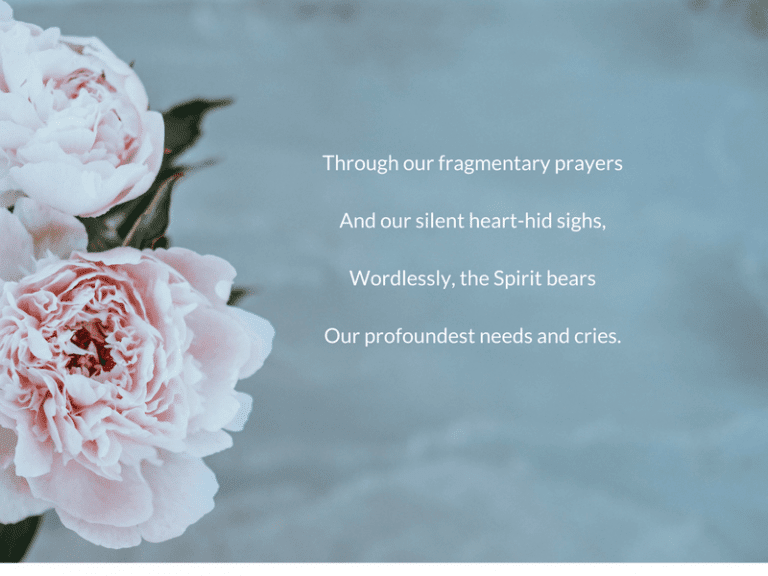
Through our fragmentary prayers
And our silent heart-hid sighs,
Wordlessly, the Spirit bears
Our profoundest needs and cries.
=====
Click here, to read more blogs on Patheos from Gospel for Asia.
Go here to know more about Gospel for Asia: Twitter | GFA Reports | My GFA
Previous Post

February 22, 2018
Billy Graham, Good and Faithful Servant (1918 – 2018)
Next Post

February 26, 2018 The Bride is Brawling ... Again
Browse Our Archives
Select a Category About Gospel for Asia Bishop Daniel Children's Education Clean Water Daniel Yohannan Disaster Relief GFA World Guest Writer Humanitarian Services Inspiration Leprosy Medical Ministry Mission Support Team Modern Slavery National Missions Poverty Alleviation Powerful Prayer School of Discipleship Special Report Spiritual Growth Uncategorized Women's Issues
Select a Month April 2026 March 2026 December 2025 September 2025 June 2025 May 2025 March 2025 December 2024 November 2024 October 2024 June 2024 May 2024 April 2024 December 2023 November 2023 October 2023 September 2023 May 2023 April 2023 March 2023 February 2023 January 2023 December 2022 November 2022 October 2022 September 2022 August 2022 July 2022 June 2022 May 2022 April 2022 March 2022 February 2022 January 2022 December 2021 November 2021 October 2021 September 2021 August 2021 July 2021 June 2021 May 2021 April 2021 March 2021 February 2021 December 2020 November 2020 October 2020 September 2020 August 2020 July 2020 June 2020 May 2020 April 2020 March 2020 February 2020 January 2020 December 2019 November 2019 October 2019 September 2019 August 2019 July 2019 June 2019 May 2019 April 2019 March 2019 February 2019 January 2019 December 2018 November 2018 October 2018 September 2018 August 2018 July 2018 June 2018 May 2018 April 2018 March 2018 February 2018 January 2018 December 2017 November 2017 October 2017 September 2017
Follow Us!
TAKE THE
Religious Wisdom Quiz
How many years did Solomon reign?
Select your answer to see how you score.
35 years 50 years 40 years 30 years
Related posts from What Motivates Us.

Father's Day Without My Father
Your Hunger for God CAN Be Satisfied |...
GFA World & Ministry Leaders Celebrate KP Yohannan...
K.P. Yohannan (Metropolitan Yohan) Laid to Rest
TRENDING AT PATHEOS Evangelical

Emotion in Early Christianity by Andrew Crislip
Andrew Crislip’s Emotion in Early Christianity examines an often overlooked dimension of...

16 Spiritual Touchstones for a More Grounded Life
After decades of spiritual study, here are 16 principles I try...

Catholic Evangelization: Sharing Your Faith Every Day
Welcome back to the Graceful Awakening mini-series called, “From Faith to Mission.” ...

The Pillar of the Boatmen: the Ancient Monument...
The Pillar of the Boatmen is a Romano-Gaulish sculpture that dates from...

In one sense walking into Westminster Abbey is like walking down the...

'Super Scam Me' Exposes AI Jon Bon Jovi...
Leslie Pickett believed she was in a relationship with Jon Bon Jovi....
view all Evangelical blogs
Ad-Free & Subscriber Log-In Subscription Support
- About Us
- 2026 Calendar
- Videos
- Podcasts
- Library of World Religions
- Faith In Media Tracker
- Advertise With Us
- Write for Us
- Privacy Policy
- Terms of Service
- Do Not Sell My Data
- Contact Us
- Radiant Digital
- Manage Newsletter Subscriptions
- Unsubscribe From Notifications
- Sitemap
Copyright 2008-2026, Patheos. All rights reserved.
Subscription Support Ad-Free & Subscriber Log-In
Follow Patheos