
BuddhistCatholicContemplativeEvangelicalGeneral ChristianHinduJewishLatter-day SaintMuslimNew VisionsProgressive Christian
Beliefs
- Buddhist
- Catholic
- Contemplative
- Evangelical
- General Christian
- Hindu
- Jewish
- Latter-day Saint
- More Voices
- Muslim
- New Visions
- Pagan
- Progressive Christian
Topics
- Religion News
- Food and Religion
- Sports and Religion
- Religious Art
- Religious Music and Entertainment
- Religious Events
- History and Religion
- Style and Religion
- Politics and Religion
- Women in Religion
- Recreation Outdoors and Religion
- Business Finance and Religion
- Careers Workplace and Religion
- Education and Religion
- Family Parenting and Religion
- Health Fitness and Religion
- Home and Religion
- Relationships and Religion
- Technology and Religion
- Travel and Religion
Columnists
- Buddhist Columnists
- Business Finance and Religion Columnists
- Careers Workplace and Religion Columnists
- Catholic Columnists
- Contemplative Columnists
- Education and Religion Columnists
- Evangelists Columnists
- Family Parenting and Religion Columnists
- General Christian Columnists
- Health Fitness and Religion Columnists
- Hindu Columnists
- History and Religion Columnists
- Home and Religion Columnists
- Jewish Columnists
- More Voices Columnists
- Latter Day Columnists
- Muslim Columnists
- New Visions Columnists
- Nonreligious Columnists
- Pagan Columnists
- Politics and Religion Columnists
- Progressive Columnists
- Recreation Outdoors and Religion Columnists
- Relationships and Religion Columnists
- Religion News Columnists
- Religious Art Columnists
- Religious Events Columnists
- Religious Music and Entertainment Columnists
- Sports and Religion Columnists
- Style and Religion Columnists
- Technology and Religion Columnists
- Travel and Religion Columnists
- Women in Religion Columnists
Resource Library
- 2026 Calendar
- Library of World Religions
- The 100 Most Holy Places on Earth
- Patheos Answers
- Podcasts
- Videos
- Faith Leaders Database
- Anglican Episcopalian
- Bahai
- Baptist
- Buddhism
- Christianity
- Confucianism
- Eastern Orthodoxy
- Hinduism
- Holiness and Pentecostal
- ISKCON
- Islam
- Judaism
- Lutheran
- Methodist
- The Church of Jesus Christ of Latter-day Saints
- New Age
- Paganism
- Presbytarian and Reformed
- Protestantism
- Religion Behind the Scenes
- Roman Catholic
- Scientology
- Shia Islam
- Sikhism
- Sufism
- Sunni Islam
- Taoism
- Zen
- See all religions
Research Tools
 Ad-Free & Subscriber Log-In Subscription Support
Ad-Free & Subscriber Log-In Subscription Support
Follow Patheos 

- Trending:
- Forgiveness
- |
- Marriage
- |
- Consciousness
- |
- Death Penalty
- |
- Election
- |
- Halloween
 Good Letters
-
Contributors
- Home
- Catholic
- Tuesday Morning at the Old Asylum, Part 1
Tuesday Morning at the Old Asylum, Part 1
Last updated on: March 10, 2014 at 2:31 pm by Jessica Griffith
Tuesday Morning at the Old Asylum, Part 1 2014-03-10T14:31:01-07:00 Jessica Griffith
Patheos Explore the world's faith through different perspectives on religion and spirituality! Patheos has the views of the prevalent religions and spiritualities of the world.
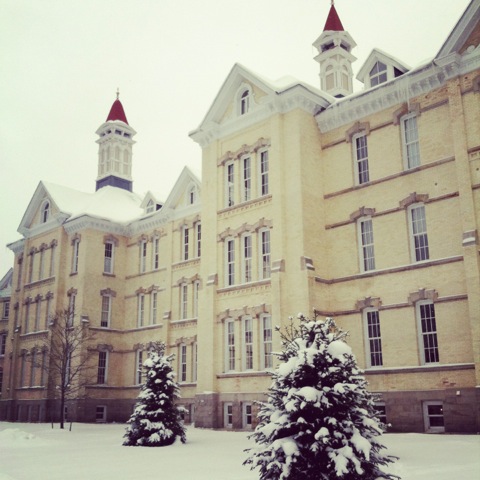 It’s probably not okay to call it the insane asylum. It’s officially the Village at Grand Traverse Commons, a mixed-use development with a brick-oven bakery, a coffee roaster, farm-to-table restaurants, a nature school and a place to buy ethically sourced yoga pants.
But there’s something satisfyingly shocking about calling it the insane asylum. It seems right to acknowledge why this place of luxury goods and services looks like the setting for A Series of Unfortunate Events, why it’s so beautiful and so obviously, poignantly, haunted.
It’s the word insane that’s the problem, for who could dislike the word asylum, which connotes protection, refuge and safety?
I love the idea that we used to shelter not only the criminally dangerous but the sick in the soul, the depressed, exhausted and nervous of the world. Not just for our sakes, but for theirs. The words insane asylum speak to me of what the Victorian-era psychiatrist Thomas Kirkbride—the designer of these buildings—described as “respectable decorum.”
Traverse City has some of the last standing Kirkbride buildings in America, and as I walk the grounds I feel perhaps a little too much sympathy with the former residents.
My thoughts turn to my uncle, a paranoid schizophrenic who spent most of his life in hospitals and a string of halfway houses, where he lived with other people’s families in a sort of adult foster care system in rural Mississippi. We’d visit him and I’d wonder who these people were and why he didn’t come home. We’d bring him books and cigarettes and I’d wonder if he spent entire days smoking in a rocker on the porch. I’d imagine how bored he must have been, how long and lonely the days, even as I was desperate to leave the unsettling quiet and the foreign smells of someone else’s home. Later I realized he was heavily sedated.
I’ve struggled with depression my whole life, and was prone to melancholy and anxiety even as a small child, well before I had any real reason. The trauma of my mother’s illness and death fanned the flames, but the fire was already burning. I started my first bottle of Prozac when I was thirteen.
And then I started to write, which is both a burden and a relief. To write is to exist momentarily on a plane where one can make connections, discern patterns, uncover and even force meaning from experience. The relief comes when I manage to write to that brief exhilarating moment when everything falls into place, a satisfaction so rarely felt in life. The burden is everything else about writing.
My uncle hunted patterns too. My sister sent me a box of his papers, which she discovered in her attic. It turns out he spent a lot of time and energy connecting our family to the Confederacy, beginning with his own initials, Cyril Solomon Arnold, the Confederate States of America. He also founded and edited a Catholic literary journal during his stay at Southeast Louisiana State Hospital.
He loved Walker Percy and Flannery O’Connor long before I discovered them. He was the only reader in our family, and it was in his abandoned bedroom at my grandmother’s house that I discovered a world of books where I could both hide and thrive. I inherited all those books. My sister and I are his sole survivors.
When I write I think of him. When I’m anxious and depressed I think of him. And now, when I go to the asylum to wander the grounds, buy coffee, and admire the architecture, I think of him, and wish he could have taken refuge in its respectable decorum. And I wonder at the fine line between writerly tendencies and pathology.
In so many ways I am his heir. My overwhelming need to be alone. My obsession over single words or images for weeks at a time. My excessive religiosity. My ability—no, my need—to make connections between seemingly disparate ideas and images, to articulate a relationship that’s invisible to others but as obvious to me as glowing line from point A to point B.
I’ve often suspected that this was all symptomatic of some sort of mental illness, and now I’ve got the paperwork to prove how vague the boundary between creativity and insanity has been in my very own family. Paranoid schizophrenia runs in families, I’ve read. And if you experience trauma before adolescence the risk is even higher.
To be continued tomorrow.
Jessica Mesman Griffith‘s writing has appeared in many publications, including Image and Elle, and has been noted in Best American Essays. She is the author, with Amy Andrews, of the memoir Love and Salt, A Spiritual Friendship in Letters. She lives in Michigan with her husband and children.
Previous Post

March 7, 2014
Her and Him: Digital Love and Divine Analogues
Next Post
March 11, 2014 Tuesday Morning at the Old Asylum, Part 2
Browse Our Archives
Select a Category A. G. Harmon Alissa Wilkinson Allison Backous Art Authors Brad Fruhauff Bradford Winters Bryan Bliss Caroline Langston Chad Thomas Johnston Chris Hoke Christiana N. Peterson Culture D.G. Myers D.L. Mayfield Daniel Bowman Jr. David Griffith Elizabeth Duffy Faith Film Greg Wolfe Guest Contributor Interview Jan Vallone Jeffrey Overstreet Jessica Eddings-Roeser Jessica Mesman Griffith Kelly Foster Lindsey Crittenden Morgan Meis music Natalie Vestin Nick Olson Peggy Rosenthal Personal Reflection Poetry Friday Reflection Relationships Review Richard Chess Richard Cole Sara Zarr Shannon Huffman Polson Sonya Bilocerkowycz Tania Runyan Tony Woodlief Topical Categories Uncategorized Vic Sizemore Writing
Select a Month October 2018 September 2018 August 2018 July 2018 June 2018 May 2018 April 2018 March 2018 February 2018 January 2018 December 2017 November 2017 October 2017 September 2017 August 2017 July 2017 June 2017 May 2017 April 2017 March 2017 February 2017 January 2017 December 2016 November 2016 October 2016 September 2016 August 2016 July 2016 June 2016 May 2016 April 2016 March 2016 February 2016 January 2016 December 2015 November 2015 October 2015 September 2015 August 2015 July 2015 June 2015 May 2015 April 2015 March 2015 February 2015 January 2015 December 2014 November 2014 October 2014 September 2014 August 2014 July 2014 June 2014 May 2014 April 2014 March 2014 February 2014 January 2014 December 2013 November 2013 October 2013 September 2013 August 2013 July 2013 June 2013 May 2013 April 2013 March 2013 February 2013 January 2013 December 2012 November 2012 October 2012 September 2012 August 2012 July 2012 June 2012 May 2012 February 2008
Follow Us!
TAKE THE
Religious Wisdom Quiz
What body part did Peter cut off a servant during Jesus’ arrest?
Select your answer to see how you score.
Hand Ear Finger Nose
Related posts from Good Letters

On Writing Odes: Taking Time to Celebrate


A Conversation with Barbara Brown Taylor

Wabi-Sabi: Living with Beauty and Ugliness
TRENDING AT PATHEOS Catholic

Rejecting Doom: Christian Hope And Human Action
Christianity is a religion of hope. We are to have hope and...

It’s What Comes From Within Which Matters
One of the most difficult things for us to understand is why...

Why I Choose the Eucharist Over the Sermon
Choose the Eucharist, Not the Sermon What are we supposed to get...

5 Design Elements Found in Spiritually Rooted Homes
Putting Spirituality Into Home Decor Our homes are more than our living...

Credo: A Story of God Told with the...
About 10 years ago, I began to imagine a personal "Credo" that...

The Anatomy of Divine Revelation in Catholic Thought
The claim that God has made Himself known to human beings is...
view all Catholic blogs
Ad-Free & Subscriber Log-In Subscription Support
- About Us
- 2026 Calendar
- Videos
- Podcasts
- Library of World Religions
- Faith In Media Tracker
- Advertise With Us
- Write for Us
- Privacy Policy
- Terms of Service
- Do Not Sell My Data
- Contact Us
- Radiant Digital
- Manage Newsletter Subscriptions
- Unsubscribe From Notifications
- Sitemap
Copyright 2008-2026, Patheos. All rights reserved.
Subscription Support Ad-Free & Subscriber Log-In
Follow Patheos